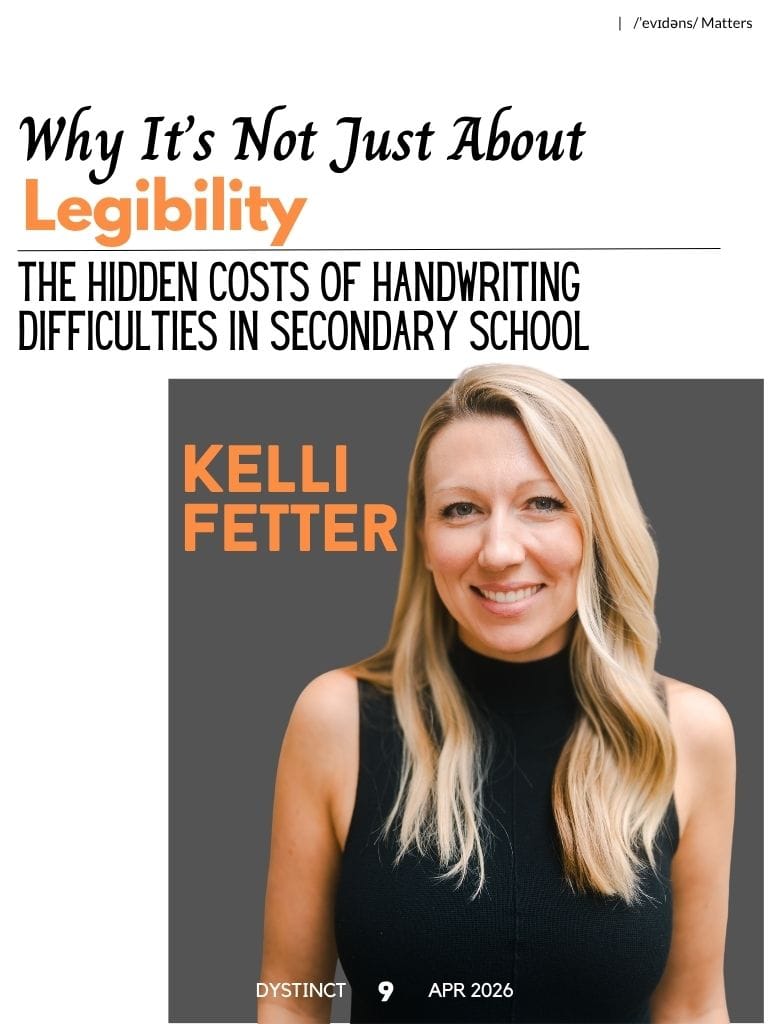
Issue 30: Why It’s Not Just About Legibility: The Hidden Costs of Handwriting Difficulties in Secondary School | Kelli Fetter
Kelli Fetter explains how handwriting difficulties in secondary school are not just about legibility but create a hidden cognitive bottleneck that impacts learning, highlighting the need for a balanced approach combining skill-building and targeted accommodations to support student success.

Table of Contents
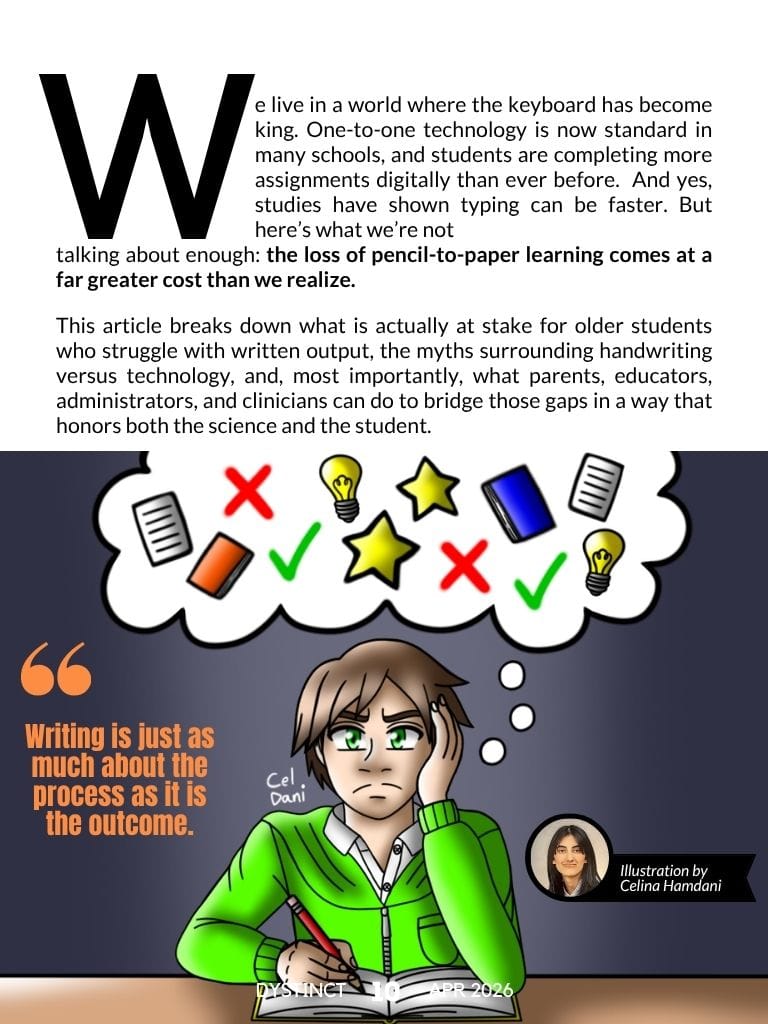
We live in a world where the keyboard has become king. One-to-one technology is now standard in many schools, and students are completing more assignments digitally than ever before. And yes, studies have shown typing can be faster. But here’s what we’re not talking about enough: the loss of pencil-to-paper learning comes at a far greater cost than we realize.
This article breaks down what is actually at stake for older students who struggle with written output, the myths surrounding handwriting versus technology, and, most importantly, what parents, educators, administrators, and clinicians can do to bridge those gaps in a way that honors both the science and the student.
The Student Who “Looks Fine on Paper”
The Student Who “Looks Fine on Paper”
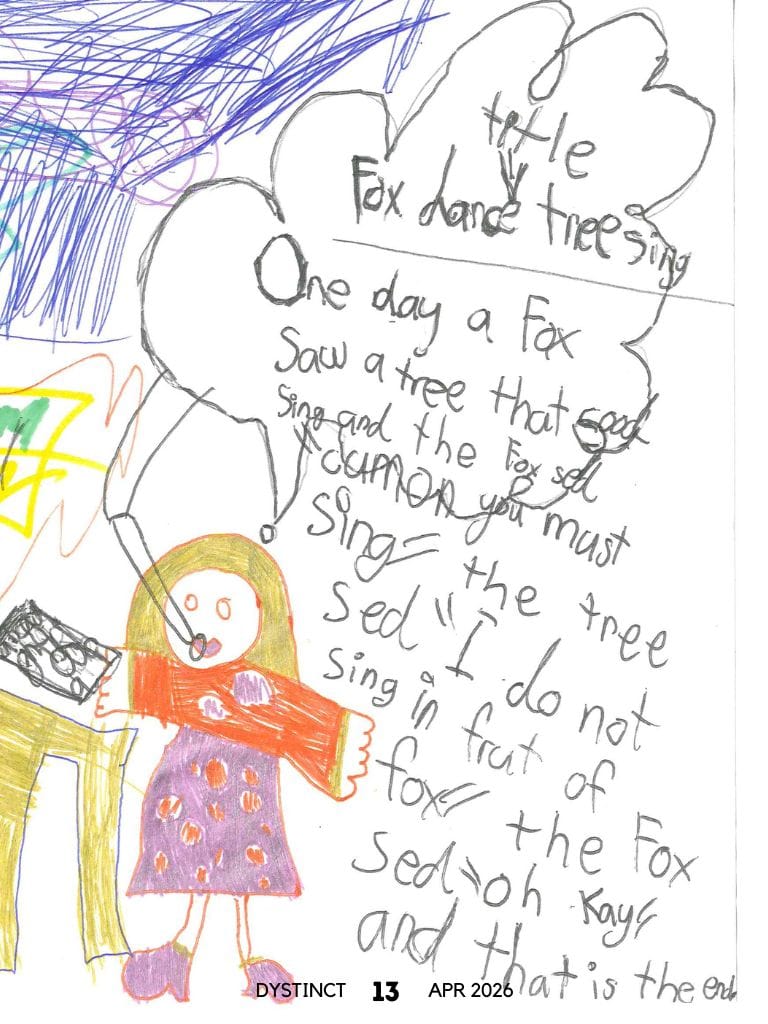
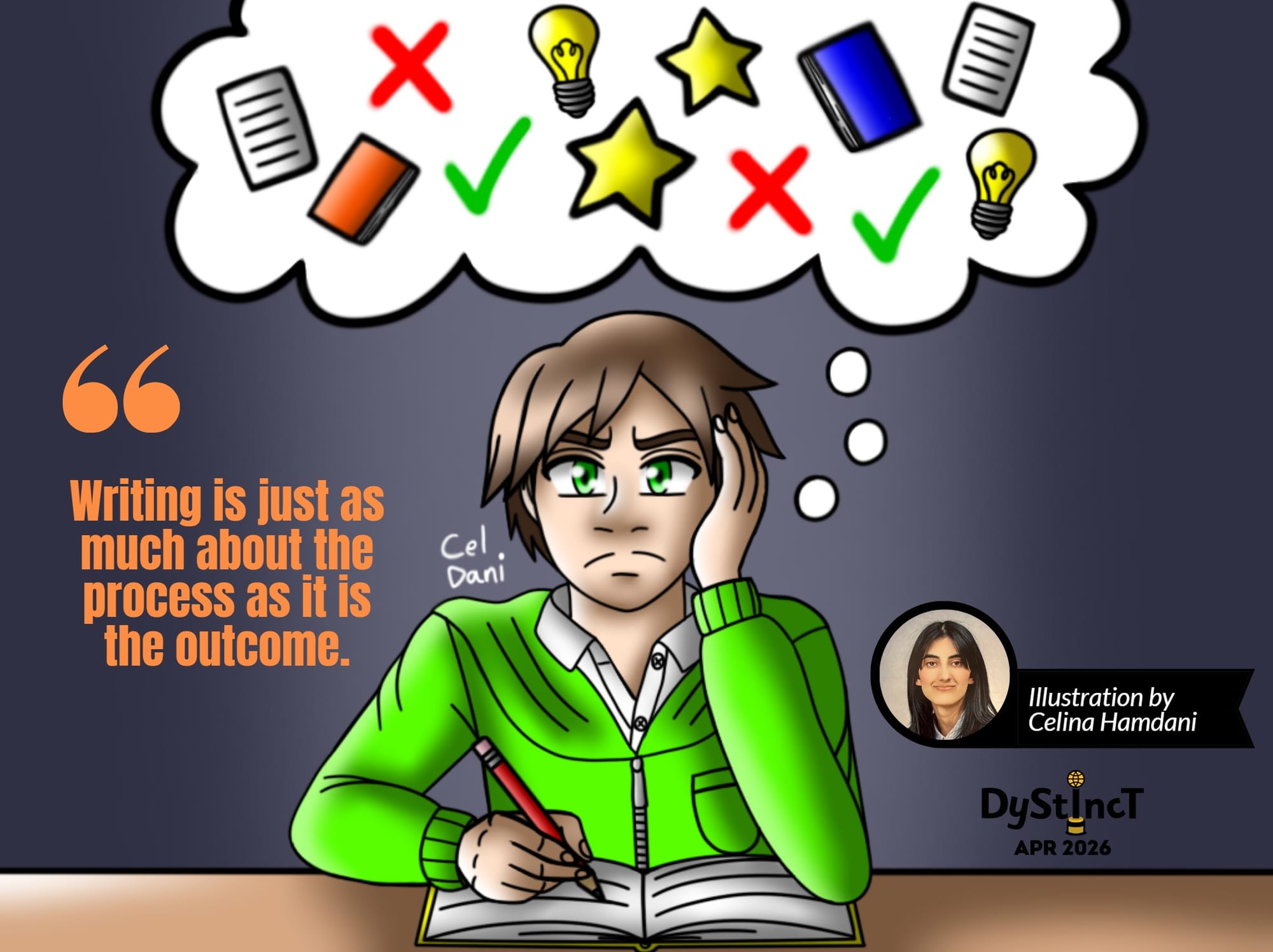
Picture this: a middle schooler who is sharp, funny, bursting with ideas in class discussion, but the moment a writing task lands on their desk, something shifts. They stall. They rush. They turn in three sentences when they clearly had three paragraphs worth of thought.
These students are often labeled as “not trying,” “sloppy,” or told to “slow down and focus.” But here’s the truth that often goes unspoken:
this student is likely working harder than most of their peers just to keep up.
When writing is a struggle, that’s not just a writing problem; it’s an access problem.
Writing is embedded in virtually every subject, every day. When it’s a struggle, that’s not just a writing problem; it’s an access problem. And legibility? That’s only the surface. The real impact runs much deeper, and most of the time, it’s completely invisible.
The Big Misconception
The Big Misconception
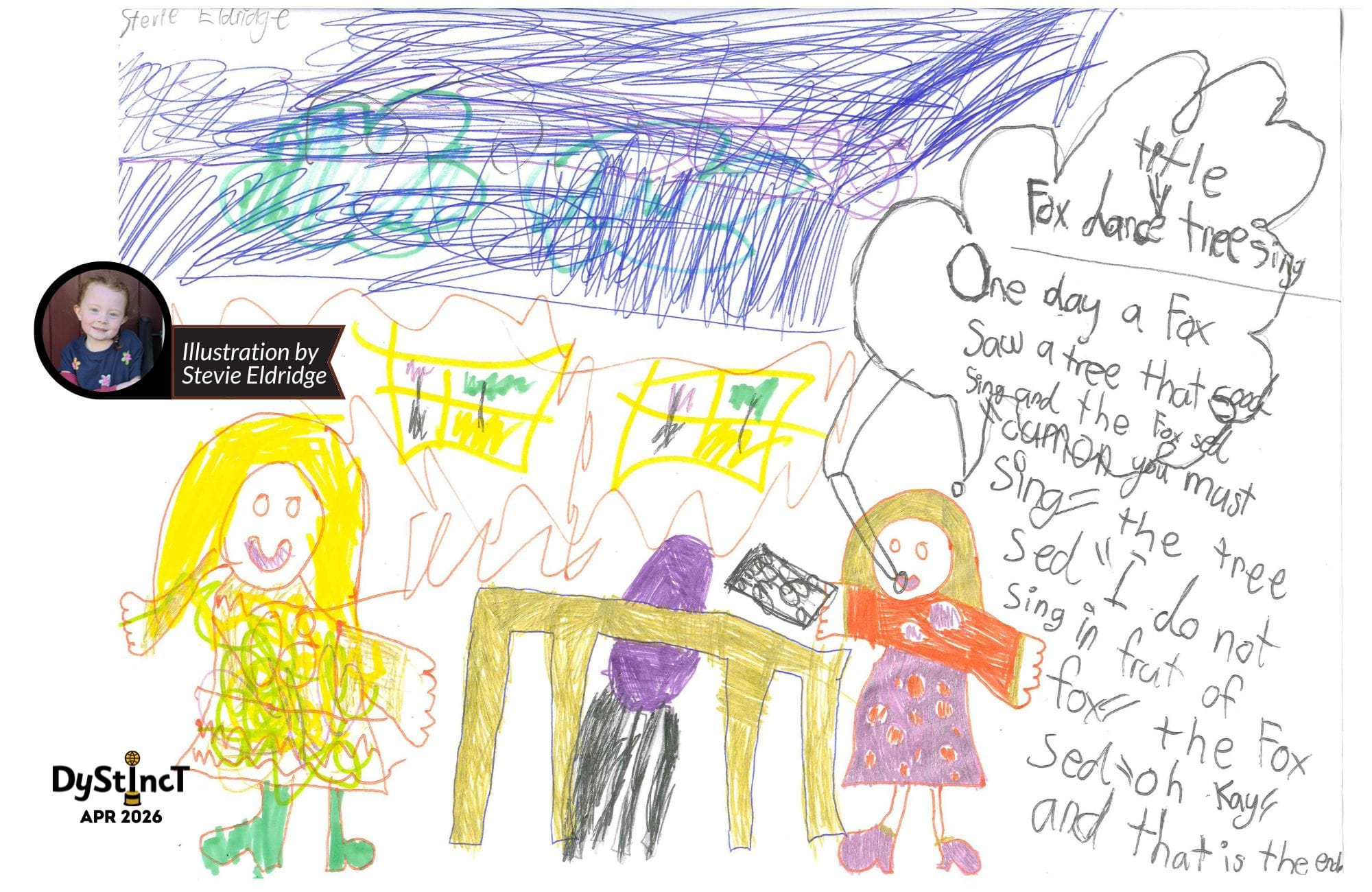
When young students struggle with handwriting, the two most common responses are: “they’ll grow out of it” or “just let them type.” Both are well-intentioned. Neither is sufficient on its own.
The reality is that handwriting is a complex neurodevelopmental skill… one that integrates motor planning, visual-motor integration, orthographic processing, executive function, working memory, and fine motor coordination, all at once. It is a gateway skill that supports literacy development in the early years and remains a critical cognitive tool well into secondary school and beyond.
Without appropriate instruction or targeted remediation when needed, handwriting will not automatically improve to the level of legibility or automaticity. And keyboarding? It carries its own learning curve. It, too, is a complex neuromotor task that must be explicitly taught.
Writing is a gateway skill that supports literacy development in the early years and remains a critical cognitive tool well into secondary school and beyond.
What Changes in Secondary School
What Changes in Secondary School
In early elementary school, handwriting is often the focus of instruction. By secondary school, it has become the vehicle for everything else.
Middle and high school students are expected to:
- Take real-time notes while listening, processing, and filtering information.
- Produce multi-paragraph written responses under time pressure.
- Demonstrate knowledge across all content areas, not just ELA.
- Keep pace with fast instruction, increased workload, and decreasing support.
Writing is no longer being taught at this level. It is assumed. So, when a student’s handwriting is not automatic, they are not just struggling with writing; they are struggling to capture information, demonstrate knowledge, and keep pace with learning. This is the point where the gap can widen rapidly, and where the right support can make all the difference.
If handwriting isn’t automatic, the brain can’t afford to think.
The Hidden Costs: What Is Actually Happening in the Brain
The Hidden Costs: What Is Actually Happening in the Brain
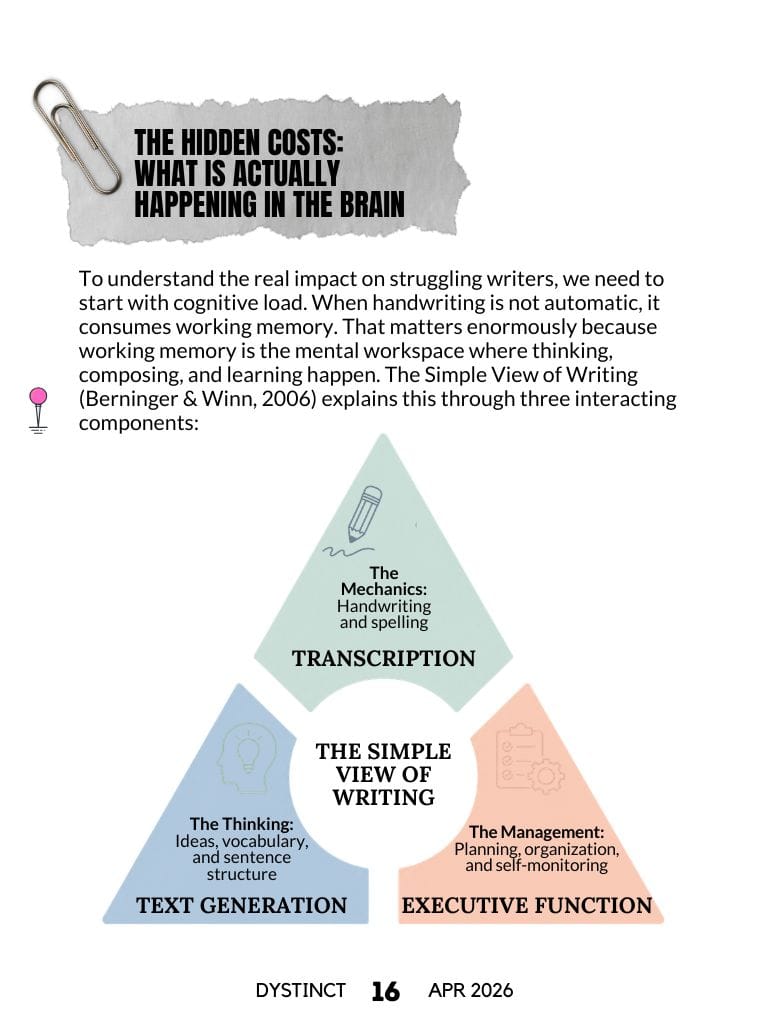
To understand the real impact on struggling writers, we need to start with cognitive load. When handwriting is not automatic, it consumes working memory. That matters enormously because working memory is the mental workspace where thinking, composing, and learning happen. The Simple View of Writing (Berninger & Winn, 2006) explains this through three interacting components:
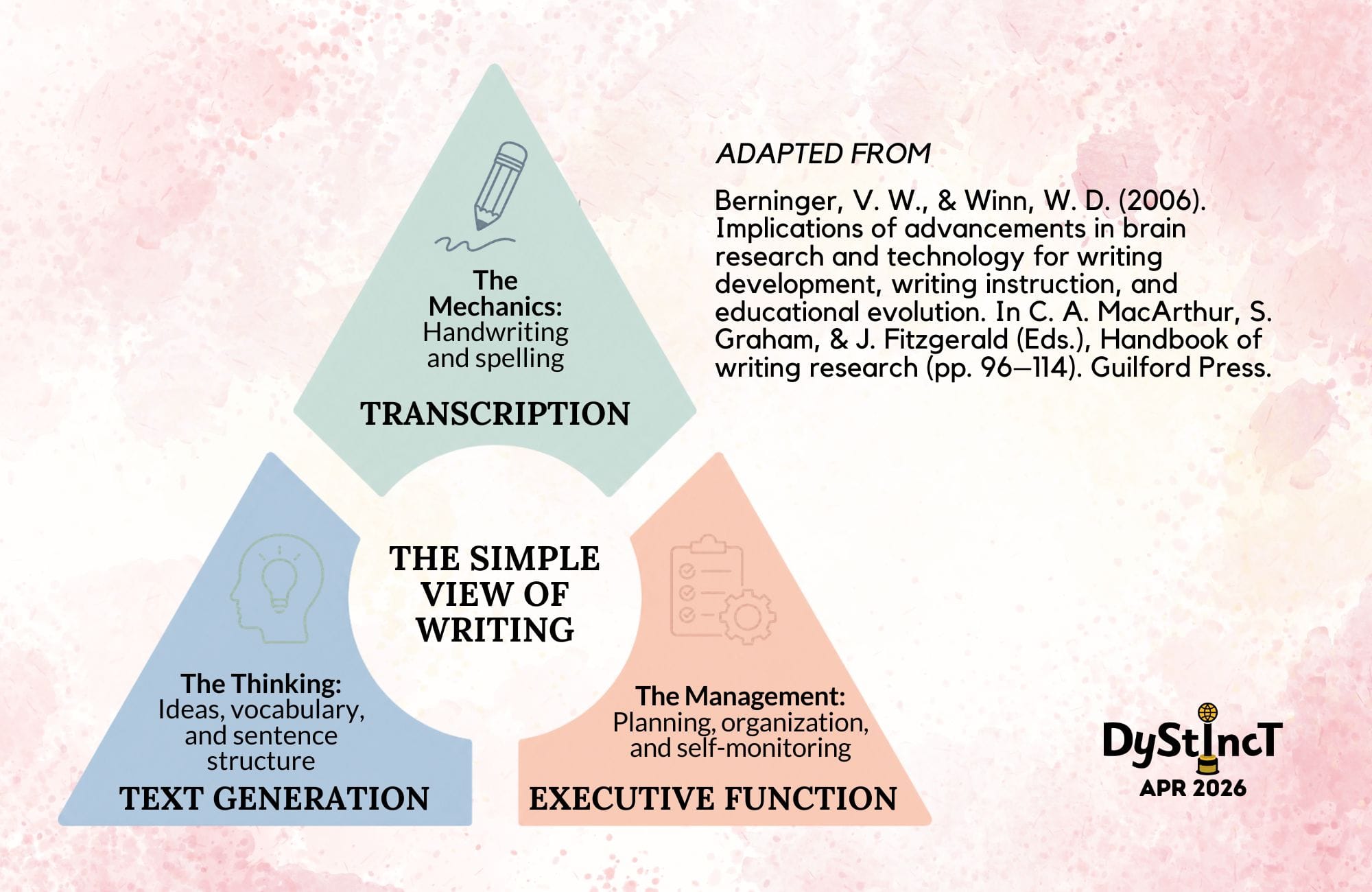
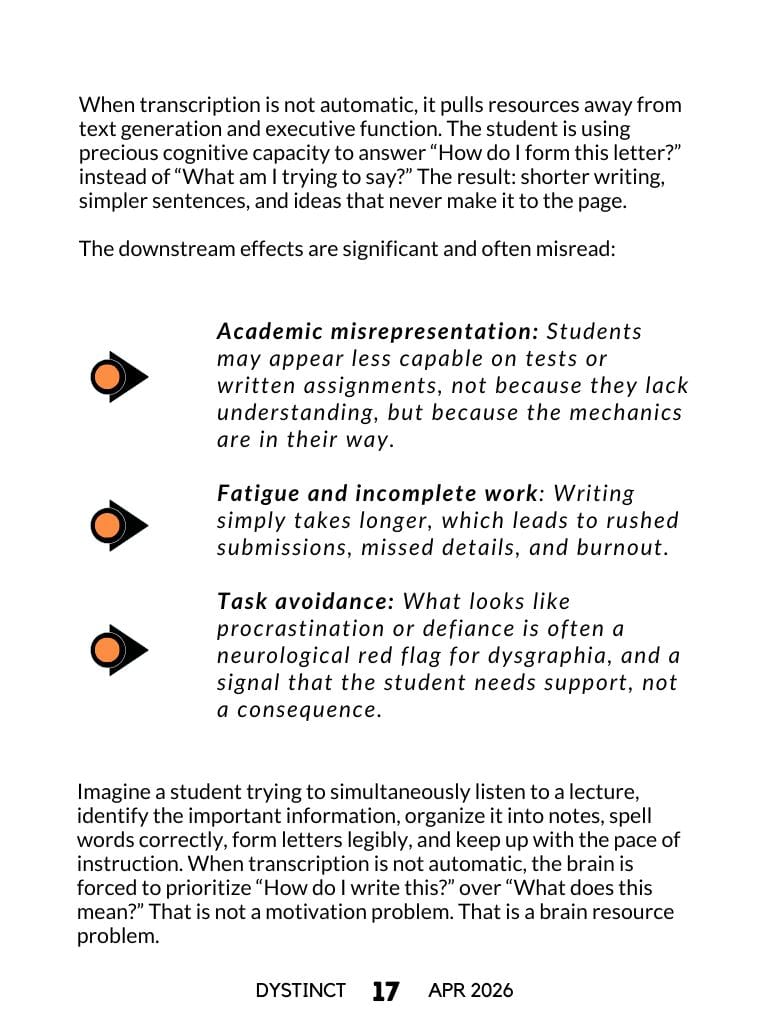
When transcription is not automatic, it pulls resources away from text generation and executive function. The student is using precious cognitive capacity to answer “How do I form this letter?” instead of “What am I trying to say?” The result: shorter writing, simpler sentences, and ideas that never make it to the page.
The downstream effects are significant and often misread:
- Academic misrepresentation: Students may appear less capable on tests or written assignments, not because they lack understanding, but because the mechanics are in their way.
- Fatigue and incomplete work: Writing simply takes longer, which leads to rushed submissions, missed details, and burnout.
- Task avoidance: What looks like procrastination or defiance is often a neurological red flag for dysgraphia, and a signal that the student needs support, not a consequence.
Imagine a student trying to simultaneously listen to a lecture, identify the important information, organize it into notes, spell words correctly, form letters legibly, and keep up with the pace of instruction. When transcription is not automatic, the brain is forced to prioritize “How do I write this?” over “What does this mean?” That is not a motivation problem. That is a brain resource problem.
“Just Let Them Type” Isn’t the Full Answer
“Just Let Them Type” Isn’t the Full Answer
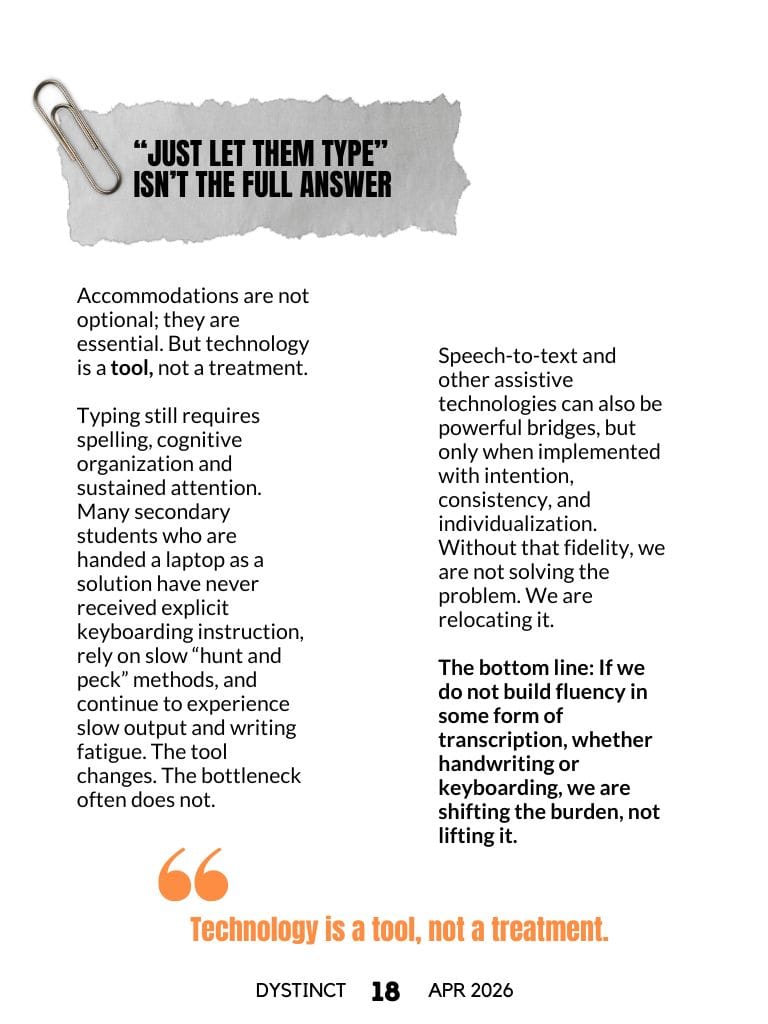
Accommodations are not optional; they are essential. But technology is a tool, not a treatment.
Typing still requires spelling, cognitive organization and sustained attention. Many secondary students who are handed a laptop as a solution have never received explicit keyboarding instruction, rely on slow “hunt and peck” methods, and continue to experience slow output and writing fatigue. The tool changes. The bottleneck often does not.
Speech-to-text and other assistive technologies can also be powerful bridges, but only when implemented with intention, consistency, and individualization. Without that fidelity, we are not solving the problem. We are relocating it.
The bottom line: If we do not build fluency in some form of transcription, whether handwriting or keyboarding, we are shifting the burden, not lifting it.
Technology is a tool, not a treatment.
What Actually Helps: The Case for Both/And Thinking
What Actually Helps: The Case for Both/And Thinking
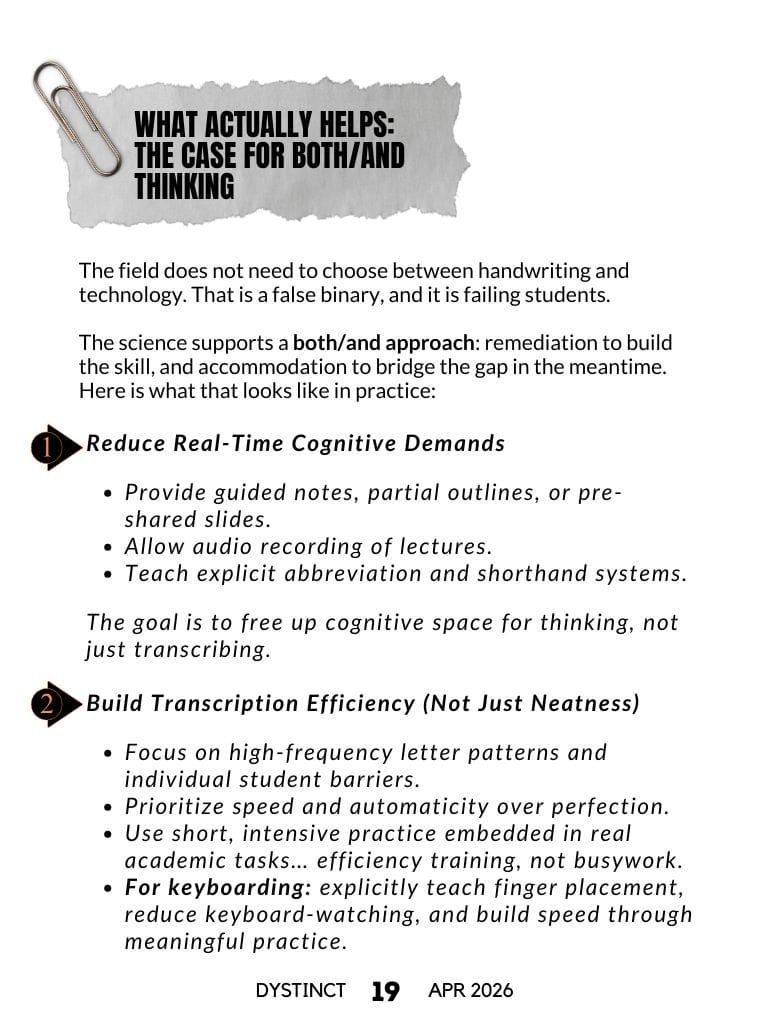
The field does not need to choose between handwriting and technology. That is a false binary, and it is failing students.
The science supports a both/and approach: remediation to build the skill, and accommodation to bridge the gap in the meantime. Here is what that looks like in practice:
Reduce Real-Time Cognitive Demands
- Provide guided notes, partial outlines, or pre-shared slides.
- Allow audio recording of lectures.
- Teach explicit abbreviation and shorthand systems.
The goal is to free up cognitive space for thinking, not just transcribing.
Build Transcription Efficiency (Not Just Neatness)
- Focus on high-frequency letter patterns and individual student barriers.
- Prioritize speed and automaticity over perfection.
- Use short, intensive practice embedded in real academic tasks… efficiency training, not busywork.
- For keyboarding: explicitly teach finger placement, reduce keyboard-watching, and build speed through meaningful practice.
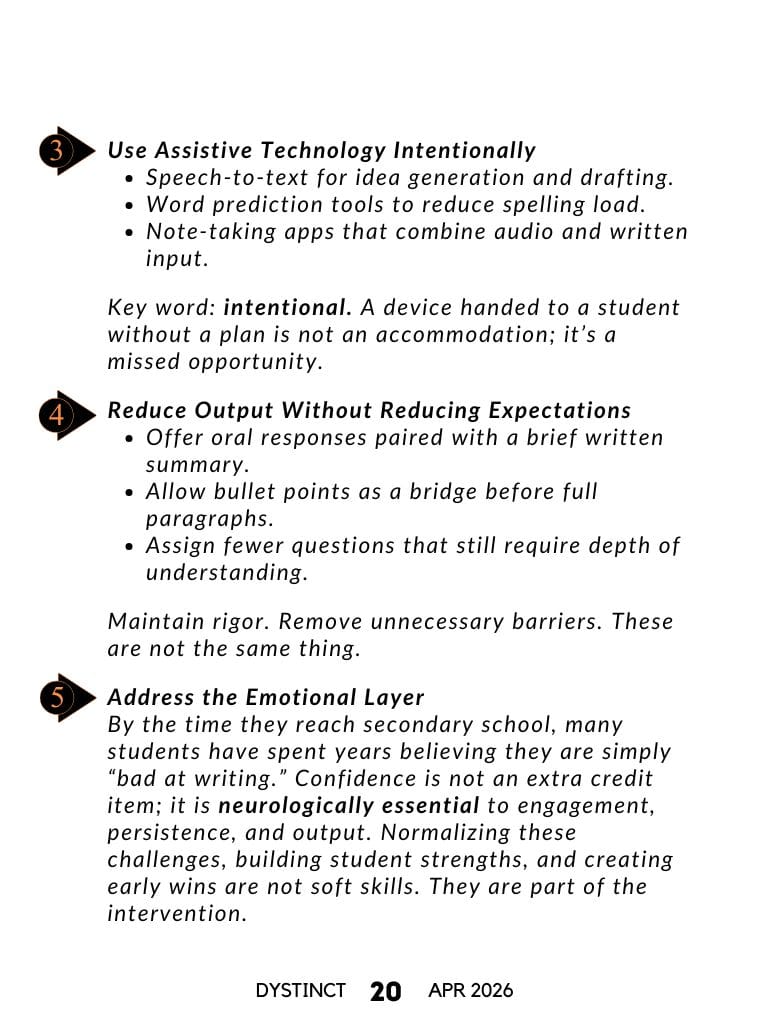
Use Assistive Technology Intentionally
- Speech-to-text for idea generation and drafting.
- Word prediction tools to reduce spelling load.
- Note-taking apps that combine audio and written input.
Key word: intentional. A device handed to a student without a plan is not an accommodation; it’s a missed opportunity.
Reduce Output Without Reducing Expectations
- Offer oral responses paired with a brief written summary.
- Allow bullet points as a bridge before full paragraphs.
- Assign fewer questions that still require depth of understanding.
Maintain rigor. Remove unnecessary barriers. These are not the same thing.
Address the Emotional Layer
By the time they reach secondary school, many students have spent years believing they are simply “bad at writing.” Confidence is not an extra credit item; it is neurologically essential to engagement, persistence, and output. Normalizing these challenges, building student strengths, and creating early wins are not soft skills. They are part of the intervention.
Reframe the Narrative
Reframe the Narrative
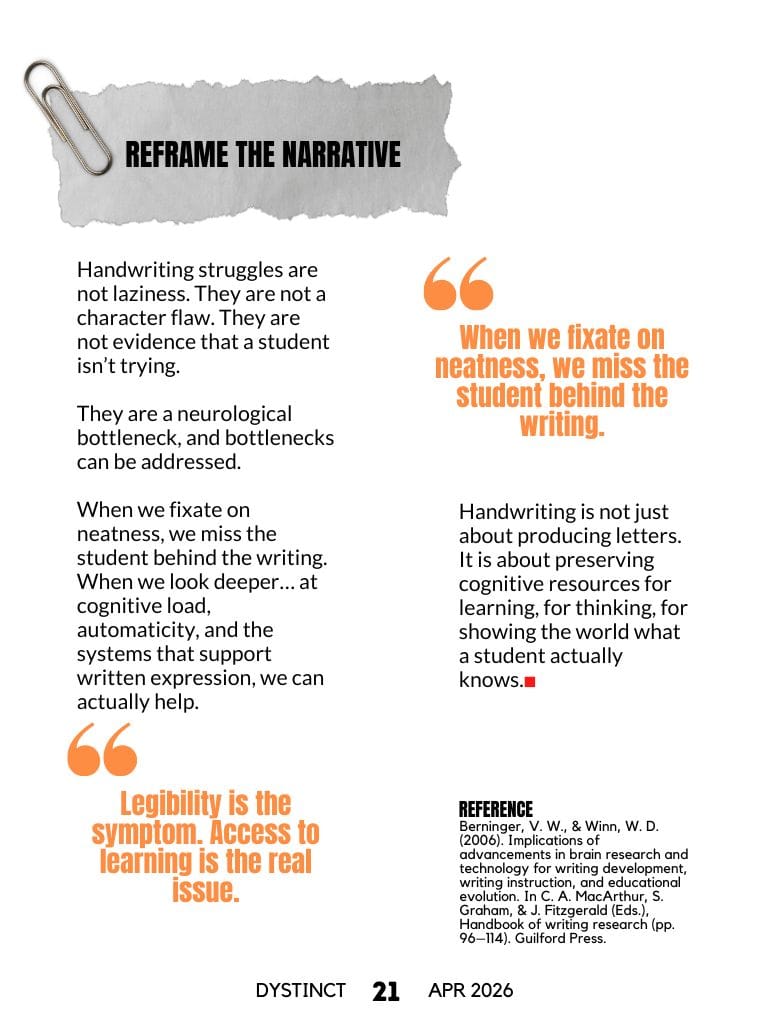
Handwriting struggles are not laziness. They are not a character flaw. They are not evidence that a student isn’t trying.
They are a neurological bottleneck, and bottlenecks can be addressed.
When we fixate on neatness, we miss the student behind the writing. When we look deeper… at cognitive load, automaticity, and the systems that support written expression, we can actually help.
Legibility is the symptom. Access to learning is the real issue.
When we fixate on neatness, we miss the student behind the writing.
Handwriting is not just about producing letters. It is about preserving cognitive resources for learning, for thinking, for showing the world what a student actually knows.
Reference
Reference
Berninger, V. W., & Winn, W. D. (2006). Implications of advancements in brain research and technology for writing development, writing instruction, and educational evolution. In C. A. MacArthur, S. Graham, & J. Fitzgerald (Eds.), Handbook of writing research (pp. 96–114). Guilford Press.
Kelli Fetter
Certified Handwriting Specialist & Founder | handwritingsolutions.org | Facebook | Instagram | Pinterest | LinkedIn
Kelli Fetter

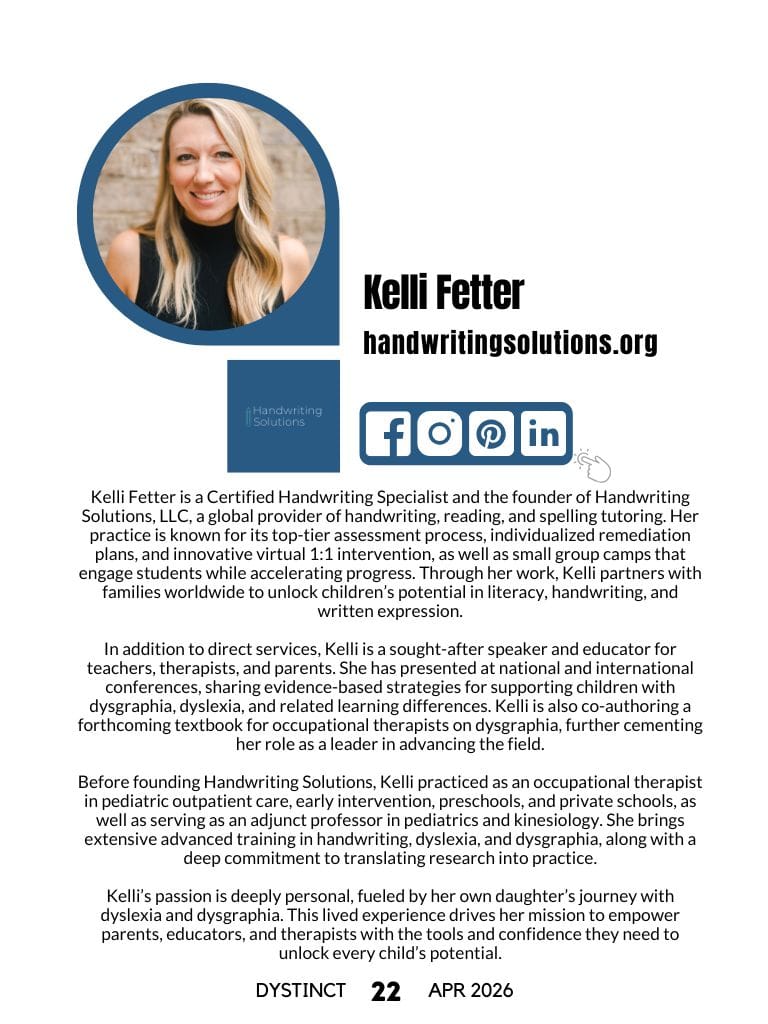
Kelli Fetter is a Certified Handwriting Specialist and the founder of Handwriting Solutions, LLC, a global provider of handwriting, reading, and spelling tutoring. Her practice is known for its top-tier assessment process, individualized remediation plans, and innovative virtual 1:1 intervention, as well as small group camps that engage students while accelerating progress. Through her work, Kelli partners with families worldwide to unlock children’s potential in literacy, handwriting, and written expression.
In addition to direct services, Kelli is a sought-after speaker and educator for teachers, therapists, and parents. She has presented at national and international conferences, sharing evidence-based strategies for supporting children with dysgraphia, dyslexia, and related learning differences. Kelli is also co-authoring a forthcoming textbook for occupational therapists on dysgraphia, further cementing her role as a leader in advancing the field.
Before founding Handwriting Solutions, Kelli practiced as an occupational therapist in pediatric outpatient care, early intervention, preschools, and private schools, as well as serving as an adjunct professor in pediatrics and kinesiology. She brings extensive advanced training in handwriting, dyslexia, and dysgraphia, along with a deep commitment to translating research into practice.
Kelli’s passion is deeply personal, fueled by her own daughter’s journey with dyslexia and dysgraphia. This lived experience drives her mission to empower parents, educators, and therapists with the tools and confidence they need to unlock every child’s potential.
BOOK NOW
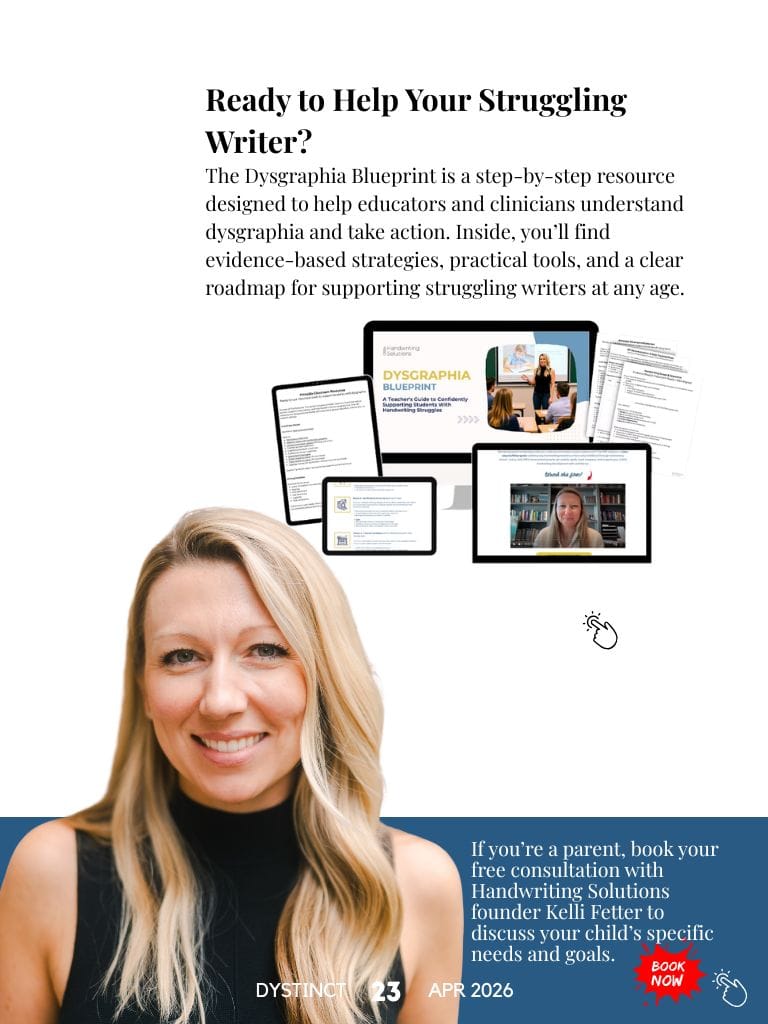
Ready to Help Your Struggling Writer?
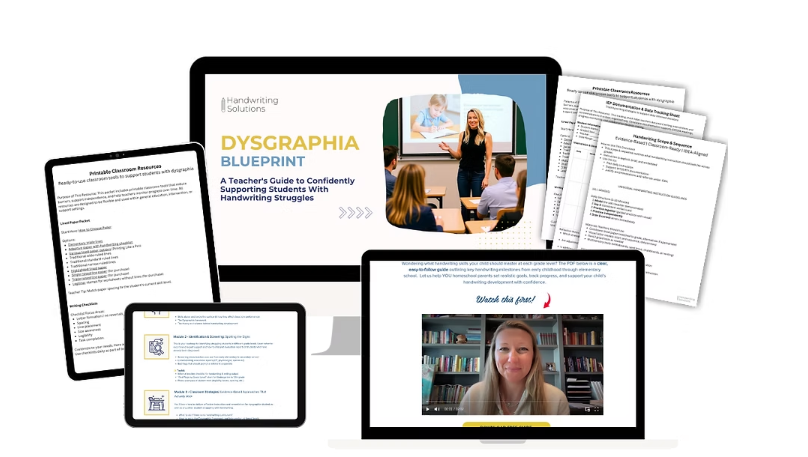
The Dysgraphia Blueprint is a step-by-step resource designed to help educators and clinicians understand dysgraphia and take action. Inside, you’ll find evidence-based strategies, practical tools, and a clear roadmap for supporting struggling writers at any age.
If you’re a parent, book your free consultation with Handwriting Solutions founder Kelli Fetter to discuss your child’s specific needs and goals.
Extracts from Dystinct Magazine
Extracts from Dystinct Magazine