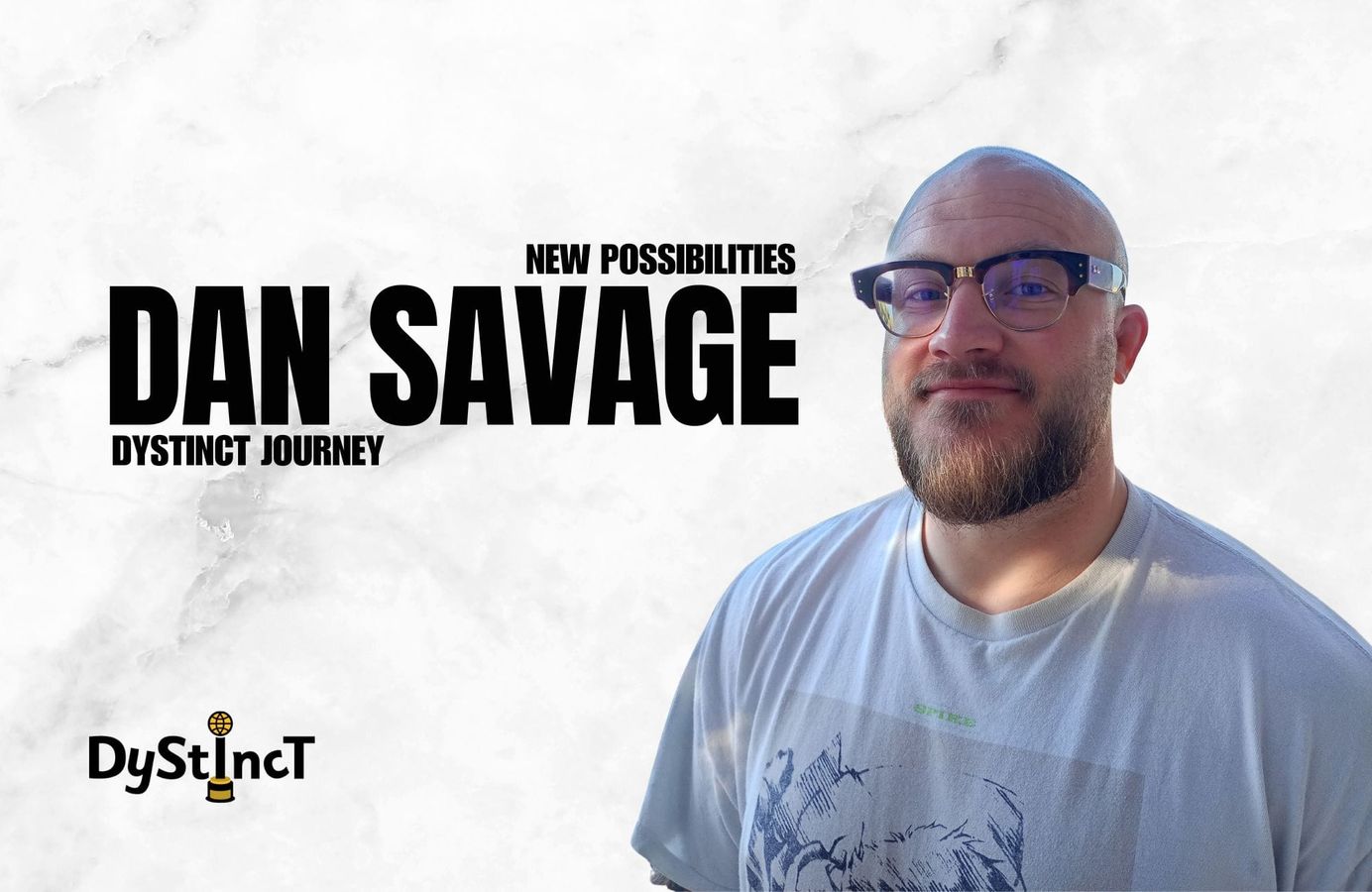
Issue 30: The Dystinct Journey of Dan Savage
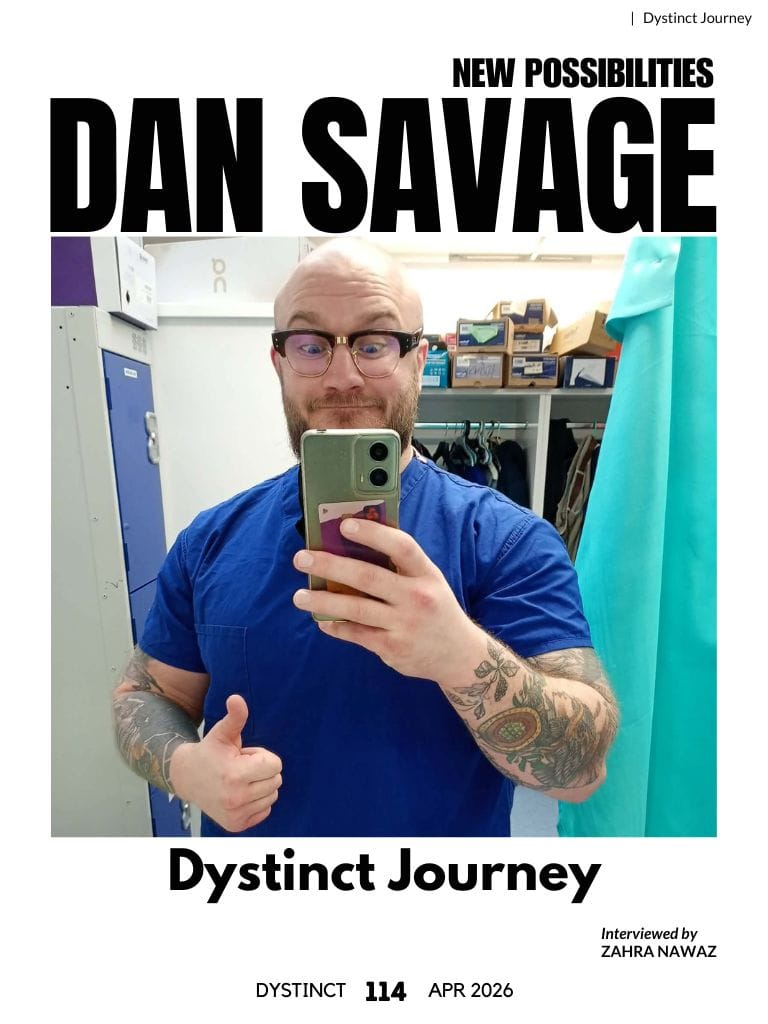
Dan Savage shares how growing up with dyslexia and ADHD left him feeling overlooked and limited, but through sport, support, and self-belief, he is now retraining as an Occupational Therapist, determined to use his journey to help others see their potential.


Table of Contents
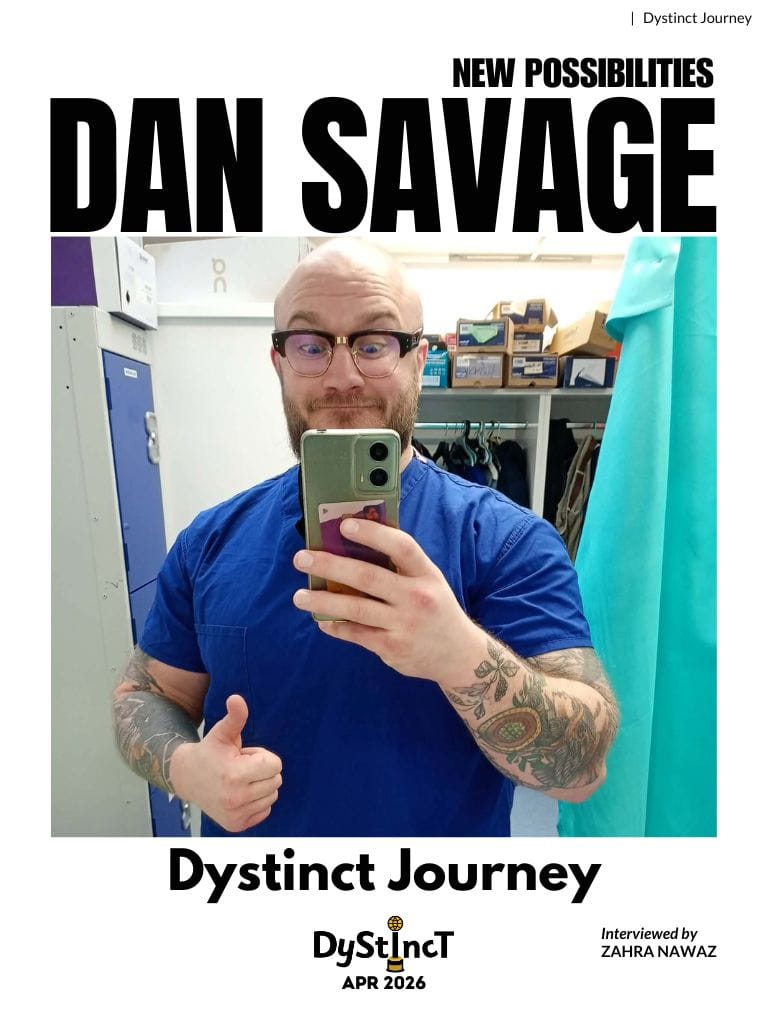
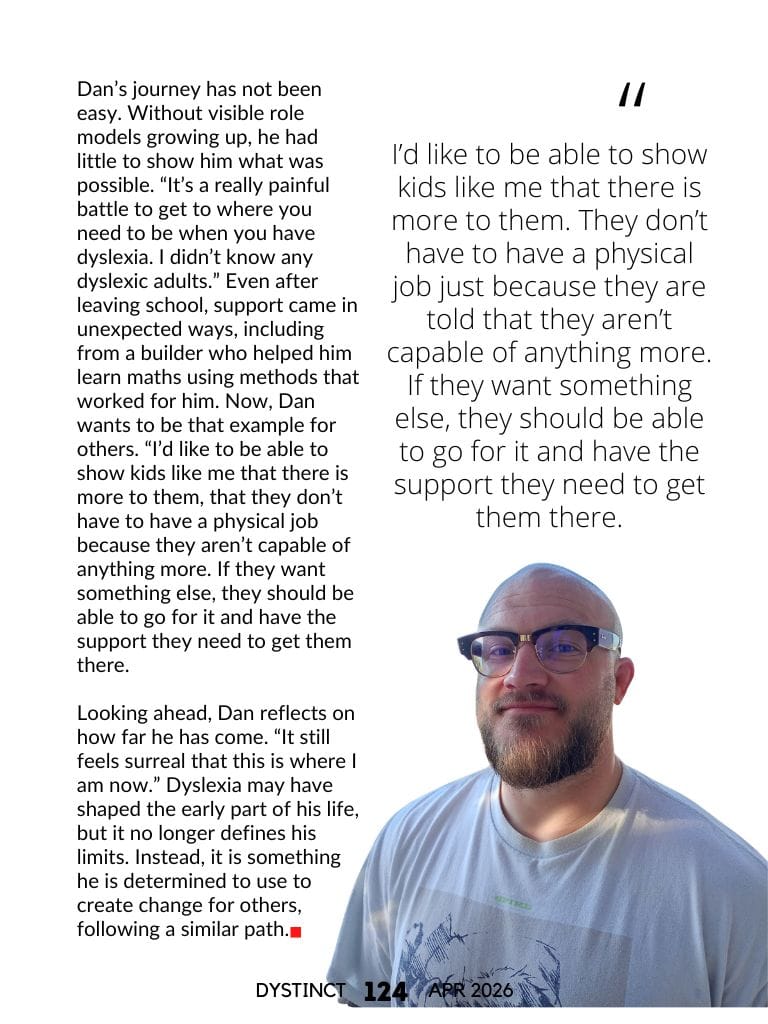
Dan Savage grew up believing that his diagnosis of dyslexia and ADHD was a limit to what he was capable of achieving. It took him years to challenge that belief. Now, he is retraining as an Occupational Therapist, hoping to use his lived experience to help children with Special Educational Needs and Disabilities (SEND) realise that their paths do not have to be defined by their challenges.
Even as a young child, Dan was made painfully aware that, unlike his peers, he was not a “normal kid”. At playgroup, he interacted differently from other children, struggled to sit still, and found it difficult to engage as expected in the classroom. It was a teacher with a dyslexic son of her own who first recognised the signs and raised concerns with his parents.
Dan’s parents took the concerns seriously and pushed for support through the school, but were met with resistance. “The process to get referred was really hard. My parents had to fight for me to get assessed, even though my teachers agreed. I know my parents found it really frustrating,” Dan recalls.
Dystinct Journey
Dystinct Journey
When he was eventually diagnosed, it gave a name to his challenges, but it did not change much about his experience. “I remember feeling different to the other kids. I struggled to tie my shoes and was put in a different class for English. At the time, it didn’t feel like it changed anything. There was so little support that knowing why I struggled didn’t matter. I was still struggling.”
The school’s plan of action to help struggling students was to group children with a diagnosis into a single classroom, leaving Dan feeling as though they were being kept out of the way. His parents supported him by seeking out different therapies to support his learning. Slowly, he settled into life at primary school, where much of the day was centred on play, and with the support of a one-to-one assistant, it became a time he could enjoy.
There was so little support that knowing why I struggled didn’t matter because I was still struggling.
Just as Dan began to settle into life at primary school, the move to secondary school brought a very different experience. What had once felt manageable now became overwhelming, and the sense of being different deepened into something far more damaging. “Secondary school was very different. There was no 1-1 support, and I could see I was slower than everyone else. I’d always felt different, but secondary school is where I started to feel stupid and developed a lot of self-loathing. School days dropped my self-esteem.”
The classroom became a place of anxiety, particularly in English. Despite knowing that Dan and another student were dyslexic, the teacher regularly made them read aloud. To cope, he developed strategies. “I worked out that I could count the students ahead of me and the lines, work out which one mine was and work on reading it before she got to me.” It helped, but it did not remove the pressure. He remembers watching as the other student struggled, met with visible disdain from the teacher and laughter from classmates. On one occasion, both were made to stand at the front and read together. “It was like she’d had a bad day and wanted to take it out on us. It was cruel.”
Dan recalls that he was often called “dumb,” “stupid,” and “retard” by his classmates, words that were deeply hurtful at a young age. But one comment sowed a seed of doubt he would carry into adulthood. “The biggest thing that stuck with me from school was when my history teacher told me I wouldn’t be able to do archaeology because there was too much reading and writing. It changed how I thought about my ability and what it might limit. I’d always thought of it as a viable career, but her comments brought in self-doubt.”
I’d always thought of archaeology as a viable career, but her comments brought in self-doubt.
At a time when life at school felt intolerable, the rugby team offered Dan the outlet he needed to feel capable at something. By Year 9, he was made Rugby Captain. “Being good at sport in general improved my social standing. In other classes, I felt like a nobody, but PE levelled the playing field and gave me a way to express myself.”
However, being bigger and stronger than many of his peers came with its own challenges. He was often manipulated into conflict. “I’d have kids come and stir the pot just to goad me into fighting other kids. They would use my lack of confidence against me, telling me so-and-so had said I was stupid, just so I’d get into an argument with them.”
People began to know me because of my sports skills, which gave me recognition and confidence.
My rugby friends didn’t care about school. They were real friends.
Over time, as his confidence grew and his role within the team became more established, his peers began to see him differently. He was no longer defined by his struggles in the classroom, but by his strengths. Up until this point, the friendships he formed were often with others who were struggling in similar ways, sharing detentions and disrupting lessons together. But through rugby, that began to change. “My rugby friends didn’t care about school. They were real friends, the mentality they had towards sport was the same they showed to me, encouraging and positive.”
Mr Target helped me see that dyslexia wasn’t a disability; I could use it as a superpower.
As things began to settle at school, there were also teachers who played a part in that shift. John Target, a science teacher who had previously been a PE teacher, was one of them. He ran many of the school trips and was known for treating students with respect, which in turn earned him their respect. He got to know students individually and approached teaching more like a coach than a traditional teacher.
Dan remembers one of their first interactions, when Mr Target asked him to explain dyslexia. “He asked me to tell him more about dyslexia, as he didn’t know a lot about it. After that, he went away and did research on his own to understand me and dyslexia better. If I saw him now, I would say thank you. He helped me see that dyslexia wasn’t a disability; I could use it as a superpower.”
As his time at secondary school came to an end, Dan faced an uncertain future. “Leaving school, I felt lost with no grades. There was so much emphasis from school that GCSEs could make or break you. I didn’t know what to do without them. I felt my options were limited, thinking I could only get into a trade or the army.”
He tried to join the army but was medically discharged due to an eye problem. After that, he was left unsure of what direction to take. None of the trades he tried felt like the right fit. “I didn’t want to be a tradesperson. It felt forced, like I had no choice. I resented it.”
Edd and I would have conversations that no one else could follow as we stopped and started, but we got each other.
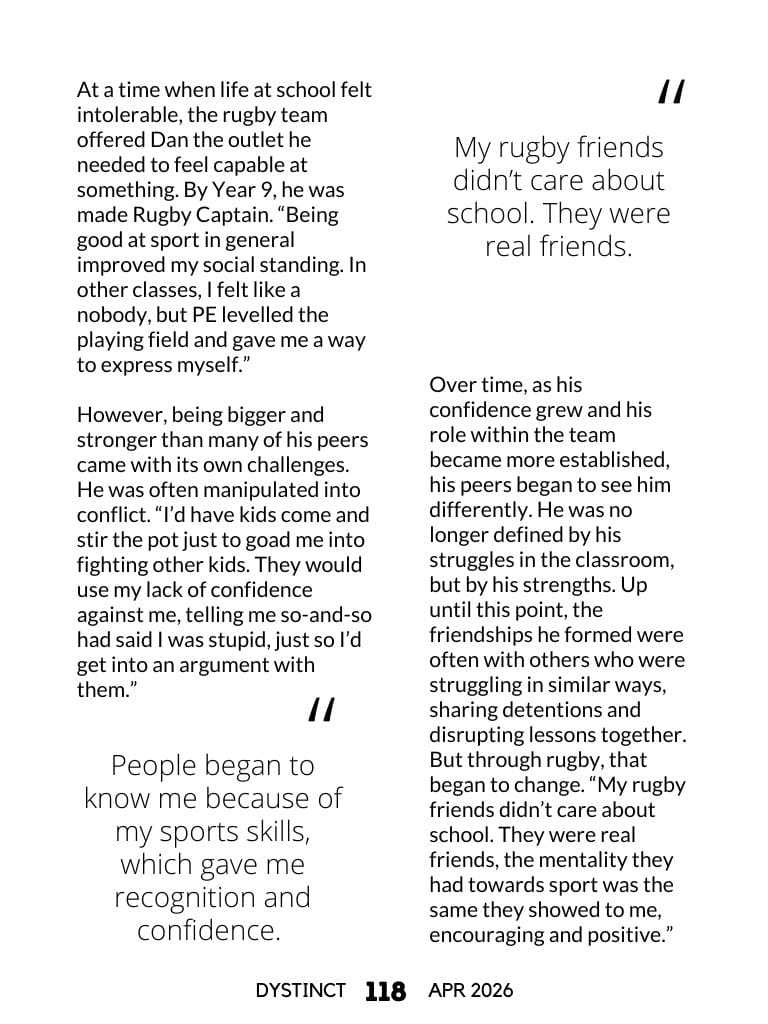
Dan worked with Edd for a year before deciding to study Arboriculture at college. He began on a Level 2 course but was quickly moved onto a Level 3, with tutors recognising his ability. He completed this while continuing to work, before going on to achieve a Foundation degree. Edd remained a constant source of support throughout, and for the first time, Dan found something he genuinely enjoyed.
Dan continued searching for a path while working in a restaurant to support himself. It was through his future wife that he was introduced to a line of work that would begin to change things for him. “My wife was studying Equine Business Management locally and introduced me to horses. I thought about training as a farrier and almost applied until she introduced me to Edd, a friend of hers who was studying Arboriculture. We got on well, and he was already running his own tree-surgery business. Edd was dyslexic as well, so our brains understood each other. We would have conversations that no one else could follow, but we got each other.”
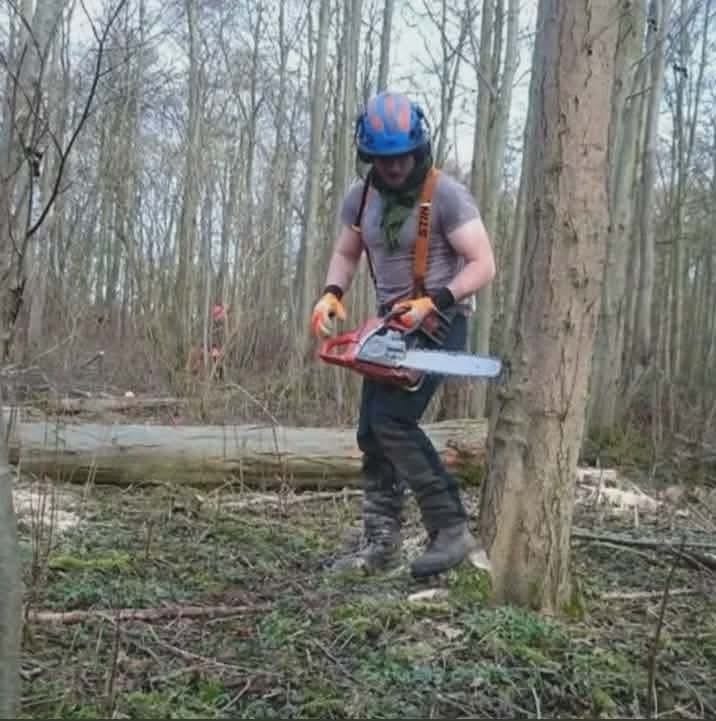
He could see a future in it. But over time, as the physical demands of the job began to take their toll and he moved into surveying and consulting, he started to feel that he still was not quite where he needed to be.
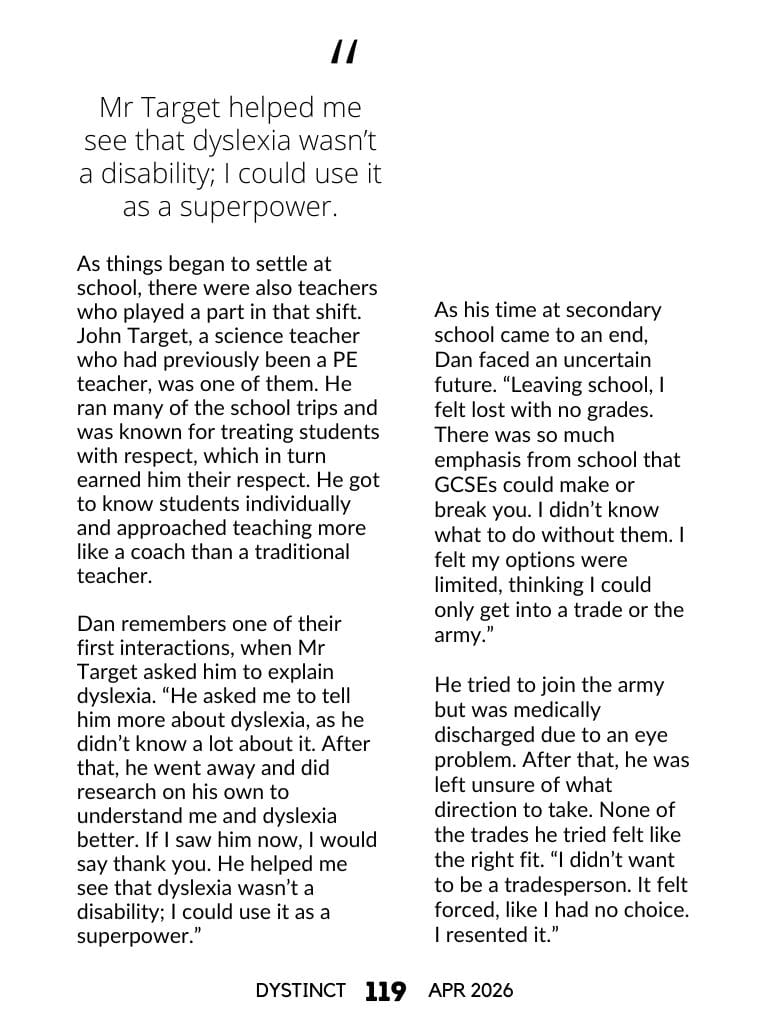
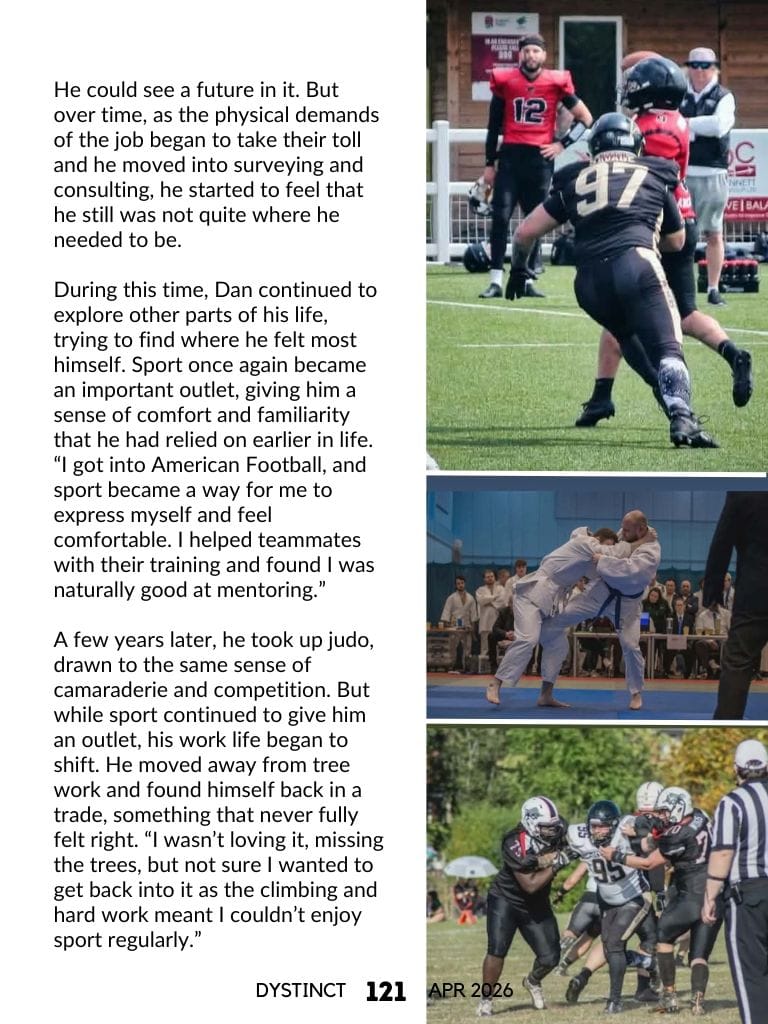
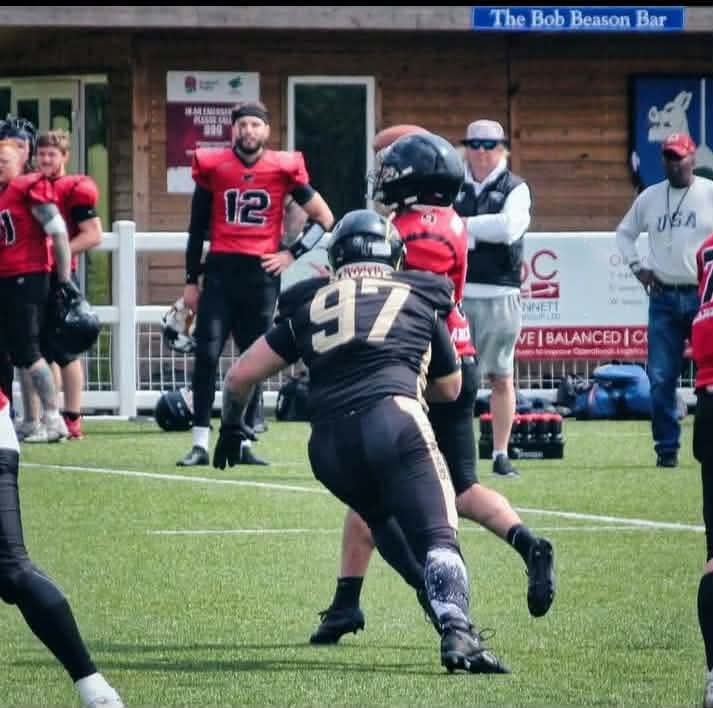
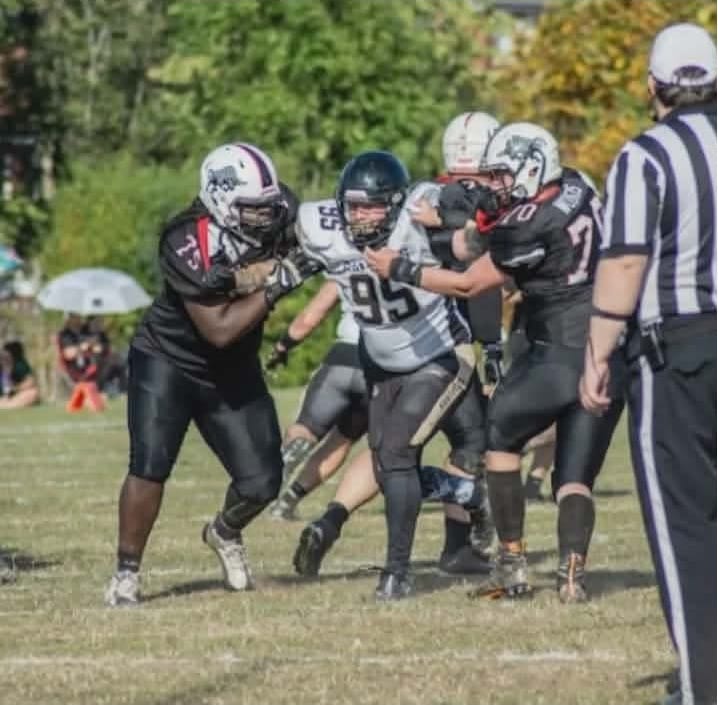
During this time, Dan continued to explore other parts of his life, trying to find where he felt most himself. Sport once again became an important outlet, giving him a sense of comfort and familiarity that he had relied on earlier in life. “I got into American Football, and sport became a way for me to express myself and feel comfortable. I helped teammates with their training and found I was naturally good at mentoring.”
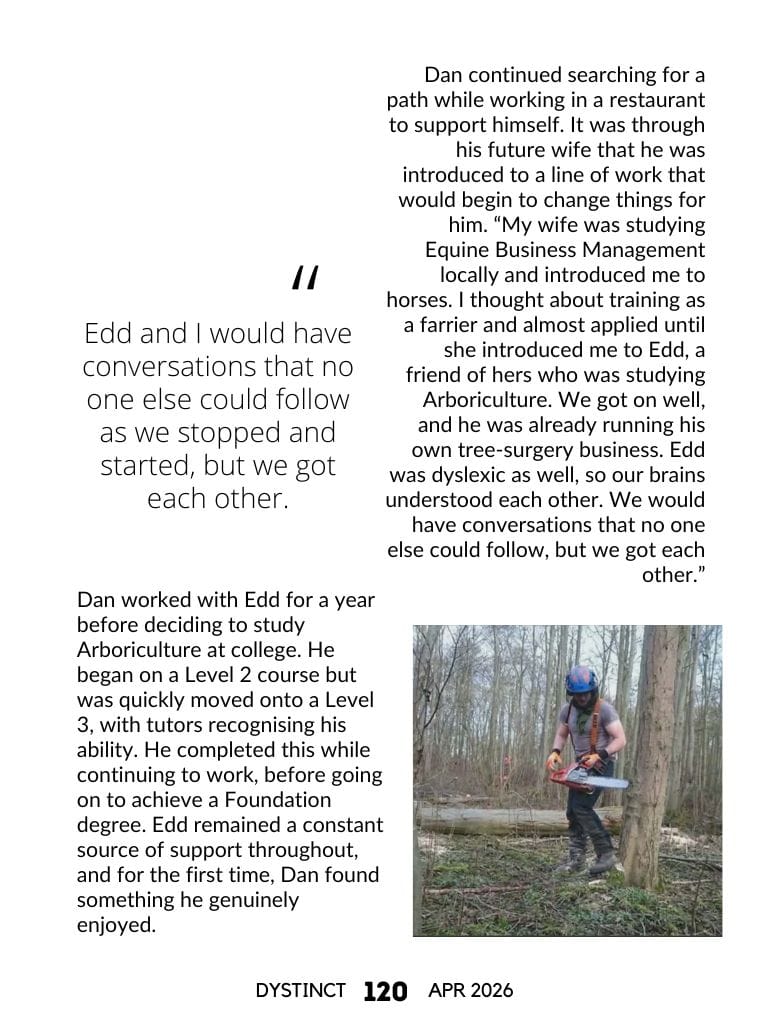
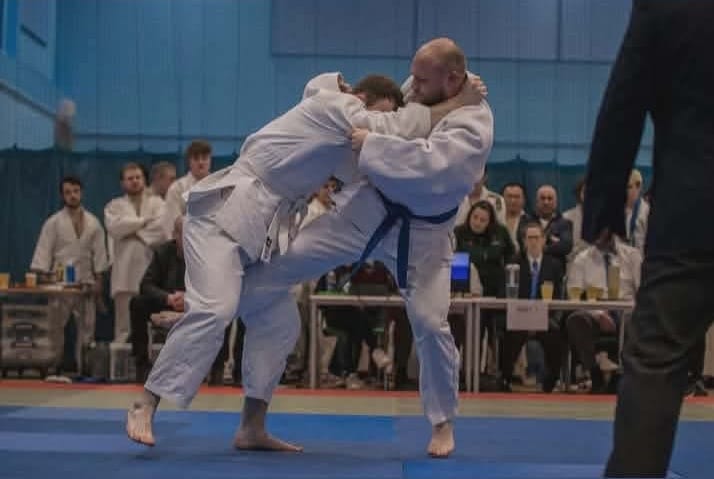
A few years later, he took up judo, drawn to the same sense of camaraderie and competition. But while sport continued to give him an outlet, his work life began to shift. He moved away from tree work and found himself back in a trade, something that never fully felt right. “I wasn’t loving it, missing the trees, but not sure I wanted to get back into it as the climbing and hard work meant I couldn’t enjoy sport regularly.”
Feeling stuck once again, Dan began to search for something more meaningful. Over time, he found a sense of faith he had not known before, and it became a space where he started to reflect on his direction and purpose. “I started praying about what I should do. I started to see that what I had gone through had shaped who I was and that I could use it to help others.”
As he tried to put that feeling into words, it was his wife who helped bring clarity. “I tried describing to my wife what I felt like I could do, and she just said, ‘Sounds like Occupational Therapy.’” What followed was a period of research and realisation, as Dan began to see how his own experiences, his background in sport and mentoring, and the way his dyslexia allowed him to think differently could all come together in one path. “It was a lightbulb moment, a series of events that all led to one path.”
I started to see that what I had gone through had shaped who I was and that I could use it to help others.
Applying to university brought its own challenges. Without GCSE results, his applications were initially declined, something that felt both frustrating and unfair given how far he had come. But the University of Worcester gave him an opportunity, recognising his Foundation degree and his ability to succeed. He admits that even now, he still has moments of doubt. “I still spend every day scared that I’m going to fail,” he says, but his experience so far has begun to shift that thinking. Through placements and meeting others in the field, he has seen that success in this profession is not defined by academic ability alone, but by empathy, connection, and understanding.
His first placement in a hospital setting gave him a glimpse of what was possible. Within weeks, he felt comfortable and capable, a reflection of how far he had come. While he has not yet had the opportunity to work directly with children with SEND, he knows that this is where his path is leading. “It’s where I feel my calling is,” he says, looking ahead to using his lived experience in a way that could make a difference to others.
The school system is still letting kids down. I have friends with kids who could be telling my story exactly.
Reflecting on his own experiences, Dan is clear that much still needs to change. “I know the school system is still letting kids down. I have friends with kids who could be telling my story exactly. I’ve heard 10-year-olds say heartbreaking things about what is happening to them at school, and it’s unacceptable.” He believes that greater understanding and practical changes are needed, particularly in how schools support children with learning difficulties. “With technology improving, I’d want to see kids being able to have support like talk-to-text and recording to really allow them equity. An extra 15 minutes at the end doesn’t make any difference. There’s a lot that can be changed to make exams a much less stressful situation.”
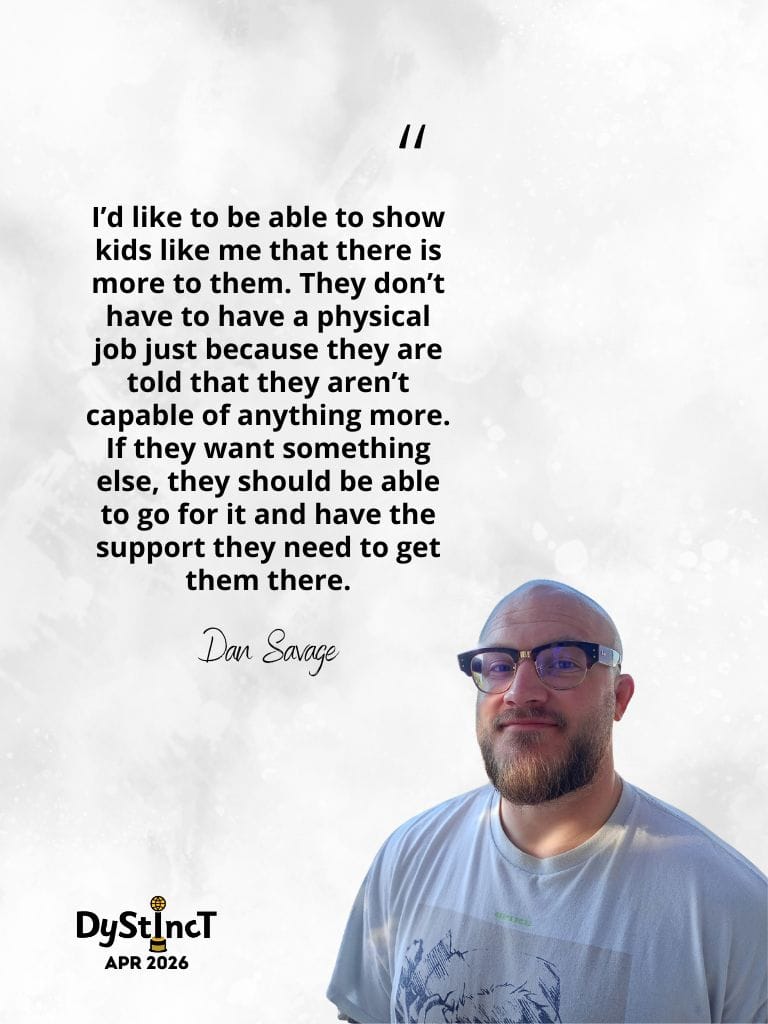
Dan’s journey has not been easy. Without visible role models growing up, he had little to show him what was possible. “It’s a really painful battle to get to where you need to be when you have dyslexia. I didn’t know any dyslexic adults.” Even after leaving school, support came in unexpected ways, including from a builder who helped him learn maths using methods that worked for him. Now, Dan wants to be that example for others. “I’d like to be able to show kids like me that there is more to them, that they don’t have to have a physical job because they aren’t capable of anything more. If they want something else, they should be able to go for it and have the support they need to get them there.
Looking ahead, Dan reflects on how far he has come. “It still feels surreal that this is where I am now.” Dyslexia may have shaped the early part of his life, but it no longer defines his limits. Instead, it is something he is determined to use to create change for others, following a similar path.
Dan Savage
Occupational Therapy Student & Neurodiversity Advocate
Dan Savage
Extracts from Dystinct Magazine
Extracts from Dystinct Magazine