Issue 15: Writing Sensational Sentences | Nancy Fetzer
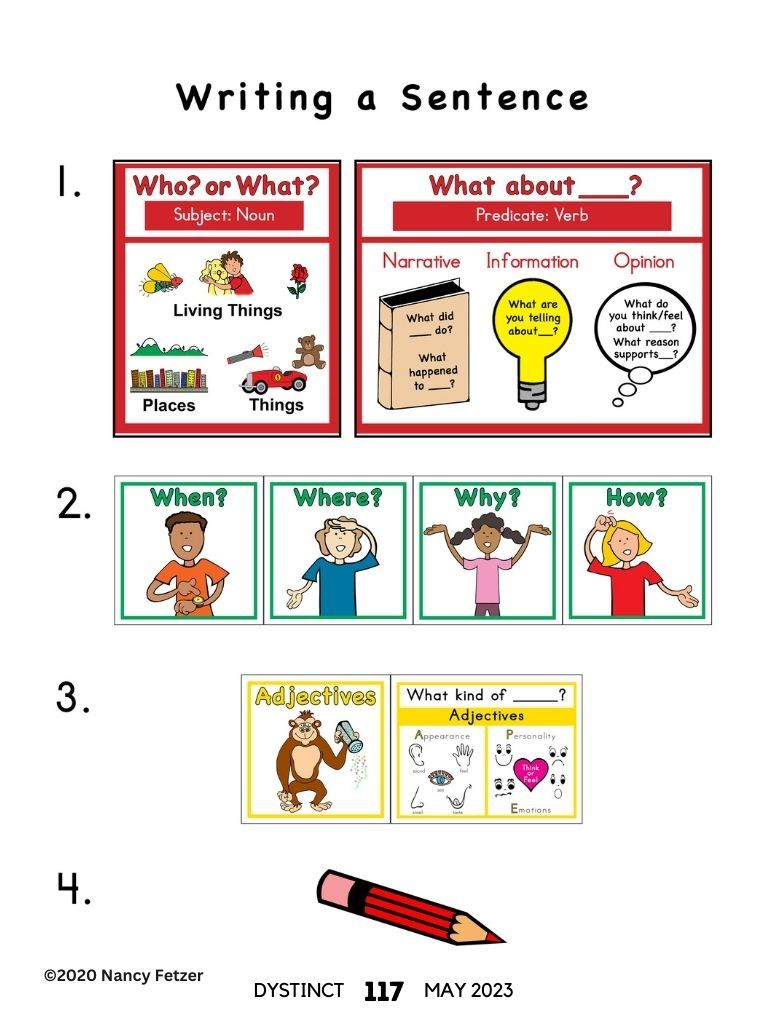
Nancy Fetzer utilizes her visual step-by-step “Writing a Sentence” chart to demonstrate how to explicitly teach students to write sensational narrative sentences.

Table of Contents
In this article, I will utilize my visual step-by-step “Writing a Sentence” chart to demonstrate “how-to” explicitly teach students to write sensational narrative sentences.
Does this sound familiar? Your child is upset, stressed, and flustered because s/he is tasked with the assignment to write a multiple-paragraph essay yet struggles to write complete sentences. According to evidenced-based research, “While all writing requires conscious effort and a great deal of practice in composing, developing and analyzing ideas, proficient and effective writing also hinges on the ability to craft formal, and well-constructed sentence structures.” (Graham, 2006; Scardamalia & Bereiter, 1986; Strong, 1986).
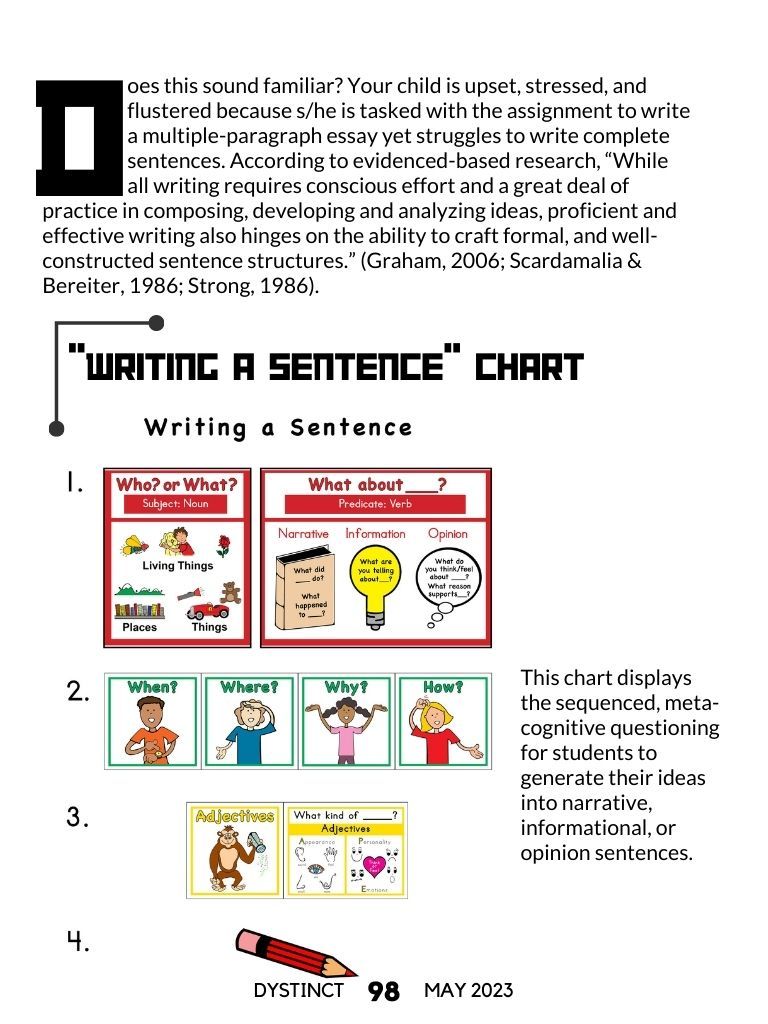
“Writing a Sentence” Chart
“Writing a Sentence” Chart
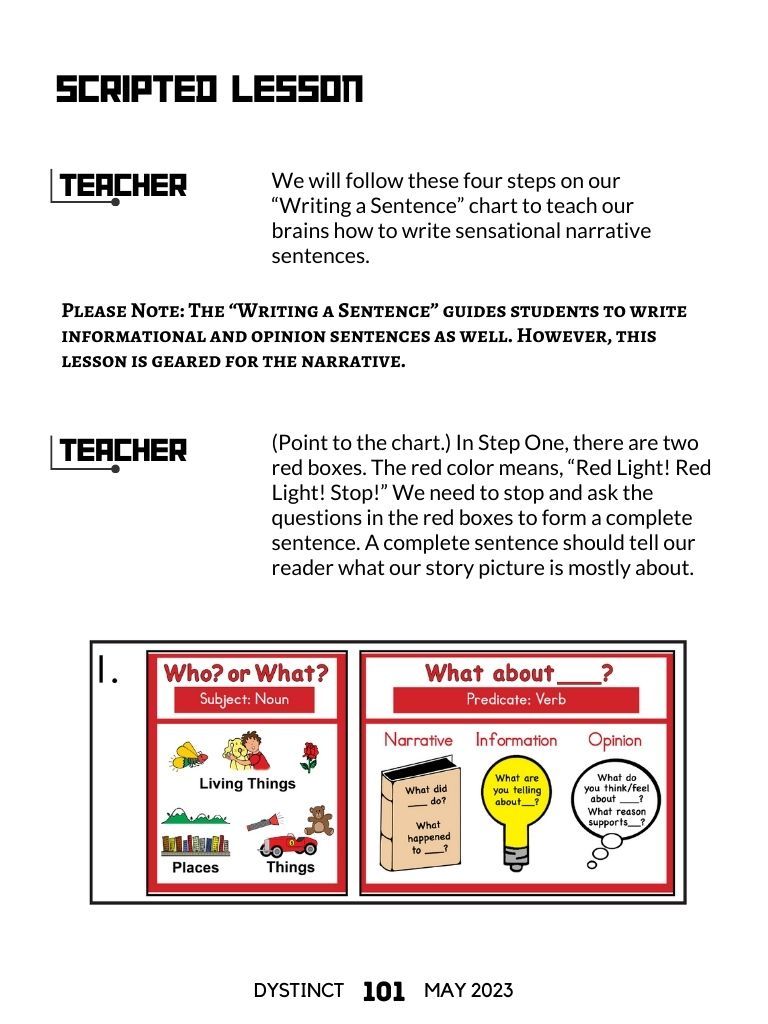
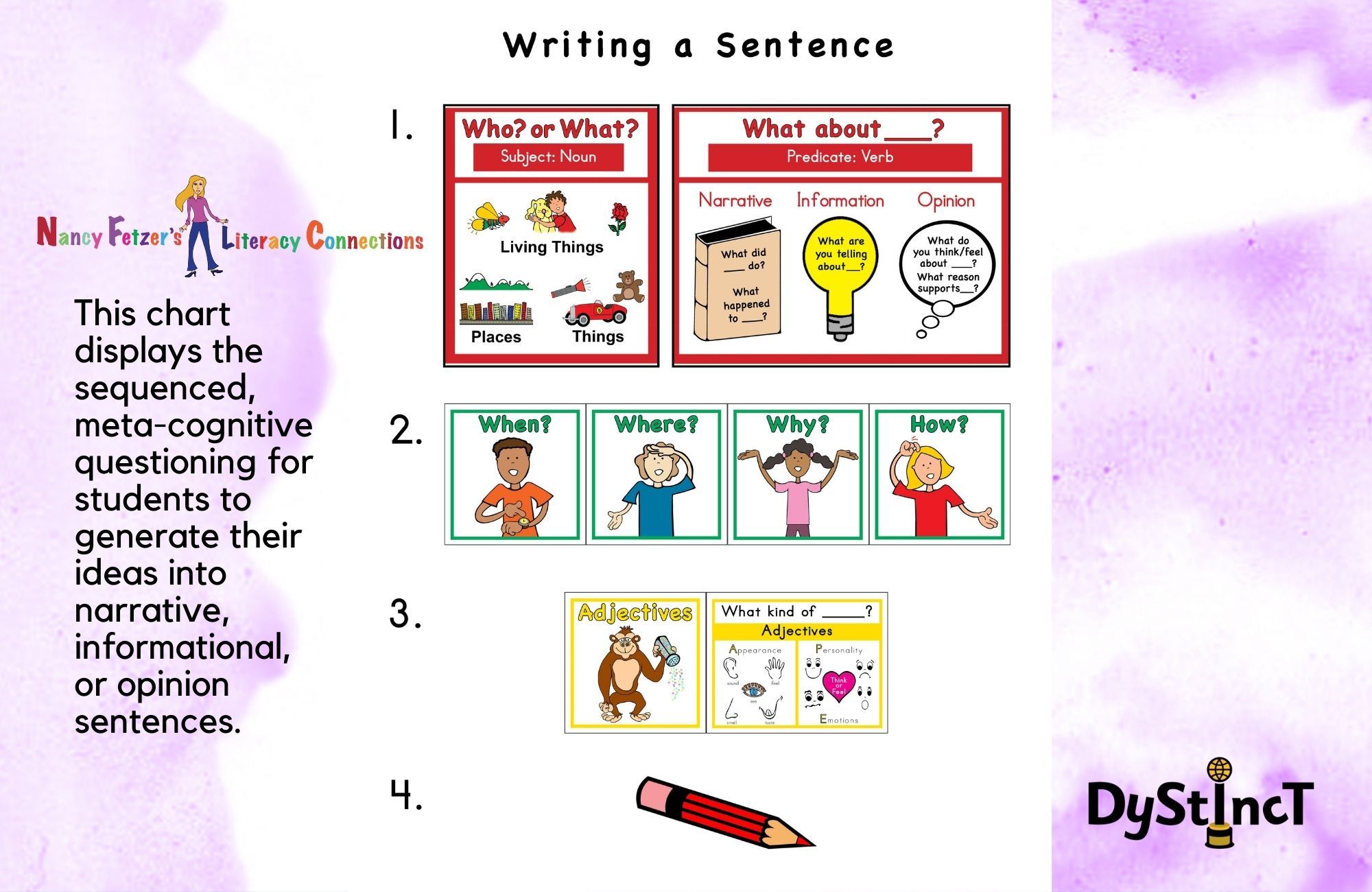
This chart displays the sequenced, meta-cognitive questioning for students to generate their ideas into narrative, informational, or opinion sentences.
Components of the Writing Lesson
Components of the Writing Lesson
Steps
To demonstrate this technique, a scripted lesson is utilized to explain to the teacher/facilitator how to implement the four steps on the “Writing a Sentence” chart.
Idea pictures
Writers always begin with an idea, something to write about. The following writing lesson begins with a drawing (representing an idea) from which a student or students generate sentences. Ultimately, this process should be mastered so students have ideas in their heads that are easily conveyed in well-crafted sentences.
Coaching
Each of the four steps includes teaching points and interventions the facilitator/ teacher may need to support the student(s).
Language Rehearsals
Students are encouraged to repeatedly rehearse and physically pantomime their sentences throughout the lessons. Language development is a critical factor to writing success.
Narrative Sentence Lesson
Narrative Sentence Lesson
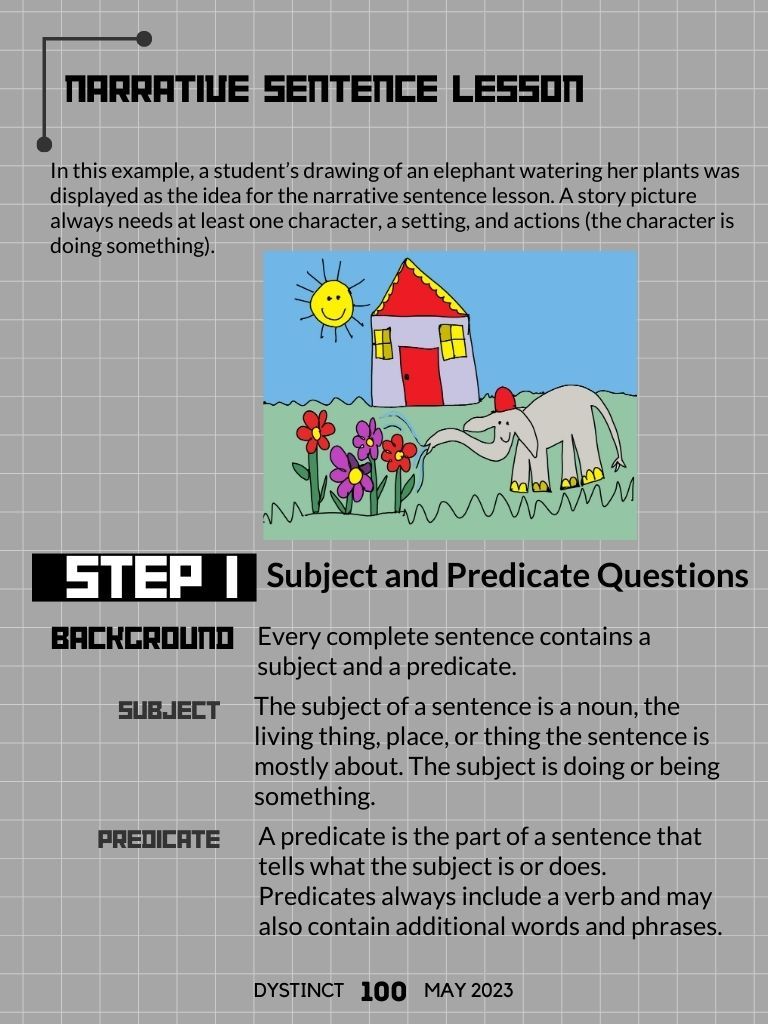
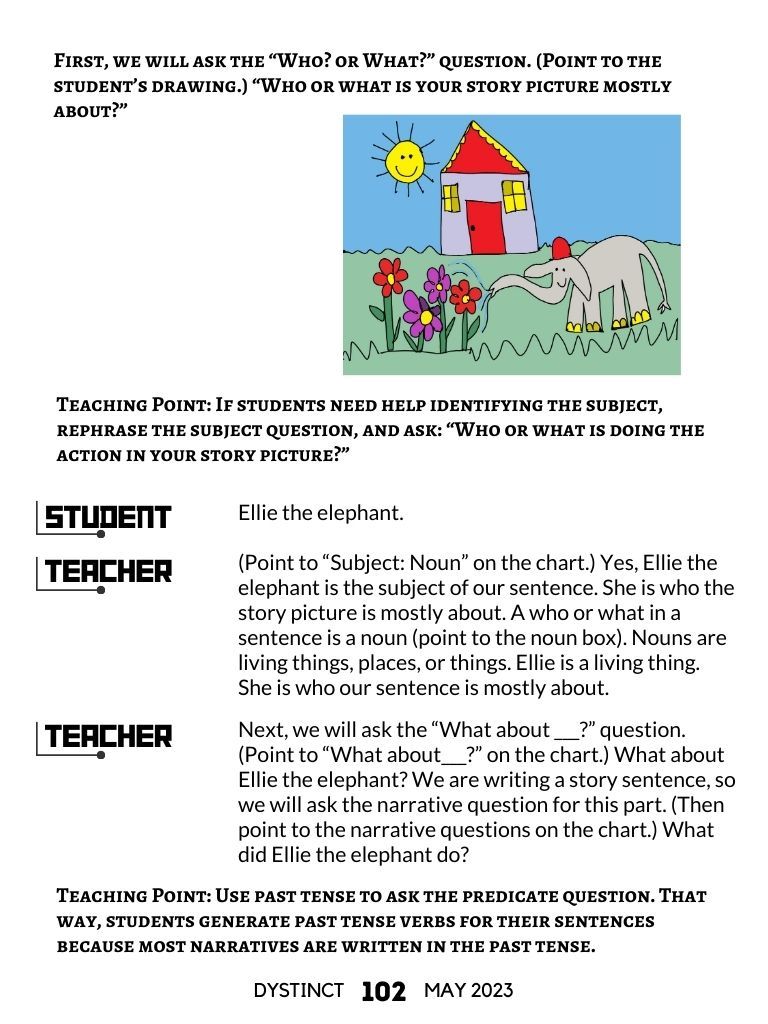
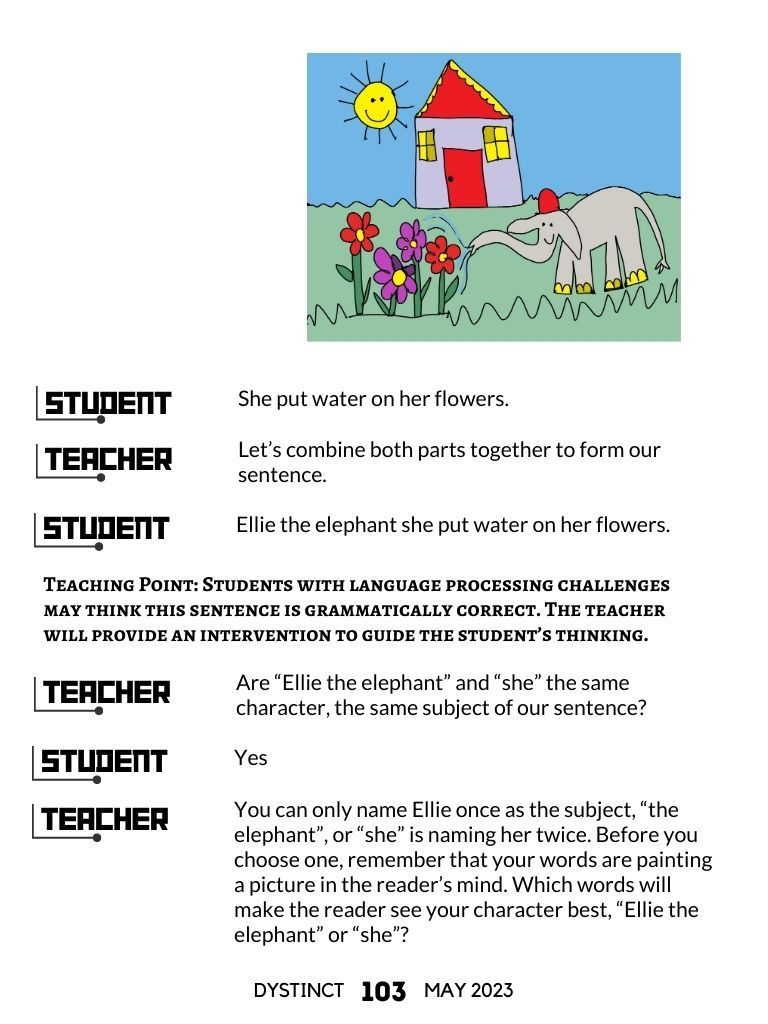
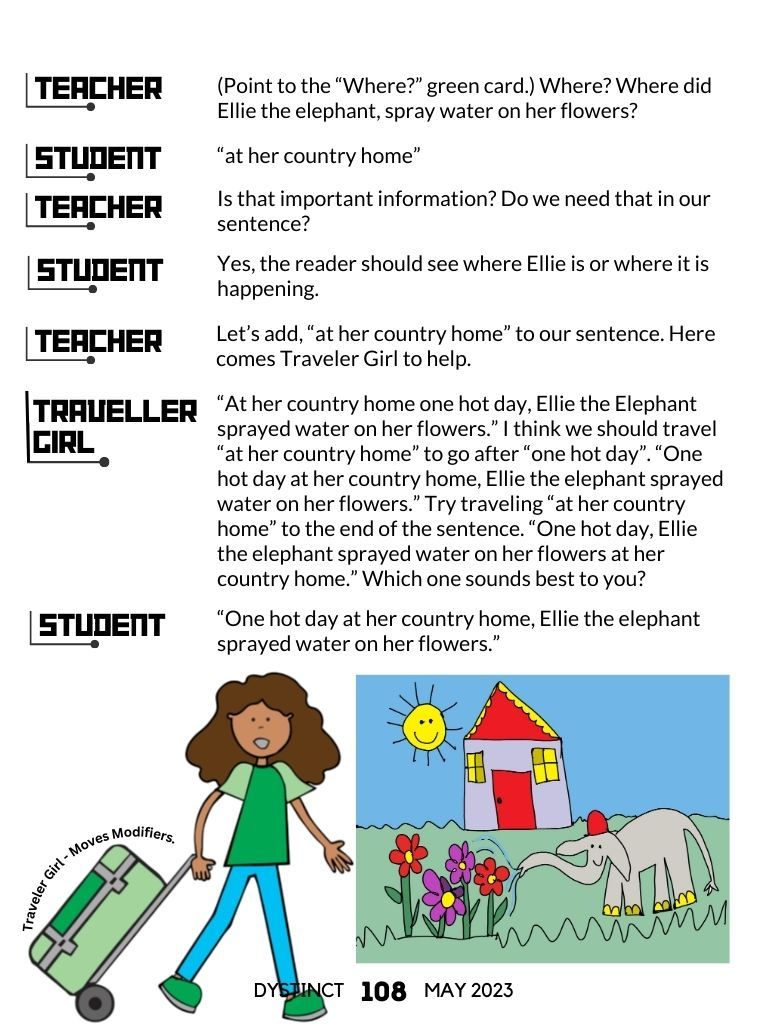
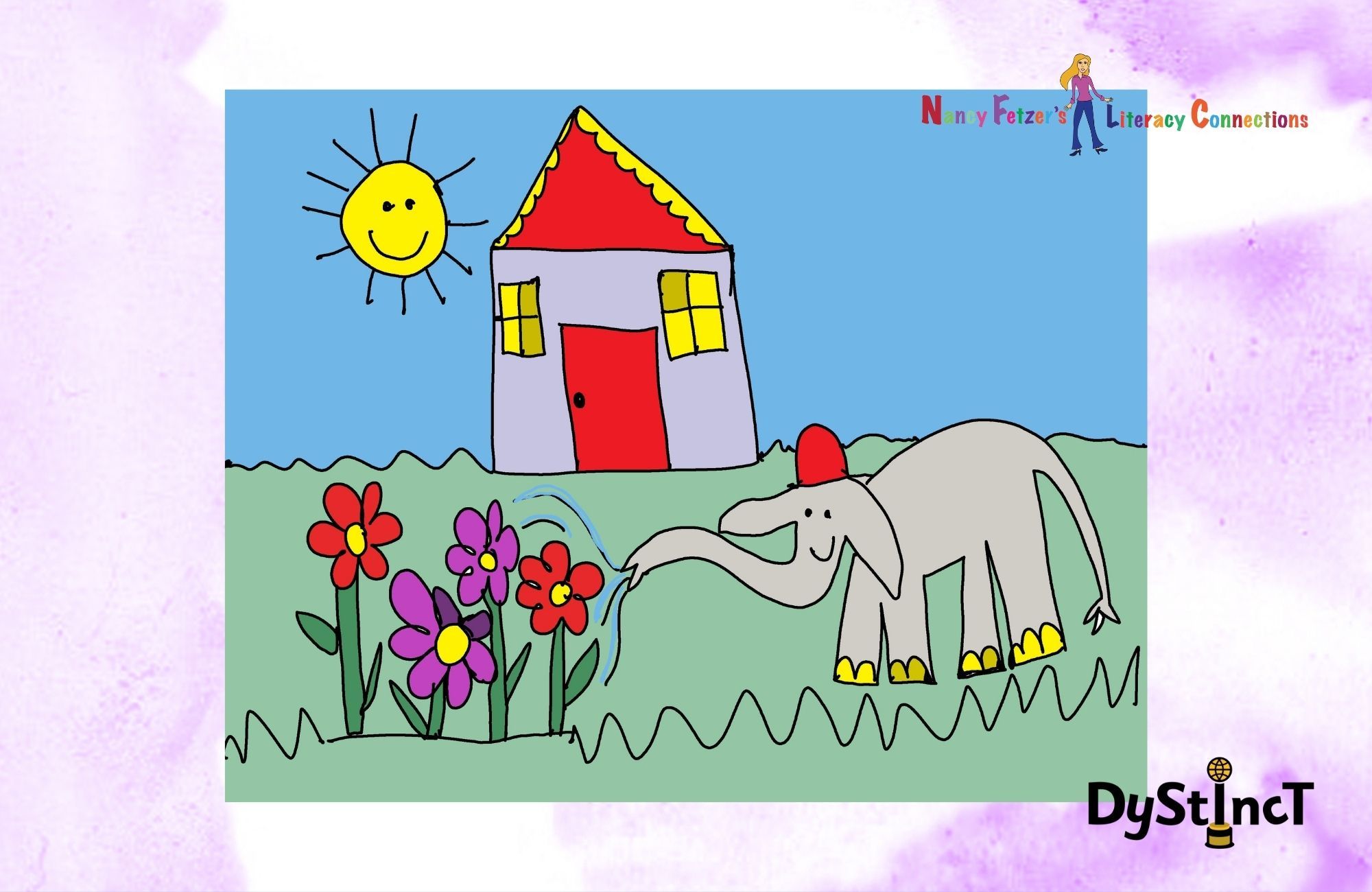
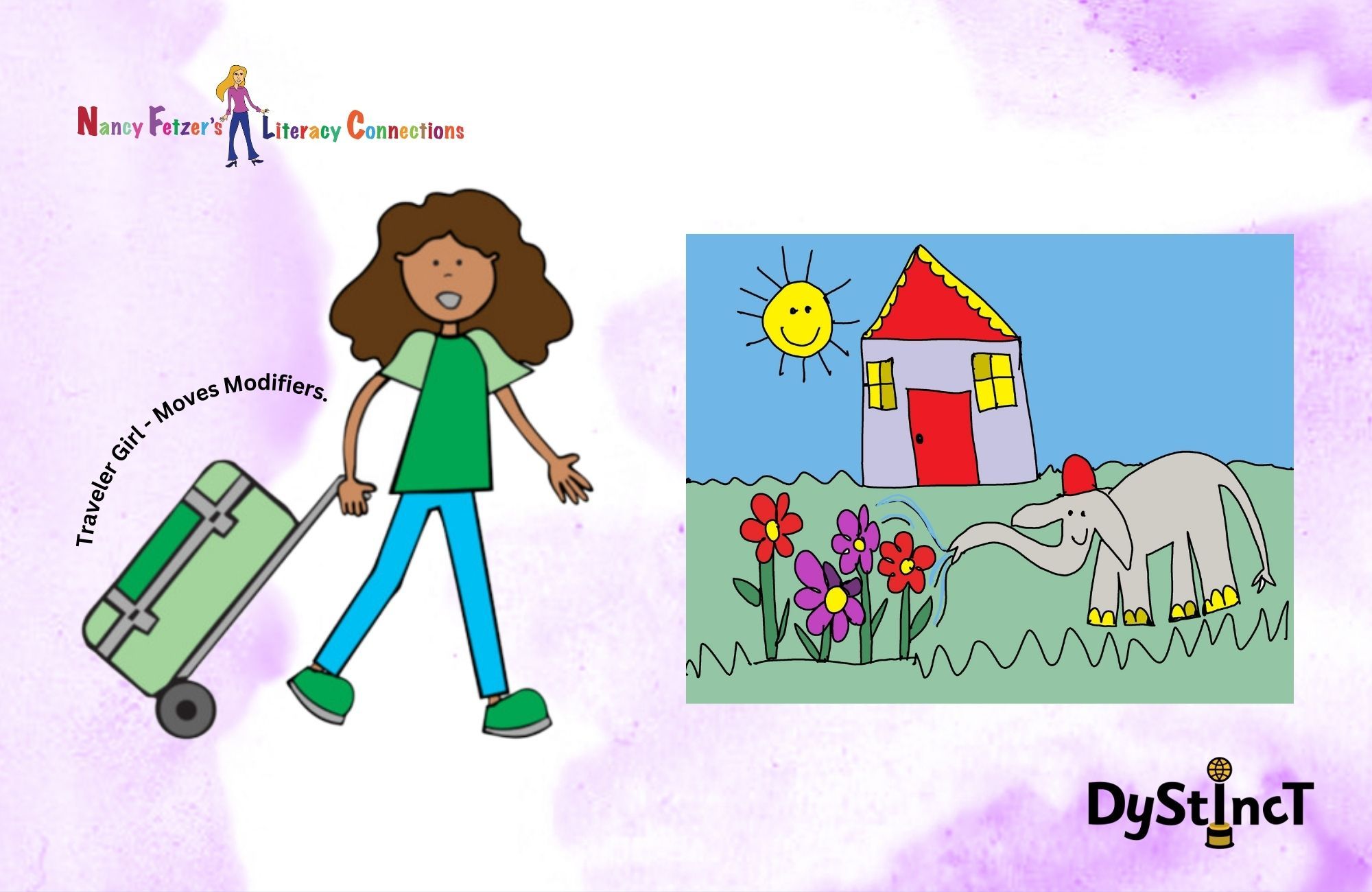
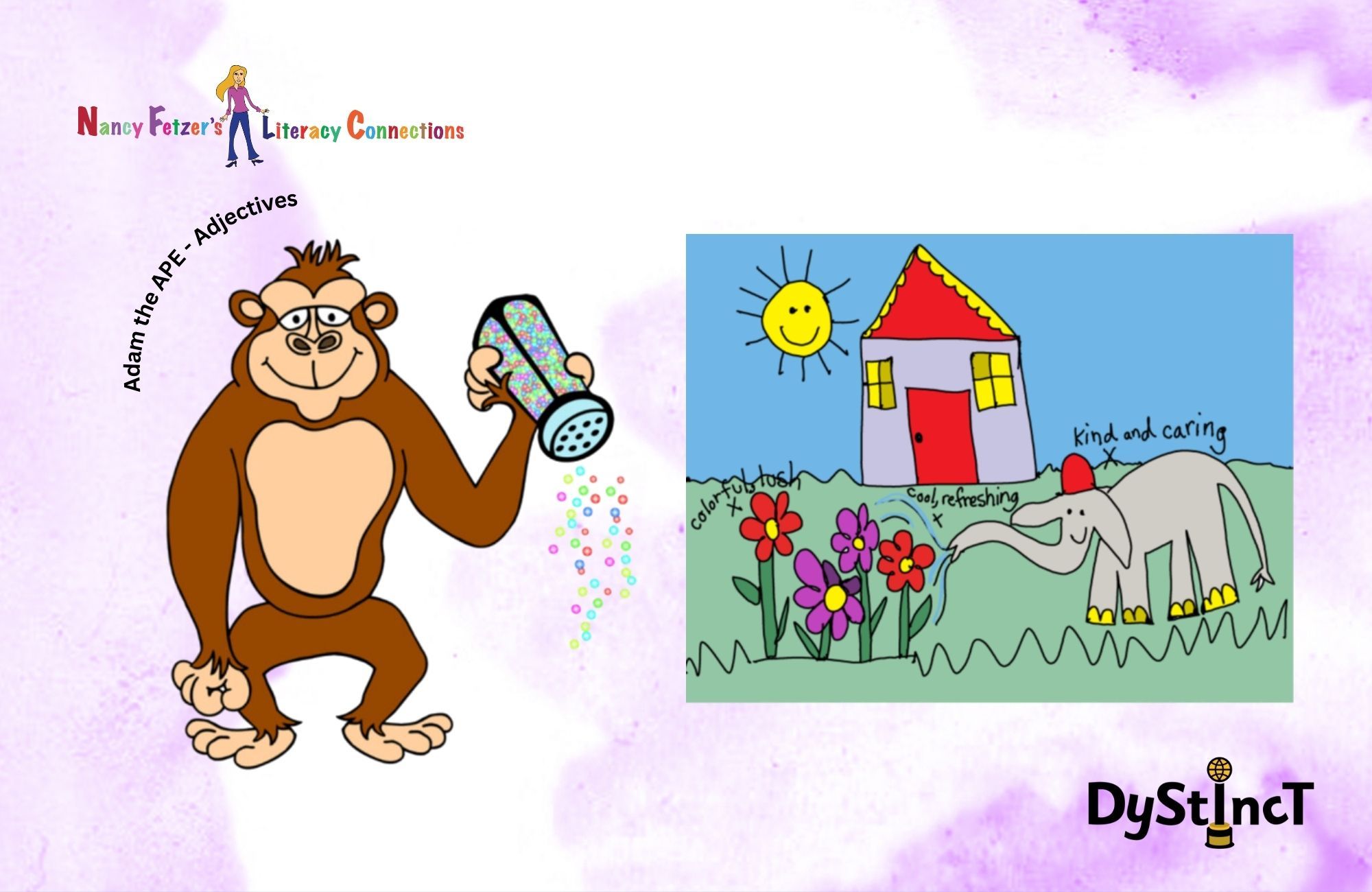
In this example, a student’s drawing of an elephant watering her plants was displayed as the idea for the narrative sentence lesson. A story picture always needs at least one character, a setting, and actions (the character is doing something).
Step 1 : Subject and Predicate Questions
Step 1 : Subject and Predicate Questions
Background
Every complete sentence contains a subject and a predicate.
Subject
The subject of a sentence is a noun, the living thing, place, or thing the sentence is mostly about. The subject is doing or being something.
Predicate
A predicate is the part of a sentence that tells what the subject is or does. Predicates always include a verb and may also contain additional words and phrases.
Scripted Lesson
Teacher: We will follow these four steps on our “Writing a Sentence” chart to teach our brains how to write sensational narrative sentences.
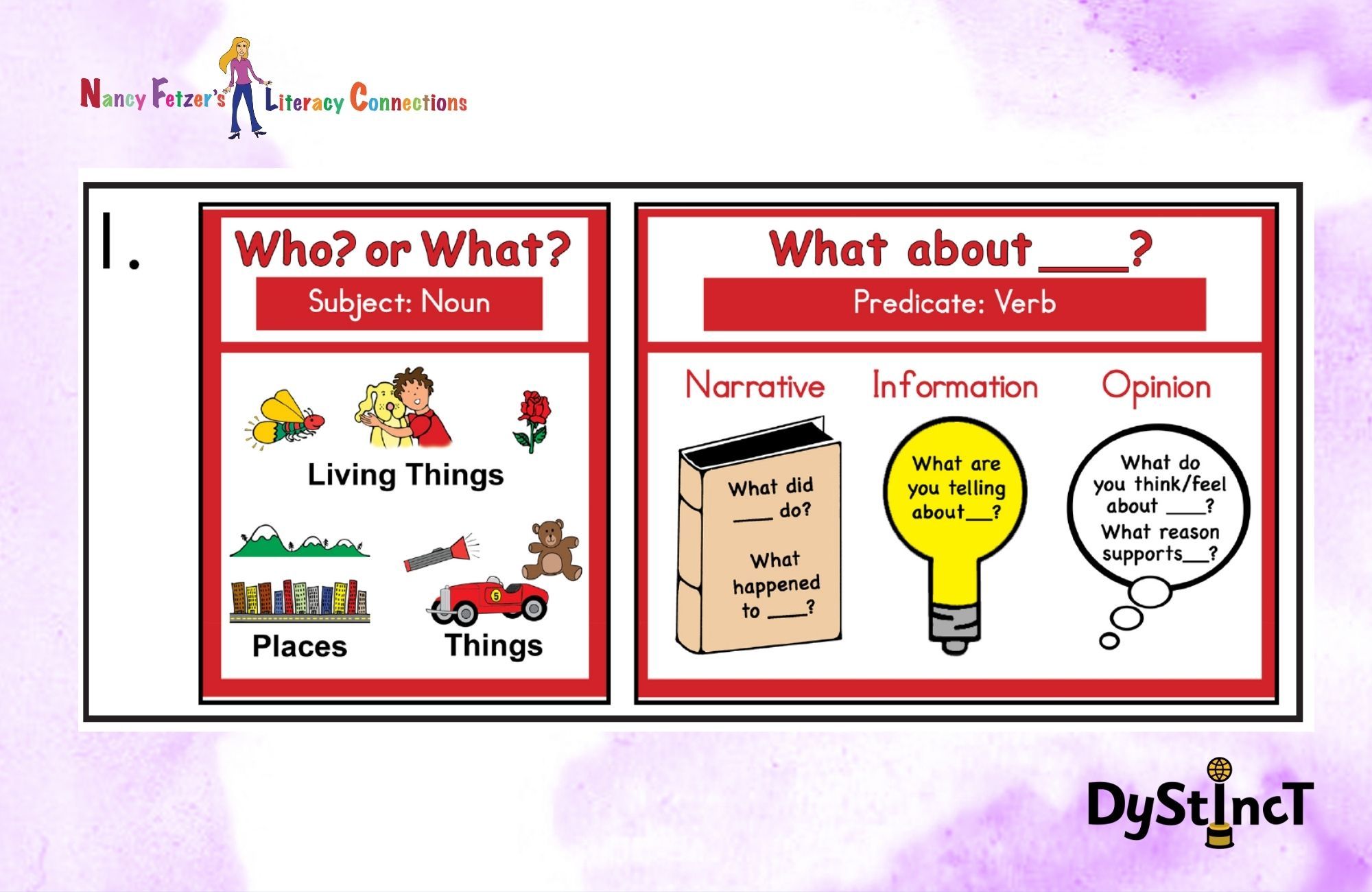
Teacher: (Point to the chart.) In Step One, there are two red boxes. The red color means, “Red Light! Red Light! Stop!” We need to stop and ask the questions in the red boxes to form a complete sentence. A complete sentence should tell our reader what our story picture is mostly about.
Student: Ellie the elephant.
Teacher: (Point to “Subject: Noun” on the chart.) Yes, Ellie the elephant is the subject of our sentence. She is who the story picture is mostly about. A who or what in a sentence is a noun (point to the noun box). Nouns are living things, places, or things. Ellie is a living thing. She is who our sentence is mostly about.
Teacher: Next, we will ask the “What about ___?” question. (Point to “What about___?” on the chart.) What about Ellie the elephant? We are writing a story sentence, so we will ask the narrative question for this part. (Then point to the narrative questions on the chart.) What did Ellie the elephant do?
Student: She put water on her flowers.
Teacher: Let’s combine both parts together to form our sentence.
Student: Ellie the elephant she put water on her flowers.
Teacher: Are “Ellie the elephant” and “she” the same character, the same subject of our sentence?
Student: Yes
Teacher: You can only name Ellie once as the subject, “the elephant”, or “she” is naming her twice. Before you choose one, remember that your words are painting a picture in the reader’s mind. Which words will make the reader see your character best, “Ellie the elephant” or “she”?
Student: Ellie the elephant.
Teacher: Yes, “Ellie the elephant” makes my mind see the elephant, “she” does not. Let’s go back and say your sentence.
Student: Ellie the elephant put water on her flowers.
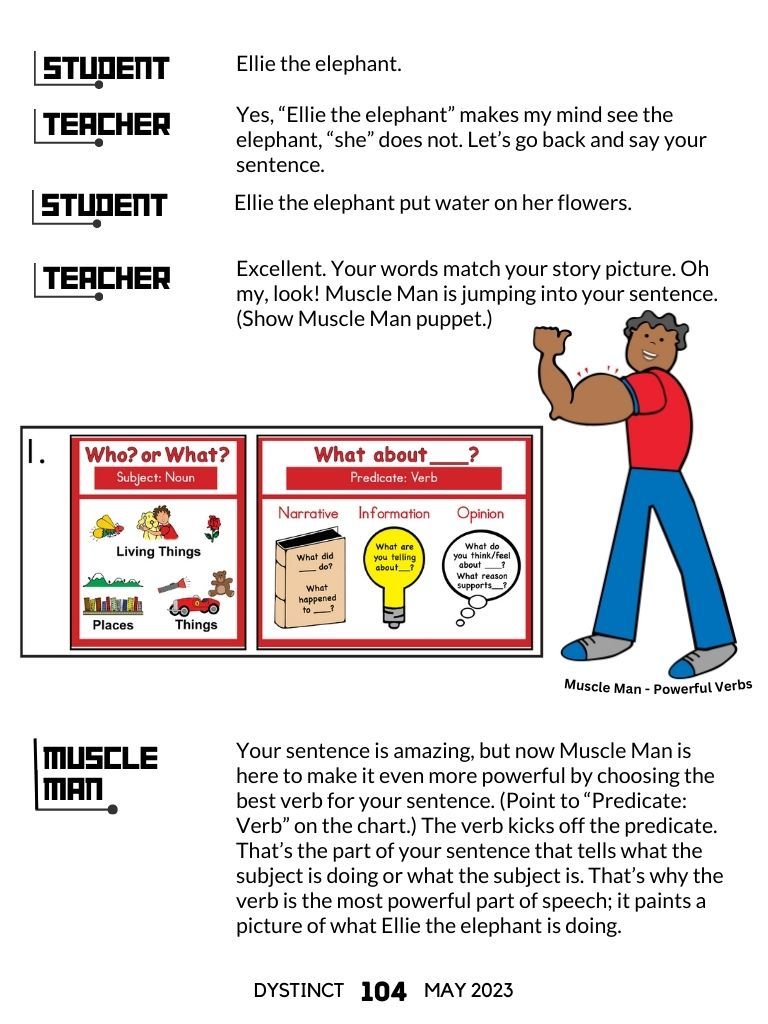
Teacher: Excellent. Your words match your story picture. Oh my, look! Muscle Man is jumping into your sentence. (Show Muscle Man puppet.)
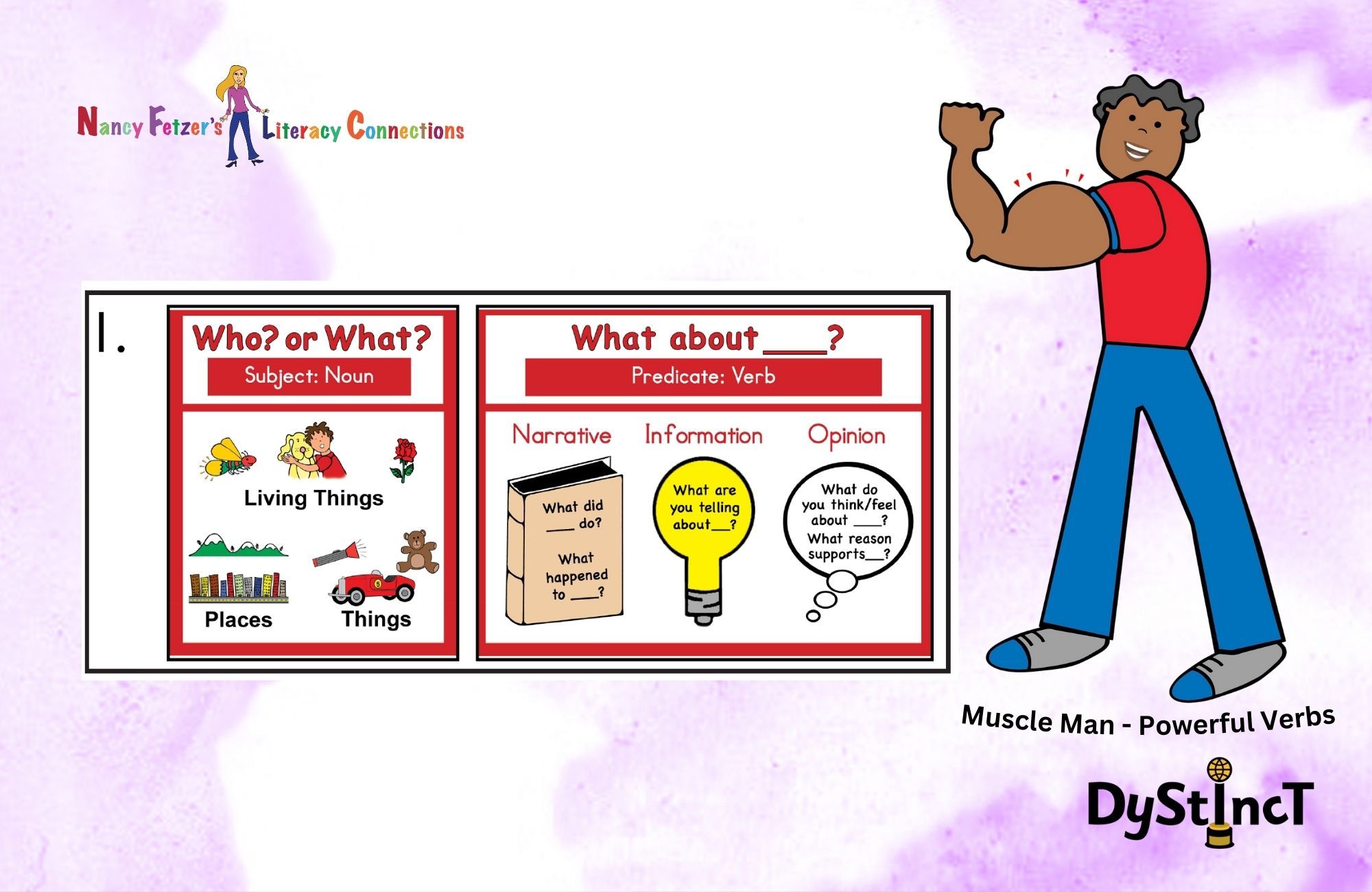
Muscle Man: Your sentence is amazing, but now Muscle Man is here to make it even more powerful by choosing the best verb for your sentence. (Point to “Predicate: Verb” on the chart.) The verb kicks off the predicate. That’s the part of your sentence that tells what the subject is doing or what the subject is. That’s why the verb is the most powerful part of speech; it paints a picture of what Ellie the elephant is doing.
Teacher: In our sentence, “put” is the action. “Put” is a verb. Let’s all brainstorm and act out different verbs that will create a more precise or exact picture of our story.
“Put.” (Physically pretend to act out putting water on flowers. Make a trunk using one arm and scoop up water to put on the flowers.)
“Sprayed.” (Make a trunk and pretend the water is spraying like a sprinkler.)
“Squirted.” (Make a trunk and pretend the water is shooting out and hitting the flowers.)
Which verb matches the picture best?
Student: Sprayed.
Teacher: Yes, sprayed is the most powerful verb or action word. It matches our story picture best. Sprayed makes me think of a hose, like Ellie’s long nose watering the flowers. Let’s say our complete sentence.
Student: Ellie the elephant sprayed water on her flowers.
Step 2 : Modifiers or Extenders
Step 2 : Modifiers or Extenders
Background
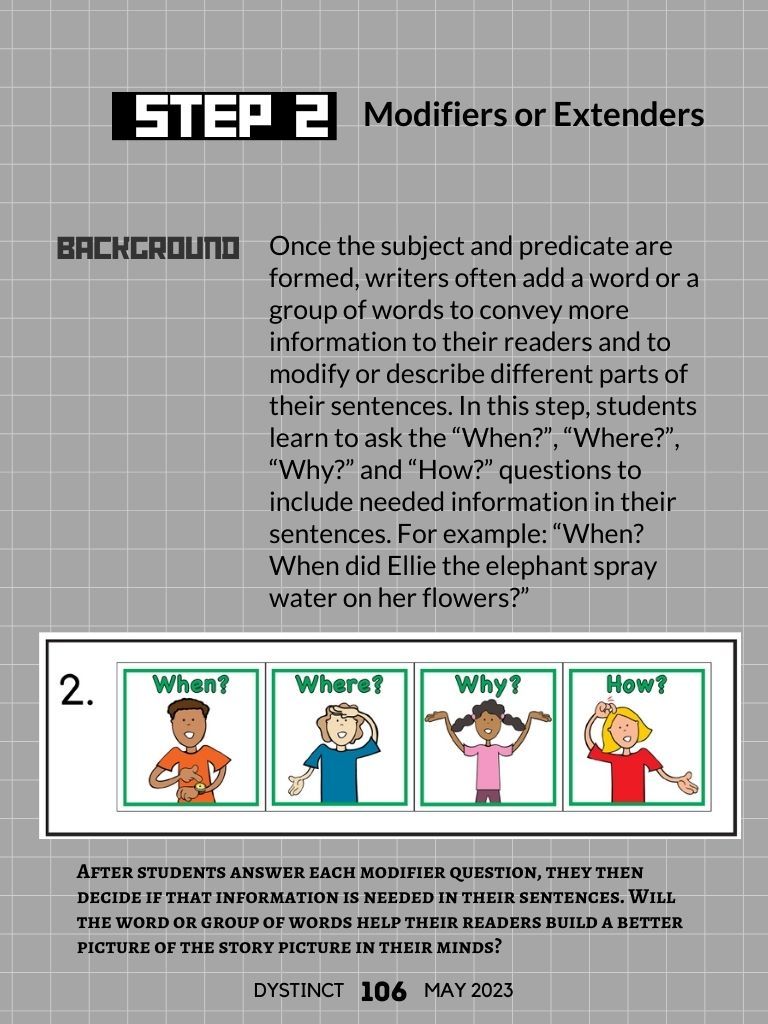
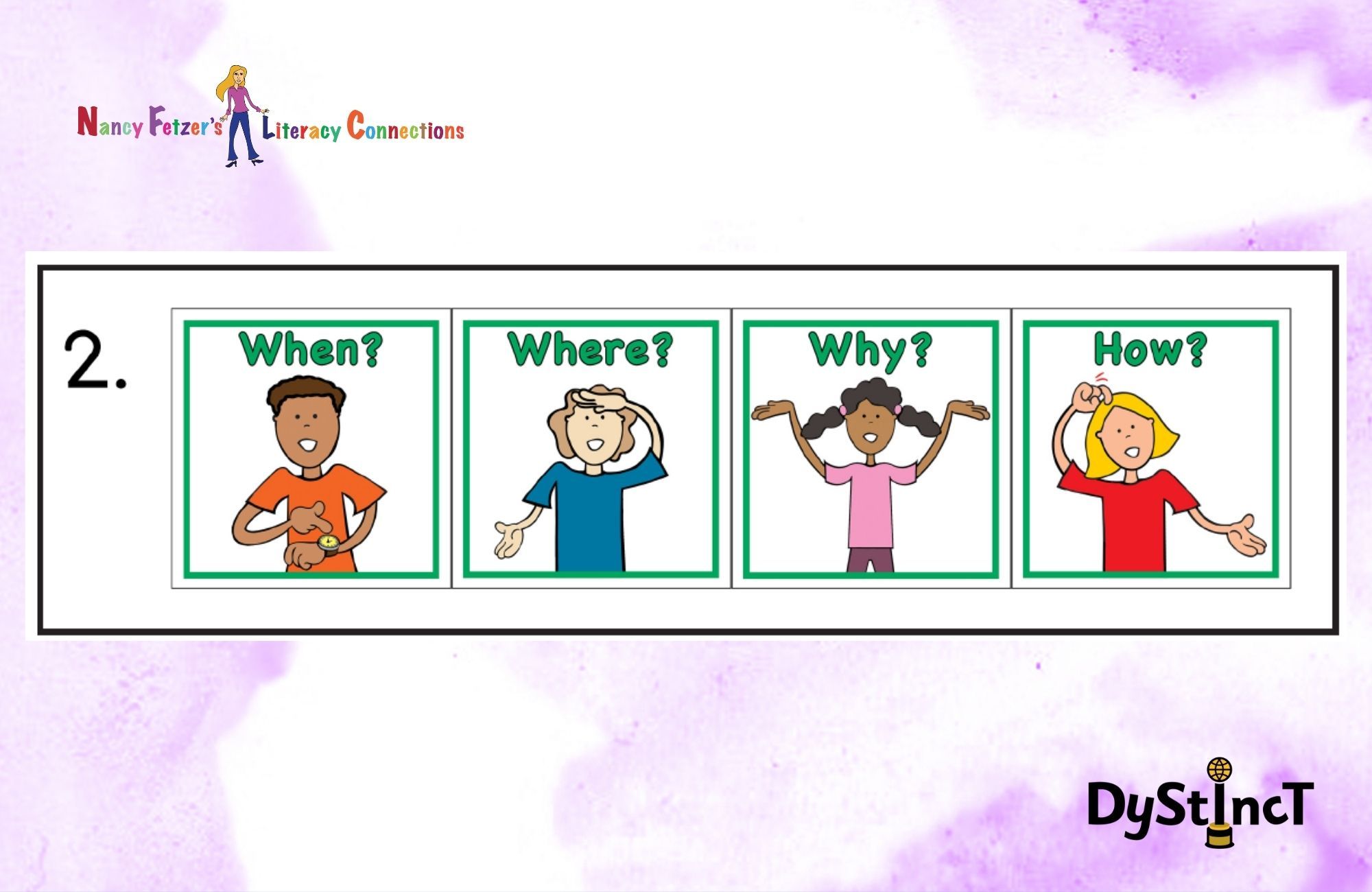
Once the subject and predicate are formed, writers often add a word or a group of words to convey more information to their readers and to modify or describe different parts of their sentences. In this step, students learn to ask the “When?”, “Where?”, “Why?” and “How?” questions to include needed information in their sentences. For example: “When? When did Ellie the elephant spray water on her flowers?”
Scripted Lesson
Teacher: (Point to the chart.) Look at Step Two on your “Writing a Sentence” chart. There are four green question boxes that help you add more information to your sentence. The green color means, “Green Light! Green Light! Go!” We ask these green questions about our sentence, then determine if the answers to the questions are important information for our story sentence. We need to determine if the word or group of words need to GO in our sentence. (Point to the “When?” card.) I will ask the “When?” question about our story sentence. When? When did Ellie the elephant spray water on her flowers?
Student: One hot day.
Teacher: Is that important information? Do we need that in our sentence?
Student: Yes, Ellie is watering the flowers because it is hot. The reader should know it’s hot. That is important information.
Teacher: Let’s add, “one hot day” to our sentence. Look, the Traveler Girl is here. (Show the Traveler Girl puppet.) She is going to teach us how to put a Green Light word or group of words in our sentences.
Traveller Girl: The “Green Light! Go!” words can travel (move around) in our sentences. “One hot day” is going to travel in our sentence until we place in the part that sounds best. Let’s place “one hot day” at the beginning of our sentence. “One hot day, Ellie the elephant sprayed water on her flowers.” That sounds amazing. Let’s go traveling again. This time we will move “one hot day” to the end of the sentence. “Ellie the elephant sprayed water on her flowers one hot day.” I think these “When?” words sound best at the beginning. “One hot day, Ellie the elephant sprayed water on her flowers.”
Teacher: (Point to the “Where?” green card.) Where? Where did Ellie the elephant, spray water on her flowers?
Student: “at her country home”
Teacher: Is that important information? Do we need that in our sentence?
Student: Yes, the reader should see where Ellie is or where it is happening.
Teacher: Let’s add, “at her country home” to our sentence. Here comes Traveler Girl to help.
Traveller Girl: “At her country home one hot day, Ellie the Elephant sprayed water on her flowers.” I think we should travel “at her country home” to go after “one hot day”. “One hot day at her country home, Ellie the elephant sprayed water on her flowers.” Try traveling “at her country home” to the end of the sentence. “One hot day, Ellie the elephant sprayed water on her flowers at her country home.” Which one sounds best to you?
Student: “One hot day at her country home, Ellie the elephant sprayed water on her flowers.”
Teacher: (Point to the “How?” green card.) How? How did Ellie the elephant spray water on her flowers one hot day at her country home?
Student: “gently”
Teacher: Is gently important information to add to this sentence?
Student: Yes, because gently means she is being careful not to hurt her flowers.
Teacher: Yes, that does make “gently” important to our sentence. Traveler Girl will help us put that word in our sentence.
Traveller Girl: “Gently” is describing how Ellie sprayed the water. We always put the “Green Light!” words close to the word(s) they describe. Place “gently” by “sprayed”.
“One hot day at her country home, Ellie the elephant gently sprayed water on her flowers.”
Teacher: (Point to the “Why?” green card.) Why? Why did Ellie the elephant gently spray water on her flowers one hot day at her country home?
Student: Because they needed to be watered. Because it was hot.
Teacher: Let’s think if we need to add this information. Your sentence already tells the reader the weather was hot, and that Ellie was watering her flowers. If you give readers enough information in a sentence, they can make inferences or figure out why Ellie was watering her flowers. Let’s leave the “Why?” part out because it’s not needed.
Step 3 : Adjectives
Step 3 : Adjectives
Background
Adjectives describe nouns. However, every noun does not need to be described in a sentence, only the important nouns. Once students identify the important nouns, they then ask the adjective question, “What kind of...?” For example, “elephant” is an important noun in the sentence, so the adjective question should be “What kind of elephant is Ellie if she gently sprays her flowers on a hot day at her country house?” Notice the adjective question included the entire sentence. This will help students to generate more precise and meaningful adjectives.
Scripted Lesson
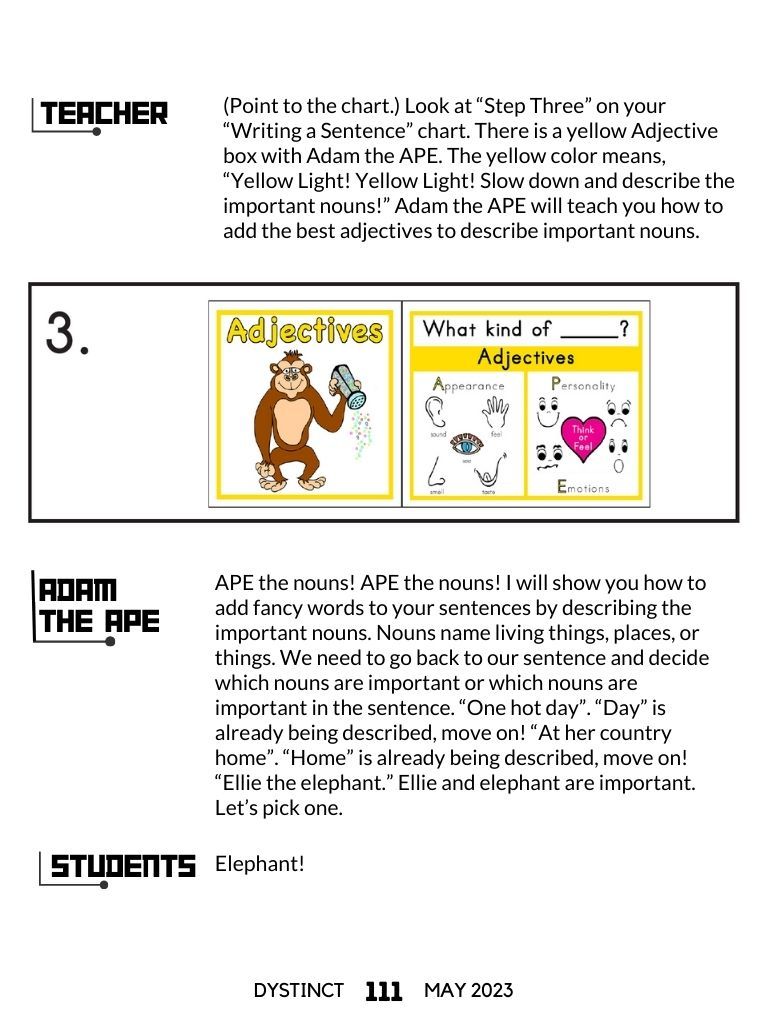
Teacher: (Point to the chart.) Look at “Step Three” on your “Writing a Sentence” chart. There is a yellow Adjective box with Adam the APE. The yellow color means, “Yellow Light! Yellow Light! Slow down and describe the important nouns!” Adam the APE will teach you how to add the best adjectives to describe important nouns.
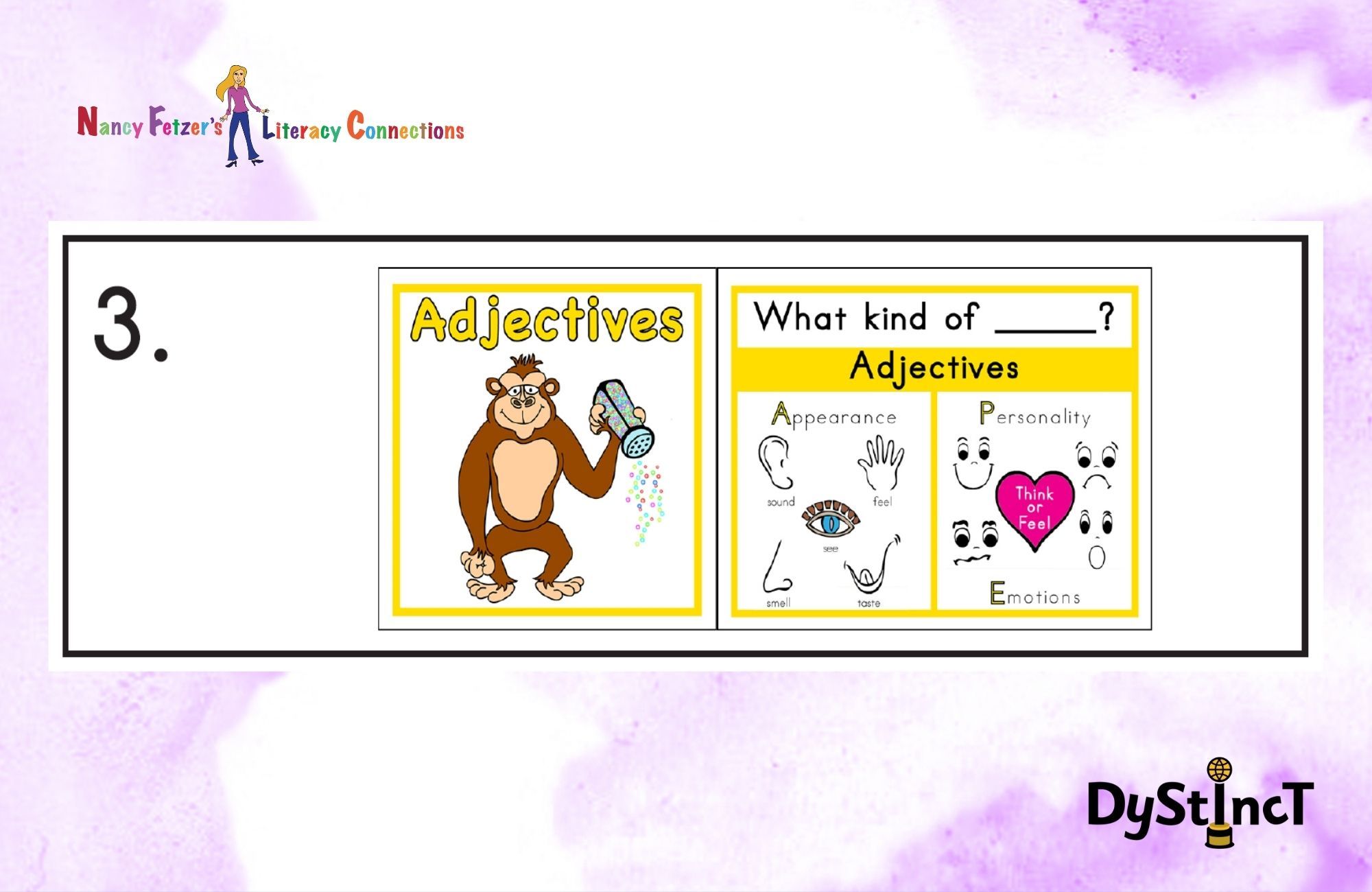
Adam the Ape: APE the nouns! APE the nouns! I will show you how to add fancy words to your sentences by describing the important nouns. Nouns name living things, places, or things. We need to go back to our sentence and decide which nouns are important or which nouns are important in the sentence. “One hot day”. “Day” is already being described, move on! “At her country home”. “Home” is already being described, move on!
“Ellie the elephant.” Ellie and elephant are important. Let’s pick one.
Student: Elephant!
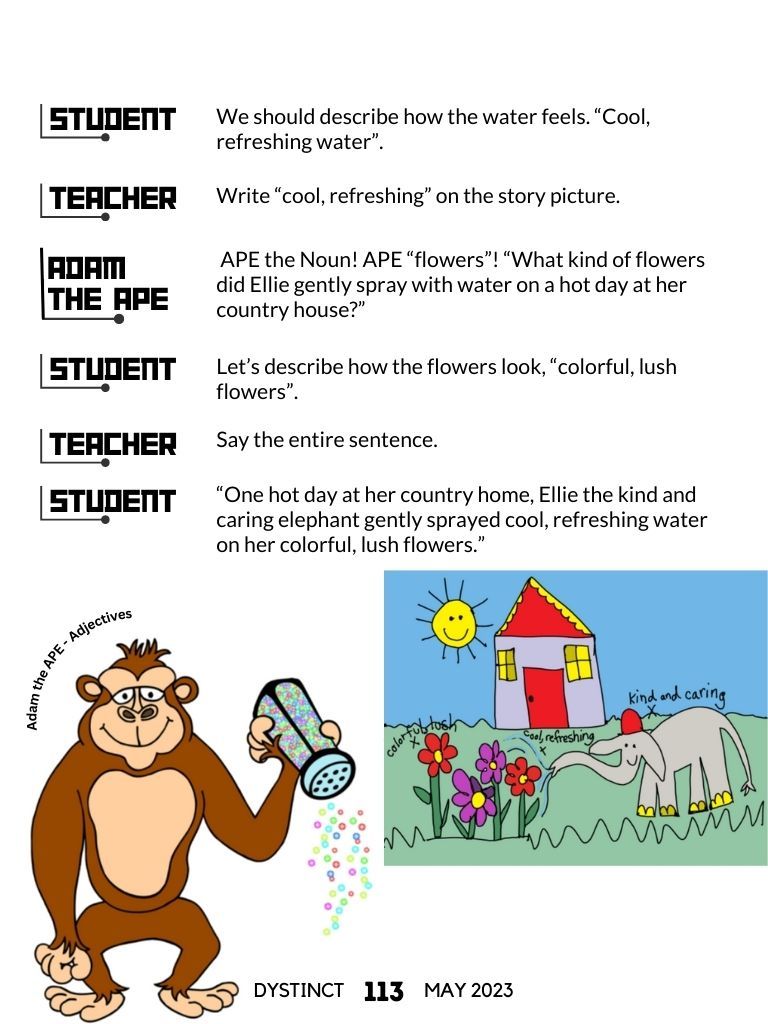
Adam the Ape: Mark an “X” above the elephant in your story picture, so have a spot to add describing words. “Sprayed water on her flowers.” “Water” and “flowers” are both nouns and important to the story sentence. Mark an “X” above both in your story picture. (Optional: Use a saltshaker filled with beads and shake it over the picture.) Time to add fancy words or adjectives to spice up the important nouns in our sentence!
Adam the Ape: We will ask the “What kind of?” question. What kind of elephant? What kind of elephant is Ellie if she gently sprays her flowers on a hot day at her country house? APE the Noun! APE “elephant”! The word APE will help you think of the best adjectives to describe “elephant”.
“A” is for appearance or five senses words - what something looks like, feels like, tastes/smells like, or sounds like.
“P” is for personality - What traits does the elephant have?
“E” is for emotion - How does the elephant feel? How should we describe “elephant?”
Student: Her personality because she’s kind and caring about her flowers.
Teacher: Write “kind and caring” on the story picture.
Adam the Ape: APE the Noun! APE “water”! “What kind of water did Ellie gently spray on her flowers on a hot day at her country house?”
Student: We should describe how the water feels. “Cool, refreshing water”.
Teacher: Write “cool, refreshing” on the story picture.
Adam the Ape: APE the Noun! APE “flowers”! “What kind of flowers did Ellie gently spray with water on a hot day at her country house?”
Student: Let’s describe how the flowers look, “colorful, lush flowers”.
Teacher: Say the entire sentence.
Student: “One hot day at her country home, Ellie the kind and caring elephant gently sprayed cool, refreshing water on her colorful, lush flowers.”
Step 4 : Editing Time
Step 4 : Editing Time
Background
Every sentence begins with a capital and ends with a stop (period, question mark, or exclamation point). Sometimes commas are needed. In these lessons, students need to understand three functions of commas: to separate adjectives (two or more coordinate adjectives that describe the same noun), in a series (to separate one list item from the next), and after an introductory clause or phrase (the word or words that provide background information or “set the stage” about the sentence).
Scripted Lesson
Teacher: (Point to the chart.) Look at Step Four on your “Writing a Sentence” chart. There is a red pencil; that means “Editing Time!”. Take out your red pencil.
(Sing or chant rule.) Every sentence begins with a capital (raise arms) and ends with a stop (stomp foot)! Every sentence begins with a capital (raise arms) and ends with a stop (stomp foot), and sometimes our sentences need commas (kick out hip)!
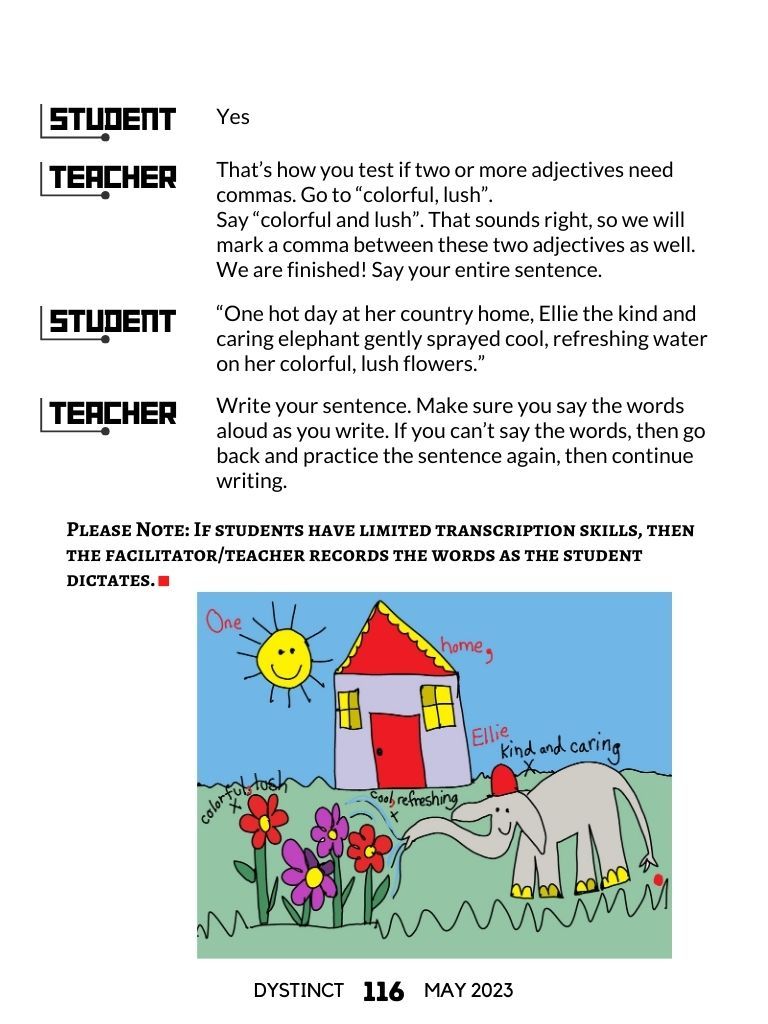
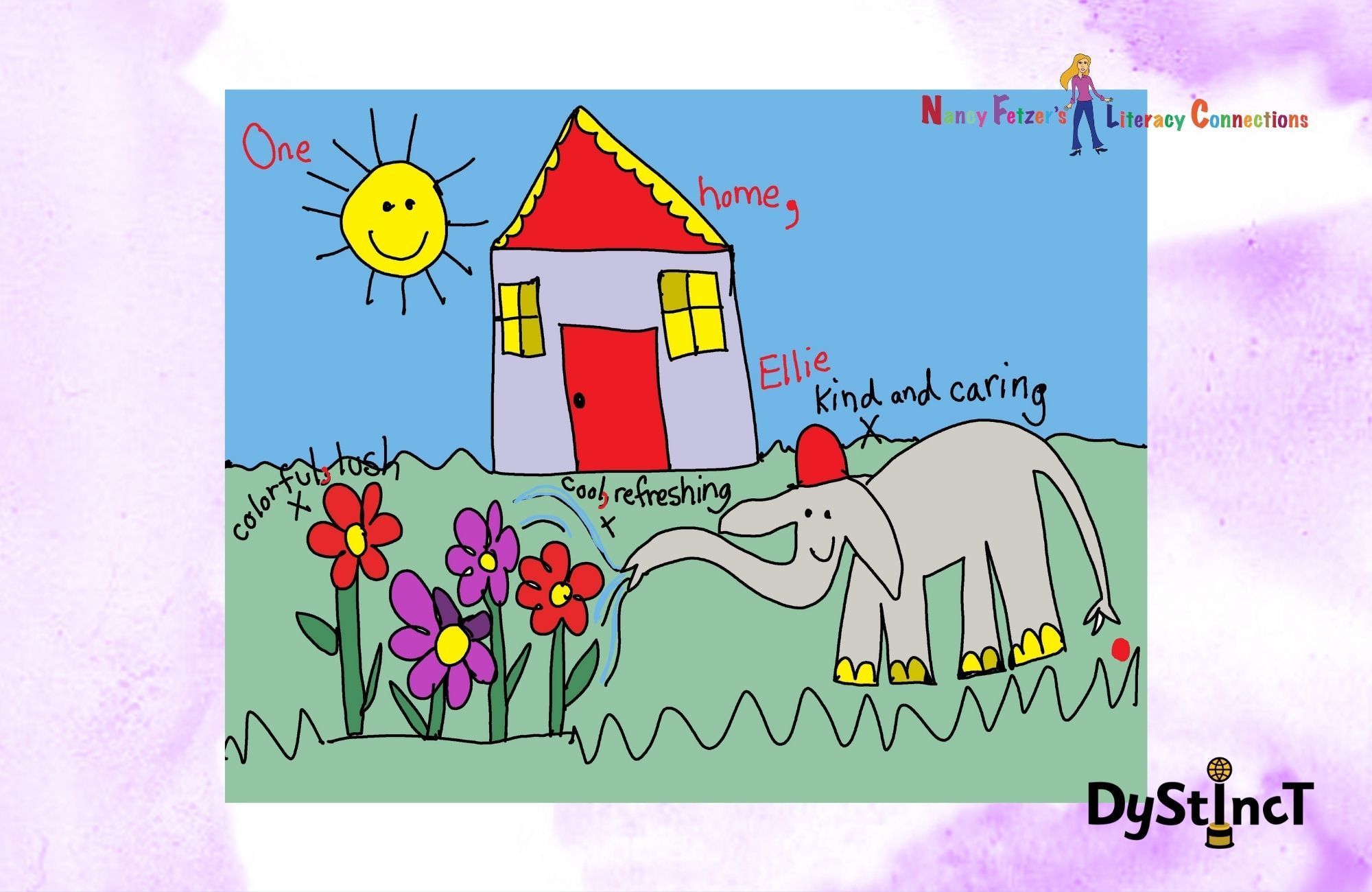
Let’s go to your story picture to mark the capital, stop, and any needed commas. Write the first word, “One” with a capital “O” on the top left side of your picture because it’s the first word in your sentence. Write Ellie with a capital “E” because that’s a name or proper noun. Next, mark a period on the bottom right of your picture to remind you to put a period at the end of your sentence. Your sentence ends with a period because it is telling about Ellie the Elephant. Telling sentences end with periods.
Check if you need any commas. Say the sentence: “One hot day at her country home, Ellie the kind and caring elephant gently sprayed cool, refreshing water on her colorful, lush flowers.”
At the beginning of your sentence, you have “Green Light” words “One hot day at her country home” that tell “When?” and “Where?” When “Green Light” words begin a sentence, you need to mark a comma after them. Go to your picture. A little after the word “One”, write “home”, then mark a comma after it.
Go to “cool, refreshing”. When there are two or more adjectives, you need to test if they need commas to separate them. Say the word “and” between the two adjectives - “cool and refreshing”. Does that sound right?
Student: Yes
Teacher: That’s how you test if two or more adjectives need commas. Go to “colorful, lush”.
Say “colorful and lush”. That sounds right, so we will mark a comma between these two adjectives as well.
We are finished! Say your entire sentence.
Student: “One hot day at her country home, Ellie the kind and caring elephant gently sprayed cool, refreshing water on her colorful, lush flowers.”
Teacher: Write your sentence. Make sure you say the words aloud as you write. If you can’t say the words, then go back and practice the sentence again, then continue writing.
Nancy Fetzer
Curriculum Expert and Staff Development Trainer
nancyfetzer.com | Facebook | YouTube | LinkedIn
Nancy Fetzer
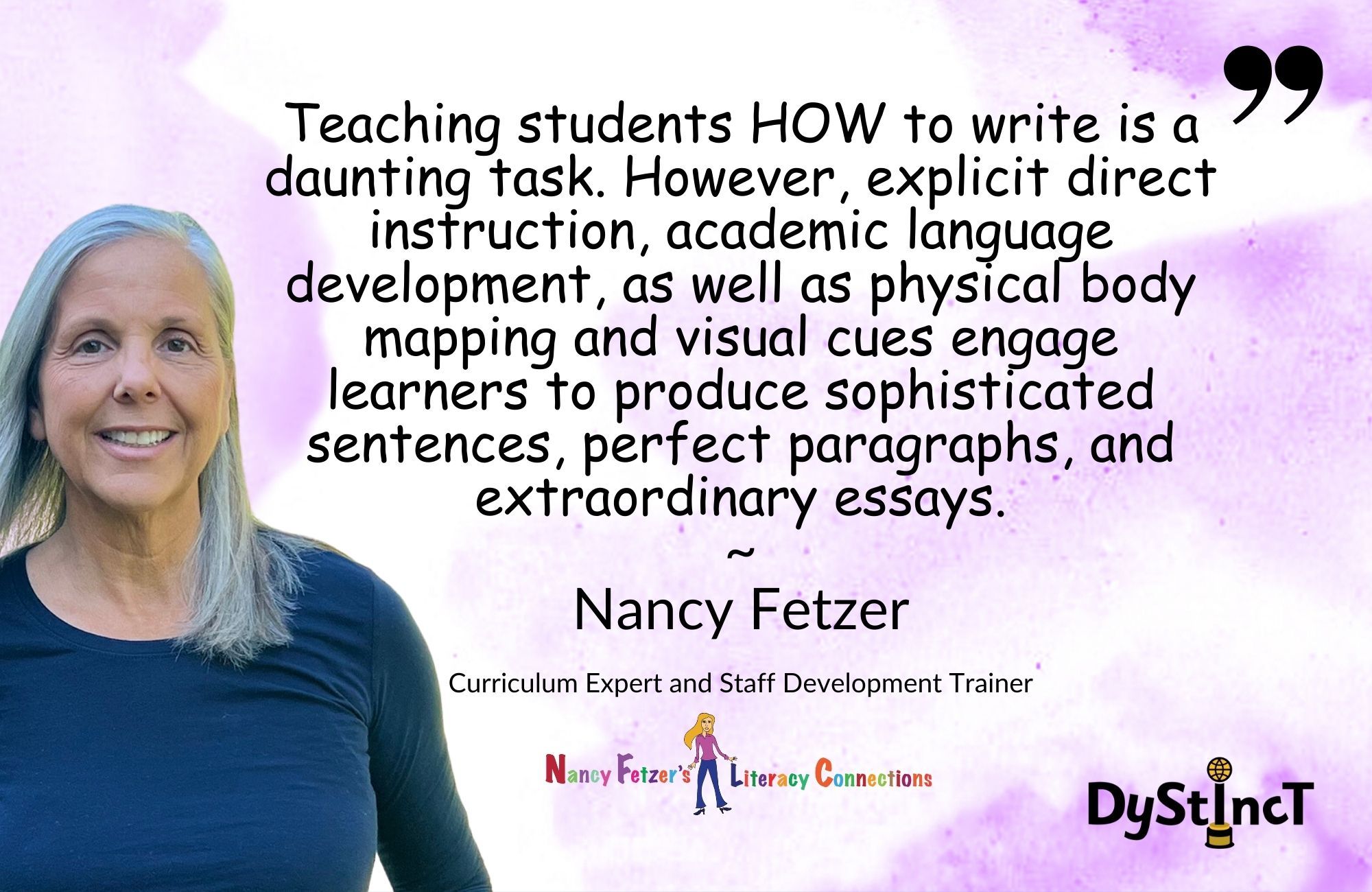
Nancy Fetzer, M.A., is a nationally recognized curriculum expert and staff development trainer. She is an award-winning teacher who has authored and illustrated many books, manuals, and videos. After years of research, application, and refinement, Nancy has crafted schoolwide methods and strategies that dove-tail with any adoption or framework. She provides the “how-to” methods for curriculum implementation in today’s diverse classrooms.
This is not a scripted program, but a unique process that guides all students to read, write, listen, and speak with high-levels of proficiency. For over thirty years, Fetzer has worked directly with schools and districts training staffs, as well as parents to utilize her explicit direct-instruction strategies, packed with academic language development and student engagement techniques.
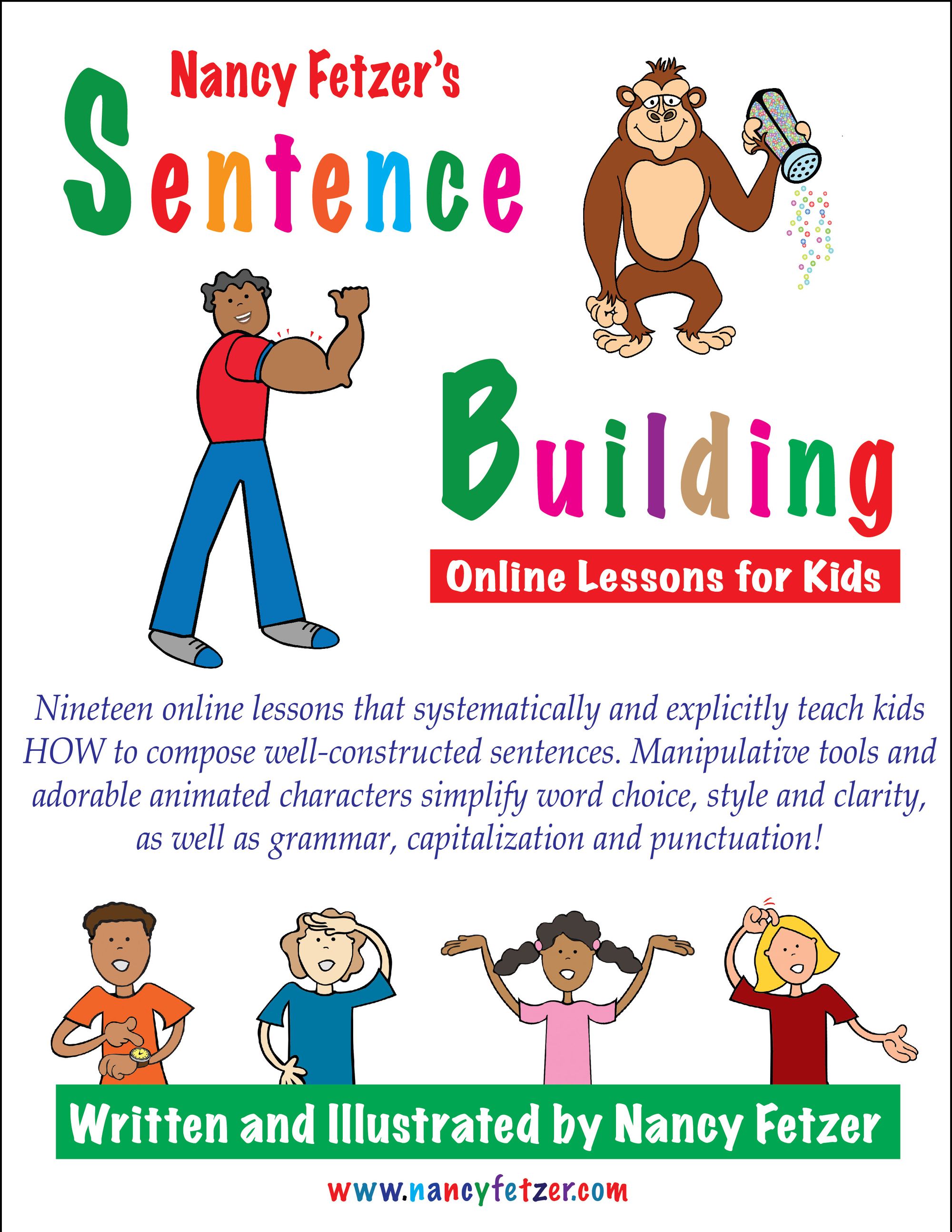
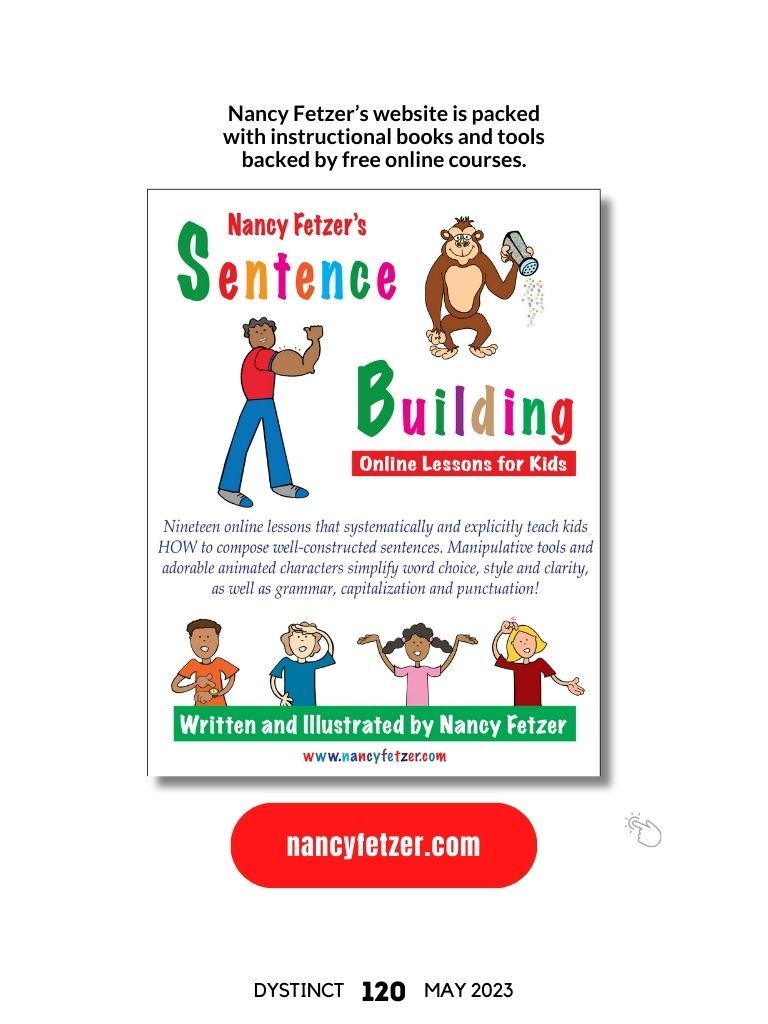
Sentence Building Online Lessons for Kids
Nancy Fetzer’s website is packed with instructional books and tools backed by free online courses.
Extracts from Dystinct Magazine
Extracts from Dystinct Magazine