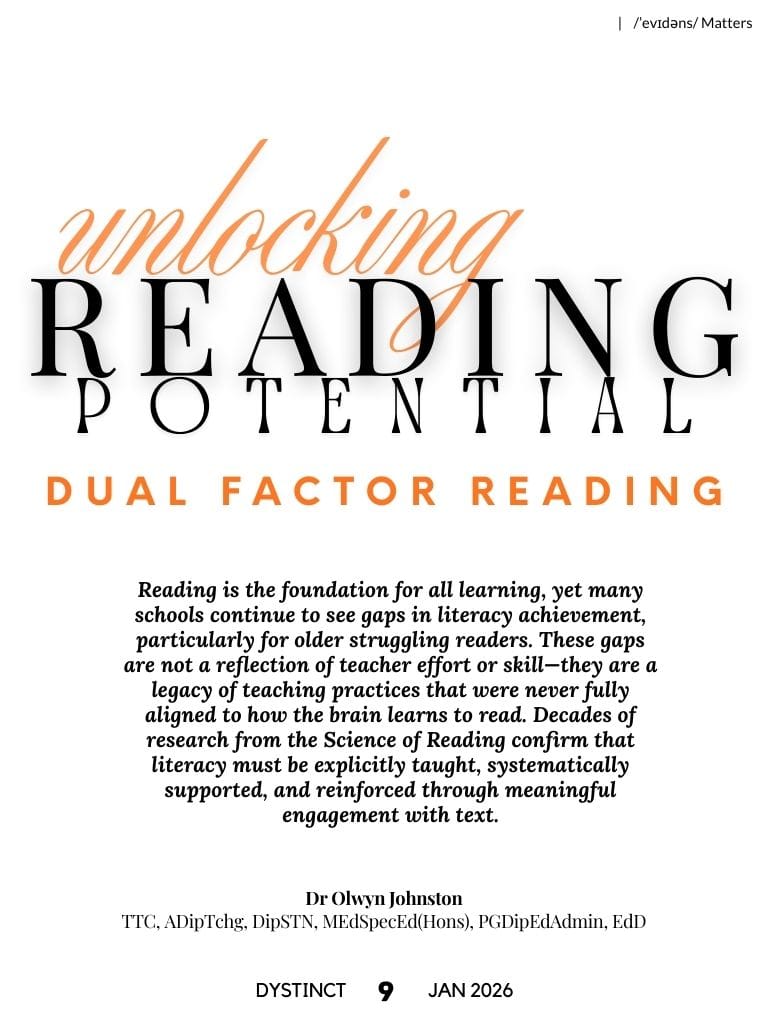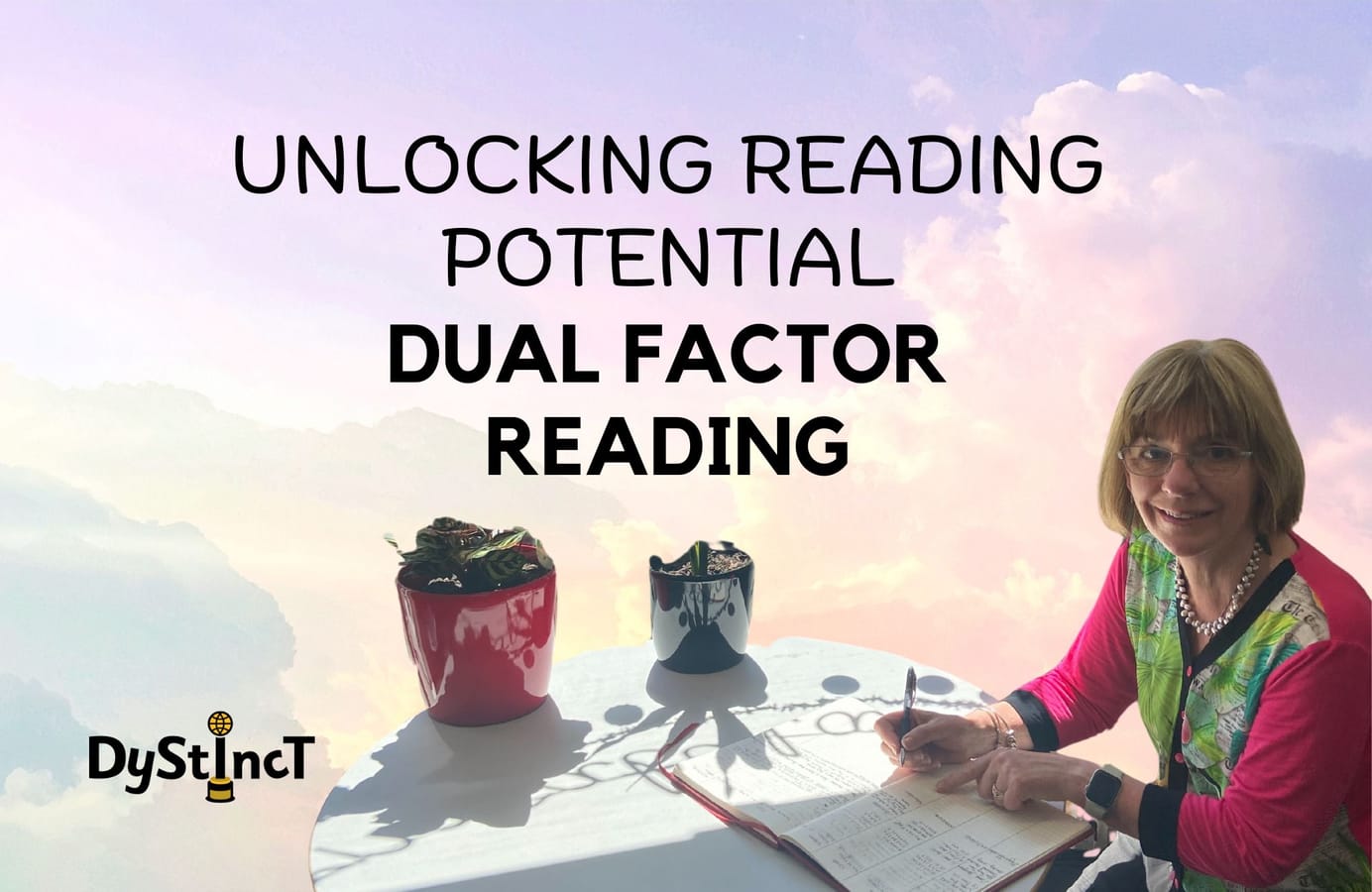
Issue 29: Unlocking Reading Potential: Dual Factor Reading | Dr Olwyn Johnston
Dr Olwyn introduces Dual Factor Reading, an evidence-informed, classroom-based framework grounded in the SoR that strengthens decoding & language comprehension simultaneously through explicit word-level instruction and technology-supported teacher read-alouds, accelerating literacy growth.

Table of Contents
Dual Factor Reading
Dual Factor Reading
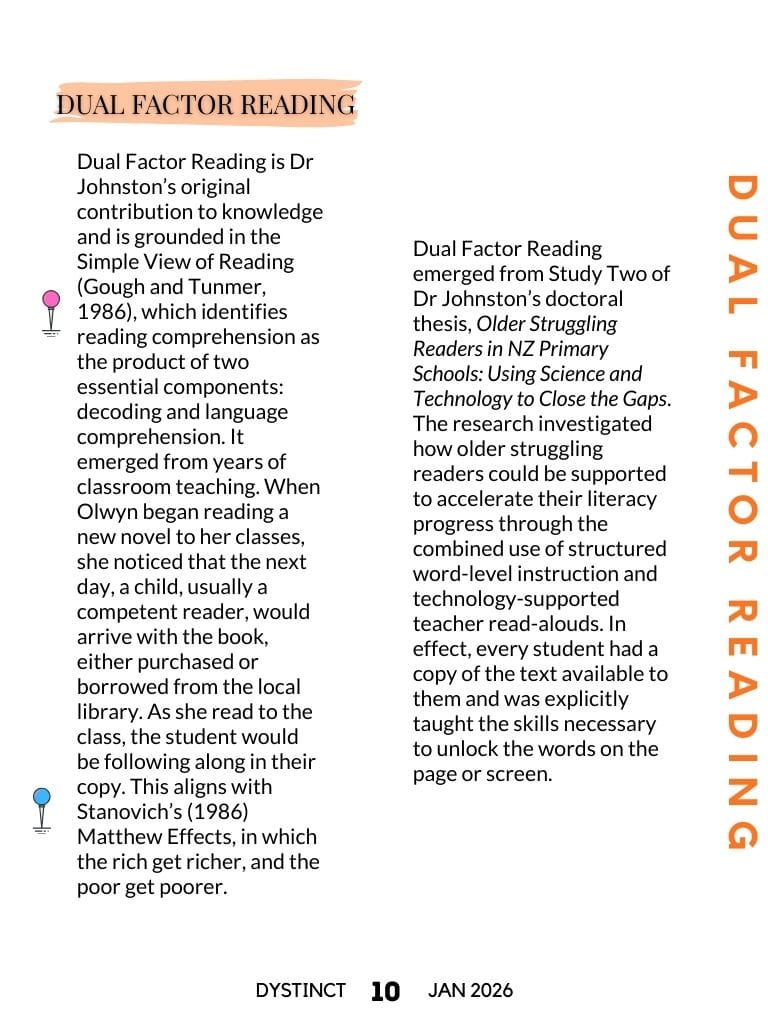
Dual Factor Reading is Dr Johnston’s original contribution to knowledge and is grounded in the Simple View of Reading (Gough and Tunmer, 1986), which identifies reading comprehension as the product of two essential components: decoding and language comprehension. It emerged from years of classroom teaching. When Olwyn began reading a new novel to her classes, she noticed that the next day, a child, usually a competent reader, would arrive with the book, either purchased or borrowed from the local library. As she read to the class, the student would be following along in their copy. This aligns with Stanovich’s (1986) Matthew Effects, in which the rich get richer, and the poor get poorer.
Dual Factor Reading emerged from Study Two of Dr Johnston’s doctoral thesis, Older Struggling Readers in NZ Primary Schools: Using Science and Technology to Close the Gaps. The research investigated how older struggling readers could be supported to accelerate their literacy progress through the combined use of structured word-level instruction and technology-supported teacher read-alouds. In effect, every student had a copy of the text available to them and was explicitly taught the skills necessary to unlock the words on the page or screen.
Research Design and Findings
Research Design and Findings
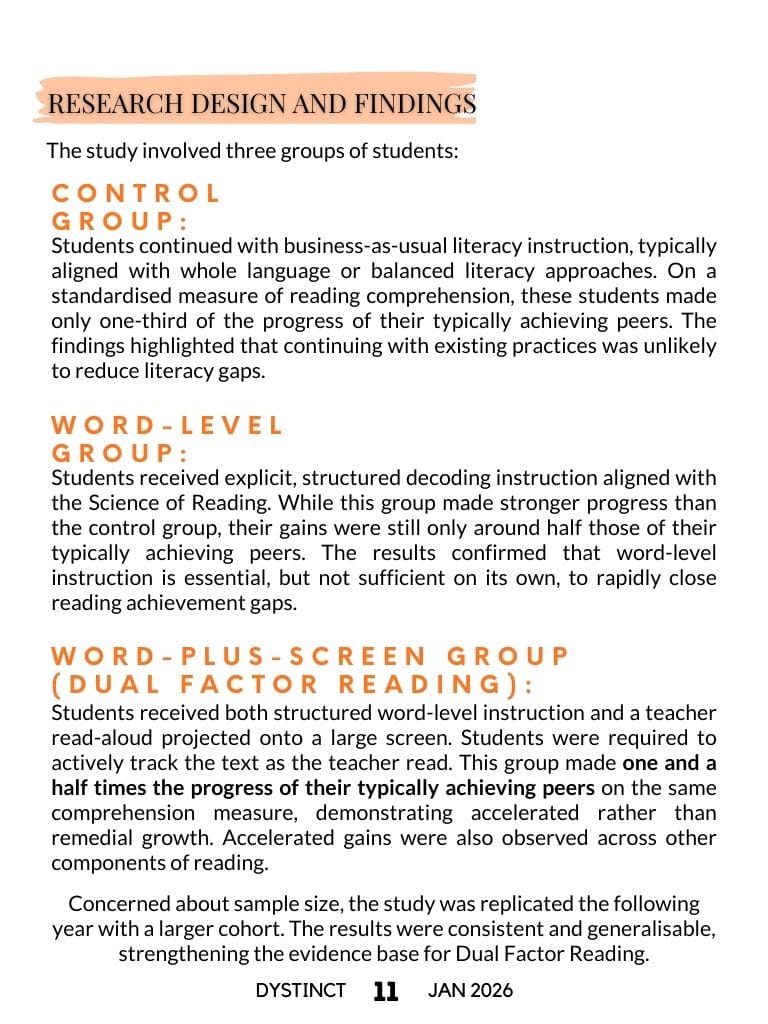
The study involved three groups of students:
Control Group:
Students continued with business-as-usual literacy instruction, typically aligned with whole language or balanced literacy approaches. On a standardised measure of reading comprehension, these students made only one-third of the progress of their typically achieving peers. The findings highlighted that continuing with existing practices was unlikely to reduce literacy gaps.
Word-Level Group:
Students received explicit, structured decoding instruction aligned with the Science of Reading. While this group made stronger progress than the control group, their gains were still only around half those of their typically achieving peers. The results confirmed that word-level instruction is essential, but not sufficient on its own, to rapidly close reading achievement gaps.
Word-Plus-Screen Group (Dual Factor Reading):
Students received both structured word-level instruction and a teacher read-aloud projected onto a large screen. Students were required to actively track the text as the teacher read. This group made one and a half times the progress of their typically achieving peers on the same comprehension measure, demonstrating accelerated rather than remedial growth. Accelerated gains were also observed across other components of reading.
Concerned about sample size, the study was replicated the following year with a larger cohort. The results were consistent and generalisable, strengthening the evidence base for Dual Factor Reading.
What Is Dual Factor Reading?
What Is Dual Factor Reading?
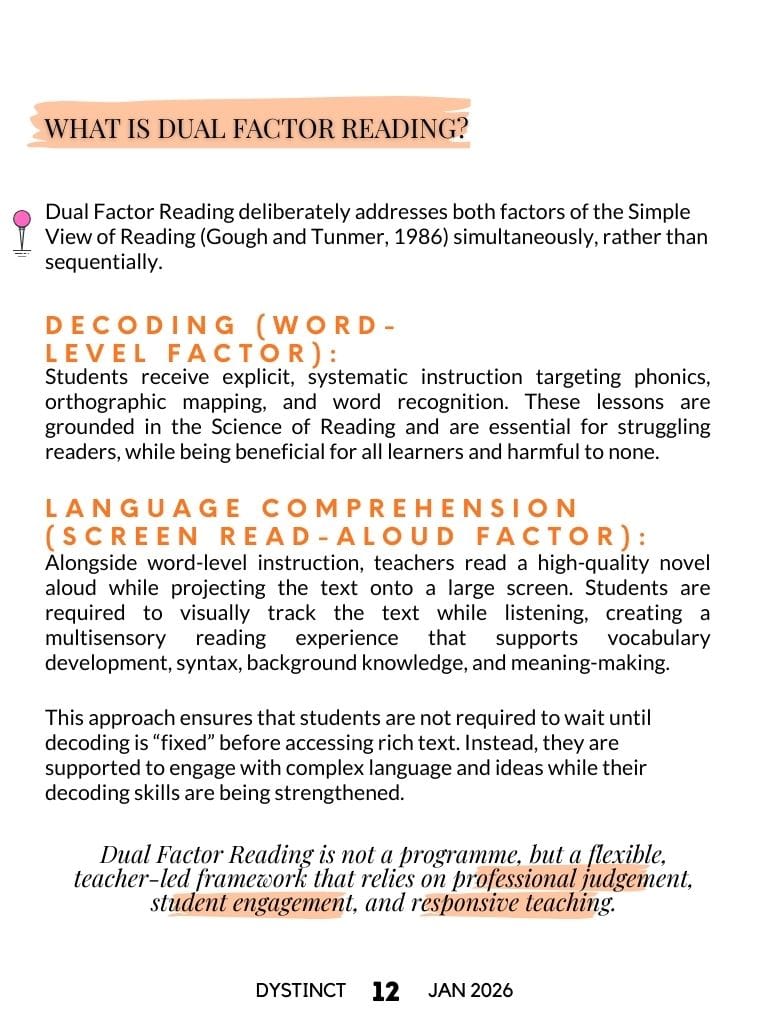
Dual Factor Reading deliberately addresses both factors of the Simple View of Reading (Gough and Tunmer, 1986) simultaneously, rather than sequentially.
Decoding (Word-Level Factor):
Students receive explicit, systematic instruction targeting phonics, orthographic mapping, and word recognition. These lessons are grounded in the Science of Reading and are essential for struggling readers, while being beneficial for all learners and harmful to none.
Language Comprehension (Screen Read-Aloud Factor):
Alongside word-level instruction, teachers read a high-quality novel aloud while projecting the text onto a large screen. Students are required to visually track the text while listening, creating a multisensory reading experience that supports vocabulary development, syntax, background knowledge, and meaning-making.
This approach ensures that students are not required to wait until decoding is “fixed” before accessing rich text. Instead, they are supported to engage with complex language and ideas while their decoding skills are being strengthened.
Dual Factor Reading is not a programme, but a flexible, teacher-led framework that relies on professional judgement, student engagement, and responsive teaching.
Classroom Implementation
Classroom Implementation
Dual Factor Reading is intentionally designed to be practical and adaptable. While the research focused on older struggling readers, teachers observed broader benefits, including improvements in spelling, decoding, and literacy knowledge for other students. This has led to the approach being used as a Tier One classroom practice, with struggling readers benefiting from repetition and spaced practice.
Key features of classroom implementation include:
- Careful selection of engaging, unfamiliar novels that students and teachers want to read together.
- Use of ebooks projected onto interactive whiteboards, data projectors, or large screens, with text size and background adjusted for readability.
- Explicit expectations that students actively track the text while listening, reinforcing that reading is not a passive activity.
- Teachers model skilled reading behaviours, including self-correction, sounding out unfamiliar words, and rereading for meaning.
- Strategic pauses for discussion, clarification, and comprehension checks, without disrupting the flow or emotional impact of the text.
- Regular review of prior reading to activate background knowledge and reinforce comprehension.
Teachers retain professional autonomy, adjusting pacing, discussion, and follow-up activities based on student engagement and emotional response to the text.
Practitioner Insights
Practitioner Insights
- Rotating the role of page-turner increases focus and engagement.
- Brief references to how reading “grows the brain” support student motivation and self-regulation.
- Highlighting repeated spelling patterns in authentic text supports orthographic mapping.
- Rich comprehension activities become accessible to struggling readers for the first time, as they are no longer constrained by limited decoding skills.
The Role of Technology
The Role of Technology
Technology is a critical enabler of Dual Factor Reading. Projecting the text allows all students to see the words clearly, track print efficiently, and synchronise visual and auditory input. This supports attention, reduces cognitive load, and enables teachers to scaffold reading in real time. Importantly, the technology is simple and widely available, making the approach feasible for most classrooms.
Cultural Responsiveness and Equity
Cultural Responsiveness and Equity
While Dual Factor Reading focuses on English orthography for decoding instruction, the teacher read-aloud provides an authentic space to incorporate tikanga Māori, oral te reo Māori, and culturally responsive discussion. This ensures that literacy instruction remains inclusive while maintaining clarity and rigour in decoding instruction.
Why Dual Factor Reading Matters
Why Dual Factor Reading Matters
The research underpinning Dual Factor Reading demonstrates that addressing decoding and language comprehension together leads to accelerated reading outcomes. Rather than simply narrowing gaps, students experience genuine literacy acceleration. Teachers also report increased engagement, stronger classroom reading cultures, and renewed professional confidence.
Dual Factor Reading offers a practical, evidence-informed framework that recognises both the complexity of reading and the realities of classroom teaching. It supports teachers to work smarter, not harder, while ensuring that students who have historically struggled with reading are no longer left behind. Dual Factor Reading mitigates the impact of Matthew Effects (Stanovich, 1986). It can be adapted to assist learners in other curriculum areas; it does not need to be limited to reading novels.
Conclusion
Conclusion
As schools look ahead, Dual Factor Reading provides a compelling framework for strengthening literacy instruction from the outset. By deliberately attending to both decoding and language comprehension, Dual Factor Reading offers a pathway to equitable, accelerated literacy outcomes for learners.
References
References
- Gough, P. B., & Tunmer, W. E. (1986). Decoding, reading, and reading disability. Remedial and Special Education, 7(1), 6–10.
- Stanovich, K. E. (1986). Matthew effects in reading: Some consequences of individual differences in the acquisition of literacy. Reading Research Quarterly, 21(4), 360–407.
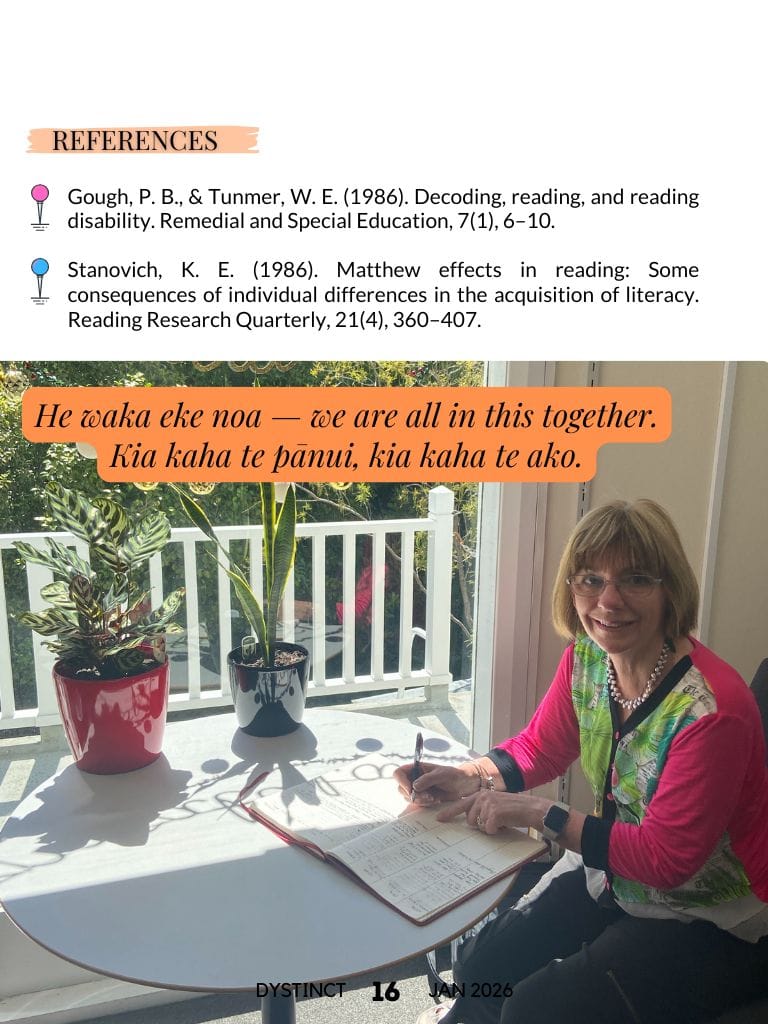
Dr Olwyn Johnston
Deputy Principal, SENCo, Science of Learning advocate & Founder | kiwireadingdoctor.nz
Dr Olwyn Johnston

Dr Olwyn Johnston is a classroom teacher, senior school leader, literacy specialist, professional development provider, researcher, and former principal. A veteran of over four decades in teaching, she remains passionate about learning and making a difference for children, parents, and teachers.
She is also the director of The Kiwi Reading Doctor Limited, which is dedicated to improving learning outcomes for all learners in New Zealand. Through professional learning and development, coaching, and resources, she supports schools and teachers to implement evidence-based, research-aligned practices, monitor student progress, and design interventions that meet the needs of students in reading, writing, and mathematics.
One of the key ways she connects with educators is through The Kiwi Reading Doctor Facebook Group. This online community provides a space for teachers, leaders, and learning support staff to share ideas, ask questions, and discuss evidence-informed literacy strategies. Members explore everything from phonics-based activities to comprehension strategies, supporting each other in translating research into practical classroom application. As Dr Johnston describes it, “The group is a space to celebrate curiosity, discuss evidence, and collaborate on what really works in classrooms.”
Extracts from Dystinct Magazine
Extracts from Dystinct Magazine