

Issue 29: The Students Schools Miss: Why Capable Kids Slip Through the Cracks (And What Parents Can Do) | Julia Davies-Duff
Julia Davies-Duff draws on nearly three decades as an educator, researcher, specialist, and parent to reveal why capable, compliant students with hidden language and cognitive difficulties are systematically overlooked in secondary schools, and offers parents clear insights.

Table of Contents
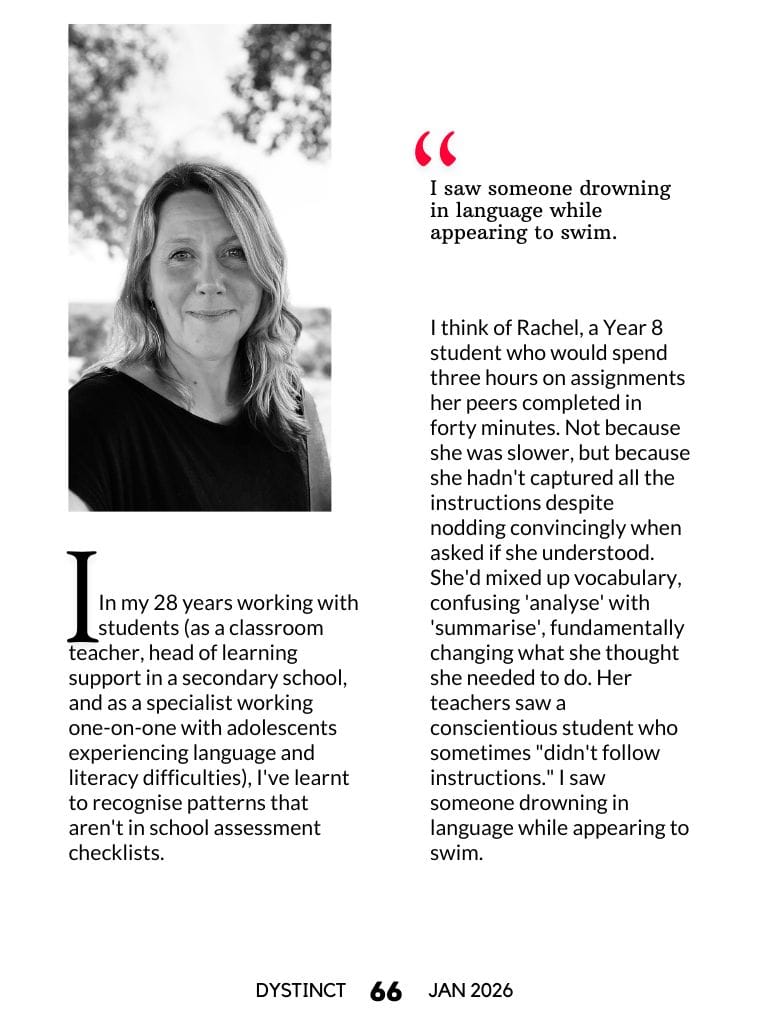
In my 28 years working with students (as a classroom teacher, head of learning support in a secondary school, and as a specialist working one-on-one with adolescents experiencing language and literacy difficulties), I've learnt to recognise patterns that aren't in school assessment checklists.
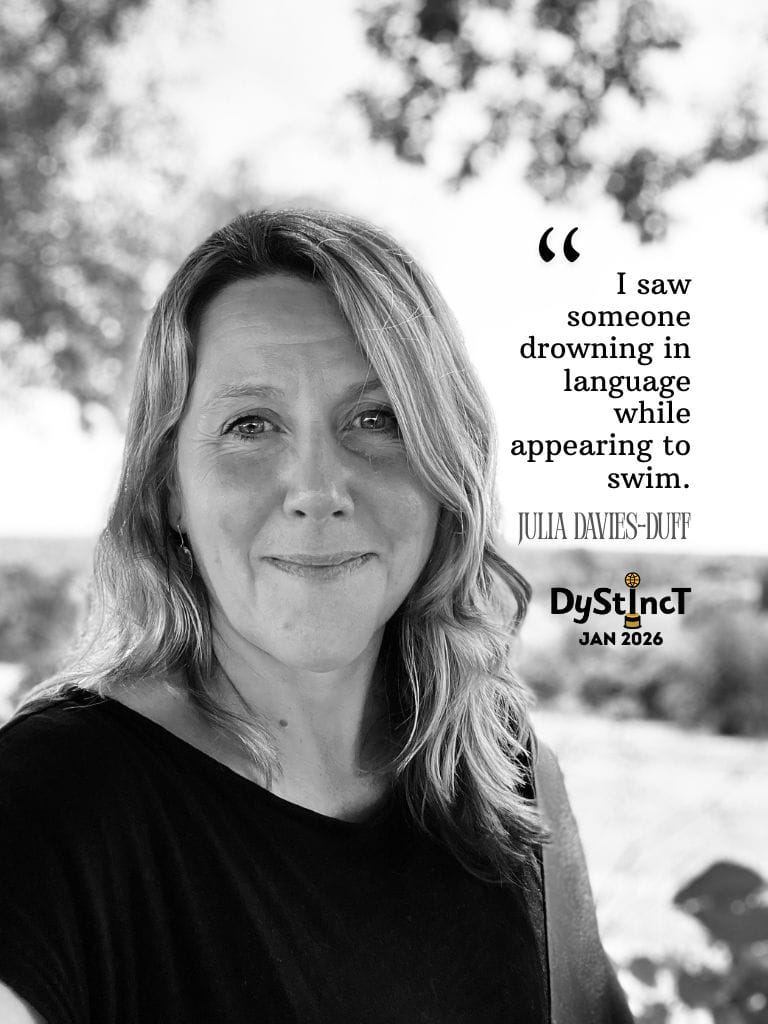
I think of Rachel, a Year 8 student who would spend three hours on assignments her peers completed in forty minutes. Not because she was slower, but because she hadn't captured all the instructions despite nodding convincingly when asked if she understood. She'd mixed up vocabulary, confusing 'analyse' with 'summarise', fundamentally changing what she thought she needed to do. Her teachers saw a conscientious student who sometimes "didn't follow instructions." I saw someone drowning in language while appearing to swim.
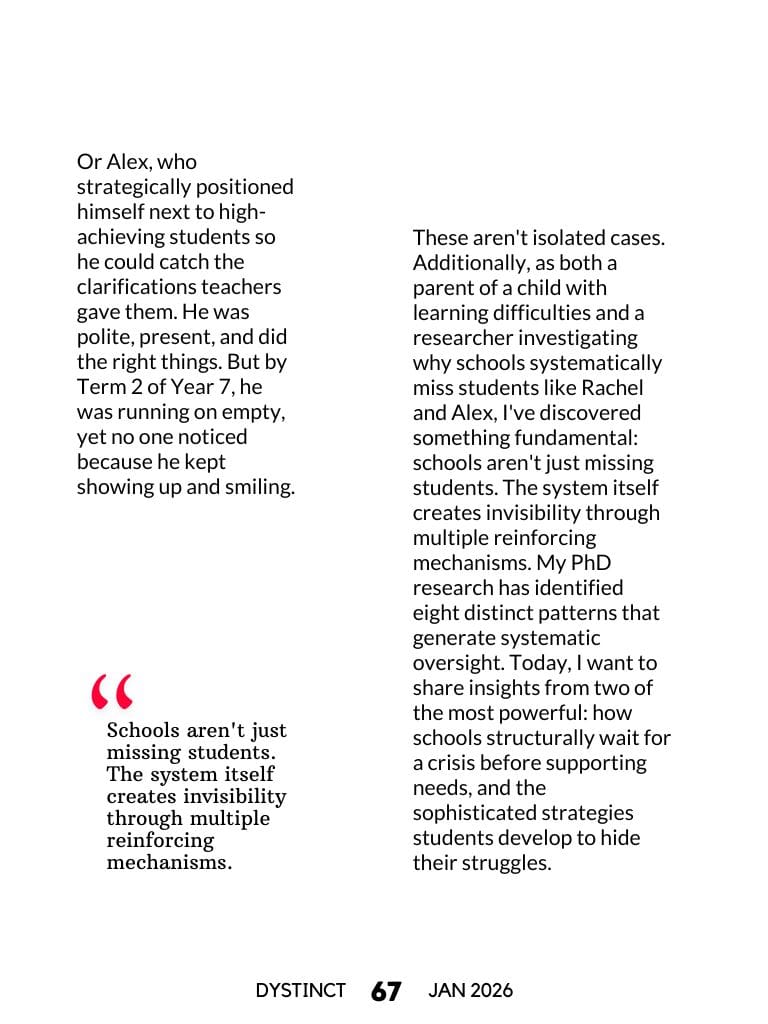
Or Alex, who strategically positioned himself next to high-achieving students so he could catch the clarifications teachers gave them. He was polite, present, and did the right things. But by Term 2 of Year 7, he was running on empty, yet no one noticed because he kept showing up and smiling.
Schools aren't just missing students. The system itself creates invisibility through multiple reinforcing mechanisms.
These aren't isolated cases. Additionally, as both a parent of a child with learning difficulties and a researcher investigating why schools systematically miss students like Rachel and Alex, I've discovered something fundamental: schools aren't just missing students. The system itself creates invisibility through multiple reinforcing mechanisms. My PhD research has identified eight distinct patterns that generate systematic oversight. Today, I want to share insights from two of the most powerful: how schools structurally wait for a crisis before supporting needs, and the sophisticated strategies students develop to hide their struggles.
When Systems Wait for Crisis
When Systems Wait for Crisis
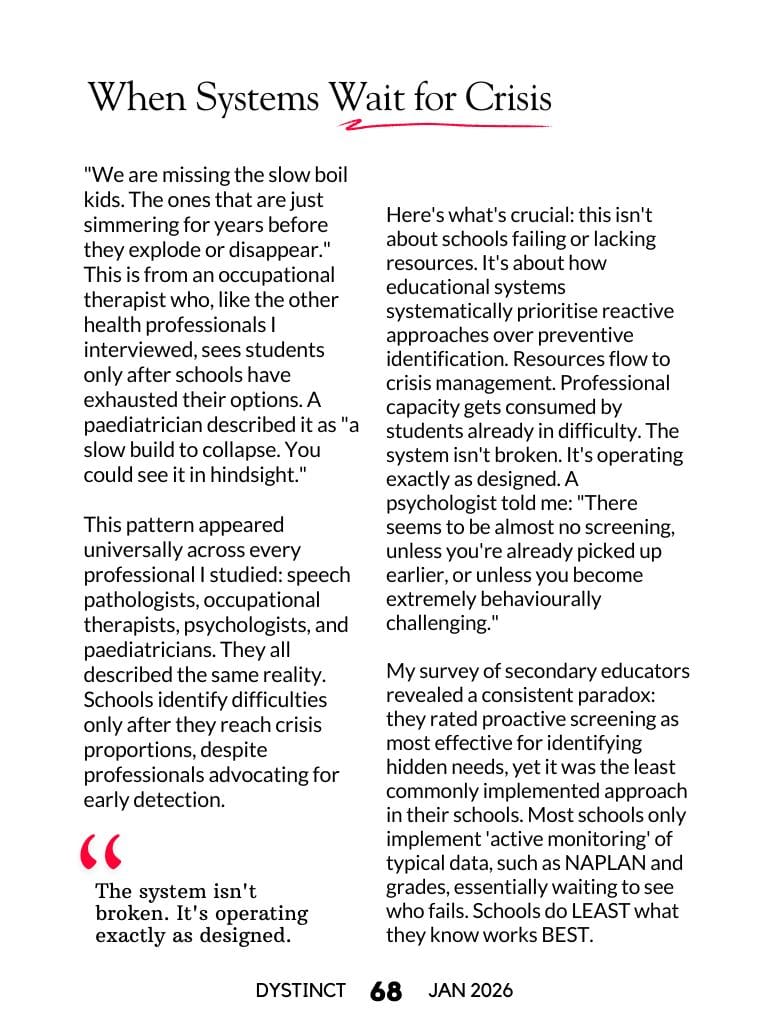
"We are missing the slow boil kids. The ones that are just simmering for years before they explode or disappear." This is from an occupational therapist who, like the other health professionals I interviewed, sees students only after schools have exhausted their options. A paediatrician described it as "a slow build to collapse. You could see it in hindsight."
This pattern appeared universally across every professional I studied: speech pathologists, occupational therapists, psychologists, and paediatricians. They all described the same reality. Schools identify difficulties only after they reach crisis proportions, despite professionals advocating for early detection.
The system isn't broken. It's operating exactly as designed.
Here's what's crucial: this isn't about schools failing or lacking resources. It's about how educational systems systematically prioritise reactive approaches over preventive identification. Resources flow to crisis management. Professional capacity gets consumed by students already in difficulty. The system isn't broken. It's operating exactly as designed. A psychologist told me: "There seems to be almost no screening, unless you're already picked up earlier, or unless you become extremely behaviourally challenging."
My survey of secondary educators revealed a consistent paradox: they rated proactive screening as most effective for identifying hidden needs, yet it was the least commonly implemented approach in their schools. Most schools only implement 'active monitoring' of typical data, such as NAPLAN and grades, essentially waiting to see who fails. Schools do LEAST what they know works BEST.
The Hidden Cost of Coping
The Hidden Cost of Coping
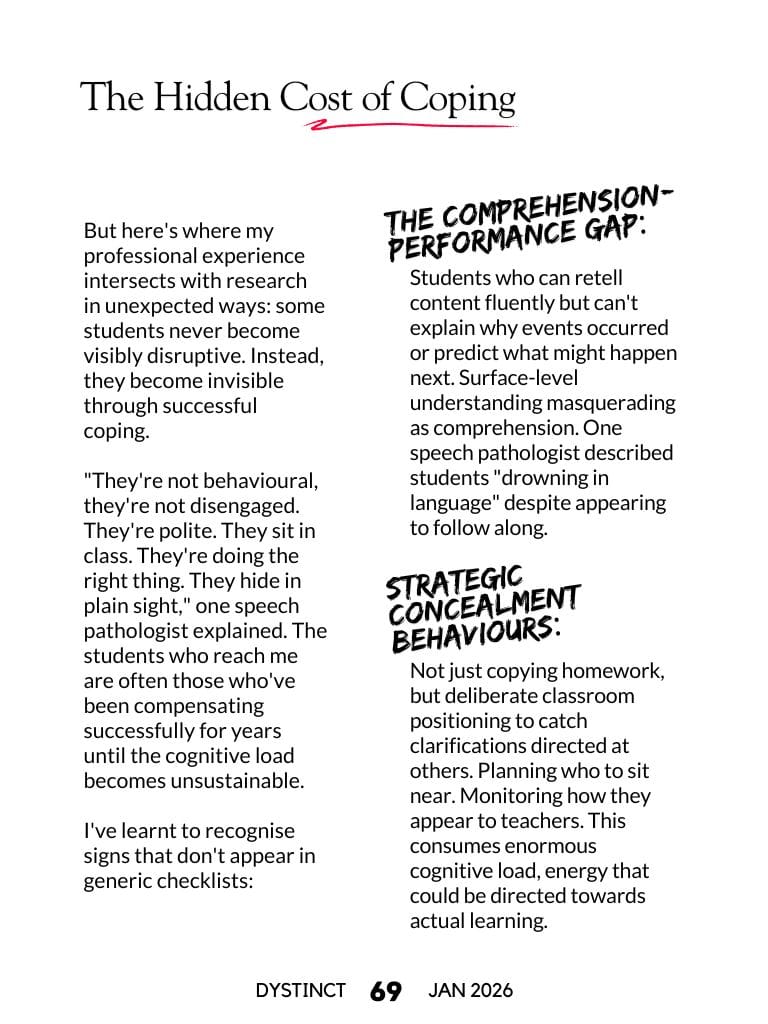
But here's where my professional experience intersects with research in unexpected ways: some students never become visibly disruptive. Instead, they become invisible through successful coping.
"They're not behavioural, they're not disengaged. They're polite. They sit in class. They're doing the right thing. They hide in plain sight," one speech pathologist explained. The students who reach me are often those who've been compensating successfully for years until the cognitive load becomes unsustainable.
I've learnt to recognise signs that don't appear in generic checklists:
The comprehension-performance gap:
Students who can retell content fluently but can't explain why events occurred or predict what might happen next. Surface-level understanding masquerading as comprehension. One speech pathologist described students "drowning in language" despite appearing to follow along.
Strategic concealment behaviours:
Not just copying homework, but deliberate classroom positioning to catch clarifications directed at others. Planning who to sit near. Monitoring how they appear to teachers. This consumes enormous cognitive load, energy that could be directed towards actual learning.
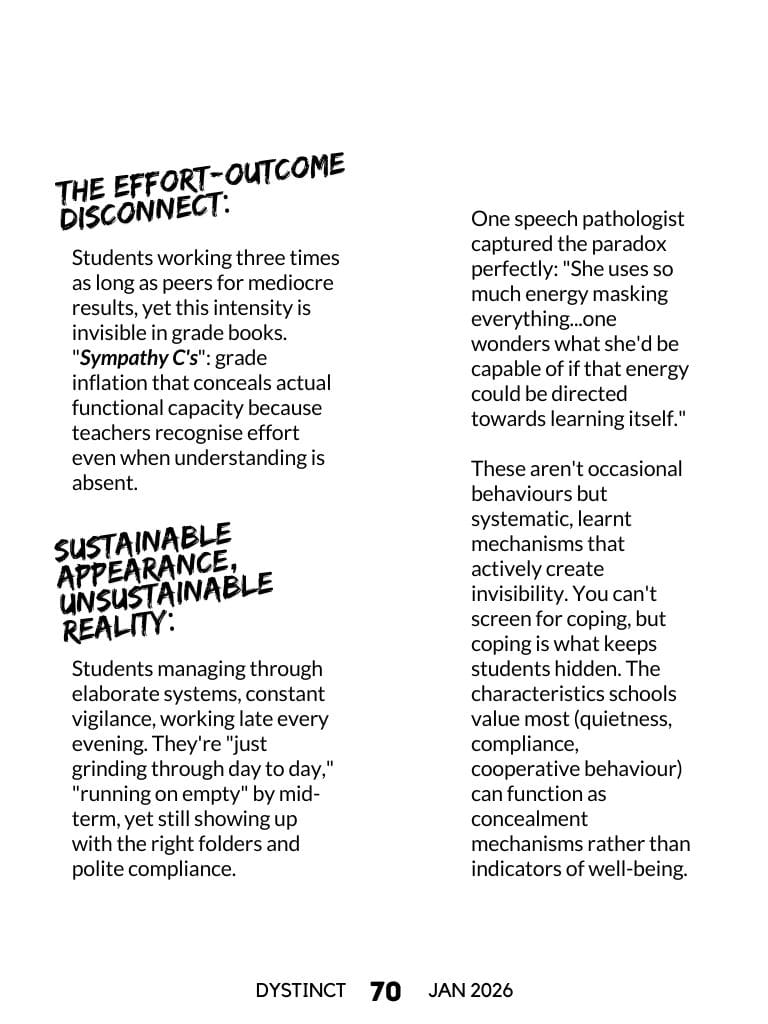
The effort-outcome disconnect:
Students working three times as long as peers for mediocre results, yet this intensity is invisible in grade books. "Sympathy C's": grade inflation that conceals actual functional capacity because teachers recognise effort even when understanding is absent.
Sustainable appearance, unsustainable reality:
Students managing through elaborate systems, constant vigilance, working late every evening. They're "just grinding through day to day," "running on empty" by mid-term, yet still showing up with the right folders and polite compliance.
One speech pathologist captured the paradox perfectly: "She uses so much energy masking everything...one wonders what she'd be capable of if that energy could be directed towards learning itself."
These aren't occasional behaviours but systematic, learnt mechanisms that actively create invisibility. You can't screen for coping, but coping is what keeps students hidden. The characteristics schools value most (quietness, compliance, cooperative behaviour) can function as concealment mechanisms rather than indicators of well-being.
Why Working Together Matters
Why Working Together Matters
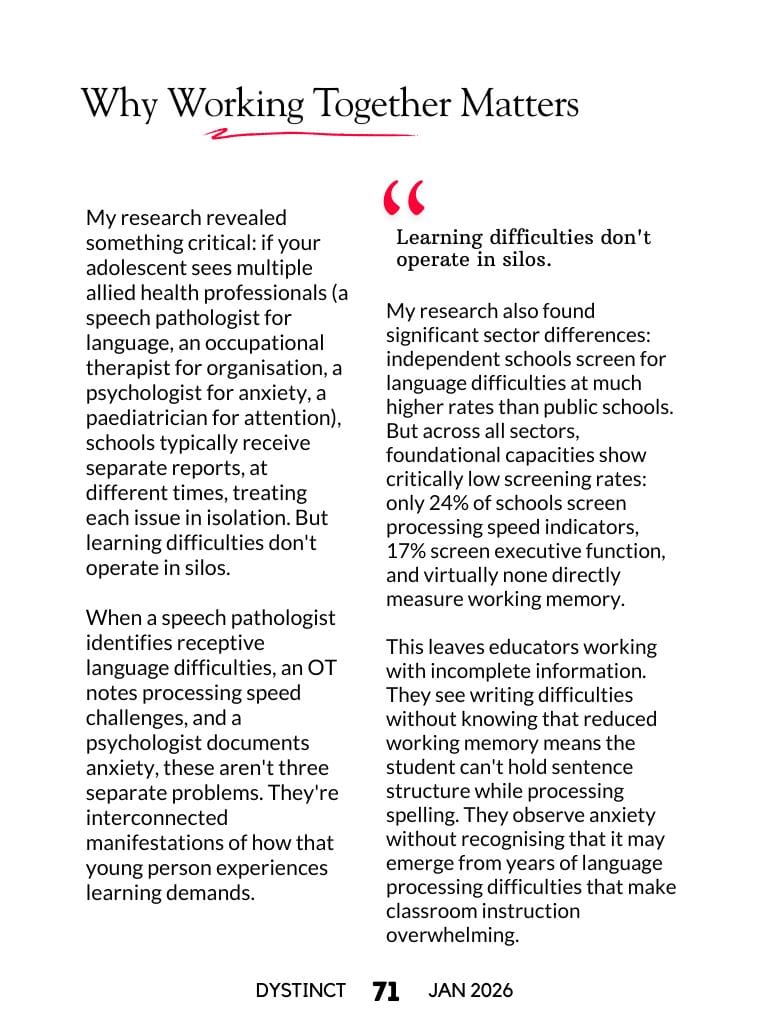
My research revealed something critical: if your adolescent sees multiple allied health professionals (a speech pathologist for language, an occupational therapist for organisation, a psychologist for anxiety, a paediatrician for attention), schools typically receive separate reports, at different times, treating each issue in isolation. But learning difficulties don't operate in silos.
When a speech pathologist identifies receptive language difficulties, an OT notes processing speed challenges, and a psychologist documents anxiety, these aren't three separate problems. They're interconnected manifestations of how that young person experiences learning demands.
Learning difficulties don't operate in silos.
My research also found significant sector differences: independent schools screen for language difficulties at much higher rates than public schools. But across all sectors, foundational capacities show critically low screening rates: only 24% of schools screen processing speed indicators, 17% screen executive function, and virtually none directly measure working memory.
This leaves educators working with incomplete information. They see writing difficulties without knowing that reduced working memory means the student can't hold sentence structure while processing spelling. They observe anxiety without recognising that it may emerge from years of language processing difficulties that make classroom instruction overwhelming.
What You Can Recognise
What You Can Recognise
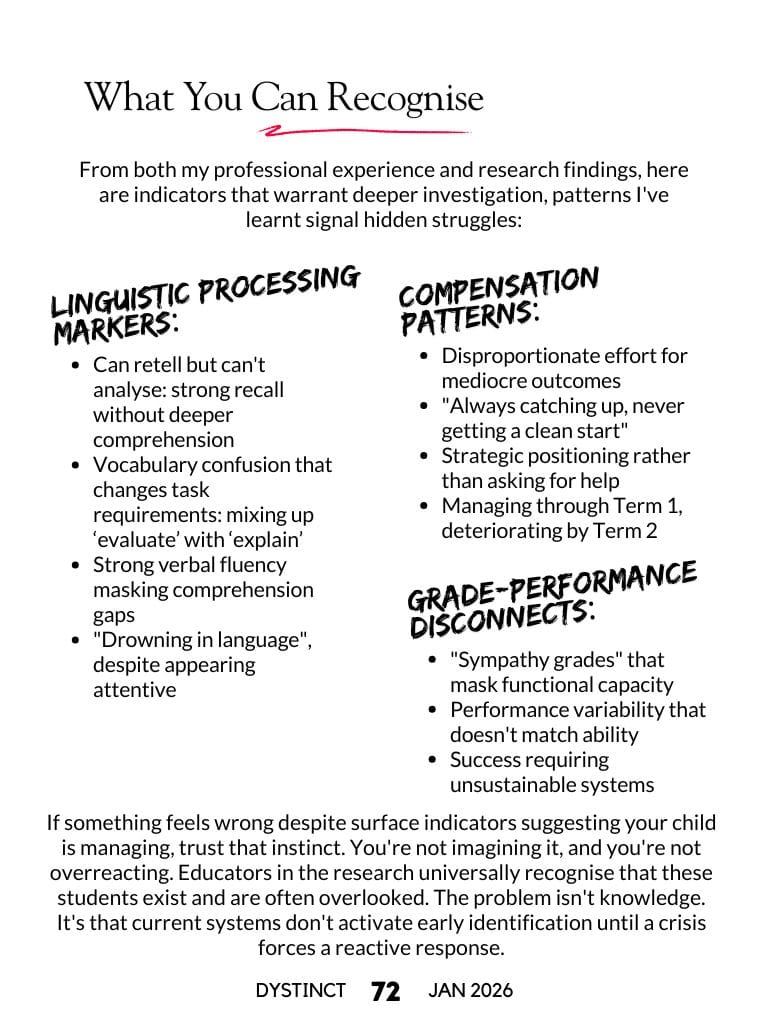
From both my professional experience and research findings, here are indicators that warrant deeper investigation, patterns I've learnt signal hidden struggles:
Linguistic processing markers:
- Can retell but can't analyse: strong recall without deeper comprehension
- Vocabulary confusion that changes task requirements: mixing up ‘evaluate’ with ‘explain’
- Strong verbal fluency masking comprehension gaps
- "Drowning in language", despite appearing attentive
Compensation patterns:
- Disproportionate effort for mediocre outcomes
- "Always catching up, never getting a clean start"
- Strategic positioning rather than asking for help
- Managing through Term 1, deteriorating by Term 2
Grade-performance disconnects:
- "Sympathy grades" that mask functional capacity
- Performance variability that doesn't match ability
- Success requiring unsustainable systems
If something feels wrong despite surface indicators suggesting your child is managing, trust that instinct. You're not imagining it, and you're not overreacting. Educators in the research universally recognise that these students exist and are often overlooked. The problem isn't knowledge. It's that current systems don't activate early identification until a crisis forces a reactive response.
What You Can Do Tonight
What You Can Do Tonight
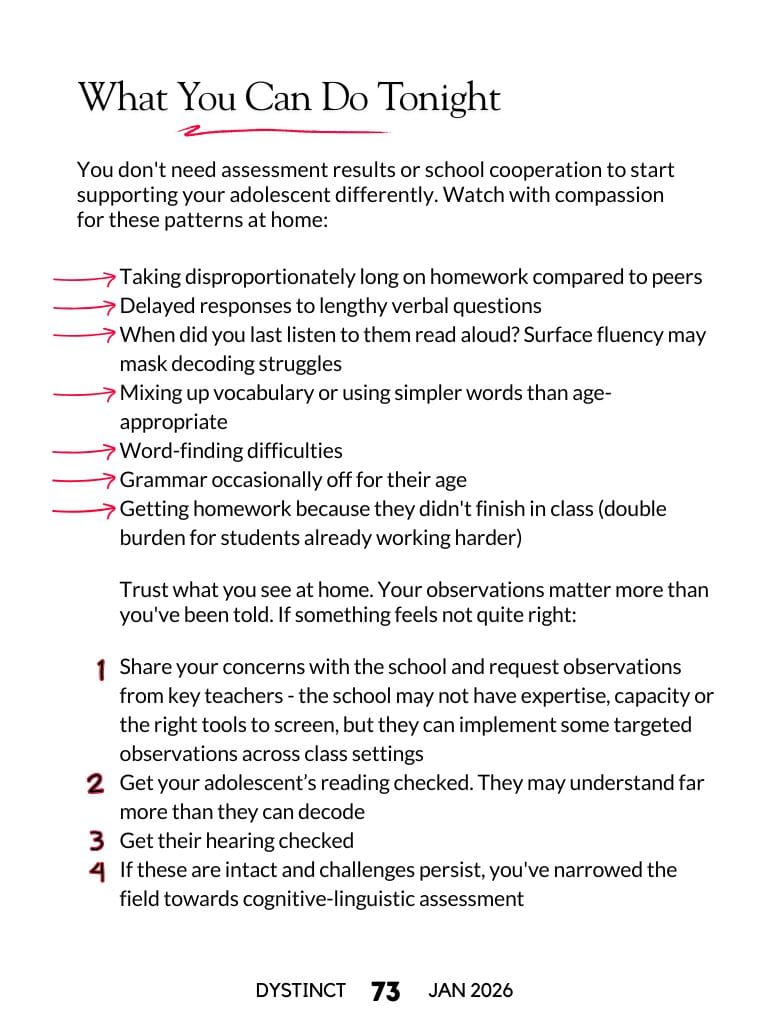
You don't need assessment results or school cooperation to start supporting your adolescent differently. Watch with compassion for these patterns at home:
- Taking disproportionately long on homework compared to peers
- Delayed responses to lengthy verbal questions
- When did you last listen to them read aloud? Surface fluency may mask decoding struggles
- Mixing up vocabulary or using simpler words than age-appropriate
- Word-finding difficulties
- Grammar occasionally off for their age
- Getting homework because they didn't finish in class (double burden for students already working harder)
Trust what you see at home. Your observations matter more than you've been told. If something feels not quite right:
- Share your concerns with the school and request observations from key teachers - the school may not have expertise, capacity or the right tools to screen, but they can implement some targeted observations across class settings
- Get your adolescent’s reading checked. They may understand far more than they can decode
- Get their hearing checked
- If these are intact and challenges persist, you've narrowed the field towards cognitive-linguistic assessment
What You Can Advocate For
What You Can Advocate For
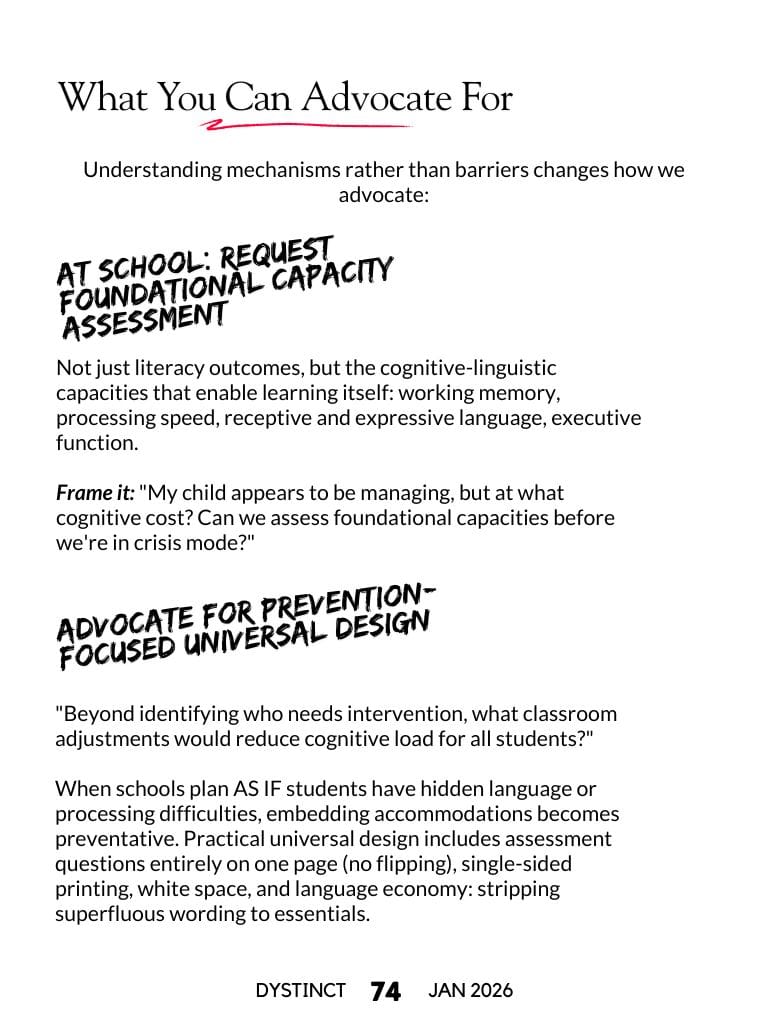
Understanding mechanisms rather than barriers changes how we advocate:
At school: Request foundational capacity assessment
Not just literacy outcomes, but the cognitive-linguistic capacities that enable learning itself: working memory, processing speed, receptive and expressive language, executive function.
Frame it: "My child appears to be managing, but at what cognitive cost? Can we assess foundational capacities before we're in crisis mode?"
Advocate for prevention-focused universal design
"Beyond identifying who needs intervention, what classroom adjustments would reduce cognitive load for all students?"
When schools plan AS IF students have hidden language or processing difficulties, embedding accommodations becomes preventative. Practical universal design includes assessment questions entirely on one page (no flipping), single-sided printing, white space, and language economy: stripping superfluous wording to essentials.
With allied health/health professionals: Request integration
- Integrated reports synthesising findings across disciplines
- Explanations of causal mechanisms that schools can understand
- Practical strategies teachers can implement within existing capacity
- Case conferences bringing all professionals together with school staff
For your adolescent:
- Help them understand their learning profile: "Your brain processes language differently. That's not a deficit, it's how you're wired"
- Validate that needing support isn't weakness
- Create safety for disclosure: "I notice you're spending three hours on this. Help me understand what's making it difficult"
Creating Conditions for Change
Creating Conditions for Change
The mechanisms I've described are just two of eight identified by my research. They reinforce each other, creating systematic invisibility. But mechanisms aren't fixed barriers. They're context-dependent forces. When parents advocate with informed language, professionals genuinely collaborate across disciplines, and schools understand the causal relationships behind student struggles, you activate these mechanisms differently. Vulnerabilities become visible years before a crisis, enabling proactive adjustments rather than reactive intervention.
Your instincts about your child matter. You know your child better than any assessment.
You're not looking to blame anyone. You're looking for solutions. And solutions exist when we understand what's actually happening beneath the surface. Your instincts about your child matter. You know your child better than any assessment. If something feels wrong even when report cards suggest everything's fine, that dissonance deserves investigation. Help create conditions for collaboration that see your adolescent as a whole person rather than a collection of separate difficulties.
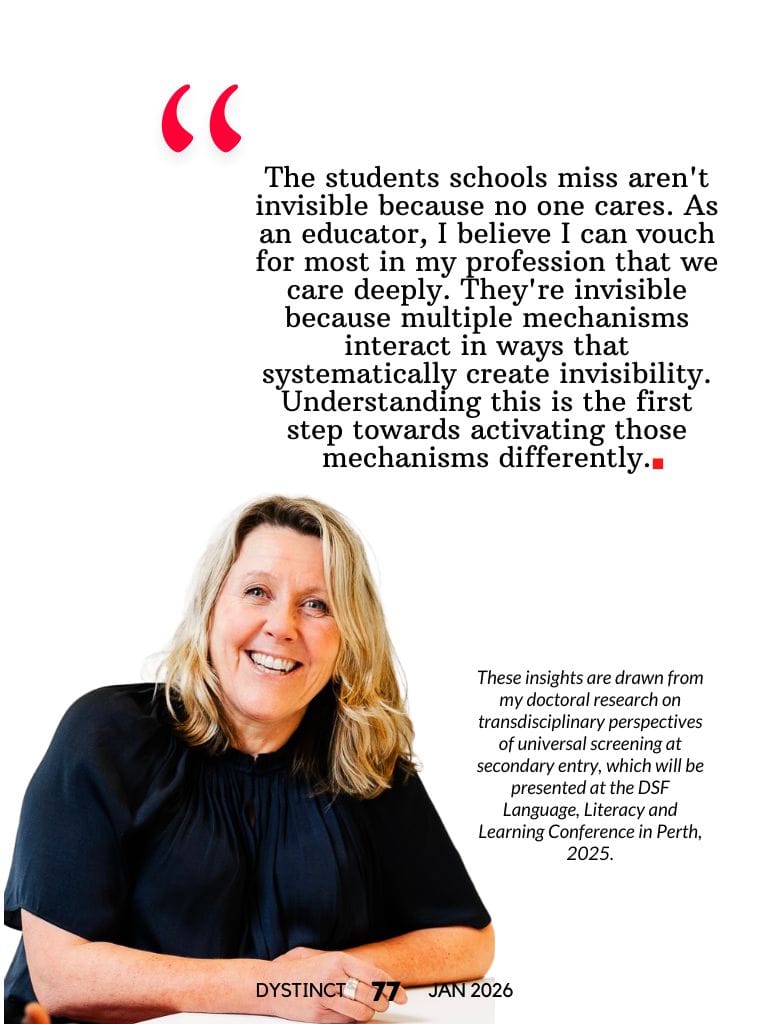
These insights are drawn from my doctoral research on transdisciplinary perspectives of universal screening at secondary entry, which will be presented at the DSF Language, Literacy and Learning Conference in Perth, 2025.
Julia Davies-Duff
Lecturer, Researcher & Learning Difficulties Specialist
Julia Davies-Duff
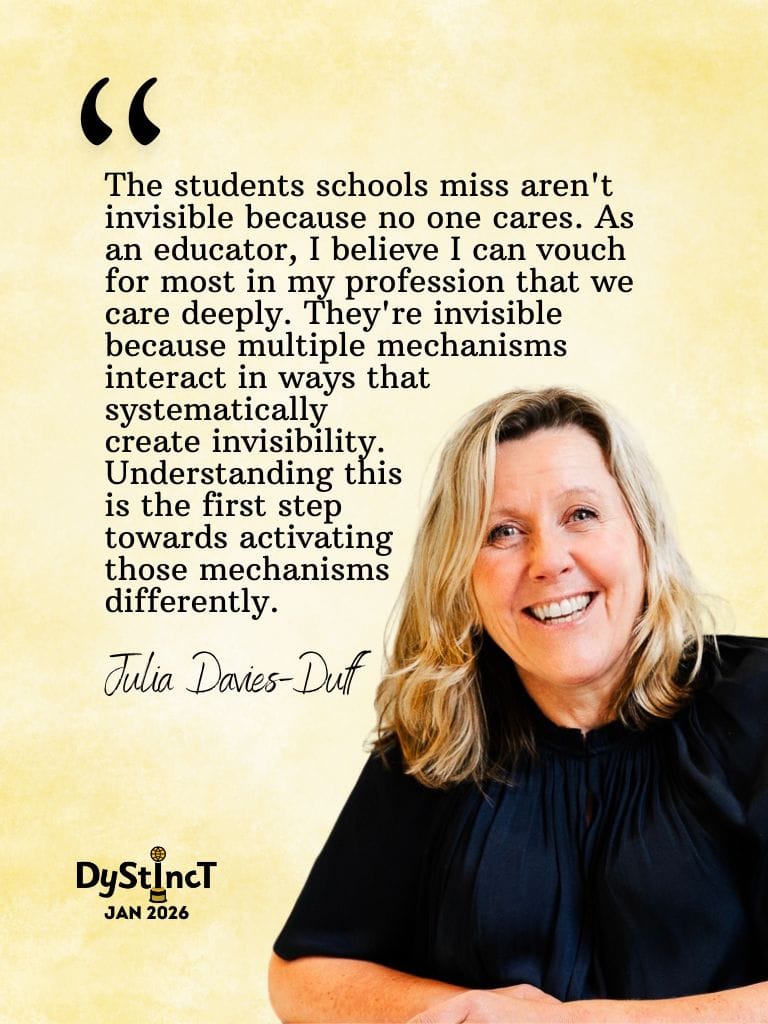
Julia Davies-Duff is a Lecturer in the Faculty of Education at the University of Canberra, completing her PhD on transdisciplinary perspectives of universal screening for hidden and late-emerging learning needs at secondary entry. With over 25 years of teaching experience, including leadership roles as head of learning support in secondary schools, she specialises in literacy, language-based learning difficulties, and evidence-informed inclusive education practices. As both a parent of a child with learning difficulties and a specialist currently supporting adolescents with language and literacy difficulties through individual intervention, she brings lived experience alongside academic and specialist intervention expertise to understanding how systems can better identify and support students whose needs remain hidden.
Extracts from Dystinct Magazine
Extracts from Dystinct Magazine









%20%7C%20Julia%20Davies-Duff)