Issue 29: Re-imagining Dyslexia: Why We Made “The Dyslexic Advantage” Movie | Dr Brock Eide
Dr Brock Eide reflects on what inspired him and Dr Fernette Eide to create the documentary movie The Dyslexic Advantage, in which they share decades of clinical insight and lived stories to challenge deficit-based views of dyslexia and reframe it as a specialised way of thinking.
Table of Contents
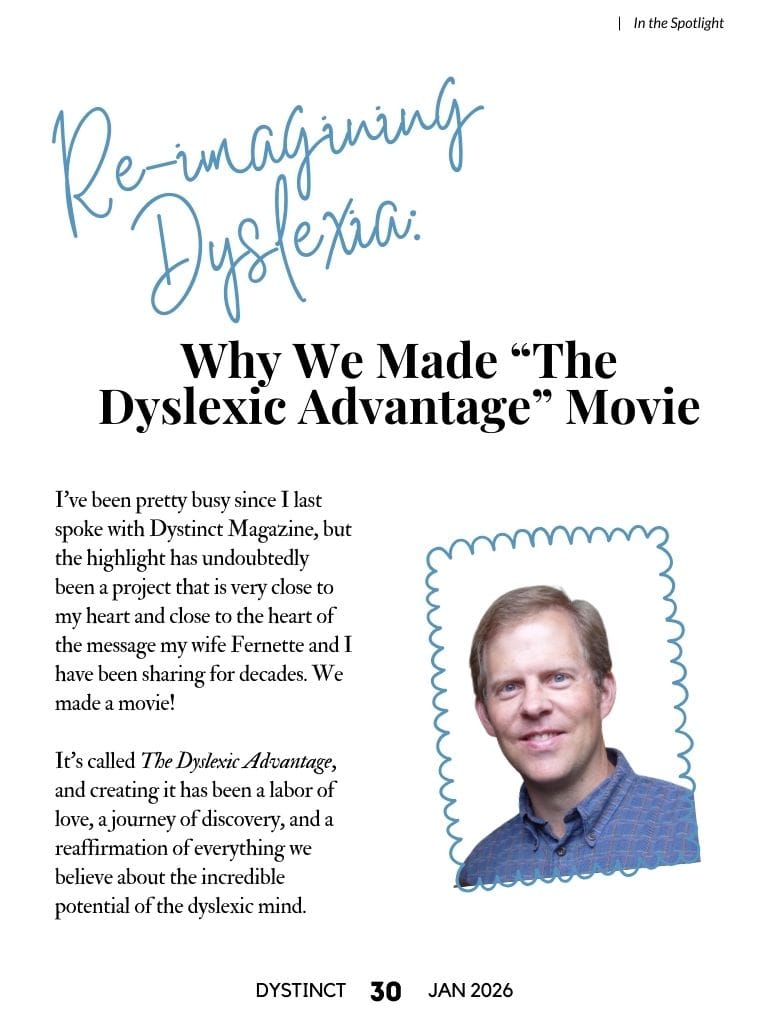
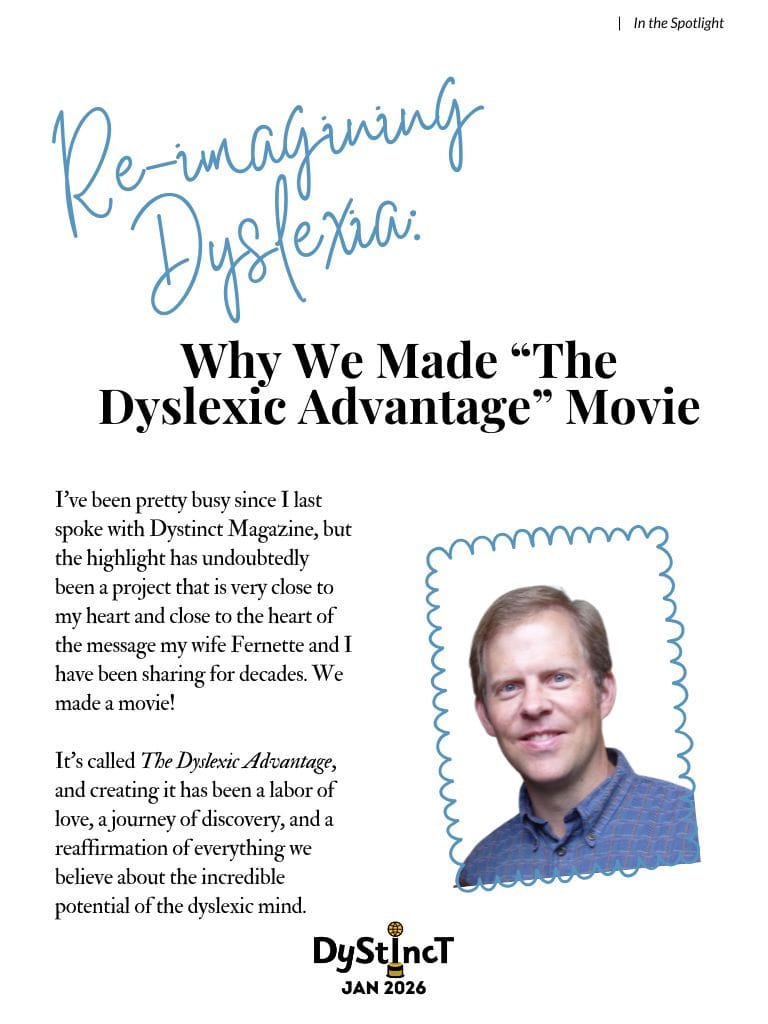
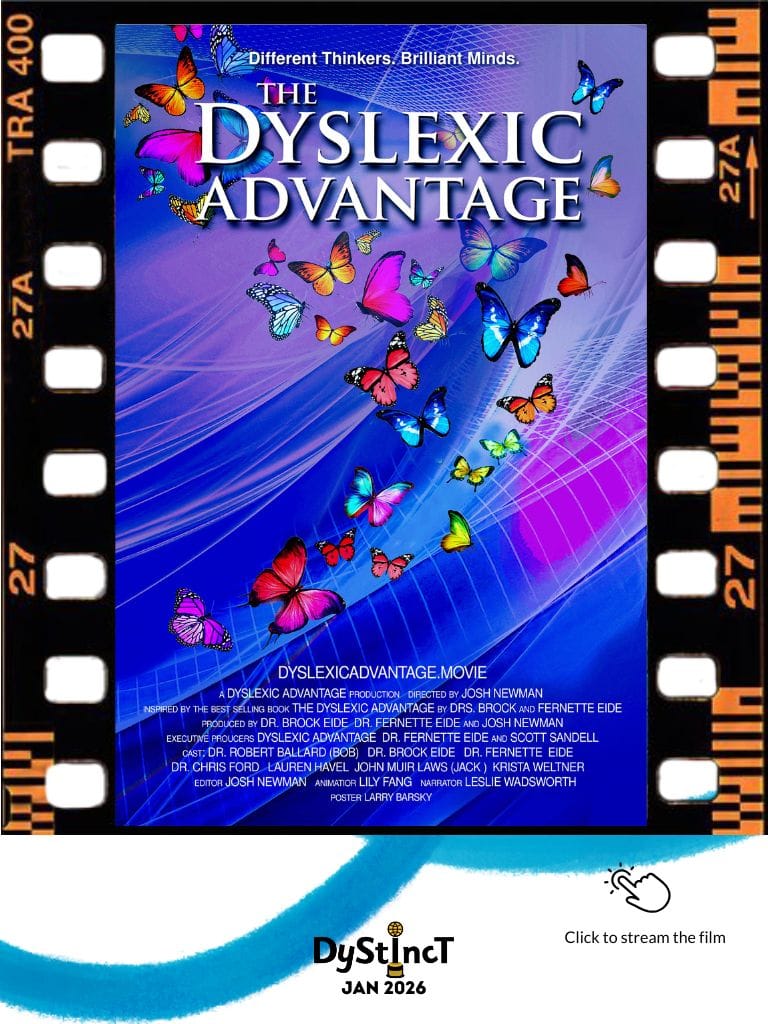
I’ve been pretty busy since I last spoke with Dystinct Magazine, but the highlight has undoubtedly been a project that is very close to my heart and close to the heart of the message my wife Fernette and I have been sharing for decades. We made a movie!
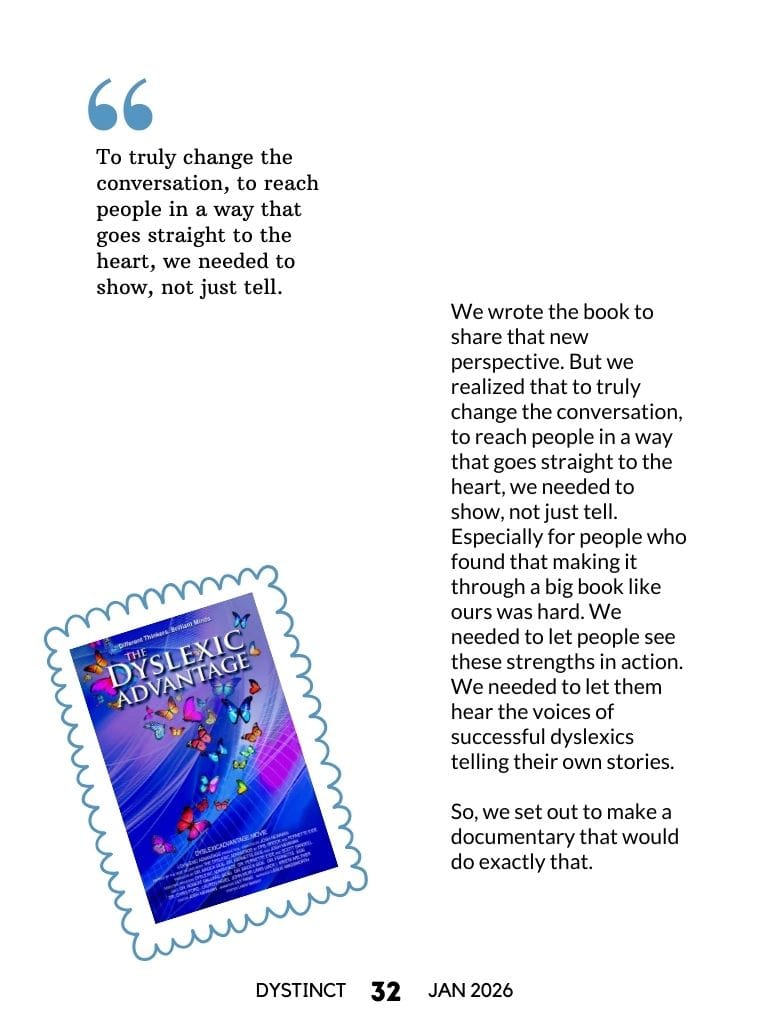
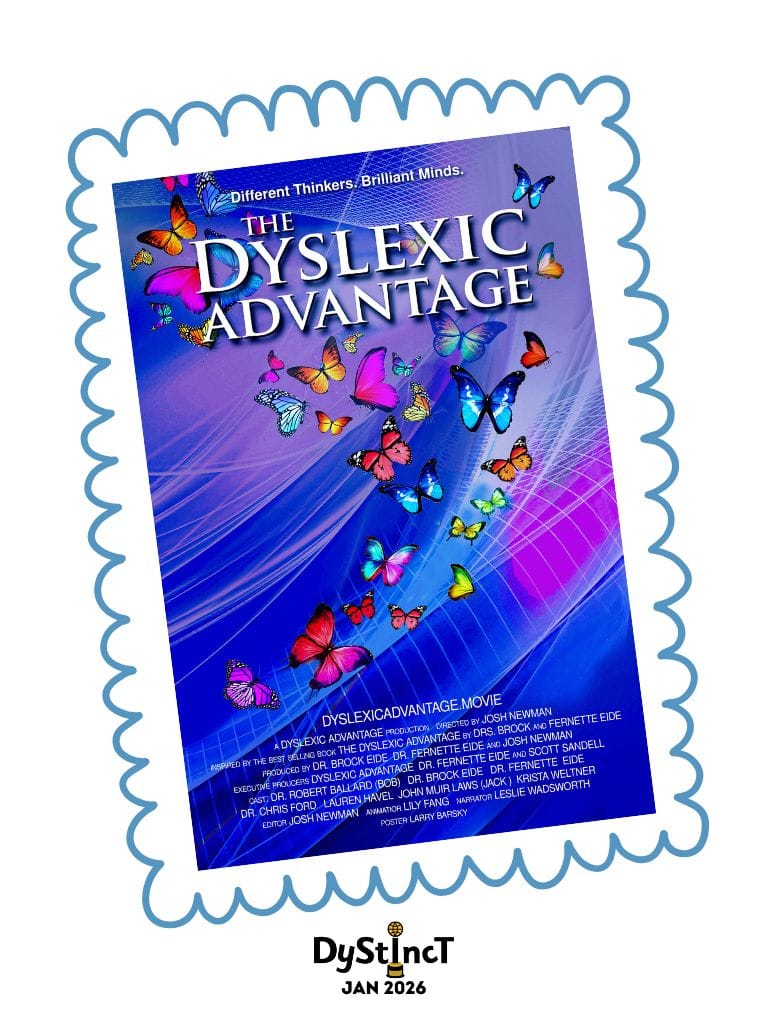
It’s called The Dyslexic Advantage, and creating it has been a labor of love, a journey of discovery, and a reaffirmation of everything we believe about the incredible potential of the dyslexic mind.
Why a Movie? Why Now?
Why a Movie? Why Now?
For over twenty years, Fernette and I have worked with thousands of dyslexic individuals. We wrote our book, The Dyslexic Advantage, because we kept seeing a disconnect. The traditional story of dyslexia was about problems, about what people couldn’t do. It was a story about children struggling to read, feeling broken, and trying desperately to catch up.
We saw that the challenges and the strengths weren’t random; they were two sides of the same coin.
But that wasn’t the whole story we were seeing when we worked with dyslexic people. In our clinic, we saw the struggles, yes. But we also saw amazing strengths. We saw 3D spatial brilliance in future surgeons, architects, and builders. We saw amazing abilities to think about connections and relationships in future mechanics, business people, and scientists. We saw incredible storytelling talents in writers, filmmakers, salespeople, and teachers. We saw the ability to spot connections and predict trends in entrepreneurs, investors, and farmers. We saw that the challenges and the strengths weren’t random; they were two sides of the same coin.
To truly change the conversation, to reach people in a way that goes straight to the heart, we needed to show, not just tell.
We wrote the book to share that new perspective. But we realized that to truly change the conversation, to reach people in a way that goes straight to the heart, we needed to show, not just tell. Especially for people who found that making it through a big book like ours was hard. We needed to let people see these strengths in action. We needed to let them hear the voices of successful dyslexics telling their own stories.
The Dyslexic Mind: Specialized, Not Broken
The Dyslexic Mind: Specialized, Not Broken
The core message of the film and of our work is simple but revolutionary: Dyslexic minds are not broken. They are specialized.
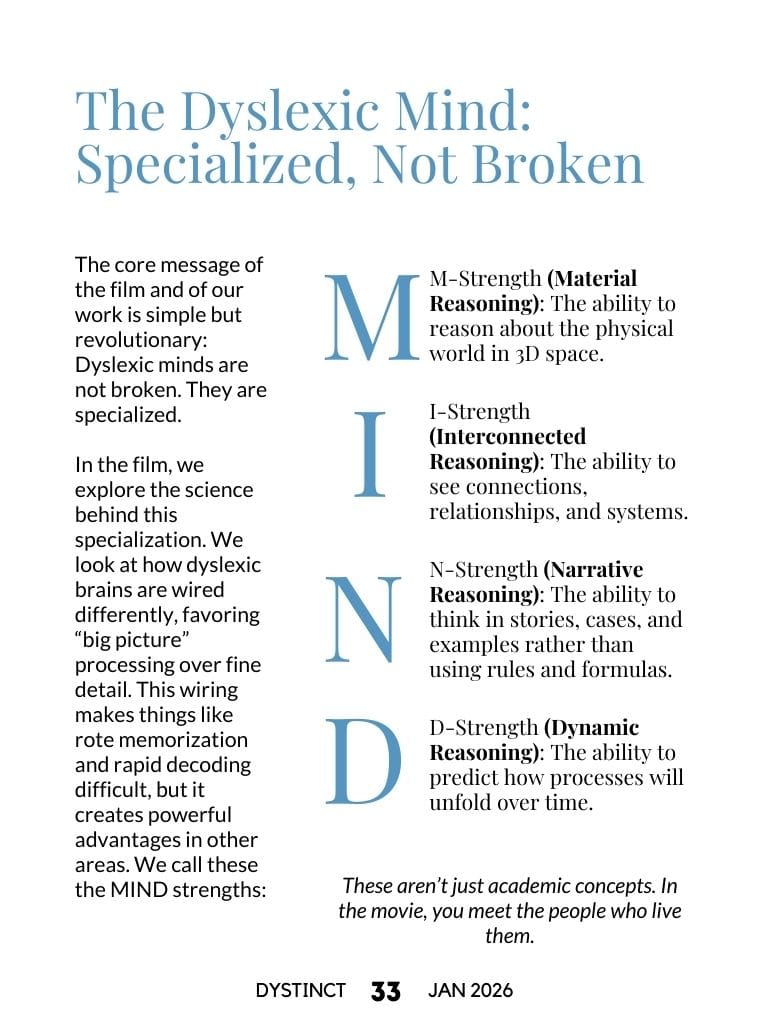
In the film, we explore the science behind this specialization. We look at how dyslexic brains are wired differently, favoring “big picture” processing over fine detail. This wiring makes things like rote memorization and rapid decoding difficult, but it creates powerful advantages in other areas. We call these the MIND strengths:
- M-Strength (Material Reasoning): The ability to reason about the physical world in 3D space.
- I-Strength (Interconnected Reasoning): The ability to see connections, relationships, and systems.
- N-Strength (Narrative Reasoning): The ability to think in stories, cases, and examples rather than using rules and formulas.
- D-Strength (Dynamic Reasoning): The ability to predict how processes will unfold over time.
These aren’t just academic concepts. In the movie, you meet the people who live them.
Meeting the Explorers
Meeting the Explorers
One of the greatest joys of making this film was interviewing the incredible individuals who embody these strengths. We wanted to show that “success” with dyslexia isn’t just about surviving school; it’s about finding your purpose.
You’ll meet Dr Bob Ballard, the oceanographer who discovered the Titanic. Bob is a classic example of both D-Strength (Dynamic Reasoning) and M-Strength (Material Reasoning). He describes how his dyslexic mind allows him to run mental simulations, predicting where debris would fall on the ocean floor, a skill that allowed him to find the ship when everyone else had failed. He told us, “There’s no doubt in my mind whatsoever that I found the Titanic when all before me failed because I’m dyslexic and they weren’t.”
You’ll meet Dr Chris Ford, an ER physician and inventor who used his M-Strength (Material Reasoning) to visualize anatomy and invent life-saving medical devices. Chris shares his journey from struggling student to award-winning teacher and inventor, proving that the dyslexic mind belongs in medicine just as much as in art or business.
You’ll meet Jack Laws, a naturalist and artist whose I-Strength (Interconnected Reasoning) helps him see the hidden web of relationships in nature. And you’ll meet Lauren Havel and Krista Weltner, young filmmakers and artists whose N-Strengths (Narrative Reasoning) combine with their other abilities to help them tell stories that move the world.
A Message for the Next Generation
A Message for the Next Generation
We didn’t just make this movie for adults. We made it for the young people, the students sitting in classrooms right now, feeling like they don’t fit in. We wanted them to see people who look like them, think like them, and are thriving because of how they think, not in spite of it.
While the school years can be tough, the ‘caterpillar years,’ as we call them. They are growing into butterflies.
In the film, naturalist and artist Jack Laws says something profound: “If somebody came up to me and said, ‘Hey, Jack… I have this magic wand, and with one stroke I could cure your dyslexia…’ I would run from this person as fast as I possibly could.” That is the level of self-acceptance and pride we want for every dyslexic child. We want them to understand that while the school years can be tough, the “caterpillar years,” as we call them. They are growing into butterflies.
What We’ve Been Up To: Building the Future
What We’ve Been Up To: Building the Future
We need to move from a story of “disability” to a story of “advantage.”
Since finishing the film, our work has been about getting this message out. We want parents to watch this movie with their children. We want teachers to watch it to understand the potential sitting in their classrooms. We want tutors working with children to understand how their minds work through simulation.
We are also hard at work on the next phase of Neurolearning, creating practical tools that help families put these insights into action. We are developing new ways to help parents identify their child’s specific MIND strengths and create personalized learning profiles. We want to move beyond just identifying “dyslexia” to identifying “this specific person’s unique way of learning.”
But right now, the most important thing we can do is change the narrative. We need to move from a story of “disability” to a story of “advantage.”
Join the Movement
Join the Movement
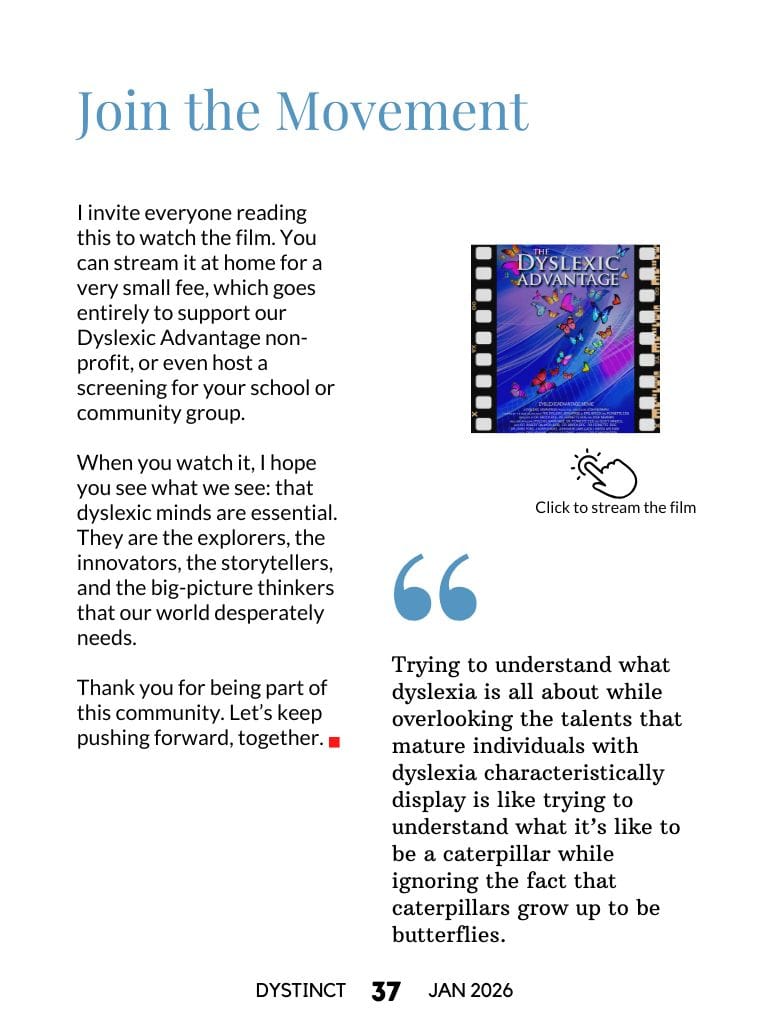
I invite everyone reading this to watch the film. You can stream it at home for a very small fee, which goes entirely to support our Dyslexic Advantage non-profit, or even host a screening for your school or community group.
When you watch it, I hope you see what we see: that dyslexic minds are essential. They are the explorers, the innovators, the storytellers, and the big-picture thinkers that our world desperately needs.
Thank you for being part of this community. Let’s keep pushing forward, together.
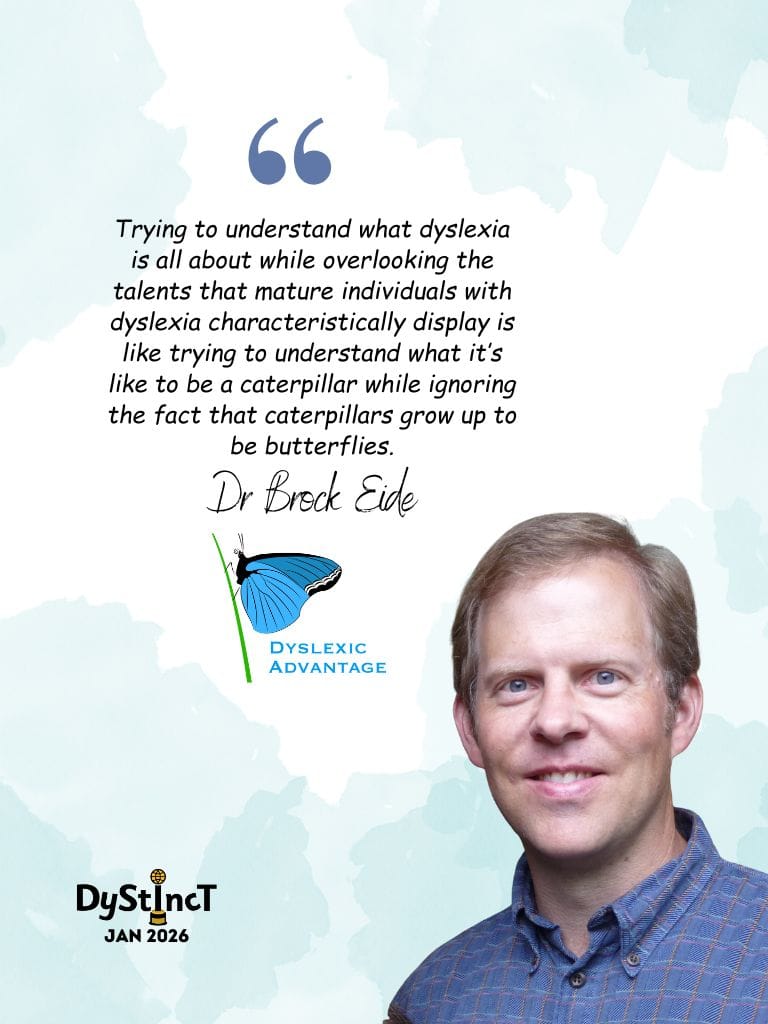
Trying to understand what dyslexia is all about while overlooking the talents that mature individuals with dyslexia characteristically display is like trying to understand what it’s like to be a caterpillar while ignoring the fact that caterpillars grow up to be butterflies.
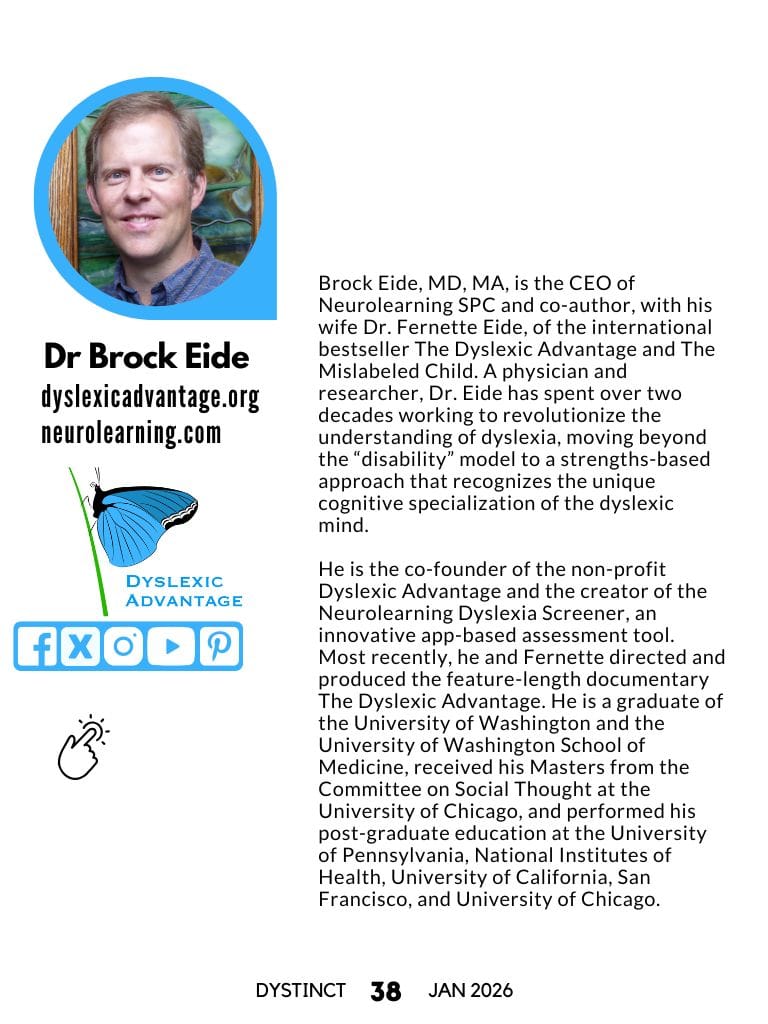
Dr Brock Eide
Physician, Researcher, Co-Founder & CEO | dyslexicadvantage.org | neurolearning.com | Facebook | X | Instagram | YouTube | Pinterest
Dr Brock Eide
Brock Eide, MD, MA, is the CEO of Neurolearning SPC and co-author, with his wife Dr. Fernette Eide, of the international bestseller The Dyslexic Advantage and The Mislabeled Child. A physician and researcher, Dr. Eide has spent over two decades working to revolutionize the understanding of dyslexia, moving beyond the “disability” model to a strengths-based approach that recognizes the unique cognitive specialization of the dyslexic mind.
He is the co-founder of the non-profit Dyslexic Advantage and the creator of the Neurolearning Dyslexia Screener, an innovative app-based assessment tool. Most recently, he and Fernette directed and produced the feature-length documentary The Dyslexic Advantage. He is a graduate of the University of Washington and the University of Washington School of Medicine, received his Masters from the Committee on Social Thought at the University of Chicago, and performed his post-graduate education at the University of Pennsylvania, National Institutes of Health, University of California, San Francisco, and University of Chicago.
BUY BOOK
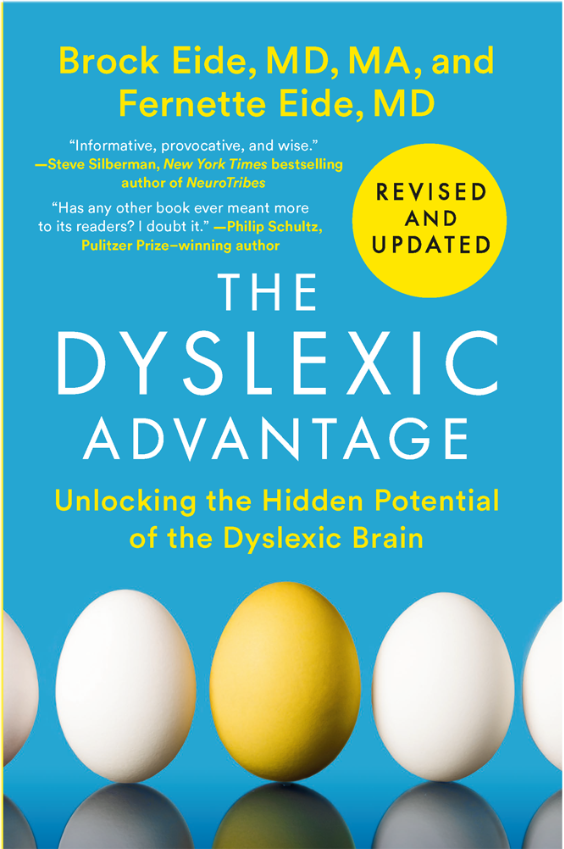
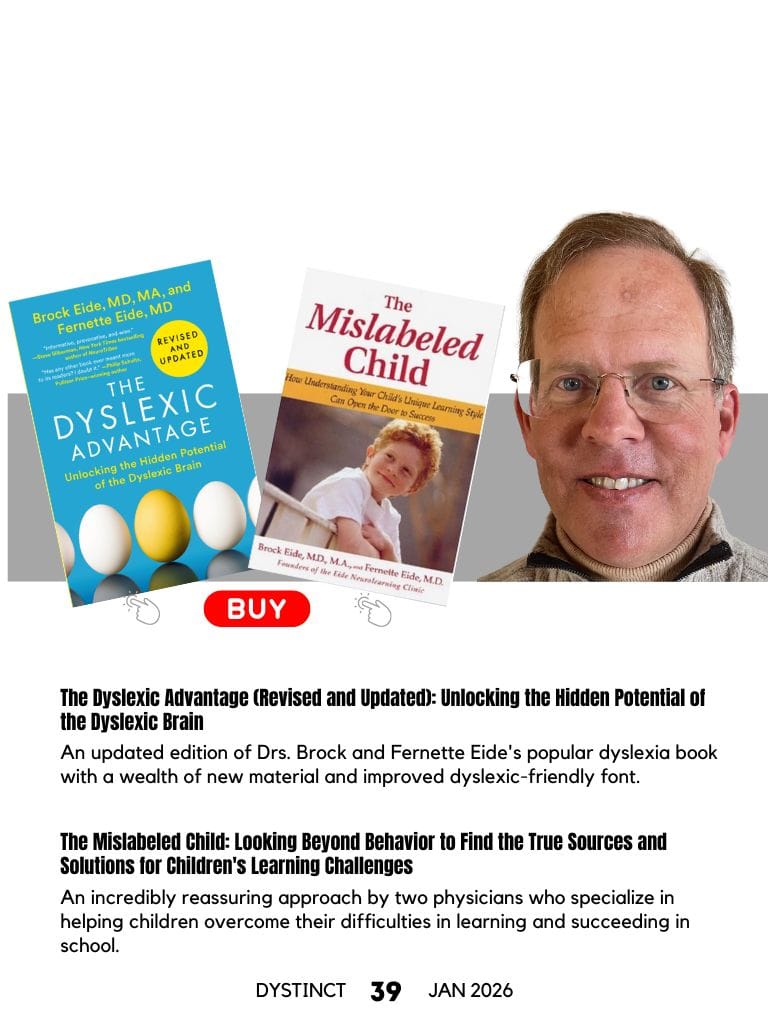
The Dyslexic Advantage (Revised and Updated): Unlocking the Hidden Potential of the Dyslexic Brain
Drs. Brock and Fernette Eide use their impressive backgrounds in neurology and education to debunk the standard deficit-based approach to dyslexia. People typically define "dyslexia" as a reading and spelling disorder. But through published research studies, clinical observations, and interviews with dyslexic individuals, the Eides prove that these challenges are not dyslexia's main features but are instead trade-offs resulting from an entirely different pattern of brain organization and information processing that has powerful advantages. For example, dyslexic adults routinely outperform their non-dyslexic peers in studies on three-dimensional spatial reasoning and divergent creativity--one of the reasons why so many dyslexics are successful engineers. Approximately 20 percent of the U.S. population has dyslexia, and The Dyslexic Advantage shows how each one is predisposed to powerful skills called MIND strengths (Material, Interconnected, Narrative, and Dynamic Reasoning), leading them to possess incredible pattern detection, divergent thinking, episodic memory, problem solving, and prediction abilities.
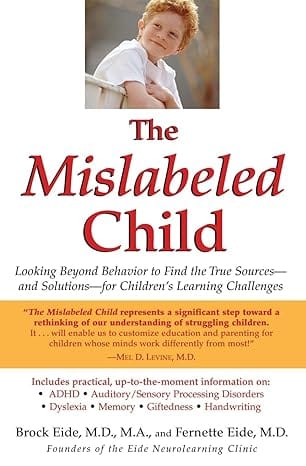
The Mislabeled Child: Looking Beyond Behavior to Find the True Sources -- and Solutions -- for Children's Learning Challenges
An incredibly reassuring approach by two physicians who specialize in helping children overcome their difficulties in learning and succeeding in school
For parents, teachers, and other professionals seeking practical guidance about ways to help children with learning problems, this book provides a comprehensive look at learning differences ranging from dyslexia to dysgraphia, to attention problems, to giftedness. In The Mislabeled Child, the authors describe how a proper understanding of a child's unique brain-based strengths can be used to overcome many different obstacles to learning. They show how children are often mislabeled with diagnoses that are too broad (ADHD, for instance) or are simply inaccurate. They also explain why medications are often not the best ways to help children who are struggling to learn. The authors guide readers through the morass of commonly used labels and treatments, offering specific suggestions that can be used to help children at school and at home. This book offers extremely empowering information for parents and professionals alike.
The Mislabeled Child examines a full spectrum of learning disorders, from dyslexia to giftedness, clarifying the diagnoses and providing resources to help. The Eides explain how a learning disability encompasses more than a behavioral problem; it is also a brain dysfunction that should be treated differently.
Extracts from Dystinct Magazine
Extracts from Dystinct Magazine