Issue 18: From Frustration to Triumph: Strategies for Parents Advocating for Their Child's Education | Lisa Stewart
Lisa Stewart offers a comprehensive guide for parents navigating the education system, particularly when advocating for children with special needs, empowering them to foster success and happiness in their child's educational journey.

Table of Contents
As parents, we want nothing more than to see our children succeed, thrive, and be happy in all aspects of life. When my family moved from overseas 5 years ago, we entered into the US Special Education system with no IEP in place. I was appalled at how long it took for my child with CLEAR disabilities to get services through the school. We call that year "the lost year" because services had been in place for roughly 7 weeks before COVID hit. It was a nightmare for him, his teachers, his school, and our family.
Since then, the tools in my advocacy toolbox have grown so much that I had to get a new toolbox. In this article, we'll explore practical strategies and resources that can make a positive difference when advocating in your child's educational journey.
Create a Plan
Create a Plan
When your child is struggling, setting up a meeting with your child's teacher, case manager, or administrator is the first crucial step. Engage in an open and constructive conversation to gain a deeper understanding of the specific challenges your child is facing and the areas in which they need support. Encourage your child's involvement in these discussions to empower them and foster self-advocacy. Develop a plan with the teacher tailored to your child's needs. Following the meeting, send a follow-up email (DO NOT SKIP THIS STEP) to ensure everyone is on the same page and to maintain an ongoing dialogue.
Proactive Communication and Gratitude
Proactive Communication and Gratitude
Once a plan is in place, it's essential to remain proactive in maintaining communication with the teacher or case manager. Teachers are busy, so don't wait for them to email you. Most teachers work on the "No news is good news" mentality. I recommend emailing at least once a week to set the tone of regular communication. Start the email acknowledging their commitment and time dedicated to your child. You can use this email to update them on your child's progress at home, sharing both improvements and setbacks. By doing this, you are setting the expectation of actively partnering with the teacher in your child's journey.
In this communication, you could ask about specific accommodations and services that are being provided to your child. How are they being provided? Is additional help needed to make sure they are provided consistently and with accuracy? Ask about your child's behavior. Even if your child does not have a "behavior problem" withdrawal, and limited participation is a behavior that will impact learning.
Additionally, expressing gratitude for the teacher's support and efforts can make a meaningful impact. Appreciation fosters a positive relationship, keeps the goals you created at the forefront of the teacher's mind, and could lead to additional attention for your child because the communication is fresh in their mind.
My child's IEP (Individualized Education Plan) called for support in one of his classes. After many, many emails back and forth with the teacher, I believed the IEP was being implemented more or less, but he was still failing one of his favorite subjects.
I took the emails to the administrator and requested he go in and observe the class and see what on earth was causing the struggle. The answer? A poor instructional match. The teacher supporting him was demanding and unkind. My kid did not take well to demanding and unkind and refused to work; he just shut down or left the class. So, what do we do? I asked. After a bit of discussion, it was decided that an aide would be placed in the class to support him. Continued communication revealed that the remainder of the year went well.
This communication was vital in providing the documentation necessary to request additional information and support from the school.
Stay Informed
Stay Informed
We know how valuable it is to stay informed about our child's progress in school. Checking electronic grade books can provide us with essential information, such as recent test scores, missing assignments, and upcoming assignments. I set a weekly reminder to review this
information so I can address any concerns promptly. I do this with my child so he knows he is accountable for his work, and it encourages more frequent communication from him because "Hey, mom, I tried really hard but still got a D+ on my Civics test" is better than "Dude, a D+, what happened?"
With this knowledge and your child's feedback, you can effectively communicate with the teacher in your weekly or biweekly email, utilizing this information to foster a collaborative partnership. By emphasizing open and constructive communication, not only can we support our child's education, but we can also build a strong foundation of trust and understanding with the teacher. Be careful not to place blame or make excuses for your child; explanations are fine, and asking for help finding solutions is encouraged, but accusations will break down walls and put-up defences.
If, after discussing your concerns for your child with the classroom teacher, you still feel they are not fulfilling the requirements of their job, that discussion should kindly move up the chain of command. Remember, classroom teachers are not responsible for special education services. They are only responsible for classroom accommodations and school-adopted curriculum and methods.
Seeking Additional Support
Seeking Additional Support
If your child's struggles extend beyond the capacity of the classroom or teacher to address effectively, and they do not already have an IEP, it may be necessary to request a full comprehensive educational evaluation for Special Education services. Request this evaluation in writing, clearly outlining your suspicions about the disability, why you believe it to be the case, and the steps you have already taken to support your child. This evaluation will provide a comprehensive understanding of your child's needs, leading to more targeted interventions and support services.
If your child already has an Individualized Education Program (IEP) or 504 Plan and you believe it is not being adequately implemented or not working for one reason or another, address your concerns with the teacher and case manager or call an IEP meeting to discuss team solutions to help your child find success. This could be anything from additional accommodations, additional data collection/testing, change or addition of goals, or additional service minutes.
Emotional Support and Reinforcement
Emotional Support and Reinforcement
While academic support is crucial, providing emotional support and reinforcement for your child is equally important. So much of this support can be offered at home, and it is imperative we offer it at home if it is lacking in their school day.
Celebrate and encourage your child's strengths and successes, even the little ones. Nurturing a positive mindset can be a game changer. Implement the power of "YET" by reminding them that their present struggles are temporary and that they might not be able to do it "YET", but with time, it will come. Be a pillar of understanding, patience, and unconditional love as they navigate the challenges they face at school.
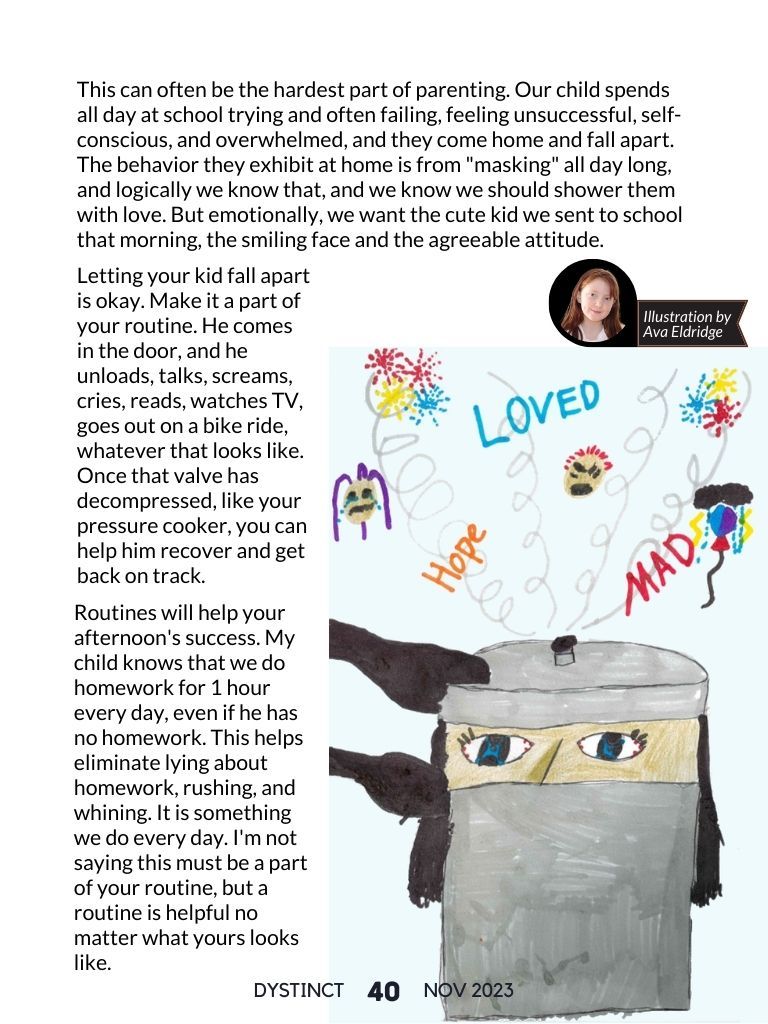
This can often be the hardest part of parenting. Our child spends all day at school trying and often failing, feeling unsuccessful, self-conscious, and overwhelmed, and they come home and fall apart. The behavior they exhibit at home is from "masking" all day long, and logically we know that, and we know we should shower them with love. But emotionally, we want the cute kid we sent to school that morning, the smiling face and the agreeable attitude.
Letting your kid fall apart is okay. Make it a part of your routine. He comes in the door, and he unloads, talks, screams, cries, reads, watches TV, goes out on a bike ride, whatever that looks like. Once that valve has decompressed, like your pressure cooker, you can help him recover and get back on track.
Routines will help your afternoon's success. My child knows that we do homework for 1 hour every day, even if he has no homework. This helps eliminate lying about homework, rushing, and whining. It is something we do every day. I'm not saying this must be a part of your routine, but a routine is helpful no matter what yours looks like.

Additional Counselling or Therapy
Additional Counselling or Therapy
Sometimes, children with learning disabilities can benefit from additional counselling or therapy to develop coping strategies, build self-confidence, and manage the emotional aspects of their educational journey. Not to mention, sometimes you just want someone you can talk to who is not going to judge or try to fix the problem. Consult with professionals or your child's school to explore therapy options that align with their needs.
If they are diagnosed with anxiety, ADHD, depression, social issues, etc., you can actually include meeting with a counsellor on the IEP or 504 plan. You can set goals around the support they need, and you can work with the school to help offer consistent support at home with similar language.
Enlist the Help of an Advocate
Enlist the Help of an Advocate
If you feel stuck or find that progress with the school is not being made, you should seek the assistance of an advocate. Advocates are experienced professionals who understand the intricacies of the special education system. They can guide you through the process, advocate
for your child's rights, and help facilitate meaningful changes in their educational experience.
When meeting with an advocate, ask about their training, experience, and what their plan is for your child. You want to make sure not another minute is lost in your child's education. Hiring an advocate who doesn't have the time for you or experience to help you will only prolong support.
A good advocate will change not only your child's journey but transform what the entire school path looks like. What was uphill will now be level. What was backward will now have forward momentum.
When kids feel confident at school, they will be happier. When kids are happy at school, they will learn. When kids feel safe, they will explore. When kids are supported, they are successful.
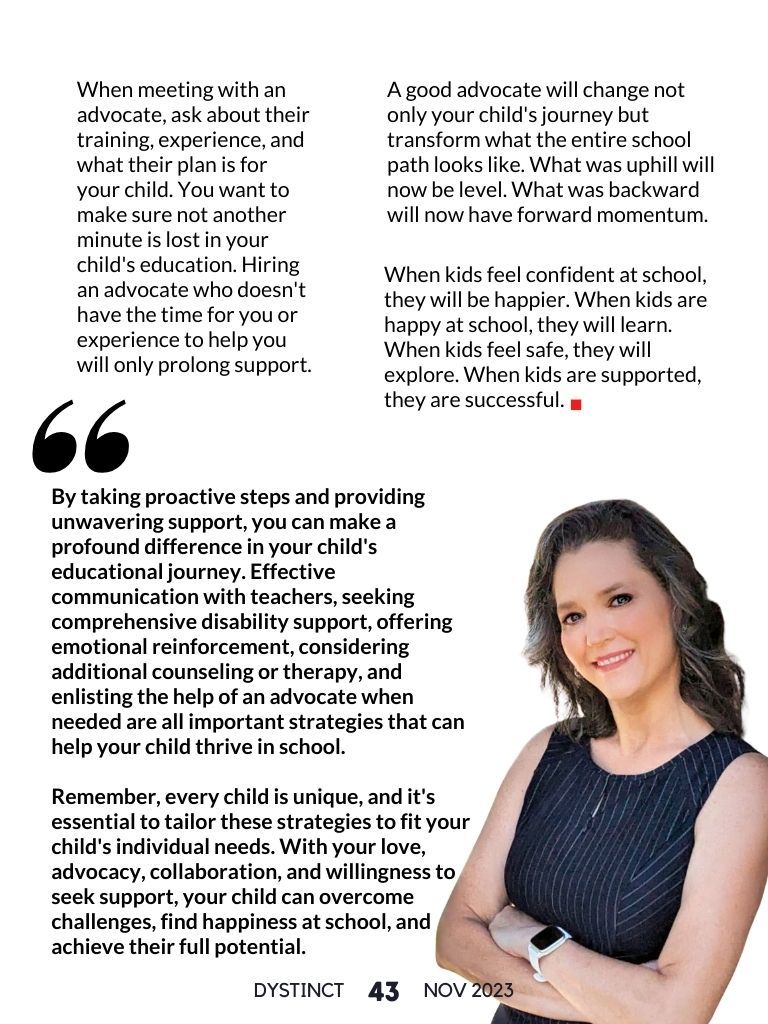
Lisa Stewart
Special Education Advocate and IEP Coach
Advocating4FairEducation.com | Facebook | Instagram | LinkedIn | X
Lisa Stewart
As a dyslexic herself, Lisa brings a unique perspective and personal understanding to her work in the field of special education. With a master's degree in Curriculum and Instruction, specializing in behavioral science, and experience as an inclusion classroom teacher, Lisa possesses a wealth of knowledge and expertise in supporting students with diverse learning needs.
Through Advocating4faireducation, Lisa not only shares her own experiences and tools but also offers comprehensive advocacy services across the USA.
By embracing her own journey and experiences as a dyslexic and parent of a child with dyslexia, ADHD, and Autism, Lisa sparks a reassuring sense of camaraderie and support. She weaves her personal narrative seamlessly with evidence-based strategies, empowering parents to embrace their role as advocates and champions for their children.
Extracts from Dystinct Magazine
Extracts from Dystinct Magazine