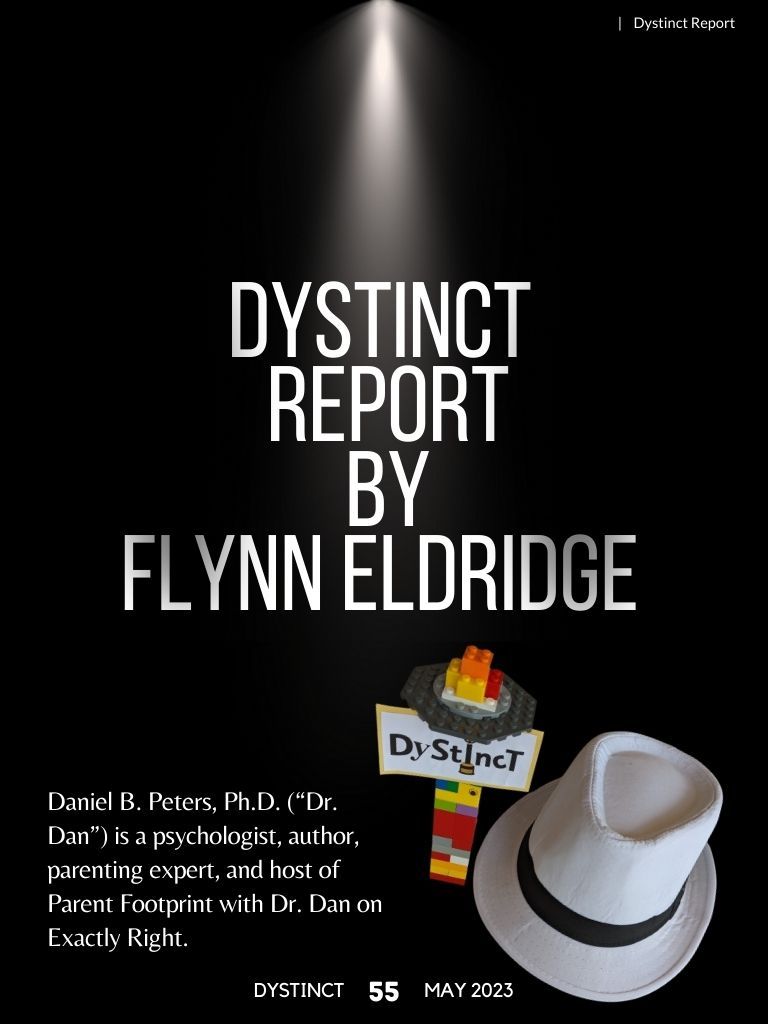
Issue 15: Dystinct Report – Flynn Eldridge’s Interview with Dr Dan Peters
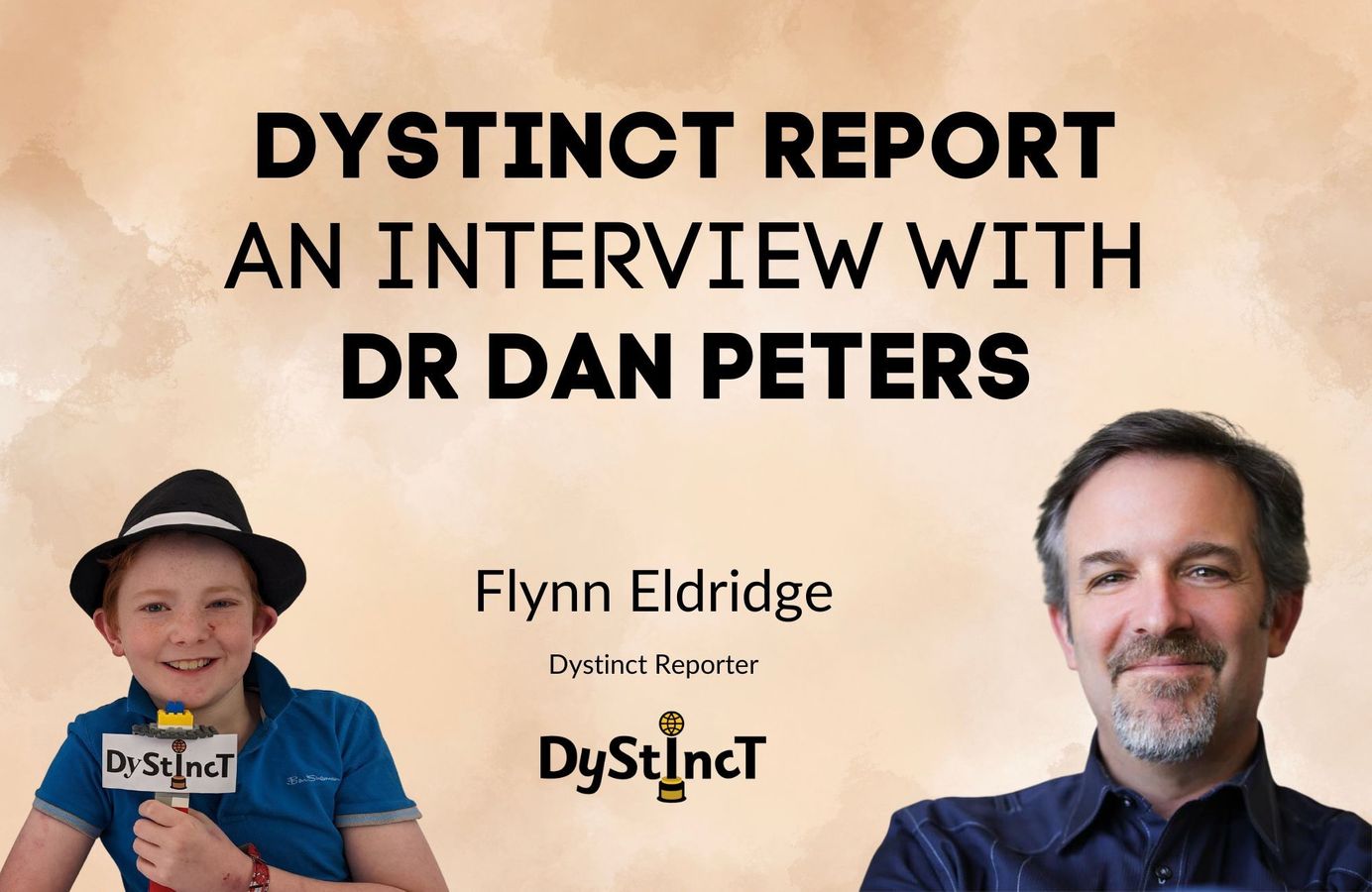
Ten-year-old journalist Flynn Eldridge has a chat with Dr Dan Peters, a psychologist, author, and parenting expert, about his work and life.

Table of Contents
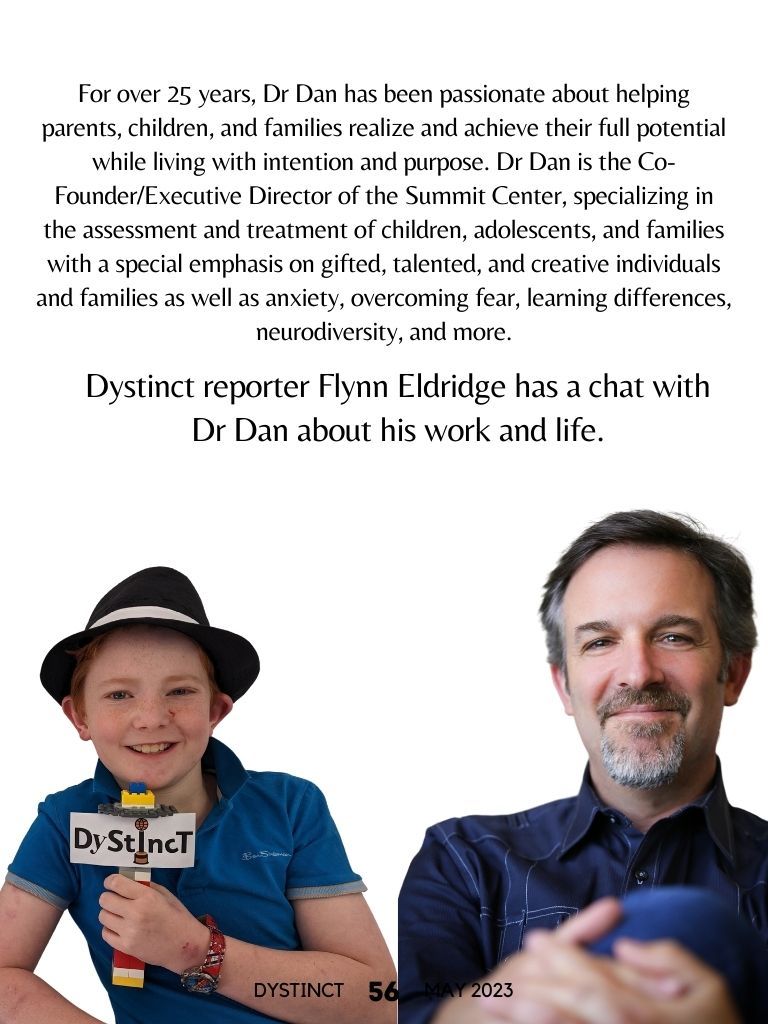
For over 25 years, Dr Dan has been passionate about helping parents, children, and families realize and achieve their full potential while living with intention and purpose. Dr Dan is the Co-Founder/Executive Director of the Summit Center (summitcenter.us), specializing in the assessment and treatment of children, adolescents, and families with a special emphasis on gifted, talented, and creative individuals and families as well as anxiety, overcoming fear, learning differences, neurodiversity, and more.
The Interview
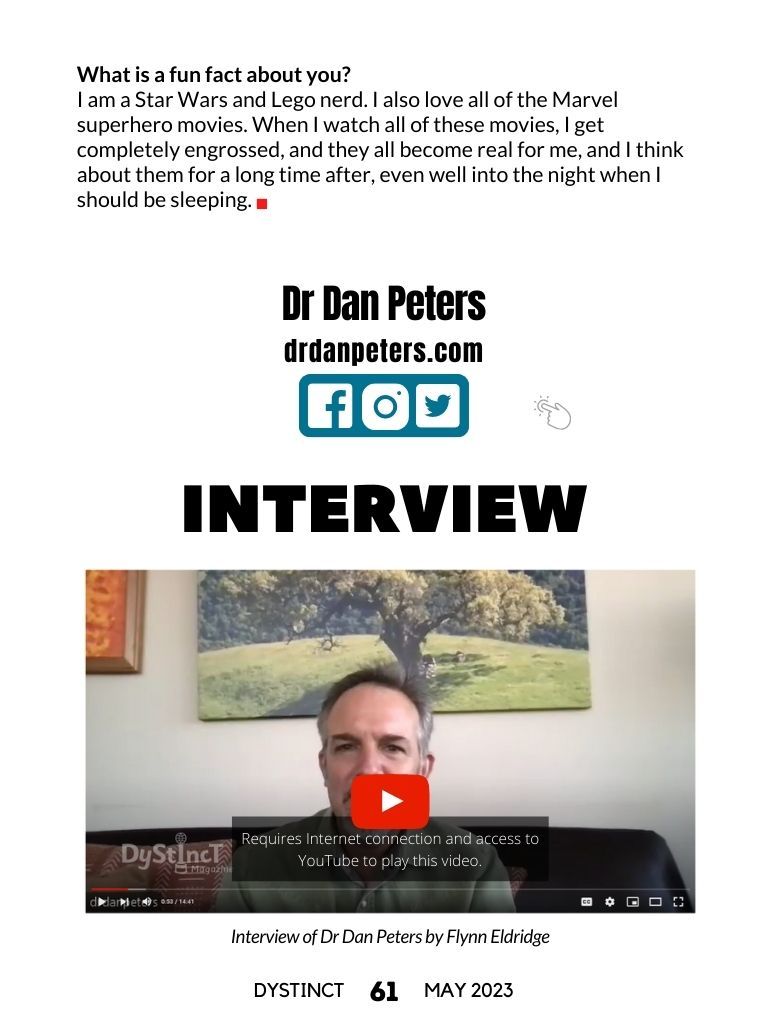
The Interview
Dystinct reporter Flynn Eldridge has a chat with Dr Dan about his work and life.
Excerpts from the Interview
Excerpts from the Interview
Who do you help in your job, and why?
I help children, adolescents, adults, parents and families. I am passionate about helping people realize their full potential and then live meaningful and fulfilling lives, knowing more about who they are, their strengths, their challenges, and how their own unique profile can be best accepted and utilized in their world.
What is twice exceptionality?
Twice exceptionality is when someone has advanced abilities on one end of an imaginary bell curve. On the one end, you might have advanced thinking abilities that we call cognitive abilities; You might be advanced in academics, math, science, English, or writing. You can also be advanced in creativity, leadership abilities or performing arts abilities like music, for example. And on the other end of the bell curve, you also have some challenges. And those challenges can show up, like dyslexia, dysgraphia, attentional issues like ADHD, Autism Spectrum Disorder, auditory processing or visual processing issues, anxiety, depression, or other mood challenges. And the reason we say you're twice exceptional is because you have exceptionalities on both ends of the bell curve. But in reality, we know most people are not that neat and tidy, and we all usually have more exceptionalities than that.
How would you describe someone who is twice exceptional?
I would describe them as someone who is very bright and creative and also has weaknesses or challenges in one of the many different domains of life functioning that I just mentioned. So really, we think about it as significant strengths and also some other developmental challenges, which can be frustrating and keep us from being able to show our best selves or our best work.
How do you measure challenges such as building creativity and adventure?
We know that most of the tests don't really capture that. Many of the cognitive tests do have visual portions. Many people who are really good at Lego and building can show strongly on the visual portions of the cognitive test. However, when it comes to building creativity and other skills that fall outside of a test, we really have to look towards what we call portfolios. That is where we actually look at people's work and creations and see the detail and the sophistication. Many of these people who are very bright, creative, twice exceptional, and gifted will be doing advanced building and creating and inventing at a very young age.
What type of questions would parents ask you?
Parents ask questions to understand their children better. They want to understand how to help their child be at their best and develop in an optimal way. They want to ask questions if their child has an observable or diagnosable challenge, which might be hidden due to their strengths. They might have concerns about their child's worries. Largely most questions fall under the umbrella of them really wanting to be the best parents they can be for their kids and wanting to understand their children to support them and their growth.
What do parents tell the kid's teacher after they find out their kid is twice exceptional?
It depends on the parent. Parents know their kids best. I think it's very important to help twice exceptional kids know that they are smart, that they do have all of these strengths, and to break down where those strengths are. Because when we have strengths, we actually just think it's normal. We don't think there's anything special about ourselves because we've always been that way. While parents tell their children about the things that they're good at, I also think it's important for parents to find a way to tell their child who is twice exceptional the things that are challenging in terms of how it's causing them frustration in school or in life. The question then becomes, depending on the child's age and depending on how the child feels about themselves, do we actually use labels like dyslexia, ADHD, and autism, or do we talk about those profiles in terms of where the challenges lie. That's where I think it's up to each parent to decide whether their child would benefit by hearing a label or just learning about the challenges. And this is also so that a child can ultimately have a positive identity about all of their abilities, the ones that they're really good at, the ones that they might be typical at, and the ones that might be harder for them.
Do you have a learning difference? If so, what?
I have dyslexia and dysgraphia. I didn't know that I had those because I compensated in school. But it made reading and writing at school very challenging for me, and I didn't like it very much at all. In fact, it was not until I had my own kids who have the same profiles that I then became aware that, "Hey, this is me too, and I've just been living my whole life trying to get by without knowing it."
What did you want to be as a kid?
I wanted to be a professional tennis player because I played a lot of tennis, and I was passionate about it. In hindsight, I see that my strong visual and spatial strengths that comes from being dyslexic was very much utilized in tennis. Once I realized that I wasn't going to be a professional tennis player when I got older, I wanted to work with people. And that's how I found my way into psychology.
What makes you happy in your work? Does it keep you happy, excited, and want to keep helping?
What makes me happy in my work and keeps me motivated and happy in my work is seeing people grow and become the people they want to be and realizing their strengths, and having success in the world. I will never get sick of that, and that will always be my motivating factor.
You are an author. What books have you written about twice exceptionality?
I have written some books on conquering the Worry Monster. There's some information in there about being bright and also about having challenges known as twice exceptionality. I co-authored a book about creativity. The new version is just out. It's called Boosting Your Child's Creativity. There's information in there about twice exceptionality and what we call developmental asynchrony. And then I also co-authored a book called Bright Complex Kids: Supporting Their Social and Emotional Development, and in that book, there is information about twice exceptionality.
👉From Worrier to Warrior (amazon.com) #
👉The Warrior Workbook (amazon.com) #
👉Boosting Your Child’s Natural Creativity (giftedunlimitedllc.com)
👉Bright, Complex Kids: Supporting Their Social and Emotional Development (amazon.com) #
We have people listening from across the world. What part of the world are you from, and what do you like about this place?
It's really exciting that you have people from all over the world. I am in Northern California in the United States. What I like about Northern California is that the area where we live is a short drive to many different things. So there's always something to do. We are a few hours away from the mountains. We are an hour or less away from the beach. We are right across the bay from San Francisco, which is a wonderful city. We are near the wine country, just about an hour away. I just love that there's so many different things to do where we live.
What is a fun fact about you?
I am a Star Wars and Lego nerd. I also love all of the Marvel superhero movies. When I watch all of these movies, I get completely engrossed, and they all become real for me, and I think about them for a long time after, even well into the night when I should be sleeping.
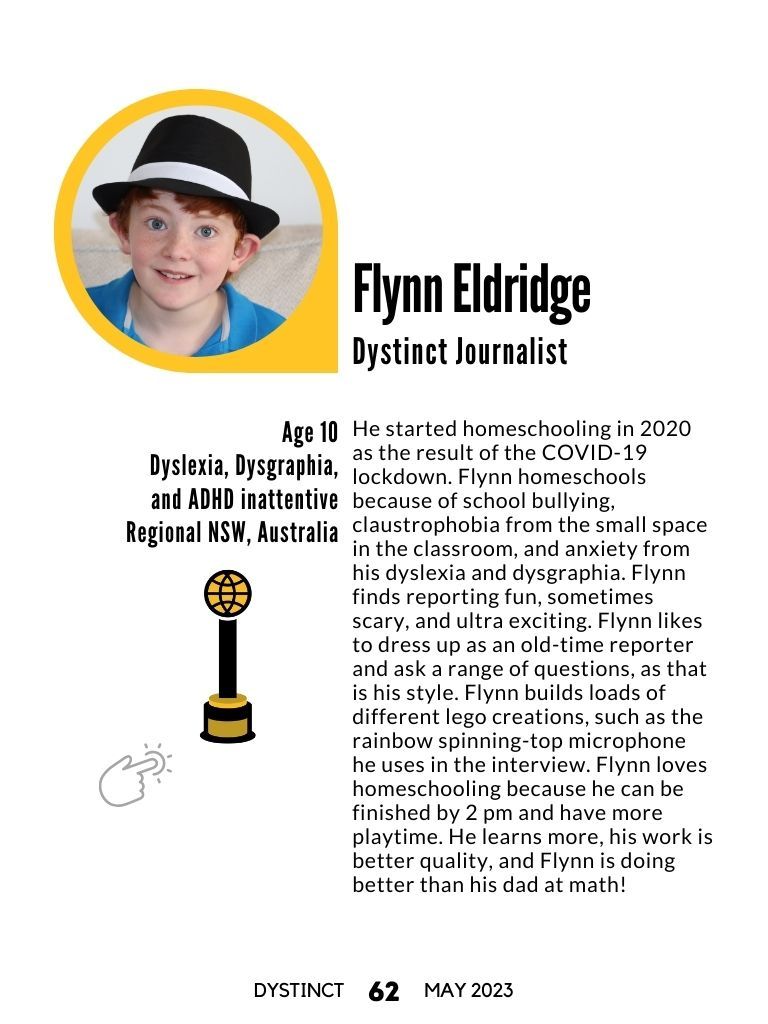
Flynn Eldridge
Dystinct Journalist
Age 10
Dyslexia, Dysgraphia, and ADHD inattentive
Regional NSW, Australia
Flynn Eldridge
Flynn started homeschooling in 2020 as the result of the COVID-19 lockdown. Flynn homeschools because of school bullying, claustrophobia from the small space in the classroom, and anxiety from his dyslexia and dysgraphia. Flynn finds reporting fun, sometimes scary, and ultra exciting. Flynn likes to dress up as an old-time reporter and ask a range of questions, as that is his style. Flynn builds loads of different lego creations, such as the rainbow spinning-top microphone he uses in the interview. Flynn loves homeschooling because he can be finished by 2 pm and have more playtime. He learns more, his work is better quality, and Flynn is doing better than his dad at math!
Extracts from Dystinct Magazine
Extracts from Dystinct Magazine