
Issue 26: Dyslexic Thinkers: Testament of Time - The Reasons Dyslexics (and some Neurodivergent) Need Additional Time | Georgie Cooney | Dyslexia Spell
Georgie Cooney, dyslexia specialist, explains why additional time is essential for dyslexic and neurodivergent learners, whose processing differences require more time to read, write, and spell, emphasising that with this support, they can thrive and reach their potential.

Table of Contents
To stand the test of time means to be able to prove its long-lasting value and survive. This is what so many of our dyslexic thinkers can do, particularly if they are given opportunities to thrive; this includes additional time to process information. Dyslexics have historically been known to 'think outside the box' and find solutions that many others might struggle with.
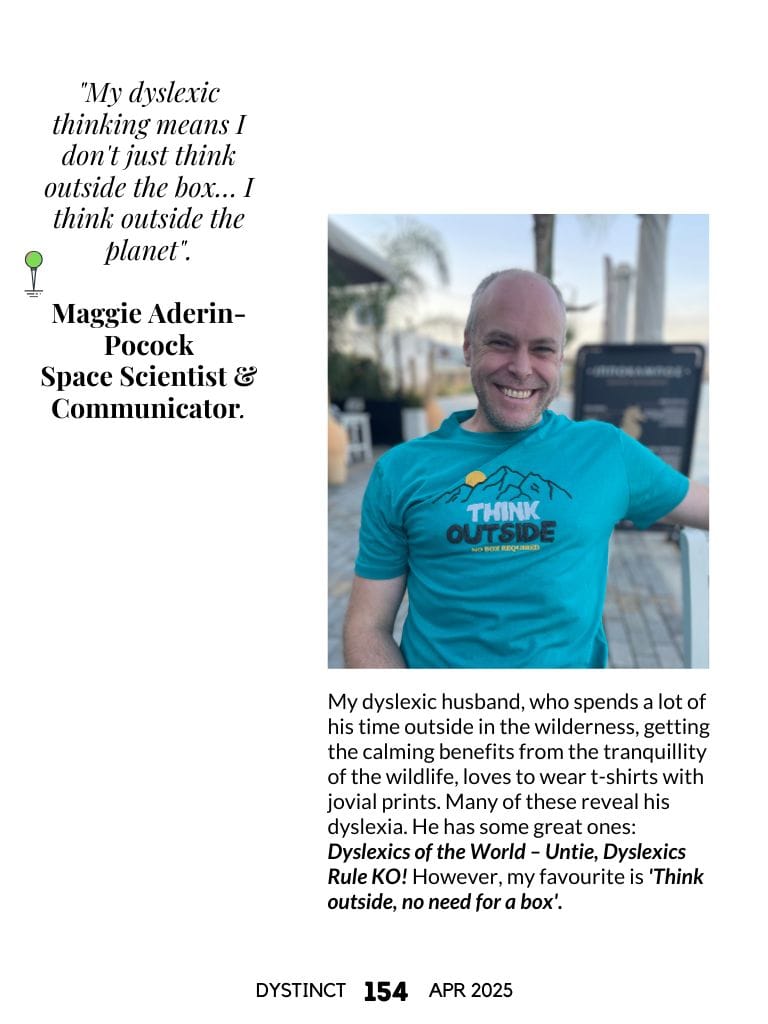
My dyslexic thinking means I don't just think outside the box… I think outside the planet.
~
Maggie Aderin-Pocock
Space Scientist & Communicator.

My dyslexic husband, who spends a lot of his time outside in the wilderness, getting the calming benefits from the tranquillity of the wildlife, loves to wear t-shirts with jovial prints. Many of these reveal his dyslexia. He has some great ones: Dyslexics of the World – Untie, Dyslexics Rule KO! However, my favourite is 'Think outside, no need for a box'.
Understanding Dyslexia & Learning Differences
Understanding Dyslexia & Learning Differences
A new definition for dyslexia came out in 2024 from the Delphi Study (Patoss, 2024):
- Dyslexia is primarily a set of processing difficulties that affect the acquisition of reading and spelling.
- In dyslexia, some or all aspects of literacy attainment are weak in relation to age, standard teaching and instruction, and level of other attainments.
- Across languages and age groups, difficulties in reading and spelling fluency are a key marker of dyslexia.
- The nature and developmental trajectory of dyslexia depends on multiple genetic and environmental influences.
- Dyslexic difficulties exist on a continuum and can be experienced to various degrees of severity.
- Dyslexia can affect the acquisition of other skills, such as mathematics, reading comprehension or learning another language.
- The most commonly observed cognitive impairment in dyslexia is a difficulty in phonological processing (i.e. in phonological awareness, phonological processing speed or phonological memory). However, phonological difficulties do not fully explain the variability that is observed.
- Working memory, orthographic skills and processing speed problems can contribute to the impact of dyslexia and, therefore, should be assessed.
- Dyslexia frequently co-occurs with one or more other developmental difficulty, including developmental language disorder, dyscalculia, ADHD, and developmental coordination disorder.
As processing difficulties are the primary problem with dyslexia, I ask myself why I am not seeing this recognition and awareness at home, in schools, colleges, the workplace and in society as a whole.
If the government allows and provides for it, an accommodation for individuals with dyslexia is the provision of additional time for tests, assignments, and other time-sensitive activities. However, not only is this not the case in all countries, but allowing additional time is not being practised on a daily basis both at home and abroad.
Cognitive Processing Differences
Cognitive Processing Differences
Dyslexics often process information differently from their non-dyslexic peers. What is so frustrating is that so many of the dyslexic learners I teach are very quick and beautifully expressive verbally, but it's getting things down on paper that causes so many issues. Nevertheless, some have word-finding problems (like myself) and will use circumlocutory language to get to what they're saying, which can take ages. An example would be, 'Oh, you know, the thing with the white around the yellow circle (describing a fried egg). I'm often being urged to 'get to the point' or as some of my friends have sarcastically but warmly called me 'Mrs Long Story Short'. I do like to talk, I must admit, but I really struggle to cut a long story short (sorry, but it's just me!).
Dyslexia affects how the brain ultimately processes the written language, making it more challenging to decode (read), encode (spell) and comprehend text. You can see here how things just take longer. Extra time allows them to process information at their own pace, ensuring they have an equal opportunity to demonstrate their knowledge and skills. However, I still wish things weren't timed when it comes to reading and writing.
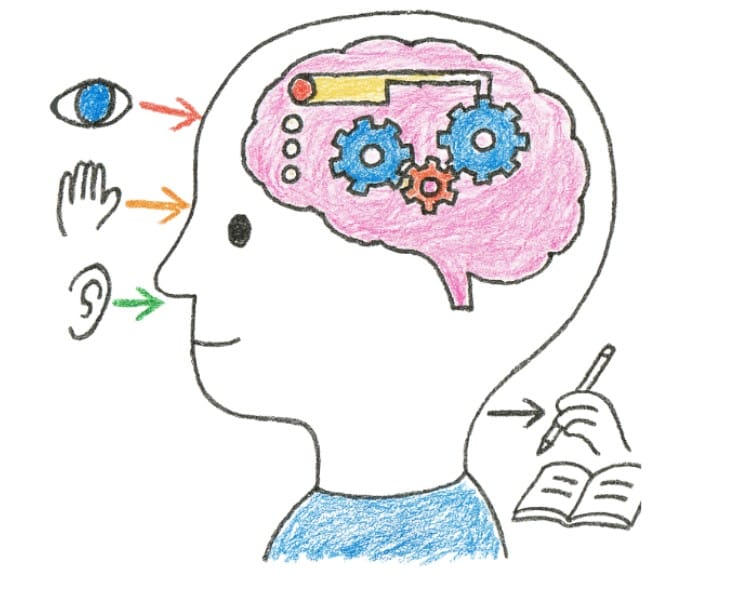
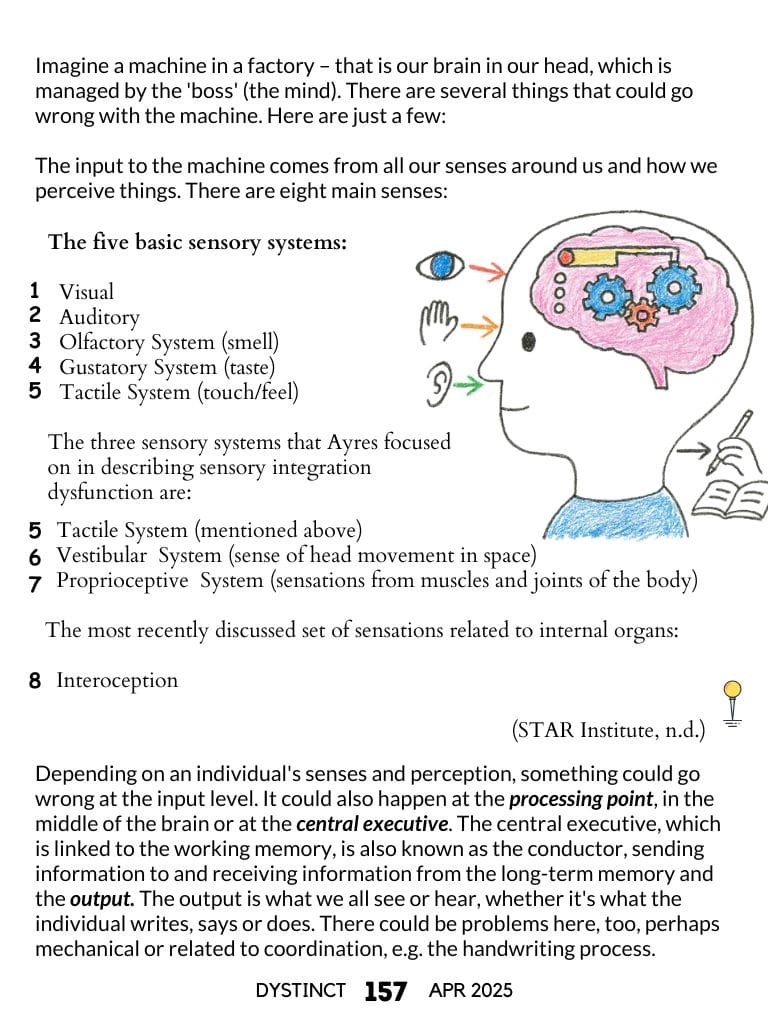
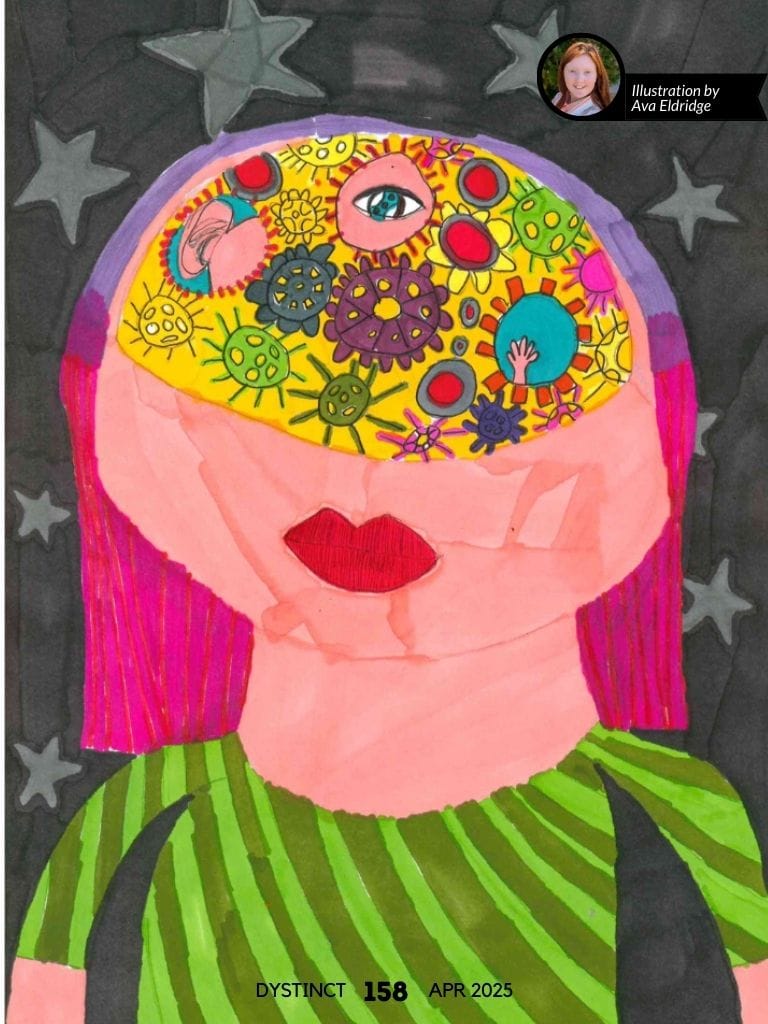
Imagine a machine in a factory – that is our brain in our head, which is managed by the 'boss' (the mind). There are several things that could go wrong with the machine. Here are just a few:
The input to the machine comes from all our senses around us and how we perceive things. There are eight main senses (STAR Institute, n.d.):
The five basic sensory systems:
- Visual
- Auditory
- Olfactory System (smell)
- Gustatory System (taste)
- Tactile System (touch/feel)
The three sensory systems that Ayres focused on in describing sensory integration dysfunction are:
- Tactile System (mentioned above)
- Vestibular System (sense of head movement in space)
- Proprioceptive System (sensations from muscles and joints of the body)
The most recently discussed set of sensations related to internal organs:
- Interoception
Depending on an individual's senses and perception, something could go wrong at the input level. It could also happen at the processing point, in the middle of the brain or at the central executive. The central executive, which is linked to the working memory, is also known as the conductor, sending information to and receiving information from the long-term memory and the output. The output is what we all see or hear, whether it's what the individual writes, says or does. There could be problems here, too, perhaps mechanical or related to coordination, e.g. the handwriting process.
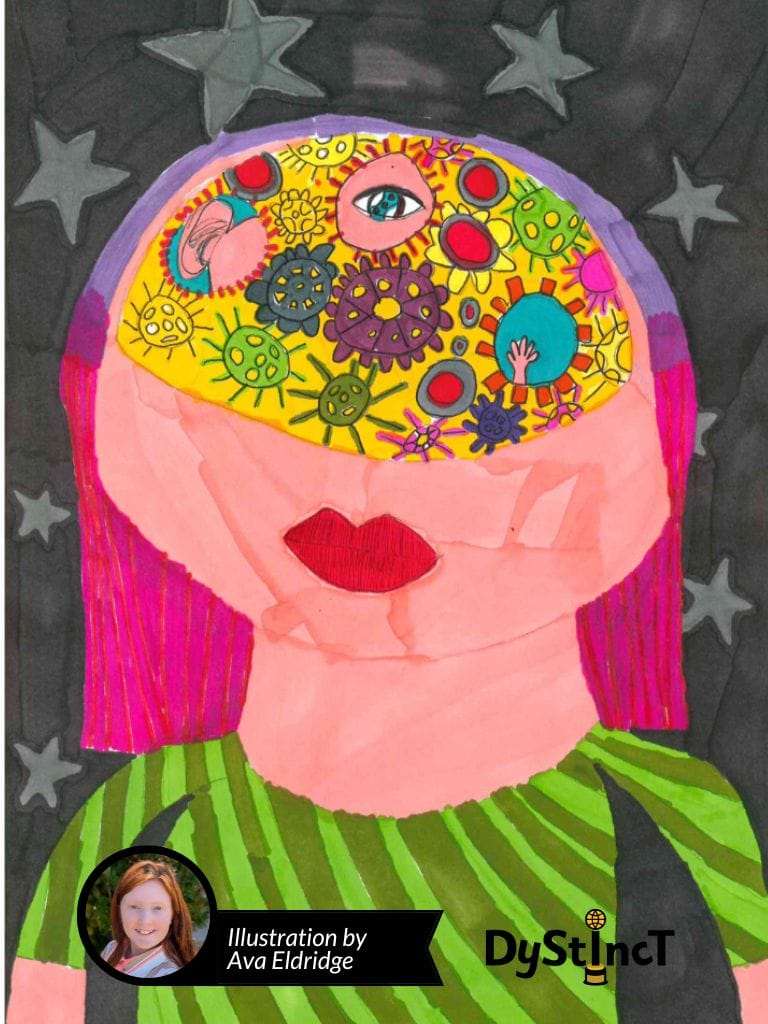
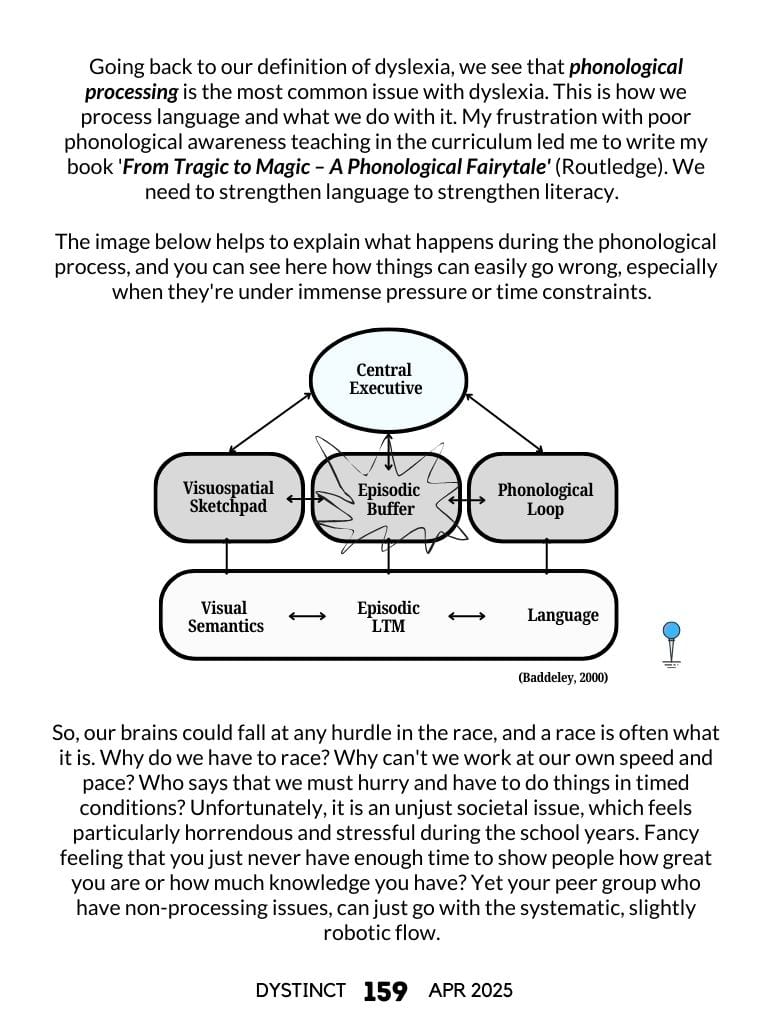
Going back to our definition of dyslexia, we see that phonological processing is the most common issue with dyslexia. This is how we process language and what we do with it. My frustration with poor phonological awareness teaching in the curriculum led me to write my book 'From Tragic to Magic – A Phonological Fairytale' (Routledge). We need to strengthen language to strengthen literacy.
The image below helps to explain what happens during the phonological process, and you can see here how things can easily go wrong, especially when they're under immense pressure or time constraints.
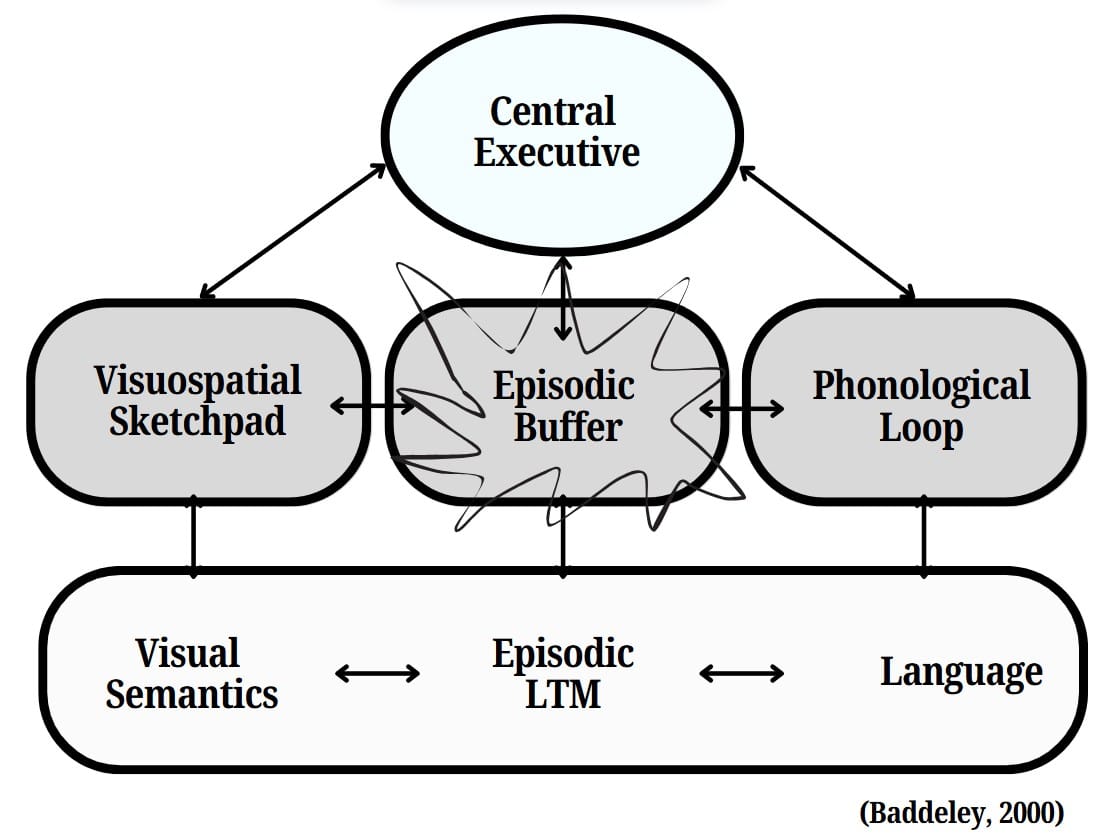
So, our brains could fall at any hurdle in the race, and a race is often what it is. Why do we have to race? Why can't we work at our own speed and pace? Who says that we must hurry and have to do things in timed conditions? Unfortunately, it is an unjust societal issue, which feels particularly horrendous and stressful during the school years. Fancy feeling that you just never have enough time to show people how great you are or how much knowledge you have? Yet your peer group who have non-processing issues, can just go with the systematic, slightly robotic flow.
Reading Fluency and Comprehension
Reading Fluency and Comprehension
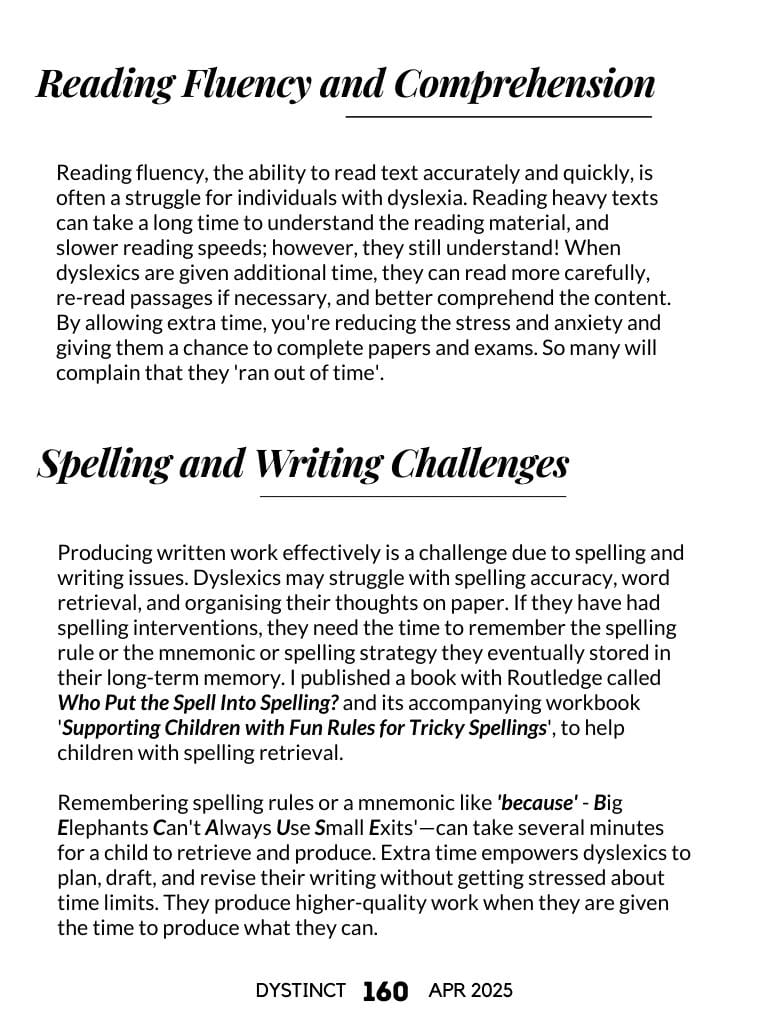
Reading fluency, the ability to read text accurately and quickly, is often a struggle for individuals with dyslexia. Reading heavy texts can take a long time to understand the reading material, and slower reading speeds; however, they still understand! When dyslexics are given additional time, they can read more carefully, re-read passages if necessary, and better comprehend the content. By allowing extra time, you're reducing the stress and anxiety and giving them a chance to complete papers and exams. So many will complain that they 'ran out of time'.
Spelling and Writing Challenges
Spelling and Writing Challenges
Producing written work effectively is a challenge due to spelling and writing issues. Dyslexics may struggle with spelling accuracy, word retrieval, and organising their thoughts on paper. If they have had spelling interventions, they need the time to remember the spelling rule or the mnemonic or spelling strategy they eventually stored in their long-term memory. I published a book with Routledge called Who Put the Spell Into Spelling? and its accompanying workbook 'Supporting Children with Fun Rules for Tricky Spellings', to help children with spelling retrieval.
Remembering spelling rules or a mnemonic like 'because' - Big Elephants Can't Always Use Small Exits'—can take several minutes for a child to retrieve and produce. Extra time empowers dyslexics to plan, draft, and revise their writing without getting stressed about time limits. They produce higher-quality work when they are given the time to produce what they can.
Ensuring Fair and Equitable Assessment
Ensuring Fair and Equitable Assessment
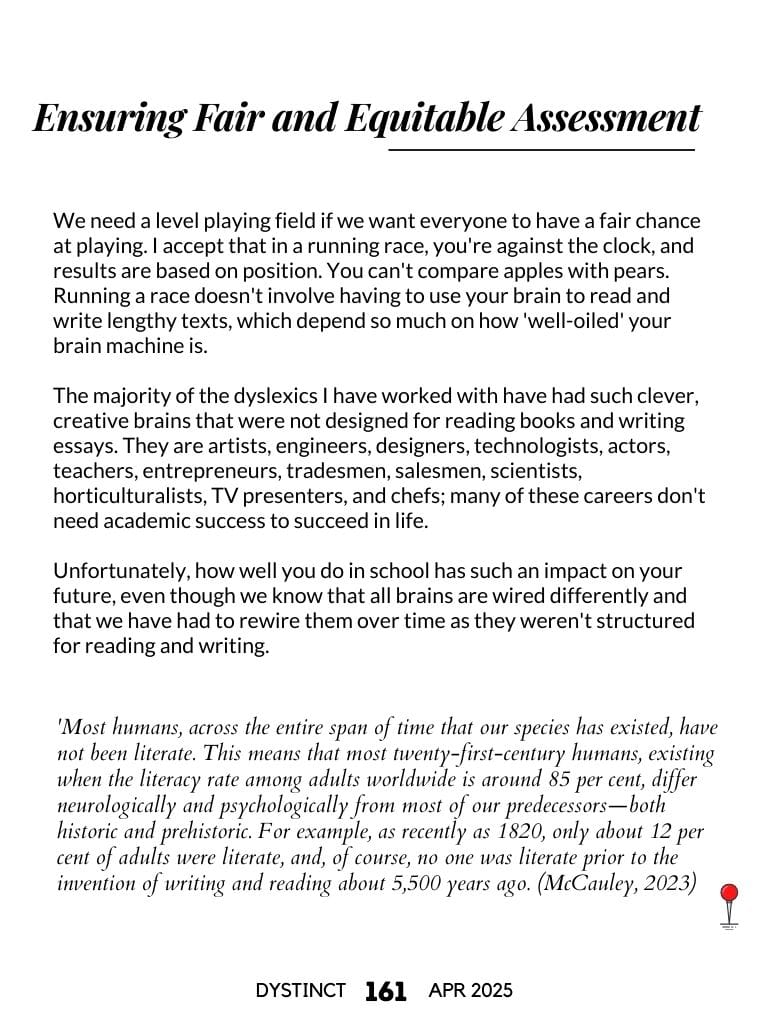
We need a level playing field if we want everyone to have a fair chance at playing. I accept that in a running race, you're against the clock, and results are based on position. You can't compare apples with pears. Running a race doesn't involve having to use your brain to read and write lengthy texts, which depend so much on how 'well-oiled' your brain machine is.
The majority of the dyslexics I have worked with have had such clever, creative brains that were not designed for reading books and writing essays. They are artists, engineers, designers, technologists, actors, teachers, entrepreneurs, tradesmen, salesmen, scientists, horticulturalists, TV presenters, and chefs; many of these careers don't need academic success to succeed in life.
Unfortunately, how well you do in school has such an impact on your future, even though we know that all brains are wired differently and that we have had to rewire them over time as they weren't structured for reading and writing.
'Most humans, across the entire span of time that our species has existed, have not been literate. This means that most twenty-first-century humans, existing when the literacy rate among adults worldwide is around 85 per cent, differ neurologically and psychologically from most of our predecessors—both historic and prehistoric. For example, as recently as 1820, only about 12 per cent of adults were literate, and, of course, no one was literate prior to the invention of writing and reading about 5,500 years ago. (McCauley, 2023)
Supporting Long-Term Success
Supporting Long-Term Success
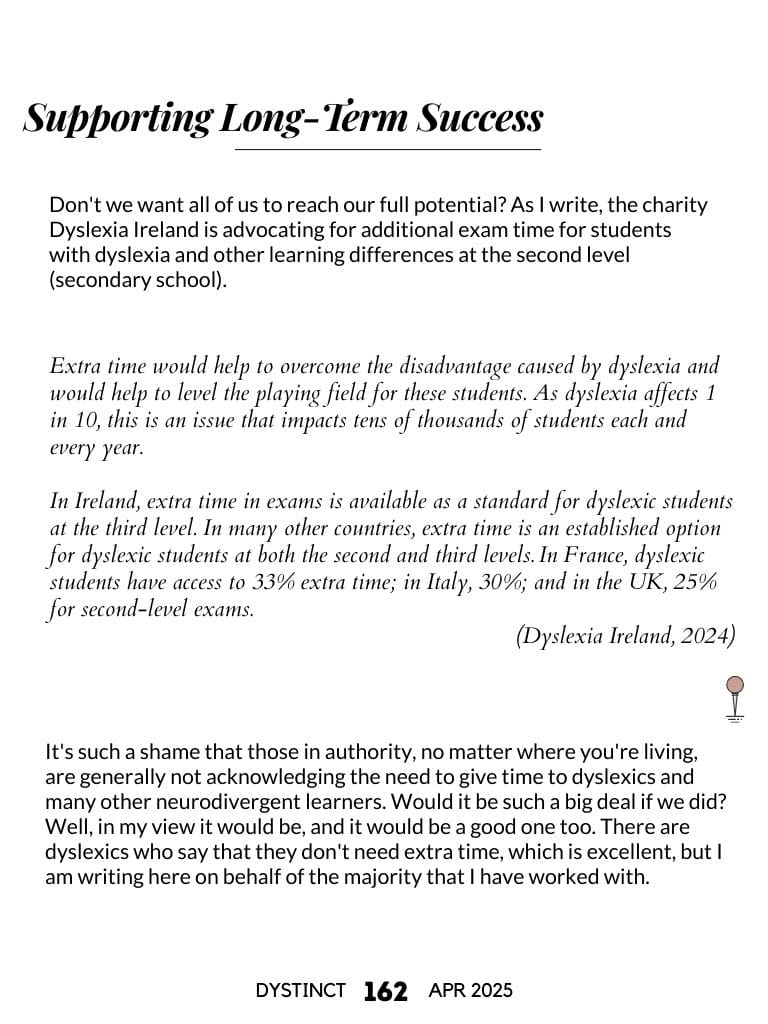
Don't we want all of us to reach our full potential? As I write, the charity Dyslexia Ireland is advocating for additional exam time for students with dyslexia and other learning differences at the second level (secondary school).
Extra time would help to overcome the disadvantage caused by dyslexia and would help to level the playing field for these students. As dyslexia affects 1 in 10, this is an issue that impacts tens of thousands of students each and every year.
In Ireland, extra time in exams is available as a standard for dyslexic students at the third level. In many other countries, extra time is an established option for dyslexic students at both the second and third levels. In France, dyslexic students have access to 33% extra time; in Italy, 30%; and in the UK, 25% for second-level exams.
(Dyslexia Ireland, 2024)
It's such a shame that those in authority, no matter where you're living, are generally not acknowledging the need to give time to dyslexics and many other neurodivergent learners. Would it be such a big deal if we did? Well, in my view it would be, and it would be a good one too. There are dyslexics who say that they don't need extra time, which is excellent, but I am writing here on behalf of the majority that I have worked with.
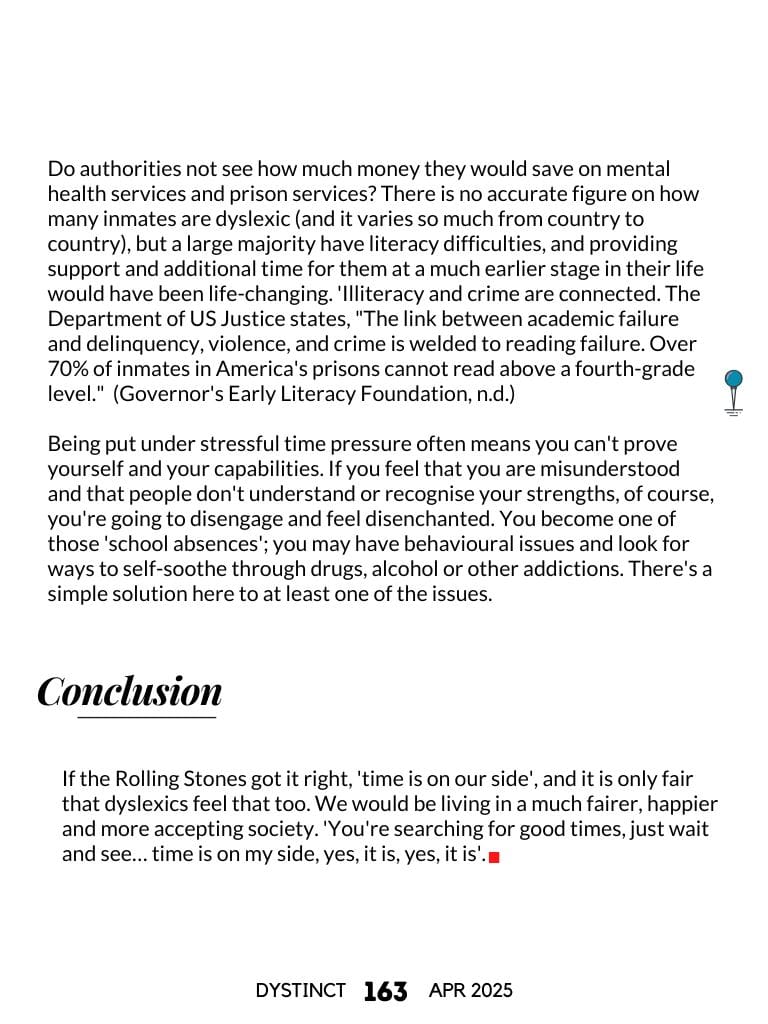
Do authorities not see how much money they would save on mental health services and prison services? There is no accurate figure on how many inmates are dyslexic (and it varies so much from country to country), but a large majority have literacy difficulties, and providing support and additional time for them at a much earlier stage in their life would have been life-changing. 'Illiteracy and crime are connected. The Department of US Justice states, "The link between academic failure and delinquency, violence, and crime is welded to reading failure. Over 70% of inmates in America's prisons cannot read above a fourth-grade level." (Governor's Early Literacy Foundation, n.d.)
Being put under stressful time pressure often means you can't prove yourself and your capabilities. If you feel that you are misunderstood and that people don't understand or recognise your strengths, of course, you're going to disengage and feel disenchanted. You become one of those 'school absences'; you may have behavioural issues and look for ways to self-soothe through drugs, alcohol or other addictions. There's a simple solution here to at least one of the issues.
Conclusion
Conclusion
If the Rolling Stones got it right, 'time is on our side', and it is only fair that dyslexics feel that too. We would be living in a much fairer, happier and more accepting society. 'You're searching for good times, just wait and see… time is on my side, yes, it is, yes, it is'.
References
References
- Baddeley, A. D. (2000). The episodic buffer: A new component of working memory. Trends in Cognitive Sciences, 4(11), 417–423. [doi.org]
- Dyslexia Ireland. (2024). Response to the State Examinations Commission’s Reply to the Call for Extra Time. [dyslexia.ie]
- Governor's Early Literacy Foundation. (n.d.). Early Literacy Connection to Incarceration. [governorsfoundation.org]
- Made By Dyslexia. (2022, October 10). Dr Maggie Aderin-Pocock: I think outside the planet | #DyslexicThinking [Video]. YouTube. [youtube.com]
- McCauley, R. N. (2023, August 14). Learning to read rewires brains. Psychology Today. [psychologytoday.com]
- Patoss. (2024). Introducing a new definition of dyslexia. Patoss. [patoss-dyslexia.org]
- STAR Institute. (n.d.). Your 8 senses. [sensoryhealth.org]
Georgie Cooney
Educator, Author, Speaker & Advocate for Neurodivergent Learners | dyslexiaspell.com | instagram | x | facebook | youtube
Georgie Cooney
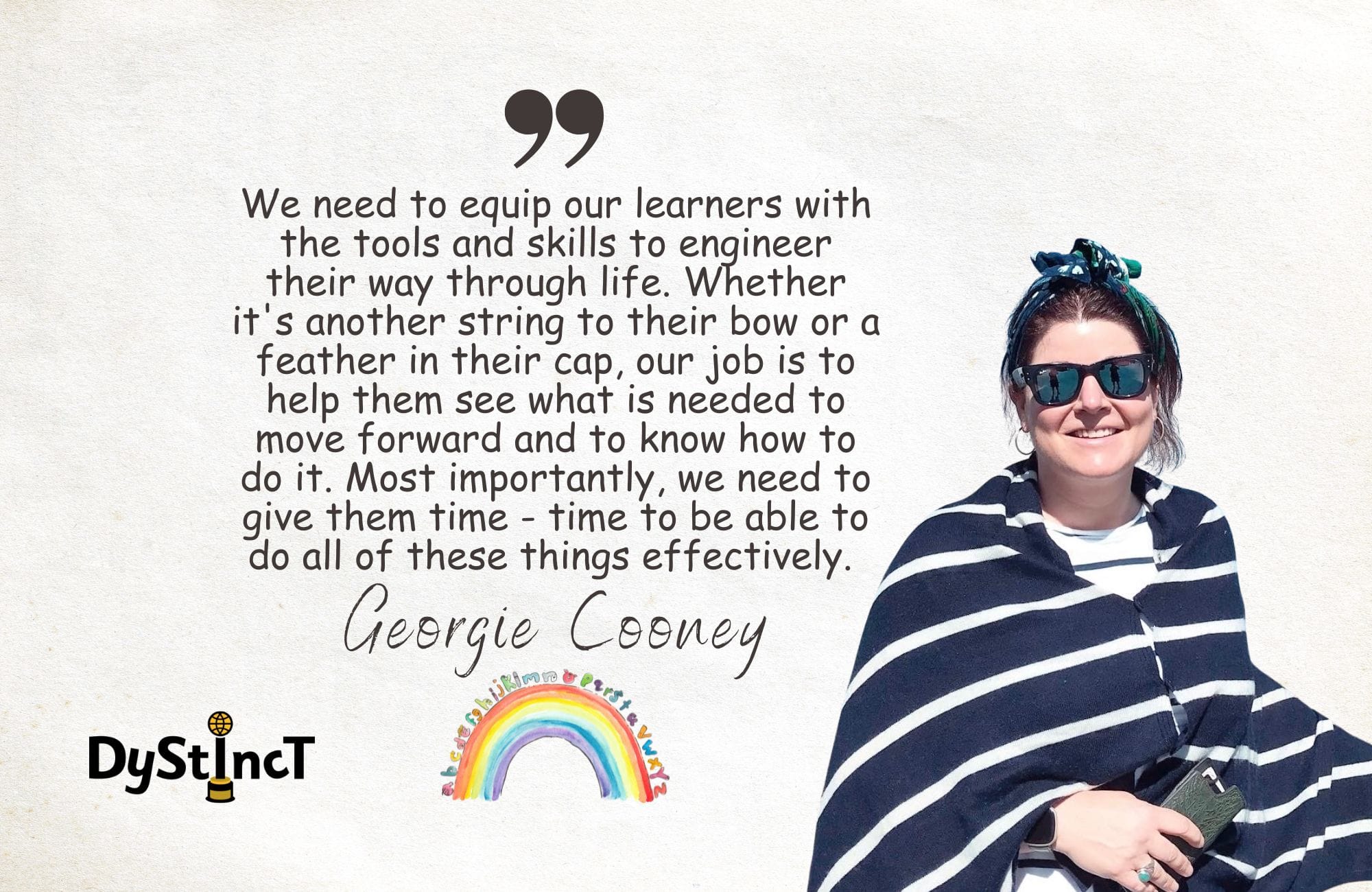
Georgie Cooney is an author and a fully qualified teacher who is passionate about creating a positive learning experience for all children. As a teacher and a dyslexia specialist, she has taught in a variety of schools both at home and abroad. Georgie has also spent many years training teachers to teach and understand neurodiverse learners.
Up until 2025, she was coordinating the Cork Workshop for Dyslexia Ireland. Georgie was also a co-host on the podcast TheLongWayBack and is now a co-host on Therapodpodcast where she discusses all things Neurodiversity. This is part of Therapix that Georgie is involved with. Furthermore, she is a tutor for ICEP (Institute of Child Education and Psychology) and a trainer for CyberSafeKids Ireland.
Georgie's main job (that she loves) is working with a range of learners with learning differences both in Co Cork, Ireland and in and around Dorset, Somerset and Wiltshire, U.K. She is rarely seen without one of her many dogs and continues to love being with her family and friends whilst walking, talking and learning. Georgie is currently studying for a Masters in Autism and Neurodiversity with the NSPC and perseveres with her love of learning.
BUY BOOK

Supporting Children with Fun Rules for Tricky Spellings
An exciting and colourful storybook and workbook set to help make spelling fun.

From Tragic to Magic
A Phonological fairytale and guide to prepare children for literacy.
Extracts from Dystinct Magazine
Extracts from Dystinct Magazine




%20Need%20Additional%20Time%20%7C%20Georgie%20Cooney%20%7C%20Dyslexia%20Spell)