Issue 30: Behavioral and Interpersonal Techniques for Improving Children’s and Teens’ Behavior and Well-Being | Steve Hoersting
Steve Hoersting outlines how combining behavioural and interpersonal strategies supports children’s and teens’ development, emphasising the role of positive reinforcement, executive function support, and strong relationships in improving behaviour and emotional well-being.

Table of Contents
Supporting healthy development in children and adolescents involves both behavioral and interpersonal strategies to promote positive change and well-being. Parents, caregivers, and professionals can use evidence-based methods to strengthen executive functions, manage anxiety, and build healthier relationships.
With over 40 years of experience addressing these issues, I have seen the field evolve beyond BF Skinner’s behavioral techniques to include more complex approaches that account for attitudes and thought processes. Incorporating these concepts is critical for professionals and beneficial for parents and caregivers seeking effective results.
With over 40 years of experience addressing these issues, I have seen the field evolve beyond BF Skinner’s behavioral techniques to include more complex approaches that account for attitudes and thought processes.
Understanding Behavior Modification at Home and in Professional Settings
Understanding Behavior Modification at Home and in Professional Settings
Behavior modification uses interventions to promote positive behaviors and decrease negative ones. Parents set clear rules and reward good behavior at home, while therapists and educators create tailored programs in professional settings.
Positive reinforcement is a cornerstone of behavior modification. It involves providing rewards or praise immediately after desired behaviors, including approximations of those behaviors, which strengthens the likelihood that those behaviors will be repeated. Techniques such as antecedent adjustment (changing triggers for behavior), behavioral contracts (written agreements outlining expectations and rewards), modeling (demonstrating desired behaviors), and shaping (reinforcing small steps toward a complex behavior) are commonly used to teach and reinforce new skills.
What are some examples of antecedent adjustment? Antecedent adjustment can be made in a variety of contexts, including homework, mealtimes, getting ready to go somewhere, and other family functions. One adjustment that can be made for homework time is to use the strategy of “circling.” Circling is taking all of the homework assignments, setting a timer, and working on a subject for a set amount of time. When the time is up, the child or adolescent then moves on to the next subject. This reduces boredom, encourages executive function skills, and prevents the child or adolescent from stopping to take a break and, at times, getting into activities that are then very difficult to move them away from. It can reduce conflict between parents and children. I have used what I call the “frog on the pond version. This is where there are lily pads that number the homework subjects, and when the time goes off, the frog jumps to the next lily pad. This may add a little fun to an otherwise less fun activity.
Another antecedent adjustment can be used in the context of video games. Video games are designed to keep children and adolescents engaged and to make it difficult for them to stop playing. Video games may be started, which can reduce conflict over stopping them, so as not to overlap with homework, meals, or bedtime; however, it is impossible to anticipate all spontaneous antecedents. However, if many of them can be reduced, this can be quite helpful.
Another method of behavior modification can be behavior contracts. Behavior contracts may be useful for behavior change and for increasing the likelihood of desired behaviors. The parents can develop a contract, introduce it to the child or adolescent, and allow them to express their wants and willing behavior. The contract can be negotiated to benefit both the parent and the adolescent. In my practice, we will develop behavioral contracts for things such as video game time, TV watching, bedtime routines, and other activities that the child continues to insist on, but that the parent would not necessarily want to provide without some give-and-take with the child. It is: if you do this, how much I will allow you to do that for how much.
Modeling is another behavioral method in which adults demonstrate the desired behaviors for the child or adolescent. Examples of this could be things such as “thank you for handing that to me”, “I appreciate you saying thank you”, “apologizing when something happened, for instance, interrupting the child when they are conversing with you. Also, physical activities such as picking up clothes and hanging up coats, etc., are demonstrated by the adults and reinforced when performed by the child or adolescent. This activity coexists with shaping.
Shaping involves reinforcing desired behaviors, not necessarily waiting for the full behavior, but rather rewarding approximations of it. Reinforcing behaviors by saying, I really like the way you walk past your sibling without touching them, or I really like the way you did not put your coat on the floor. Eventually, of course, we hope to model and shape their behavior so that they hang up their coat and treat their brother respectfully, and vice versa.
At the beginning, finding those behaviors that are a step closer to the desired behavior and reinforcing them is important. Reinforcement can be verbal, tangible, or a combination of both. It largely depends on how difficult the desired behavior is thought to be. Therefore, beginning with a tangible reinforcer is often required. This may be done in the form of a chart with specific behaviors and specific reinforcers. They are typically related to the number of times that the behaviors occur. Initially, however, reinforcers given immediately upon observing the desired behavior are most effective. So, if the child walks in the door, takes their shoes off, and places them next to the rug, and that is the desired behavior, then immediately say, “Good job! Thank you for putting your shoes over there. Let me hang up your jacket for you, and we will have a snack right now.” Anything along those lines could be used.
In my office, chips like poker chips are handed out for desired behaviors at times. At a certain point, they may be traded in for a reward. Typically, in my office, rewards are tangible. At home, I encourage parents, as much as possible, to connect the rewards to privileges, etc. These are typically things they have to wait longer for to happen. However, with the tokens they can purchase, they can get additional staying-up time on Saturday, additional video game time, additional TV time, and other things like a sleepover, etc.
At home, I encourage parents, as much as possible, to connect the rewards to privileges, etc.
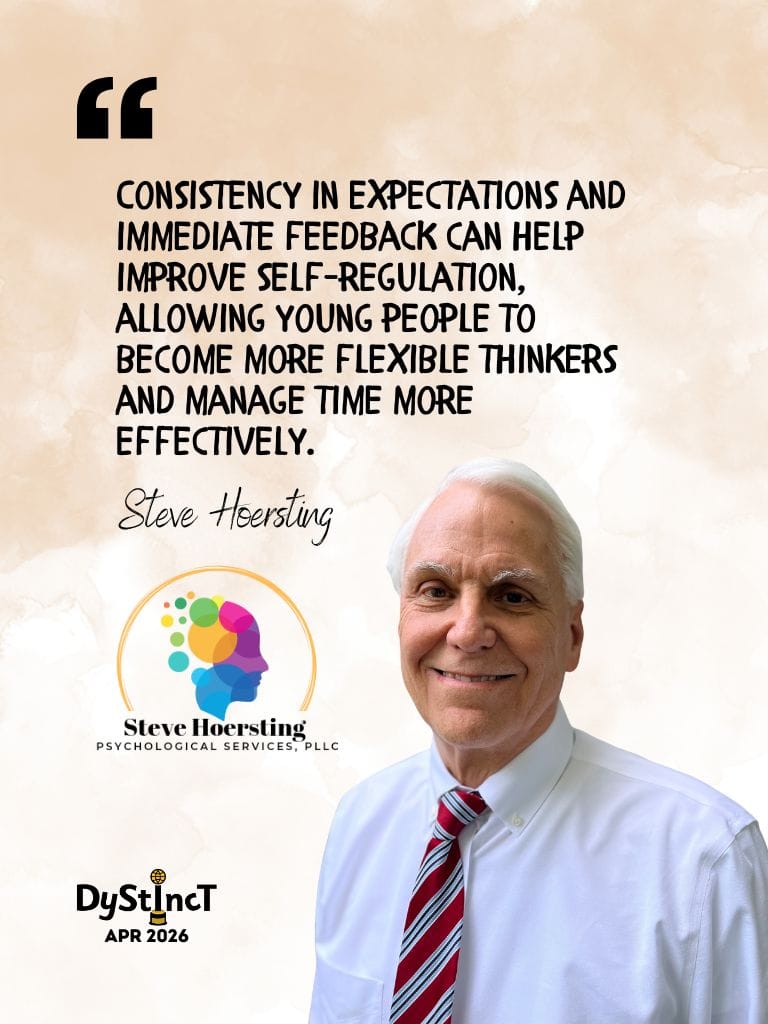
Consistency in expectations and immediate feedback can help improve self-regulation, allowing young people to become more flexible thinkers and manage time more effectively.
Teachers use these often in their classrooms to shape desired behaviors. They use modeling. Often, they will adjust antecedents by moving the child or adolescent away from another, where there is typically conversation during instruction time. They may alter the classroom seating arrangement in general, with purposeful seating in the front, etc. Teachers I have run across will also use behavior contracts with certain students to show you know this is hard for them, and these things are difficult for me. So, let’s have a contract where you perform the activities I would like you to, and in turn, I will allow you to perform certain things in the classroom. These can be, for example, helping the teacher clean. It is amazing how many children and adolescents really enjoy helping the teachers. Teachers will use shaping by pointing out when the student raises their hand, when they finish an assignment, and sit quietly, or when they raise their hand to ask before coming up to the teacher's desk. Many other behaviors often require this type of approach.
Executive function skills such as planning, organizing, and managing time are critical for children’s and teens’ success in school and life. Specific strategies to enhance these skills include teaching goal-setting, breaking tasks into manageable steps, and using visual schedules or reminders. Consistency in expectations and immediate feedback can help improve self-regulation, allowing young people to become more flexible thinkers and manage time more effectively.
Many children and teens struggle with anxiety, which can impact behavior and relationships. Techniques such as Acceptance and Commitment Therapy (ACT) encourage young people to acknowledge and accept negative thoughts and feelings rather than suppressing them. Behavioral activation, which involves gradually reintroducing enjoyable activities, can be especially helpful for children experiencing.
Interpersonal techniques, such as Interpersonal Psychotherapy (IPT), emphasize the significance of relationships in shaping behaviour. IPT is generally brief and present-focused, helping children and adolescents understand how their interactions with others affect their emotions and actions. Parent-Child Interaction Therapy (PCIT) aims to strengthen the parent-child relationship and teach social skills, thereby supporting children in developing healthier interpersonal relationships.
Families can support interpersonal skills by holding daily check-ins, scheduling calm discussions about concerns, and addressing problems when emotions are stable. Encouraging "I" statements helps children express feelings constructively. Keeping routines and social activities consistent fosters resilience. Empathy training reduces conflict, and setting small, achievable goals promotes social engagement.
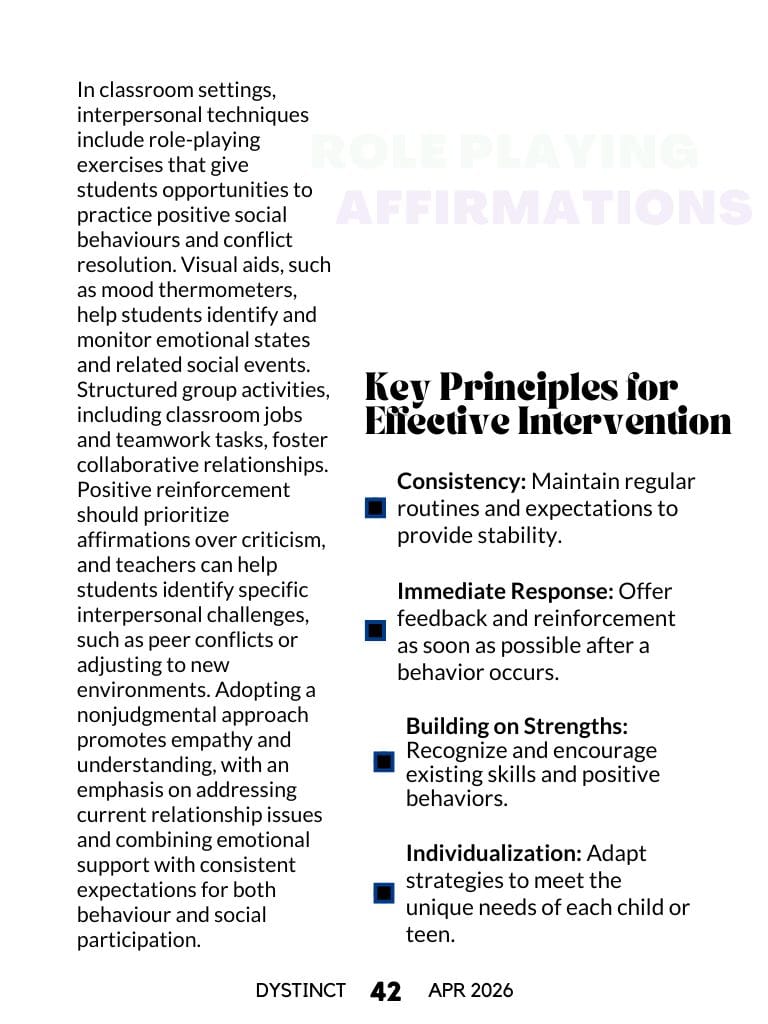
In classroom settings, interpersonal techniques include role-playing exercises that give students opportunities to practice positive social behaviours and conflict resolution. Visual aids, such as mood thermometers, help students identify and monitor emotional states and related social events. Structured group activities, including classroom jobs and teamwork tasks, foster collaborative relationships. Positive reinforcement should prioritize affirmations over criticism, and teachers can help students identify specific interpersonal challenges, such as peer conflicts or adjusting to new environments. Adopting a nonjudgmental approach promotes empathy and understanding, with an emphasis on addressing current relationship issues and combining emotional support with consistent expectations for both behaviour and social participation.
Key Principles for Effective Intervention
Key Principles for Effective Intervention
Consistency: Maintain regular routines and expectations to provide stability.
Immediate Response: Offer feedback and reinforcement as soon as possible after a behavior occurs.
Building on Strengths: Recognize and encourage existing skills and positive behaviors.
Individualization: Adapt strategies to meet the unique needs of each child or teen.
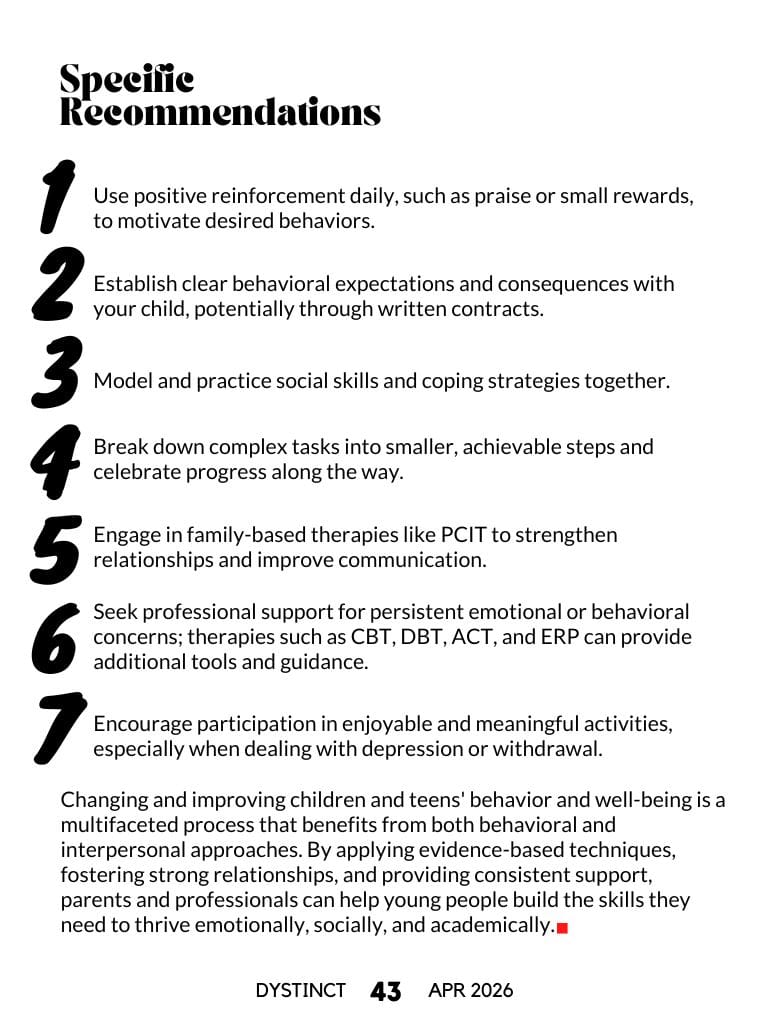
Specific Recommendations
Specific Recommendations
- Use positive reinforcement daily, such as praise or small rewards, to motivate desired behaviors.
- Establish clear behavioral expectations and consequences with your child, potentially through written contracts.
- Model and practice social skills and coping strategies together.
- Break down complex tasks into smaller, achievable steps and celebrate progress along the way.
- Engage in family-based therapies like PCIT to strengthen relationships and improve communication.
- Seek professional support for persistent emotional or behavioral concerns; therapies such as CBT, DBT, ACT, and ERP can provide additional tools and guidance.
- Encourage participation in enjoyable and meaningful activities, especially when dealing with depression or withdrawal.
Changing and improving children and teens' behavior and well-being is a multifaceted process that benefits from both behavioral and interpersonal approaches. By applying evidence-based techniques, fostering strong relationships, and providing consistent support, parents and professionals can help young people build the skills they need to thrive emotionally, socially, and academically.
Steve Hoersting
Licensed Psychological Practitioner, ADHD/Autism Specialist, & Founder | stevehoerstingpsychologicalservices.com
Steve Hoersting
Steve Hoersting, MED, LPP, CBIA, CACSP, CASCS, CMIS, CCATP, CDBTP is a Licensed Psychological Practitioner specializing in clinical child and adolescent psychology. He is the founder of Steve Hoersting Psychological Services, PLLC, in Florence, Kentucky, and holds certifications in ADHD, autism spectrum disorders, and mindfulness-informed therapy. With over 40 years of experience, Hoersting provides therapy and evaluations for individuals with various neurodevelopmental and mood disorders. He is also the author of Maintaining the Truth, a guide for parents and caregivers of neurodivergent children.
BUY BOOK

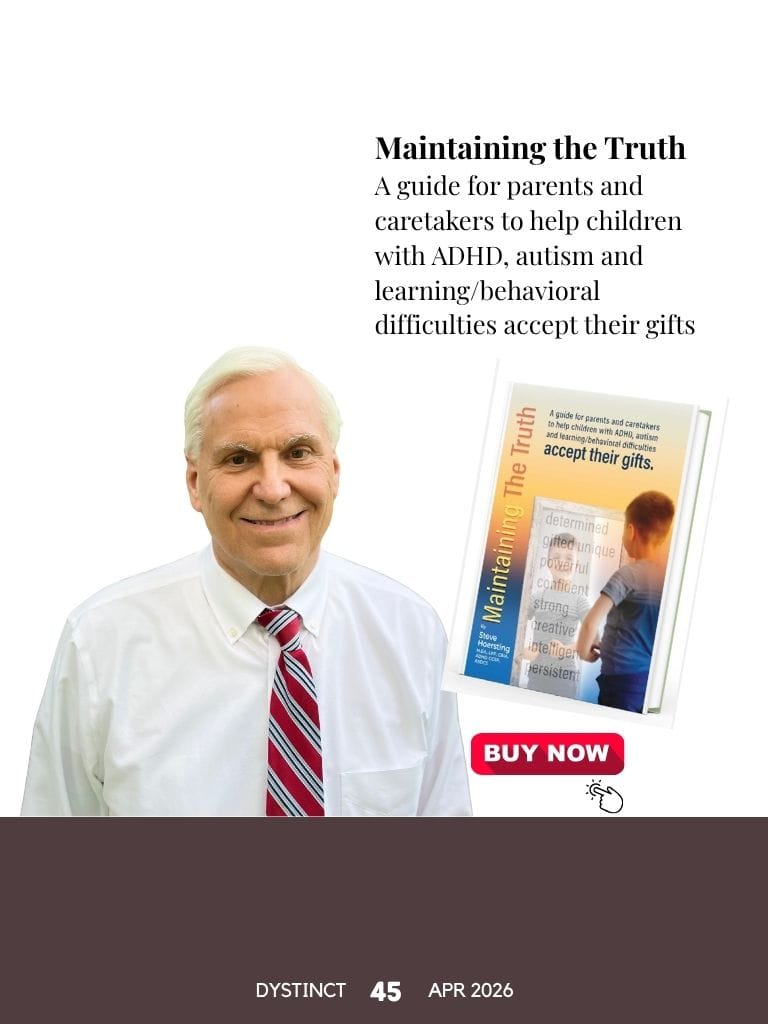
Maintaining the Truth
A guide for parents and caretakers to help children with ADHD, autism and learning/behavioral difficulties accept their gifts.
Extracts from Dystinct Magazine
Extracts from Dystinct Magazine