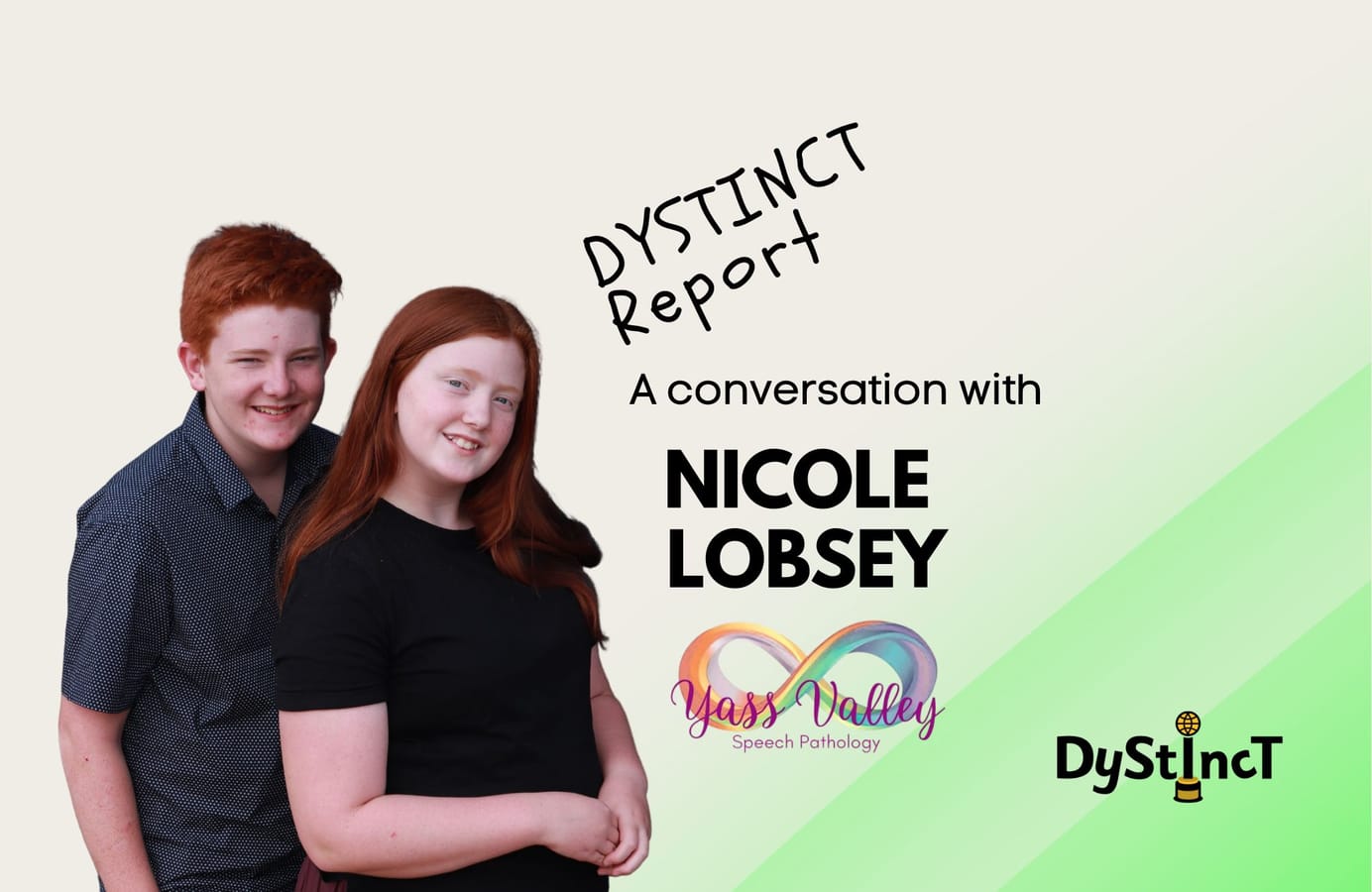
Issue 29: Dystinct Report - A Conversation with Nicole Lobsey | Flynn & Eva Eldridge
Ava and Flynn speak with neurodivergent speech pathologist and Yass Valley Speech Pathology founder Nicole Lobsey about dysgraphia, masking, schooling, and neuroaffirming practice, highlighting how lived experience and advocacy can reshape support for the neurodivergent.
Table of Contents
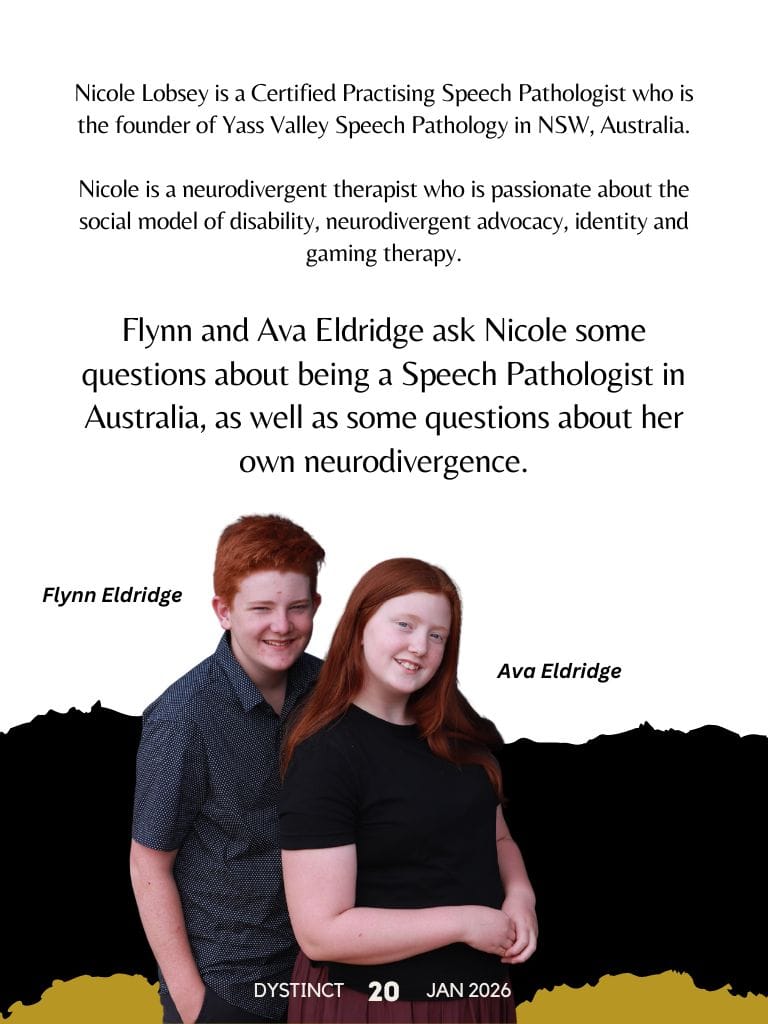
Flynn and Ava Eldridge ask Nicole some questions about being a Speech Pathologist in Australia, as well as some questions about her own neurodivergence.
Questions and Answers
Questions and Answers
AVA: Tell us about yourself and what you do for a living.
NICOLE: I am a speech pathologist working in private practice. I work with neurodivergent children and teenagers. I have been a speech pathologist for 20 years, with a few breaks in between.
I am Dysgraphic. Dysgraphia is a learning disability in writing, spelling, handwriting, and typing.
FLYNN: Why did you get into speech?
NICOLE: I was still at school and had to pick something. I wanted to work with children. I liked the mix of linguistics and science. I didn’t have a real passion for speech pathology at the time or really know what it was. If I had my time again, I would do a more general degree and then decide later.
AVA: What is the difference between speech therapy and speech pathology?
NICOLE: We have different titles in different countries. In Australia, “therapy” and “pathology” are the same. There is a push by neuro-affirming speech therapists to replace “pathology” with “therapy” because of its medical/deficit/ableist meaning.
FLYNN: When did you find out about your neurodivergence?
NICOLE: I was diagnosed as an adult at university.
AVA: How did you get on with schooling?
NICOLE: Writing, spelling and handwriting were very difficult. Because I could memorise and rote-learn, I was able to mask or “cover” my difficulties for a while until writing demands got greater in late high school.
Masking is very exhausting, so I did have difficulty with burnout, nervous system overwhelm and anxiety, and after-school collapse, which are very common in people with undiagnosed learning disabilities.
I have always explained it like being a duck - calm on top of the water but frantically paddling under the surface.
We also often become fawners and people pleasers. We often feel like the odd ones out and wonder why other people seem to be doing things so much easier than us, or why we have to put in so much more effort for the same results.
The shame and negative feedback build up over time, impacting self-esteem and self-worth.
We often feel like the odd ones out and wonder why other people seem to be doing things so much easier than us.
FLYNN: Who was supportive of you through your schooling process?
NICOLE: Learning plans and accommodations weren’t a thing back then. As writing demands increased in high school, I had a scribe and longer exam time. I had to rewrite a lot of my work, which was exhausting and caused shame and embarrassment. Something that has stuck with me is being the only person at school to not get my Pen Licence. Things like this are seen as not a big deal, but the “little” things add up over our schooling and cause shame and trauma. I will continue to advocate for removing Pen Licences.
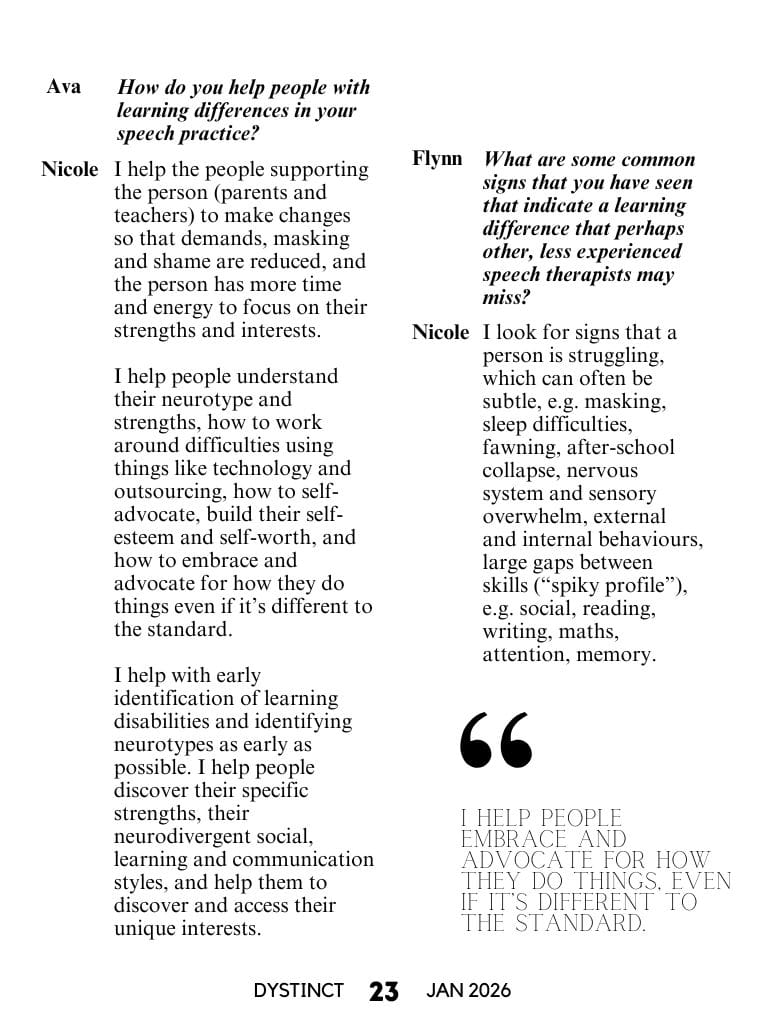
AVA: How do you help people with learning differences in your speech practice?
NICOLE: I help the people supporting the person (parents and teachers) to make changes so that demands, masking and shame are reduced, and the person has more time and energy to focus on their strengths and interests.
I help people understand their neurotype and strengths, how to work around difficulties using things like technology and outsourcing, how to self-advocate, build their self-esteem and self-worth, and how to embrace and advocate for how they do things even if it’s different to the standard.
I help with early identification of learning disabilities and identifying neurotypes as early as possible. I help people discover their specific strengths, their neurodivergent social, learning and communication styles, and help them to discover and access their unique interests.
FLYNN: What are some common signs that you have seen that indicate a learning difference that perhaps other, less experienced speech therapists may miss?
NICOLE: I look for signs that a person is struggling, which can often be subtle, e.g. masking, sleep difficulties, fawning, after-school collapse, nervous system and sensory overwhelm, external and internal behaviours, large gaps between skills (“spiky profile”), e.g. social, reading, writing, maths, attention, memory.
I help people embrace and advocate for how they do things, even if it’s different to the standard.
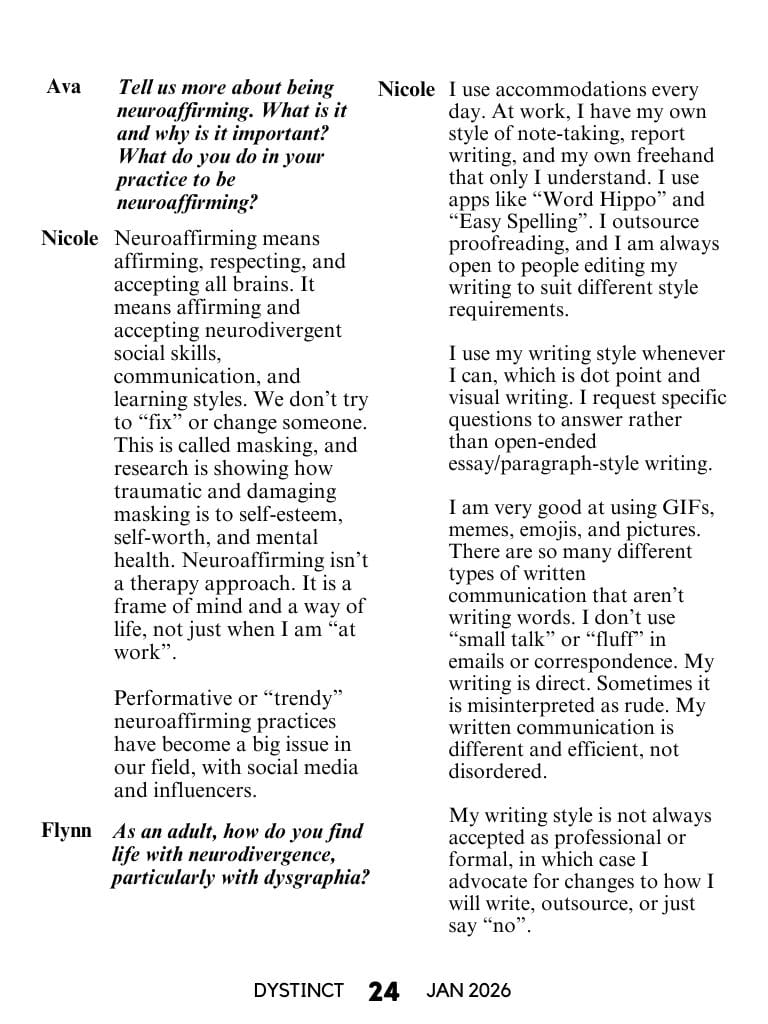
AVA: Tell us more about being neuroaffirming. What is it and why is it important? What do you do in your practice to be neuroaffirming?
NICOLE: Neuroaffirming means affirming, respecting, and accepting all brains. It means affirming and accepting neurodivergent social skills, communication, and learning styles. We don’t try to “fix” or change someone. This is called masking, and research is showing how traumatic and damaging masking is to self-esteem, self-worth, and mental health. Neuroaffirming isn’t a therapy approach. It is a frame of mind and a way of life, not just when I am “at work”.
Performative or “trendy” neuroaffirming practices have become a big issue in our field, with social media and influencers.
FLYNN: As an adult, how do you find life with neurodivergence, particularly with dysgraphia?
NICOLE: I use accommodations every day. At work, I have my own style of note-taking, report writing, and my own freehand that only I understand. I use apps like “Word Hippo” and “Easy Spelling”. I outsource proofreading, and I am always open to people editing my writing to suit different style requirements.
I use my writing style whenever I can, which is dot point and visual writing. I request specific questions to answer rather than open-ended essay/paragraph-style writing.
I am very good at using GIFs, memes, emojis, and pictures. There are so many different types of written communication that aren’t writing words. I don’t use “small talk” or “fluff” in emails or correspondence. My writing is direct. Sometimes it is misinterpreted as rude. My written communication is different and efficient, not disordered.
My writing style is not always accepted as professional or formal, in which case I advocate for changes to how I will write, outsource, or just say “no”.
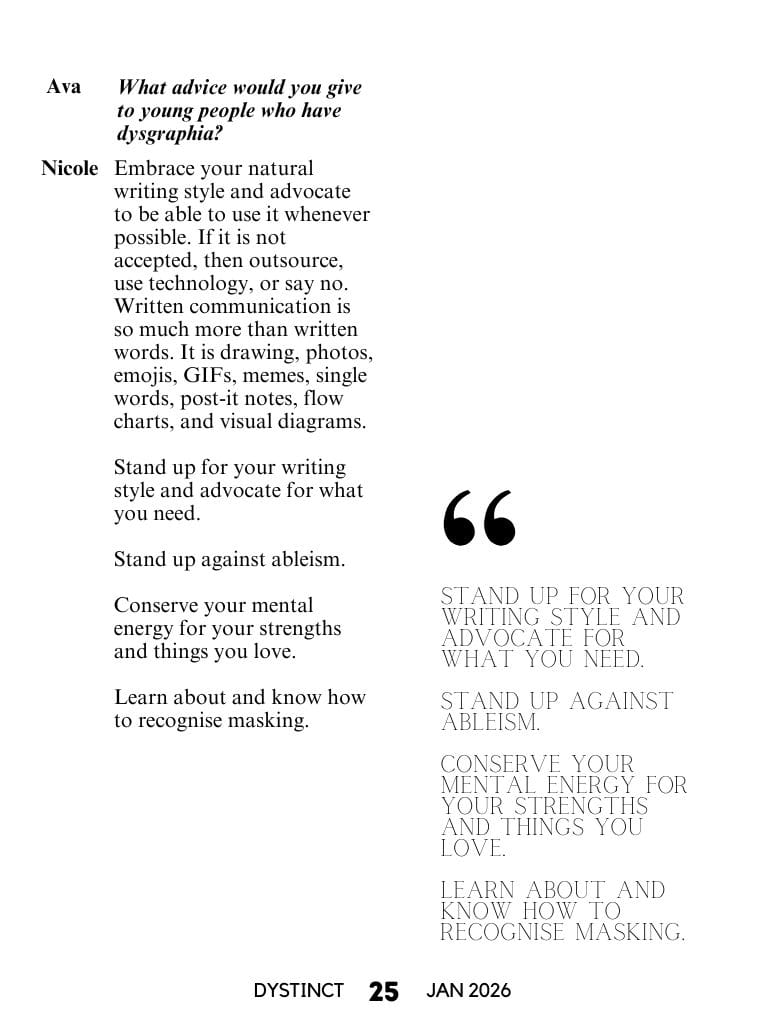
AVA: What advice would you give to young people who have dysgraphia?
NICOLE: Embrace your natural writing style and advocate to be able to use it whenever possible. If it is not accepted, then outsource, use technology, or say no.
Written communication is so much more than written words. It is drawing, photos, emojis, GIFs, memes, single words, post-it notes, flow charts, and visual diagrams.
Stand up for your writing style and advocate for what you need.
Stand up against ableism.
Conserve your mental energy for your strengths and things you love.
Learn about and know how to recognise masking.
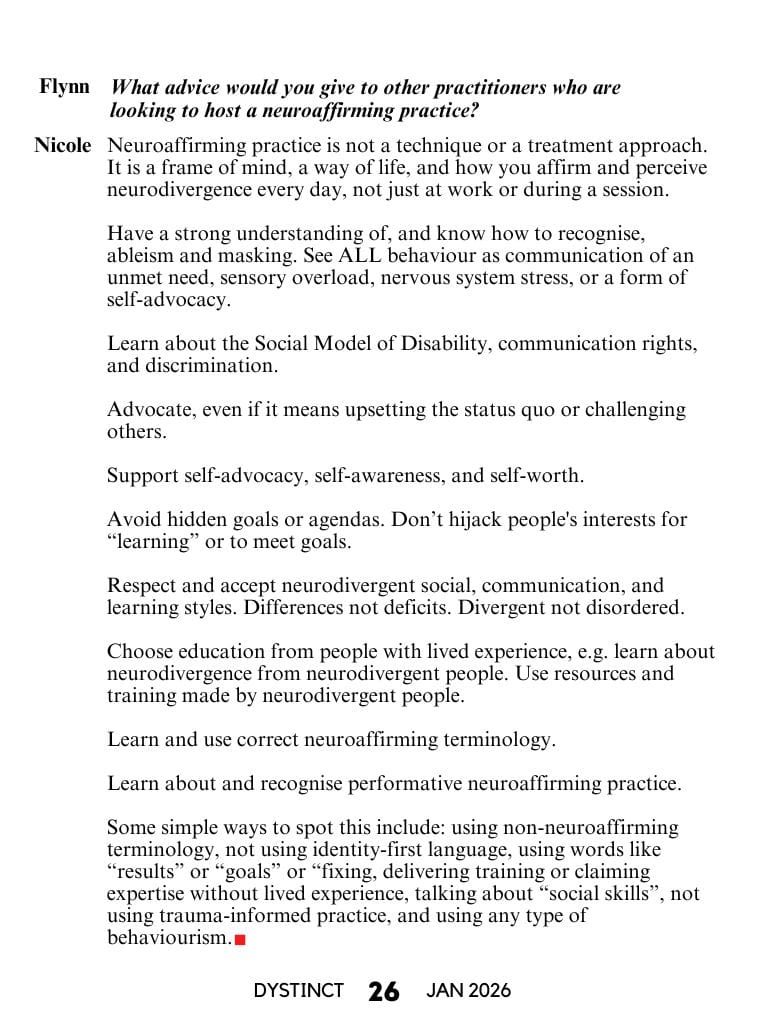
FLYNN: What advice would you give to other practitioners who are looking to host a neuroaffirming practice?
NICOLE: Neuroaffirming practice is not a technique or a treatment approach. It is a frame of mind, a way of life, and how you affirm and perceive neurodivergence every day, not just at work or during a session.
Have a strong understanding of, and know how to recognise, ableism and masking. See ALL behaviour as communication of an unmet need, sensory overload, nervous system stress, or a form of self-advocacy.
Learn about the Social Model of Disability, communication rights, and discrimination.
Advocate, even if it means upsetting the status quo or challenging others.
Support self-advocacy, self-awareness, and self-worth.
Avoid hidden goals or agendas. Don’t hijack people's interests for “learning” or to meet goals.
Respect and accept neurodivergent social, communication, and learning styles. Differences not deficits. Divergent not disordered.
Choose education from people with lived experience, e.g. learn about neurodivergence from neurodivergent people. Use resources and training made by neurodivergent people.
Learn and use correct neuroaffirming terminology.
Learn about and recognise performative neuroaffirming practice.
Some simple ways to spot this include: using non-neuroaffirming terminology, not using identity-first language, using words like “results” or “goals” or “fixing, delivering training or claiming expertise without lived experience, talking about “social skills”, not using trauma-informed practice, and using any type of behaviourism.
Flynn Eldridge
Dystinct Journalist | Age 14 | Dyslexia, Dysgraphia, and ADHD inattentive | Regional NSW, Australia
Flynn Eldridge
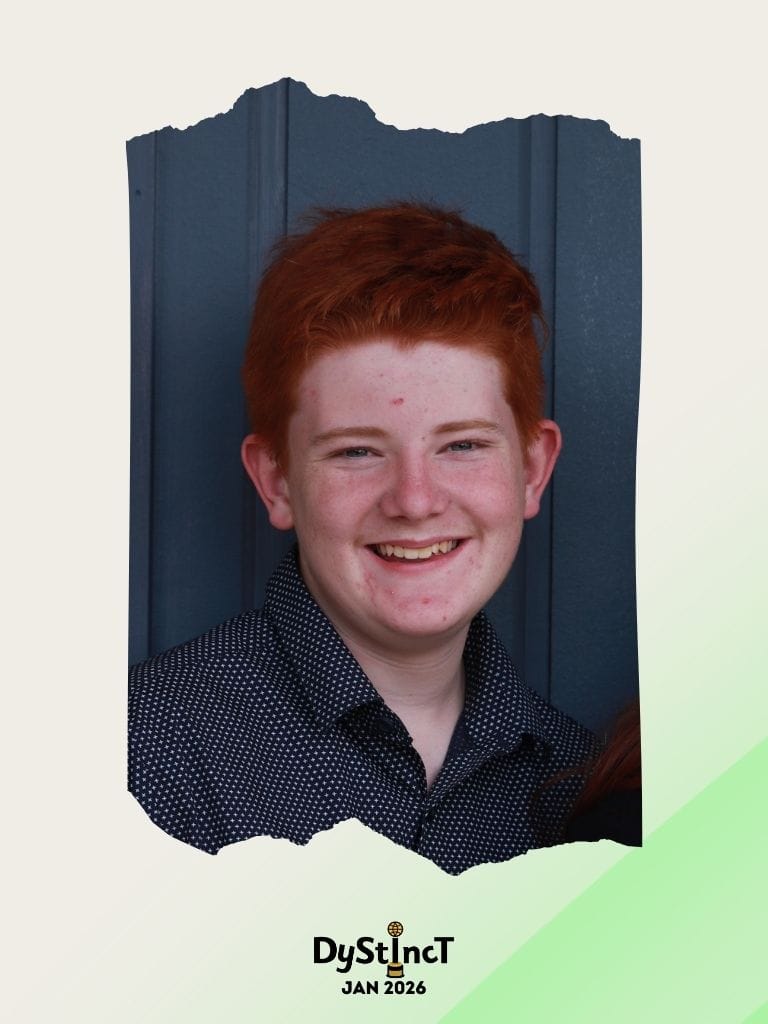
Flynn began homeschooling in 2020 as a result of the COVID-19 lockdown, after school was no longer the right fit for him. He later attempted to return to school and is now transitioning well into high school, where he is enjoying the increased choice of subjects that align with his interests.
Flynn finds reporting fun, even though it sometimes takes him outside his comfort zone. He has always loved Lego and builds a wide range of creations, including the rainbow spinning-top microphone he used in his first interviews. More recently, Flynn has expanded his innovation into wood and metal. He also enjoys sketching and photography, and uses complex coding to bring his creations to life.
Ava Eldridge
Dystinct Journalist | Age 12 | Dyslexia | Regional NSW, Australia
Ava Eldridge
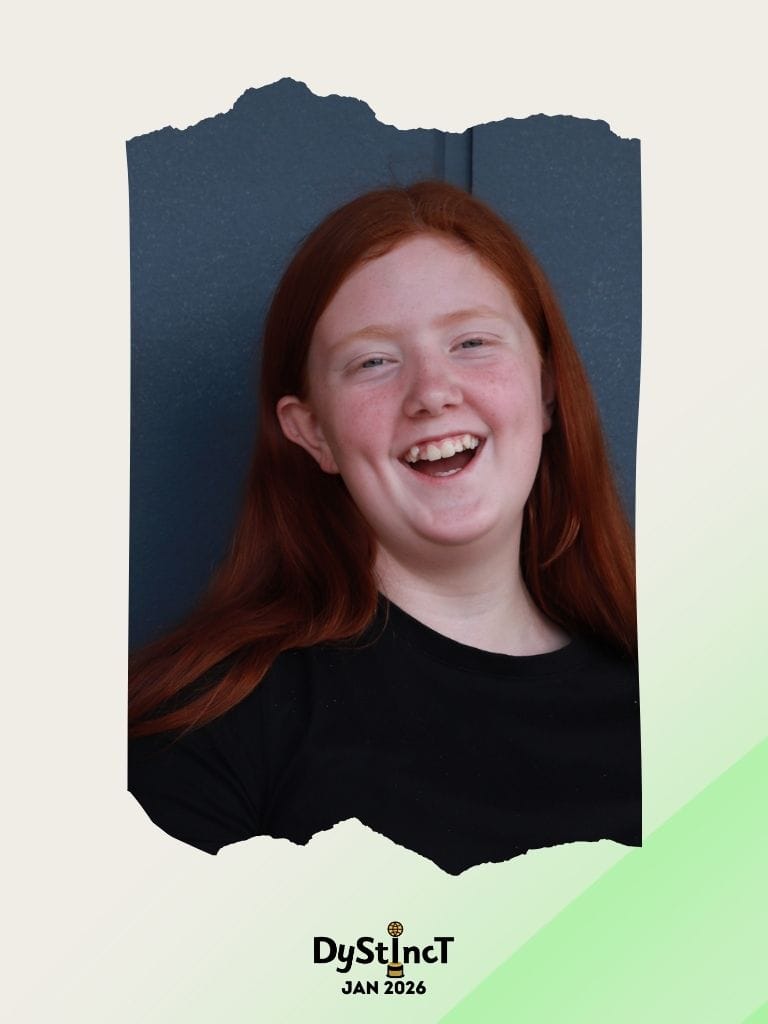
Ava Eldridge is from NSW, Australia.
Ava loves art, animals, cooking, her family, playing the piano, and she really enjoys reading!
Ava had early intervention for her dyslexia. This intervention helped her be one of the best readers and writers in her class when she was in the early years of school.
Ava decided to homeschool with her siblings when the pressure of 'tests' (everyday 'tests'/national testing) started to make her incredibly anxious, and now she is transitioning back to school.
Ava embraces her dyslexia strengths, such as her amazing long-term memory and the empathy she has towards others.
Extracts from Dystinct Magazine
Extracts from Dystinct Magazine