Issue 32: What the Birds Taught Us: How I Helped My Striving Reader Catch Up | Katie Megrian
Literacy specialist Katie Megrian draws on her expertise and experience as a parent to share practical ways families can support reading development, complement classroom instruction and nurture a love of reading.

Table of Contents
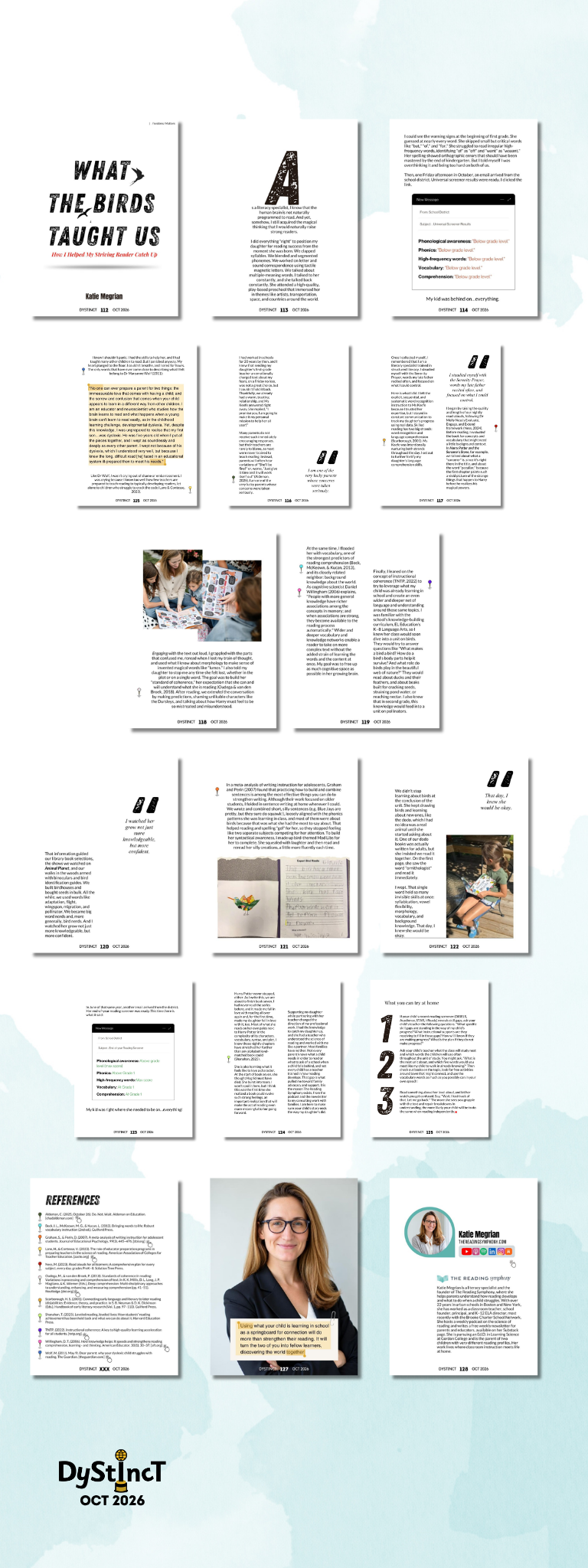
As a literacy specialist, I know that the human brain is not naturally programmed to read. And yet, somehow, I still acquired the magical thinking that I would naturally raise strong readers.
I did everything "right" to position my daughter for reading success from the moment she was born. We clapped syllables. We blended and segmented phonemes. We worked on letter and sound correspondence using tactile magnetic letters. We talked about multiple-meaning words. I talked to her constantly, and she talked back constantly. She attended a high-quality, play-based preschool that immersed her in themes like artists, transportation, space, and countries around the world.
I could see the warning signs at the beginning of first grade. She guessed at nearly every word. She skipped small but critical words like "but," "of," and "for." She struggled to read irregular high-frequency words, identifying "of" as "off" and "want" as "waaant." Her spelling showed orthographic errors that should have been mastered by the end of kindergarten. But I told myself I was overthinking it and being too hard on both of us.
Then, one Friday afternoon in October, an email arrived from the school district. Universal screener results were ready. I clicked the link.
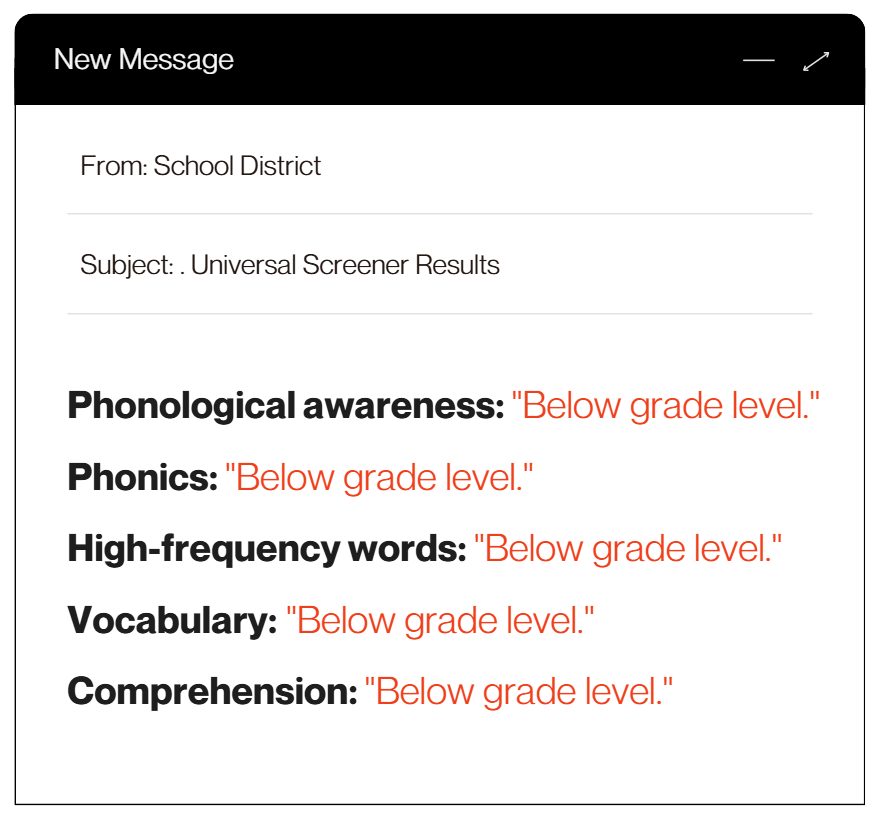
My kid was behind on…everything.
I knew I shouldn't panic. I had the skills to help her, and I had taught many other children to read. But I panicked anyway. My heart plunged to the floor. I couldn't breathe, and I cried for hours. The only words that have ever come close to describing what I felt belong to Dr Maryanne Wolf (2011):
Like Dr Wolf, I wasn't crying out of shame or embarrassment. I was crying because I know too well how few teachers are prepared to teach reading to typically developing readers, let alone to children who struggle to crack the code (Lane & Contesse, 2023).
I had worked in schools for 20 years by then, and I knew that sending my daughter's first-grade teacher an emotionally charged text about my fears, on a Friday no less, was not a great choice, but I couldn't hold it back. Thankfully, we already had a warm, trusting relationship, and Ms Keefe answered right away. She replied, "I promise you, I am going to make it my personal mission to help her all year!"
Many parents do not receive such immediately encouraging responses, but their teachers are rarely to blame, as most were never trained to teach reading. Instead, parents will often hear variations of "She'll be fine!" or, worse, "Just give it time and it will work itself out" (Aldeman, 2025). I am one of the very lucky parents whose concerns were taken seriously.
I am one of the very lucky parents whose concerns were taken seriously.
Once I collected myself, I remembered that I am a literacy specialist trained in structured literacy. I steadied myself with the Serenity Prayer, words my late father recited often, and focused on what I could control.
Here is what I did. I left the explicit, sequential, and systematic word recognition instruction to Ms Keefe because I trusted her expertise, but I stayed in constant communication to track my daughter's progress using real data. Skilled reading has two big strands: word recognition and language comprehension (Scarborough, 2001). Ms Keefe was intentionally nurturing both strands throughout the day. I set out to further fortify my daughter's language comprehension skills.
I steadied myself with the Serenity Prayer, words my late father recited often, and focused on what I could control.
I began by raising the quality and length of our nightly read-alouds, following Dr Molly Ness's Evaluate, Engage, and Extend framework (Ness, 2024). Before reading, I evaluated the book for concepts and vocabulary that might need a little background context. In Harry Potter and the Sorcerer's Stone, for example, we talked about what a "sorcerer" is, since it's right there in the title, and about the word "peculiar," because the first chapter paints such a vivid picture of the strange things that happen to Harry before he realizes his magical powers.
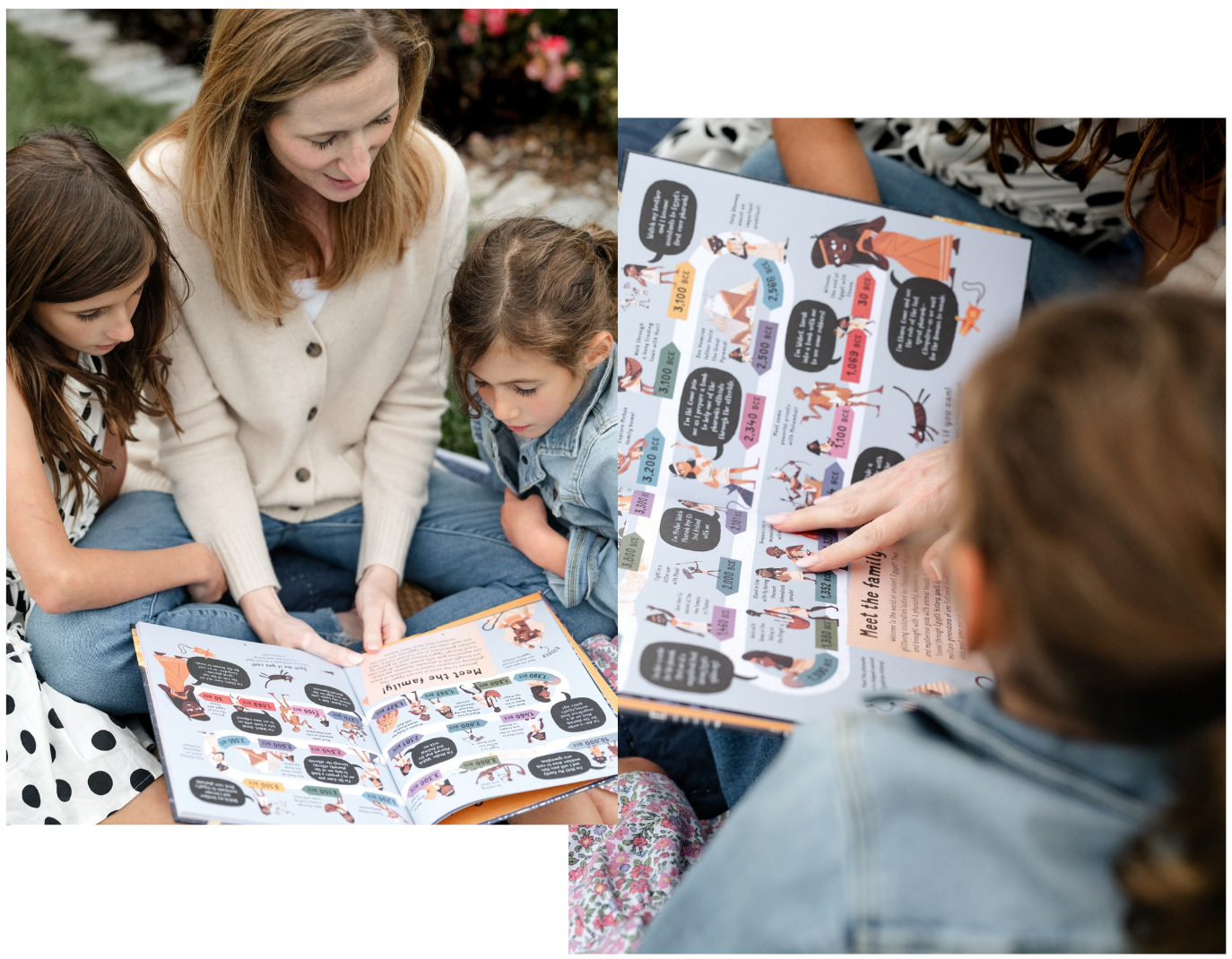
Engaging with the text out loud, I grappled with the parts that confused me, reread when I lost my train of thought, and used what I know about morphology to make sense of invented magical words like "lumos." I also told my daughter to stop me any time she felt lost, whether in the plot or on a single word. The goal was to build her "standard of coherence," her expectation that she can and will understand what she is reading (Oudega & van den Broek, 2018). After reading, we extended the conversation by making predictions, shaming unlikable characters like the Dursleys, and talking about how Harry must feel to be so mistreated and misunderstood.
At the same time, I flooded her with vocabulary, one of the strongest predictors of reading comprehension (Beck, McKeown, & Kucan, 2013), and its closely related neighbor: background knowledge about the world. As cognitive scientist Daniel Willingham (2006) explains, "People with more general knowledge have richer associations among the concepts in memory; and when associations are strong, they become available to the reading process automatically." Wider and deeper vocabulary and knowledge networks enable a reader to take on more complex text without the added strain of learning the words and the content at once. My goal was to free up as much cognitive space as possible in her growing brain.
Finally, I leaned on the concept of instructional coherence (TNTP, 2022) to try to leverage what my child was already learning in school and create an even wider and deeper net of language and understanding around those same topics. I was familiar with the school's knowledge-building curriculum, EL Education's K–8 Language Arts, so I knew her class would soon dive into a unit on birds. They would try to answer questions like "What makes a bird a bird? How do a bird's body parts help it survive? And what role do birds play in the beautiful web of nature?" They would read about ducks and their feathers, and about beaks built for cracking seeds, straining pond water, or reaching nectar. I also knew that in second grade, this knowledge would feed into a unit on pollinators.
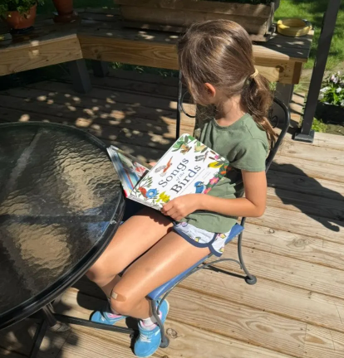
That information guided our library book selections, the shows we watched on Animal Planet, and our walks in the woods armed with binoculars and bird identification guides. We built birdhouses and bought seeds in bulk. All the while, we used words like adaptation, flight, wingspan, migration, and pollinator. We became big word nerds and, more generally, bird nerds. And I watched her grow not just more knowledgeable, but more confident.
I watched her grow not just more knowledgeable, but more confident.
In a meta-analysis of writing instruction for adolescents, Graham and Perin (2007) found that practicing how to build and combine sentences is among the most effective things you can do to strengthen writing. Although their work focused on older students, I folded in sentence writing at home whenever I could. We wrote and combined short, silly sentences (e.g. Blue Jays are pretty, but they sure do squawk!), loosely aligned with the phonics patterns she was learning in class, and most of them were about birds because that was what she had the most to say about. That helped reading and spelling "gel" for her, so they stopped feeling like two separate subjects competing for her attention. To build her syntactical awareness, I made up bird-themed Mad Libs for her to complete. She squealed with laughter and then read and reread her silly creations, a little more fluently each time.
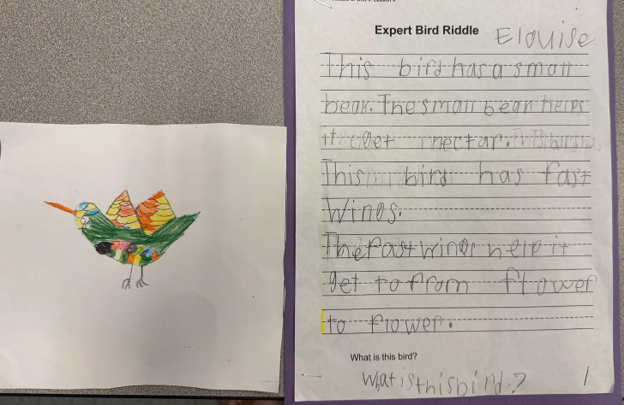
We didn't stop learning about birds at the conclusion of the unit. She kept drawing birds and learning about new ones, like the dodo, which I had no idea was a real animal until she started asking about it. One of our dodo books was actually written for adults, but she insisted we read it together. On the first page, she saw the word "ornithologist" and read it immediately.
I wept. That single word held so many invisible skills at once: syllabication, vowel flexibility, morphology, vocabulary, and background knowledge. That day, I knew she would be okay.
That day, I knew she would be okay.
In June of that same year, another email arrived from the district. Her end-of-year reading screener was ready. This time, here is what it said:
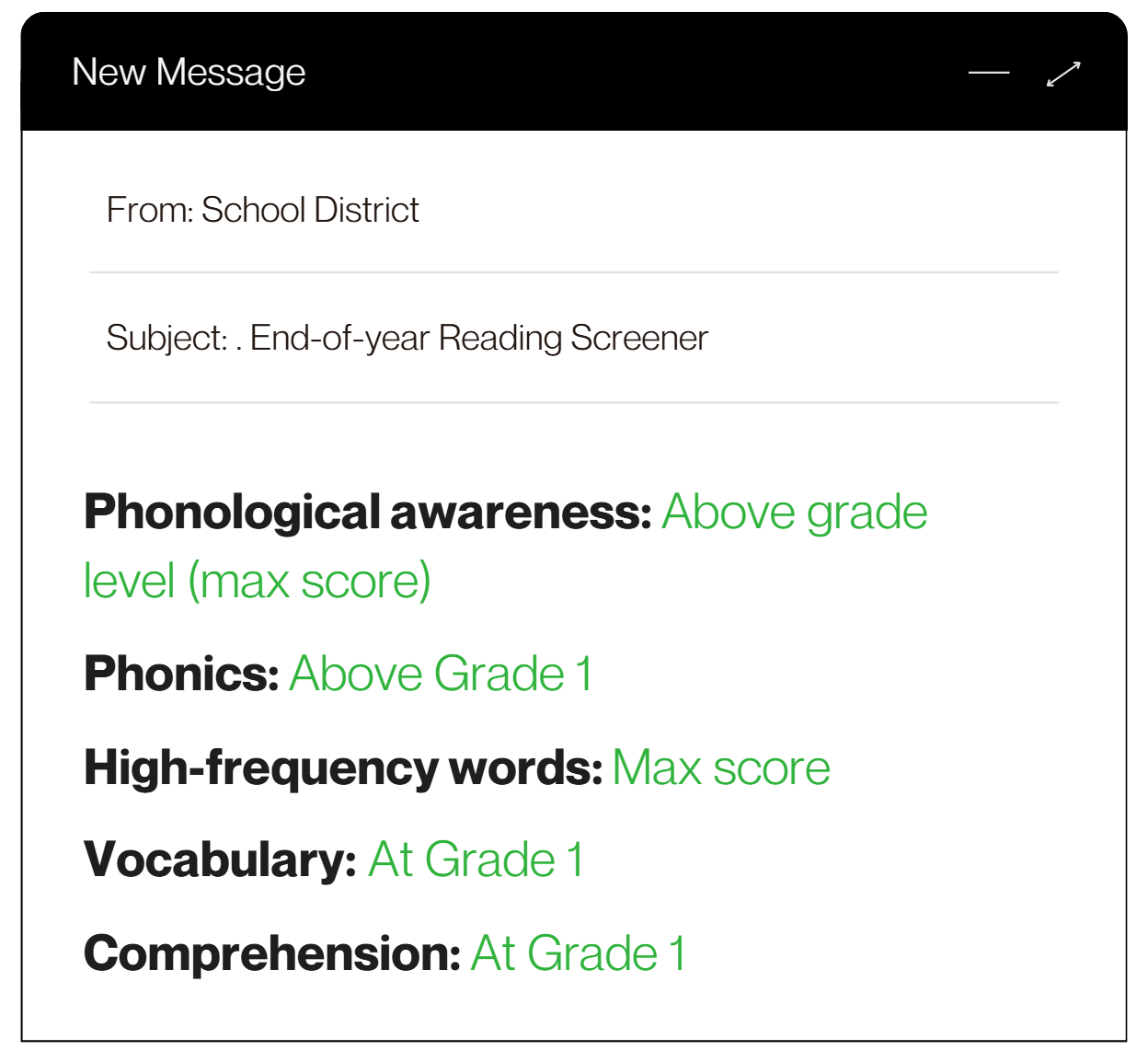
My kid was right where she needed to be on…everything!
Harry Potter never stopped, either. As I write this, we are about to finish book seven. I had never read the series before, and it made me fall in love with reading all over again and, for the first time, made my daughter fall in love with it, too. Most of what she reads on her own pales next to Harry Potter in the complexity of its characters, vocabulary, syntax, and plot. I know those nightly chapters have stretched her further than any alphabet level-matched book could (Shanahan, 2025).
She is also learning what it feels like to love a character. At the start of book seven, she thought Hagrid must have died. She burst into tears. I won't spoil it here, but I think this was the first time she realized a book could evoke such strong feelings, an important realization that will make the act of reading even more meaningful to her going forward.
Supporting my daughter while partnering with her teacher changed the direction of my professional work. I had the knowledge to catch my daughter up, and she had a teacher who understood the science of reading and worked with me like a partner. Most families have neither. Not every parent knows what a child needs in order to read or what to ask of a school when a child falls behind, and not every child has a teacher trained in how reading develops. That gap is what pulled me toward family advocacy and support. It is the reason The Reading Symphony exists, from the podcast and the newsletter to my consulting work with families. I am here to make sure your child's story ends the way my daughter's did.
What you can try at home
- If your child's recent reading screener (DIBELS, Acadience, STAR, i-Ready) reveals skill gaps, ask your child's teacher the following questions. "What specific skill gaps are standing in the way of my child's progress? What instructional supports are they receiving to fill in those gaps? How will I know if they are making progress? What is the plan if they do not make progress?"
- Ask your child's teacher what the class will study next and which words the children will use often throughout the unit of study. You might ask, "What is the next unit about, and which five words would you most like my child to walk in already knowing?" Then check out books on the topic, look for free activities around town that might connect, and use the vocabulary words as much as you possibly can in your own speech!
- Read something above her level aloud, and let her watch you get confused. Say, "Wait, I lost track of that. Let me go back." The more she sees you grapple with the text and repair breakdowns in understanding, the more likely your child will be to do the same when reading independently.
References
References
- Aldeman, C. (2025, October 26). Do. Not. Wait. Aldeman on Education. [chadaldeman.com]
- Beck, I. L., McKeown, M. G., & Kucan, L. (2013). Bringing words to life: Robust vocabulary instruction (2nd ed.). Guilford Press.
- Graham, S., & Perin, D. (2007). A meta-analysis of writing instruction for adolescent students. Journal of Educational Psychology, 99(3), 445–476. [doi.org]
- Lane, H., & Contesse, V. (2023). The role of educator preparation programs in preparing teachers in the science of reading. American Association of Colleges for Teacher Education. [aacte.org]
- Ness, M. (2023). Read alouds for all learners: A comprehensive plan for every subject, every day, grades PreK–8. Solution Tree Press.
- Oudega, M., & van den Broek, P. (2018). Standards of coherence in reading: Variations in processing and comprehension of text. In K. K. Millis, D. L. Long, J. P. Magliano, & K. Wiemer (Eds.), Deep comprehension: Multi-disciplinary approaches to understanding, enhancing, and measuring comprehension (pp. 41–51). Routledge. [doi.org]
- Scarborough, H. S. (2001). Connecting early language and literacy to later reading (dis)abilities: Evidence, theory, and practice. In S. B. Neuman & D. K. Dickinson (Eds.), Handbook of early literacy research (Vol. 1, pp. 97–110). Guilford Press.
- Shanahan, T. (2025). Leveled reading, leveled lives: How students' reading achievement has been held back and what we can do about it. Harvard Education Press.
- TNTP. (2022). Instructional coherence: A key to high-quality learning acceleration for all students. [tntp.org]
- Willingham, D. T. (2006). How knowledge helps: It speeds and strengthens reading comprehension, learning - and thinking. American Educator, 30(1), 30–37. [aft.org]
- Wolf, M. (2011, May 9). Dear parent: why your dyslexic child struggles with reading. The Guardian. [theguardian.com]
Katie Megrian
Literacy Specialist, Educator, & Founder | TheReadingSymphony.com | YouTube | Podcast | Spotify | LinkedIn | Instagram | Substack
Katie Megrian
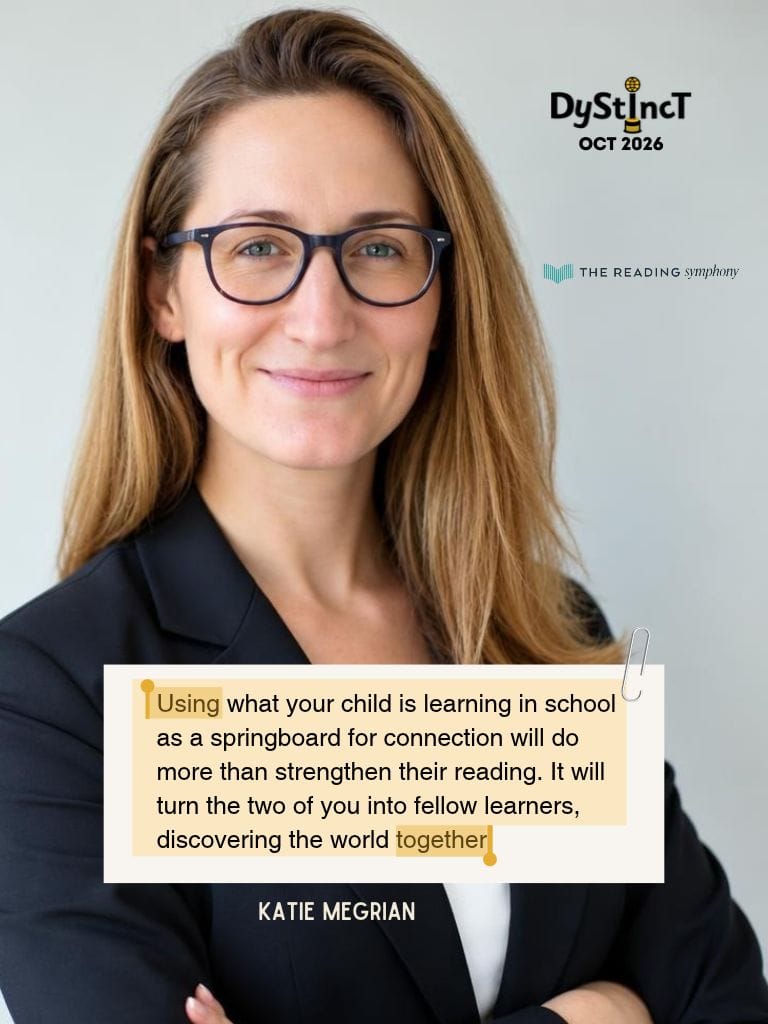
Katie Megrian is a literacy specialist and the founder of The Reading Symphony, where she helps parents understand how reading develops and what to do when a child struggles. With over 22 years in urban schools in Boston and New York, she has worked as a classroom teacher, school founder, principal, and K–12 ELA director, most recently with the Brooke Charter School Network. She hosts a weekly podcast on the science of reading and writes a free weekly newsletter for parents and educators, available on her Substack page. She is pursuing an Ed.D. in Learning Science at Gordon College and is the parent of two children with very different reading profiles. Her work lives where classroom instruction meets life at home.
Buy Printed Copies of Dystinct Magazine
Buy Printed Copies on Amazon
Select the Amazon Store based on your region
Extracts from Dystinct Magazine
Extracts from Dystinct Magazine