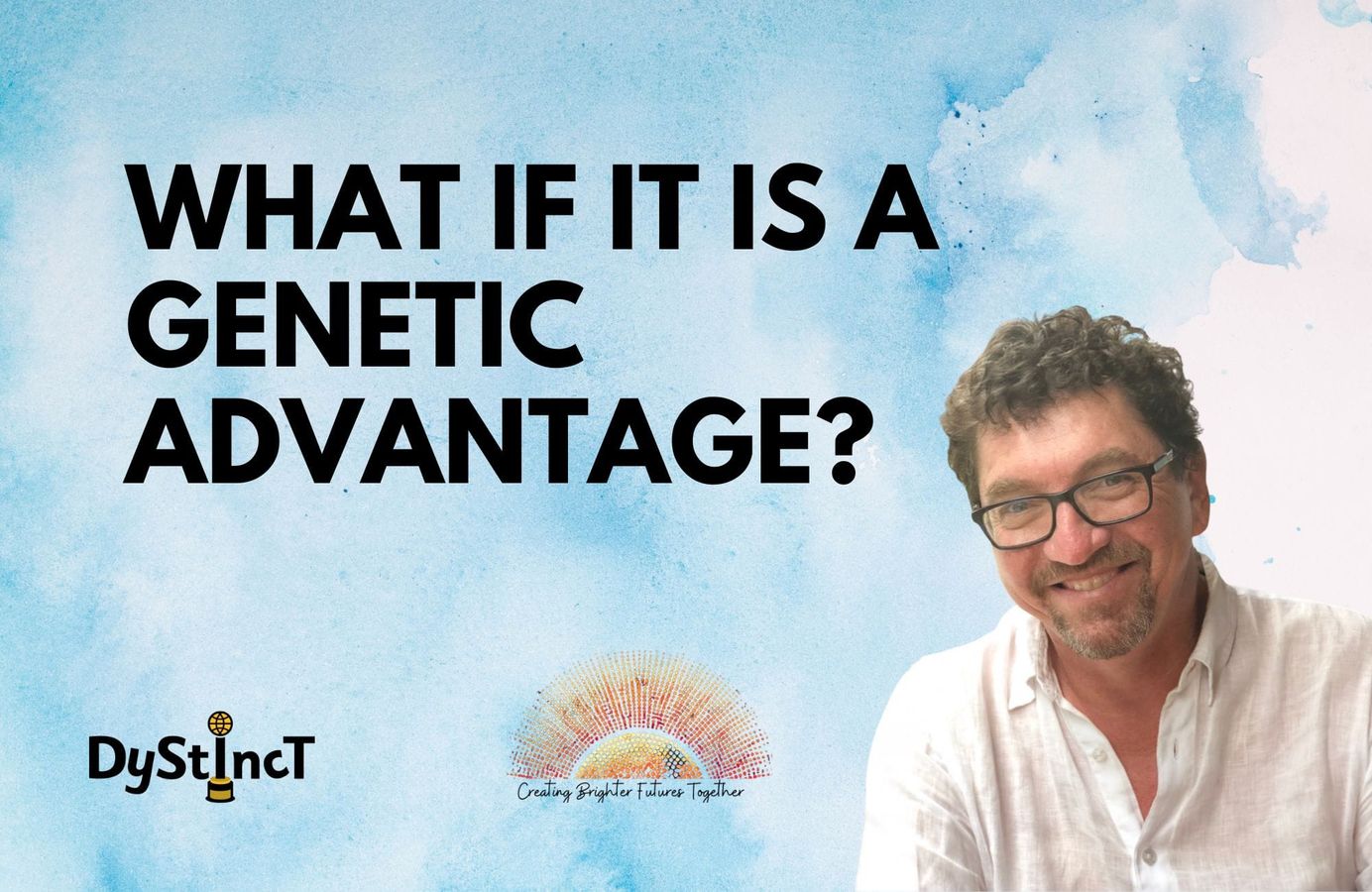
Issue 27: What if it is a genetic advantage? Simon da Roza
Simon da Roza challenges the deficit view of neurodivergence by reframing ADHD, autism, and dyslexia as valuable expressions of human diversity, arguing that modern education systems fail not because of these minds but because they were never designed for them.
Table of Contents

Over the holidays, I found myself asking a question that wouldn’t let go. If evolution is real, and I believe it is, then why do conditions like ADHD, autism, and dyslexia still exist? If they were really as disadvantageous as some people make them out to be, wouldn't our genes have bred them out by now? Why would nature preserve something that doesn't serve us as a species?
That question didn't come from doubt. It came from curiosity. The kind of restless, pattern-seeking curiosity that my neurodivergent brain thrives on. It's the same drive that makes me lose time researching, connecting dots, following ideas all the way down the rabbit hole. Some call that hyperfocus. I call it being true to myself.
So, I went looking not just in research papers, but in books that gave me a broader view: The Fall of Civilisations, The Soul, and The Memory Gene. I didn't expect them to intersect. I didn't expect them to connect so personally. They helped me see that these so-called "disorders" (according to the medical lexicon) might not be disorders at all, but actually advantages! They might be deeply human traits preserved, not in error, but because they matter.
The so-called "disorders" (according to the medical lexicon) might not be disorders at all, but actually advantages!
From The Memory Gene, I learned that oral history stretches back over 500,000 years. That's how long humans have been telling stories, passing on knowledge through voice, image, rhythm and repetition. Writing, by contrast, has existed for only 5,000 years. Our brains aren't wired for print, they're wired for people. So, when a child struggles to decode a sentence but can explain the entire plot of a movie, mimic an accent, or remember everything about a subject that excites them, maybe that's not a failure of literacy. Perhaps it's an echo of something older. Something essential.
Perhaps what we call "oral learning" isn't primitive at all but the pinnacle of relational intelligence, memory, and trust.
I couldn't reflect on oral history without acknowledging the extraordinary culture of Aboriginal and Torres Strait Islander cultures. For over 65,000 (at least) years, the world's oldest continuous civilisation sustained complex systems of knowledge, law, medicine, navigation and ecology without writing a word. Knowledge was passed down through songlines, stories, ceremonies, and land-based memory. These oral traditions weren't simply cultural expressions. They were vital survival tools. Accuracy meant life or death. Storylines were embedded into the landscape itself, allowing knowledge to be passed with extraordinary precision across countless generations. In this way, Australia's First Nations people developed and preserved knowledge systems more enduring than any written civilisation on Earth. Perhaps what we call "oral learning" isn't primitive at all but the pinnacle of relational intelligence, memory, and trust.
It left me wondering what if the way children learned in those ancient systems holds wisdom for how we might teach today? Learning that was embodied, relational, and rhythmic. Learning grounded in land, community, and meaning. No standardised tests. No behavioural charts. Just a deep connection to story, to place, and to purpose. What if we paired that ancient knowing with enlightened pedagogy, one that understands neuroscience, honours difference, and trusts children's natural curiosity? Maybe then we'd begin to repair what's been lost. Not by going backwards, but by listening to the past long enough to shape a more human future.
That thought reshaped how I see the children I work with, and how I see myself. I see the ADHD kids who can't sit still in class but can plan an entire game level in their heads. The autistic teens who notice the tiniest shifts in energy or pattern that others miss. The dyslexic thinkers who struggle with spelling but instinctively grasp the big picture and tell it back in brilliant, layered detail. These kids aren't broken. They're operating with a different kind of operating system. One that's designed to adapt, notice, persist, and remember.
These kids aren't broken. They're operating with a different kind of operating system.
I started to think maybe ADHD is the trait that helped us scan for threats, or follow a trail, or come up with five different solutions when the first four failed. Maybe autism preserved the intense focus needed to track the stars or tend to an invention. Maybe dyslexia encoded a way of understanding the world through shape, feeling and story. These aren't mistakes. They're human variation at its finest.
However, none of that fits neatly into a classroom built for uniformity. And that's where we run into trouble. Our schooling systems were never built with differences in mind. All we need to do is look to the work and legacy of Sir Ken Robinson for insight into this. As I read The Fall of Civilisations, I saw a pattern that chilled me. As societies became more centralised and hierarchical, literacy became a dividing line, a means to sort, exclude, and control. Religious institutions and empires used it to create classes of those who knew and those who obeyed. Schooling followed suit. It wasn't designed for learning. It was designed for obedience.
Our schooling systems were never built with differences in mind.
The design of written language systems, especially as they became embedded in religious and bureaucratic institutions, was never neutral. Writing became a gatekeeper used to withhold knowledge from the masses and circulate it only among the elite. Literacy was power, and by controlling who could access it, ruling classes could shape belief, behaviour, and belonging. Can you think of someone who thought you were not a very clever person because you couldn't spell? I know and have experienced too many. For too long, I believed them and I masked my voice, denied my perceptions and intelligence. (Some days I still trip over these maladaptive beliefs).
Children are not neat, predictable products of a conveyor-belt, cookie-cutter system.
We’ve inherited these systems and habits without question, and the societal norms developed around these expectations. Behaviour charts, silence in class, and punishment for not sitting still. These are not neutral. They're relics. They come from religious institutions and imperial structures built to create obedient citizens. These systems weren't designed for children. They were designed for control. They were built to produce sameness. I've worked with children my entire career, and children are not neat, predictable products of a conveyor-belt, cookie-cutter system. They are wonderfully messy, unpredictable, imaginative and curious beings, humans being human, always moving, learning, solving and creating.
Difference has always been part of our survival. Autism brings depth of focus and integrity to pattern recognition. ADHD brings rapid cognition, creative problem solving, and the ability to scan an environment for new opportunities. Dyslexia brings an intuitive grasp of meaning, big-picture thinking, and often extraordinary visual memory. These aren't limitations. They're simply different ways of processing the world. If we stopped asking children to be compliant copies and started asking what kind of thinkers they are, what might we discover?
If we stopped asking children to be compliant copies and started asking what kind of thinkers they are, what might we discover?
We see the remnants of that design everywhere today: behaviour charts, silent reading, punishment for movement, reward for compliance. And we wonder why so many children are struggling. Maybe they're not struggling at all. Maybe they're resisting something that no longer makes sense. And perhaps while they are unable to advocate and express this deep knowing in their bones, they respond and rebel in the only way they have. They are not embraced; they are silenced by the majority, and the resentment grows.
The more I read, the more I keep coming back to this idea: perhaps our current systems are not broken (hmm, maybe they are). Perhaps they're just outdated monoliths, like Kodak and Blockbuster, failing to adapt to this new environment. Like any civilisation, they rose to meet the needs of a particular time, and now they're falling under the weight of their systems and rigidity. That educational model no longer serves our current educational needs, society's needs.
We wonder why so many children are struggling. Maybe they're not struggling at all. Maybe they're resisting something that no longer makes sense.
Something else is forming, stirring in the dissonance between our inner compass and the reality of education, a flicker of hope. To me, it isn't just hope, it is a flame of clarity. It is a knowing in my bones, just like the kids in schools know too, that there is something better, something true. Something more organic and aligned with our human spirit. The rise of informal communities, co-ops, learning pods, advocacy networks, and the rise of independent schools across Australia, as parents pull away from the failure of mainstream schools. (Due to the system, not the teachers or people) People gathering not around institutions, but around shared values. It reminded me of what some call neo tribes, fluid, purpose-driven groups bound by meaning rather than rules. That's what we're doing now. That's what movements like ours are about. Recreating the villages to raise our most precious resource, our future, our children.
I don't have all the answers. But I know this. My brain is not a mistake. And neither are the kids I stand beside. We are not evolutionary leftovers. We are the next chapter in the human story. The ones who remember, who notice, who ask different questions. That's not something to fix. That's something to honour.
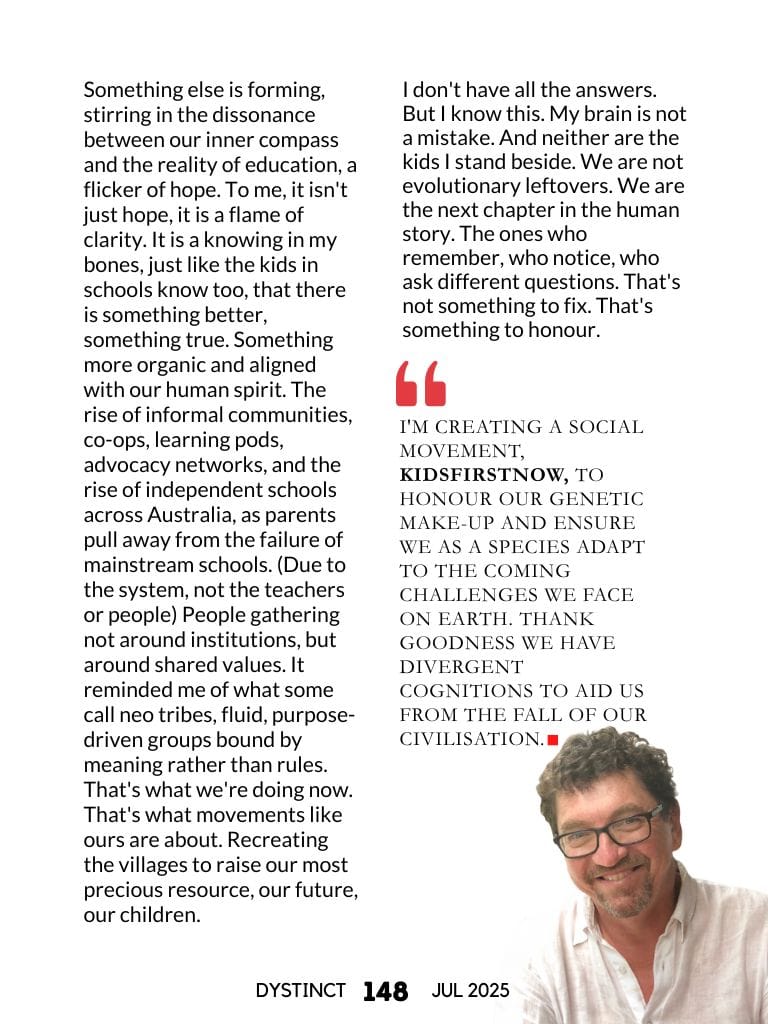
I'm creating a social movement, KidsFirstNow, to honour our genetic make-up and ensure we as a species adapt to the coming challenges we face on Earth. Thank goodness we have divergent cognitions to aid us from the fall of our civilisation.
Simon Da Roza
Neurodivergent Coach, Counsellor & Founder | Xceptionallearners.com | Facebook | Instagram | YouTube | LinkedIn | Pinterest
Simon Da Roza
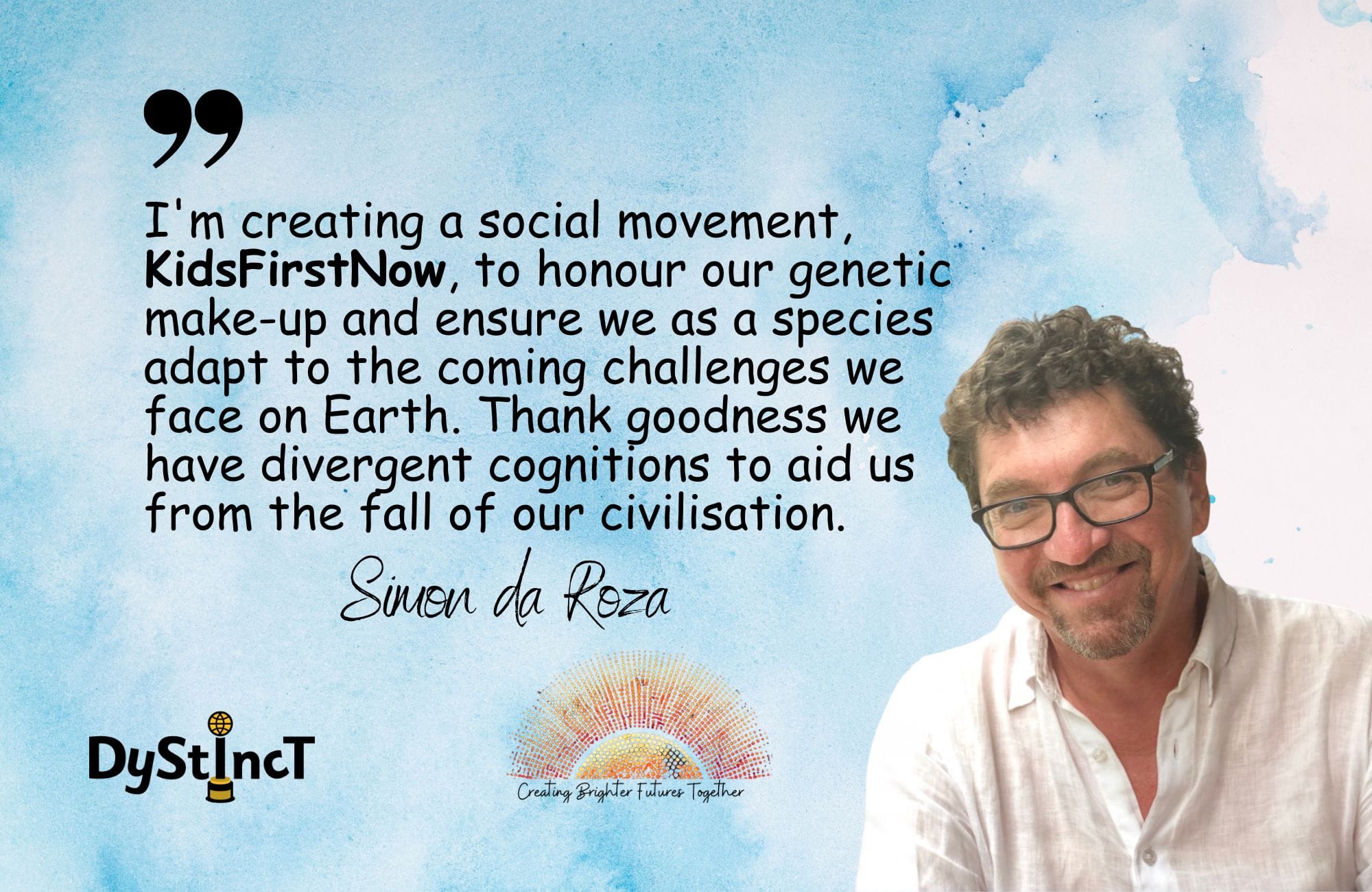
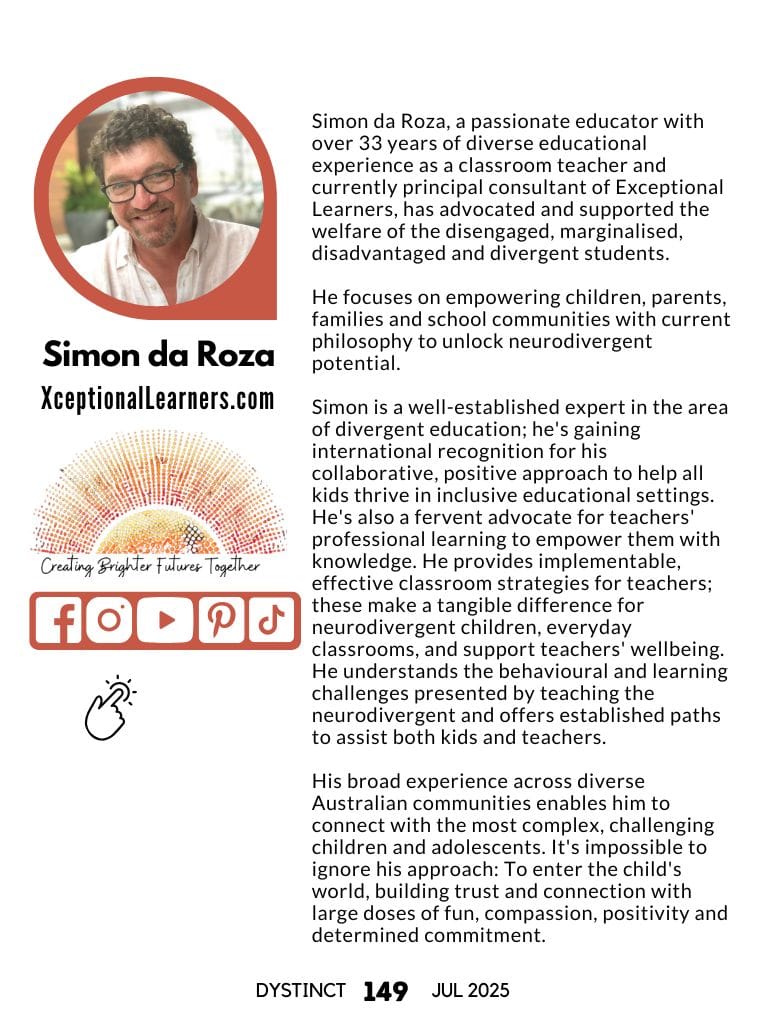
Simon da Roza, a passionate educator with over 33 years of diverse educational experience as a classroom teacher and currently principal consultant of Exceptional Learners, has advocated and supported the welfare of the disengaged, marginalised, disadvantaged and divergent students.
He focuses on empowering children, parents, families and school communities with current philosophy to unlock neurodivergent potential.
Simon is a well-established expert in the area of divergent education; he's gaining international recognition for his collaborative, positive approach to help all kids thrive in inclusive educational settings. He's also a fervent advocate for teachers' professional learning to empower them with knowledge. He provides implementable, effective classroom strategies for teachers; these make a tangible difference for neurodivergent children, everyday classrooms, and support teachers' wellbeing. He understands the behavioural and learning challenges presented by teaching the neurodivergent and offers established paths to assist both kids and teachers.
His broad experience across diverse Australian communities enables him to connect with the most complex, challenging children and adolescents. It's impossible to ignore his approach: To enter the child's world, building trust and connection with large doses of fun, compassion, positivity and determined commitment.
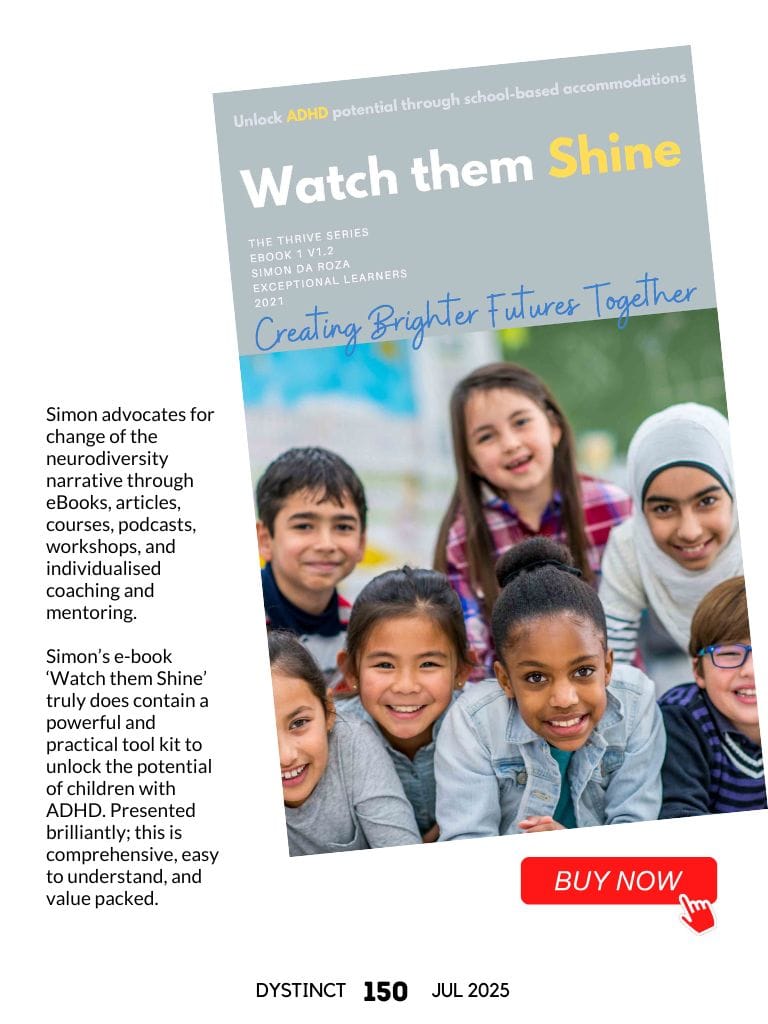
BUY eBook
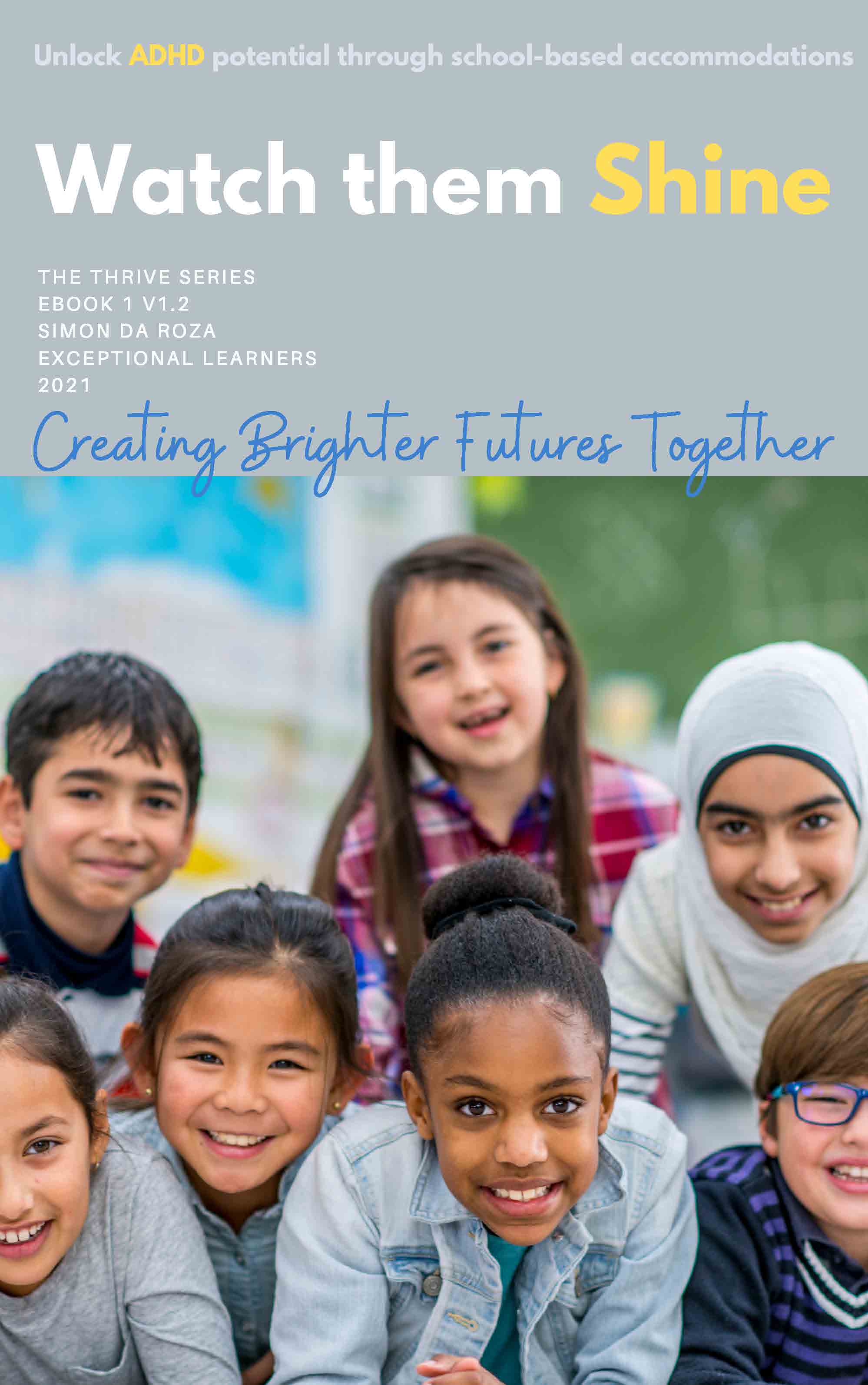
Watch Them Shine Ebook
'Watch them Shine!' An introduction for educators and parents to improve the educational outcomes and guidance of children with Attention Deficit Hyperactivity Disorder (ADHD) by applying knowledge of executive functioning delays in creating effective, reasonable adjustments in the classroom.
Let Them Shine is a resource to support your teachers in supporting divergent learners. The adjustments are free and can be implemented today. These adjustments will have an immediate positive effect on students and your teachers' wellbeing. Start from a strengths-based perspective, add empathy, guidance and watch them thrive.
When you have a deep understanding of the neurology of ADHD, you will understand the effects upon the classroom and learning. Academic research of neurology and ADHD has turned our appreciation of this disability on its head. What we once thought ADHD to be is wrong. Combine this new knowledge with the realisation that each presentation is unique and therefore each solution must also be unique. However, you are the expert in your classroom and of the children in your care, add the creative solutions you and your students collaboratively implement in light of this knowledge and you will create effective reasonable adjustments.
Extracts from Dystinct Magazine
Extracts from Dystinct Magazine