Issue 28: What Counts as Evidence-Based? A Practical Guide for Parents Navigating Tier 2 and Tier 3 Interventions | Missy Purcell
Missy Purcell explains what “evidence-based” should mean in schools, clarifies the differences between Tier 1, Tier 2, and Tier 3 instruction, and offers parents clear questions to ask when advocating for their child.

Table of Contents
When your child struggles to read, few words sound more reassuring than "evidence-based." Schools and districts often use the term, promising that the program selected for intervention is grounded in science and proven to work. But as many parents of children with dyslexia quickly discover, the phrase "evidence-based" can be slippery.
Some programs marketed this way have decades of independent research behind them. Others borrow key terms such as "structured phonics," "multisensory learning", and "cognitive load theory", but lack the rigorous studies needed to show they truly help struggling readers. For parents, this blurred line can make it difficult to know whether their child is receiving what the research supports, or simply what's available.
This article unpacks what "evidence-based" should mean in schools, explains the critical differences between Tier 1, Tier 2, and Tier 3 instruction, and offers parents a clear set of questions to ask when advocating for their child.
Why Evidence Matters More Than Labels
Why Evidence Matters More Than Labels
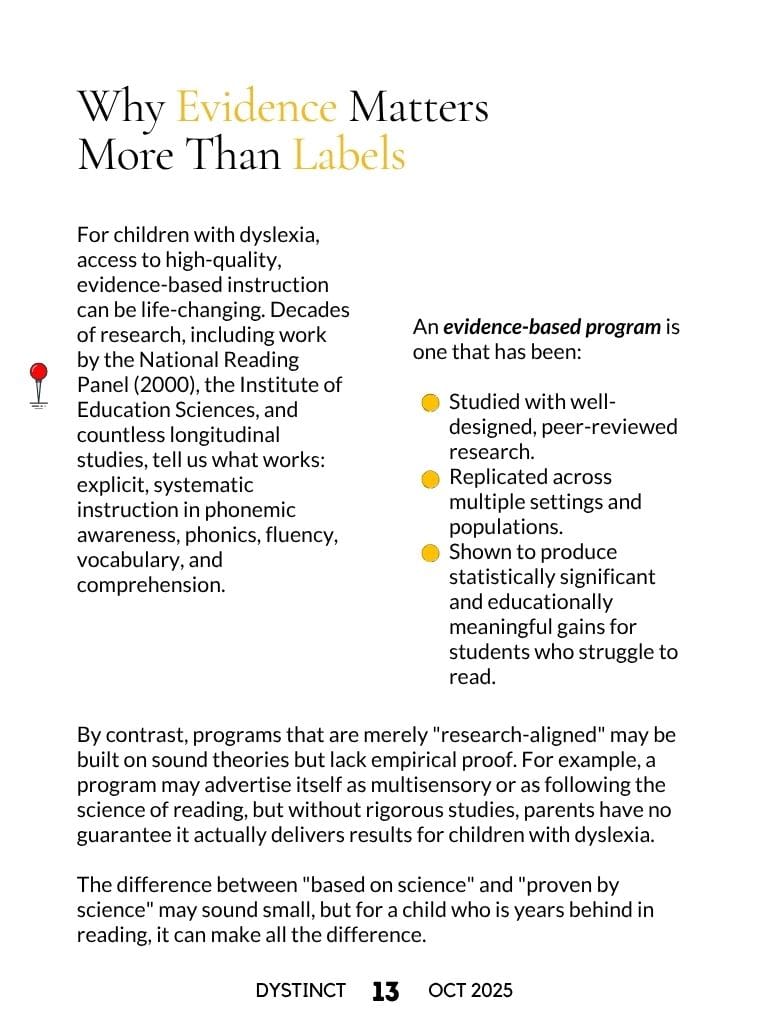
For children with dyslexia, access to high-quality, evidence-based instruction can be life-changing. Decades of research, including work by the National Reading Panel (2000), the Institute of Education Sciences, and countless longitudinal studies, tell us what works: explicit, systematic instruction in phonemic awareness, phonics, fluency, vocabulary, and comprehension.
An evidence-based program is one that has been:
- Studied with well-designed, peer-reviewed research.
- Replicated across multiple settings and populations.
- Shown to produce statistically significant and educationally meaningful gains for students who struggle to read.
By contrast, programs that are merely "research-aligned" may be built on sound theories but lack empirical proof. For example, a program may advertise itself as multisensory or as following the science of reading, but without rigorous studies, parents have no guarantee it actually delivers results for children with dyslexia.
The difference between "based on science" and "proven by science" may sound small, but for a child who is years behind in reading, it can make all the difference.
Tiered Instruction: Building Blocks of Support
Tiered Instruction: Building Blocks of Support
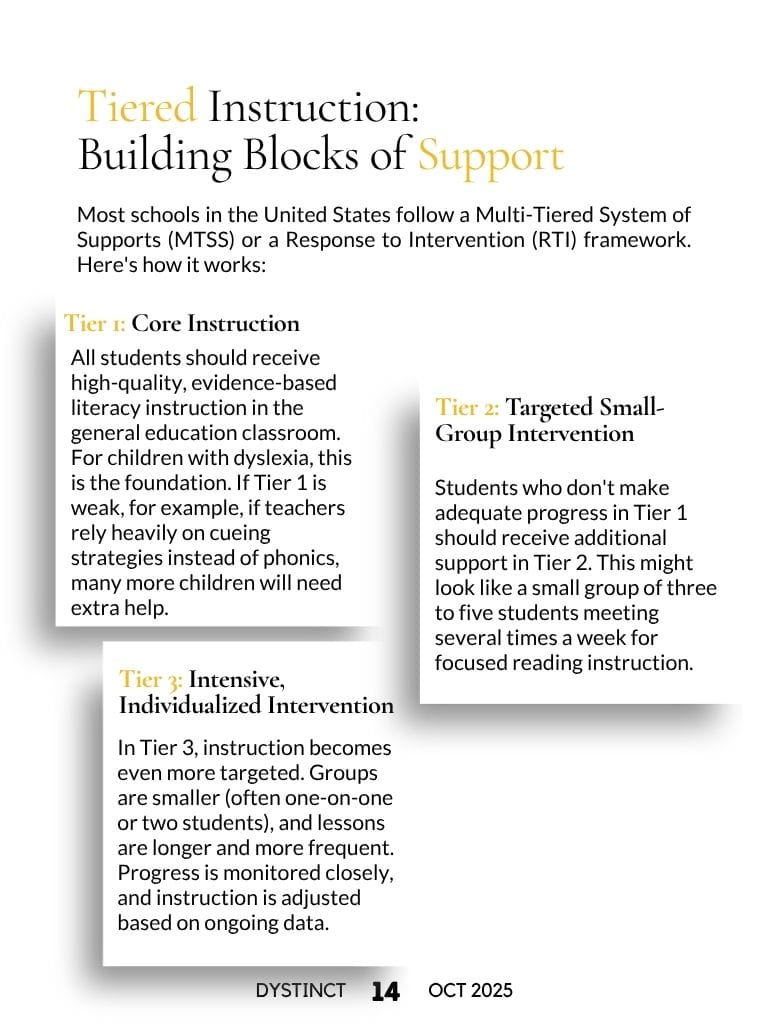
Most schools in the United States follow a Multi-Tiered System of Supports (MTSS) or a Response to Intervention (RTI) framework. Here's how it works:
Tier 1: Core Instruction
All students should receive high-quality, evidence-based literacy instruction in the general education classroom. For children with dyslexia, this is the foundation. If Tier 1 is weak, for example, if teachers rely heavily on cueing strategies instead of phonics, many more children will need extra help.
Tier 2: Targeted Small-Group Intervention
Students who don't make adequate progress in Tier 1 should receive additional support in Tier 2. This might look like a small group of three to five students meeting several times a week for focused reading instruction.
Tier 3: Intensive, Individualized Intervention
In Tier 3, instruction becomes even more targeted. Groups are smaller (often one-on-one or two students), and lessons are longer and more frequent. Progress is monitored closely, and instruction is adjusted based on ongoing data.
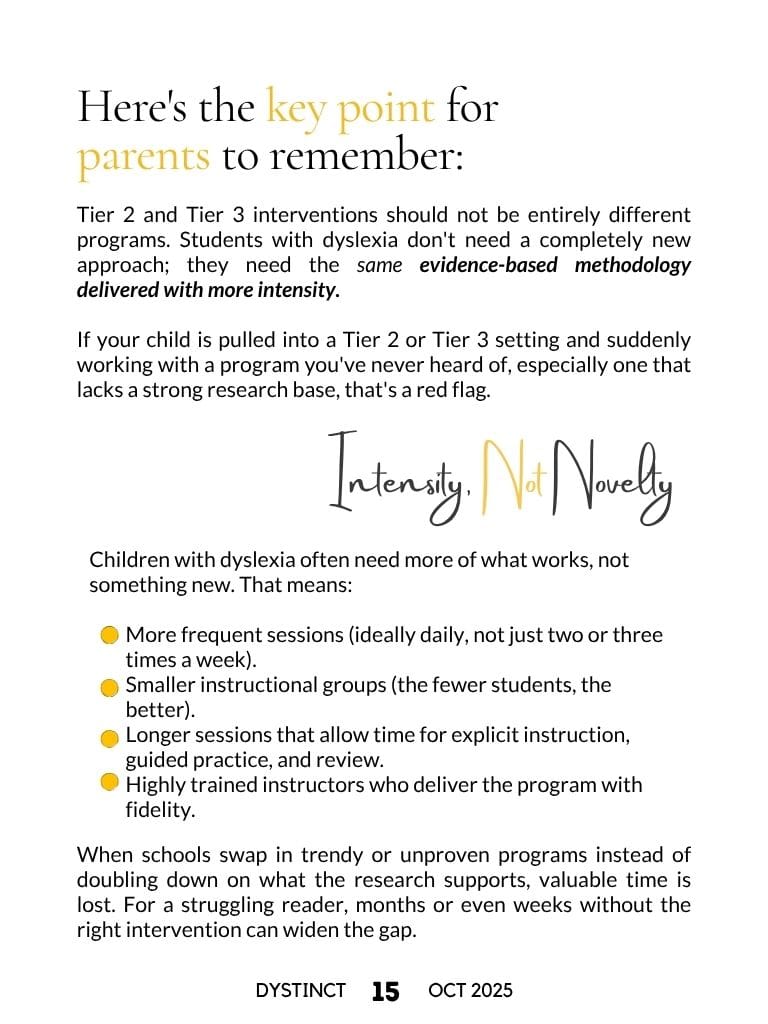
Here's the key point for parents to remember
Here's the key point for parents to remember
Tier 2 and Tier 3 interventions should not be entirely different programs. Students with dyslexia don't need a completely new approach; they need the same evidence-based methodology delivered with more intensity.
If your child is pulled into a Tier 2 or Tier 3 setting and suddenly working with a program you've never heard of, especially one that lacks a strong research base, that's a red flag.
Intensity, Not Novelty
Children with dyslexia often need more of what works, not something new. That means:
- More frequent sessions (ideally daily, not just two or three times a week).
- Smaller instructional groups (the fewer students, the better).
- Longer sessions that allow time for explicit instruction, guided practice, and review.
- Highly trained instructors who deliver the program with fidelity.
When schools swap in trendy or unproven programs instead of doubling down on what the research supports, valuable time is lost. For a struggling reader, months or even weeks without the right intervention can widen the gap.
Questions Every Parent Should Ask
Questions Every Parent Should Ask
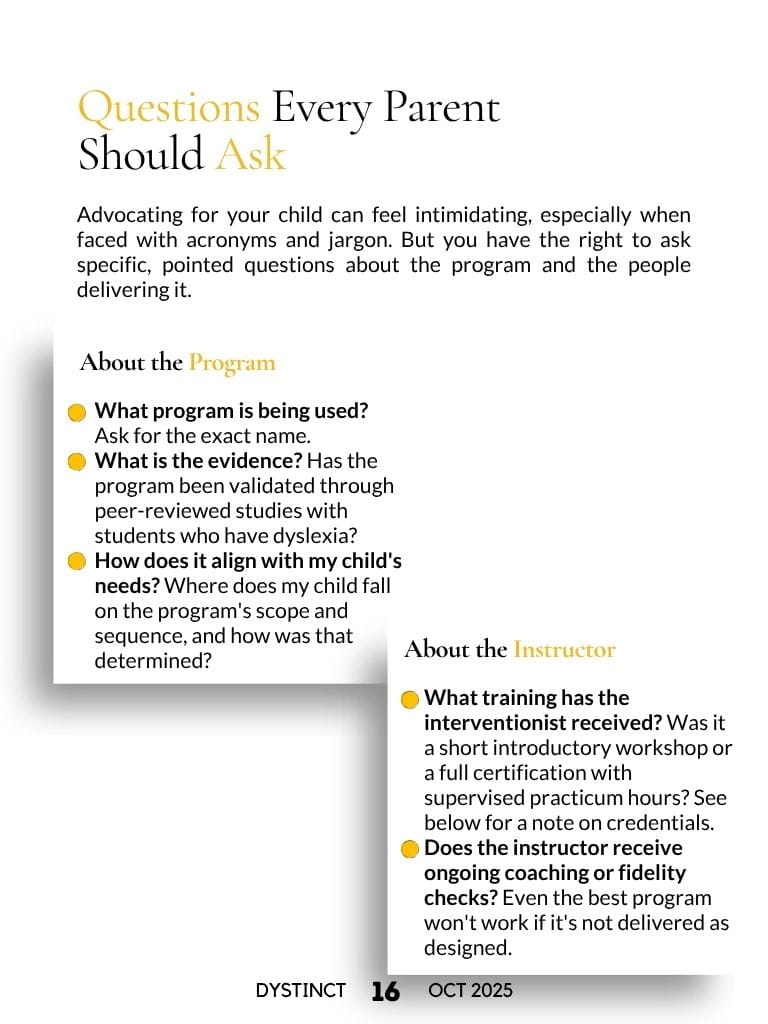
Advocating for your child can feel intimidating, especially when faced with acronyms and jargon. But you have the right to ask specific, pointed questions about the program and the people delivering it.
About the Program
- What program is being used? Ask for the exact name.
- What is the evidence? Has the program been validated through peer-reviewed studies with students who have dyslexia?
- How does it align with my child's needs? Where does my child fall on the program's scope and sequence, and how was that determined?
About the Instructor
- What training has the interventionist received? Was it a short introductory workshop or a full certification with supervised practicum hours? See below for a note on credentials.
- Does the instructor receive ongoing coaching or fidelity checks? Even the best program won't work if it's not delivered as designed.
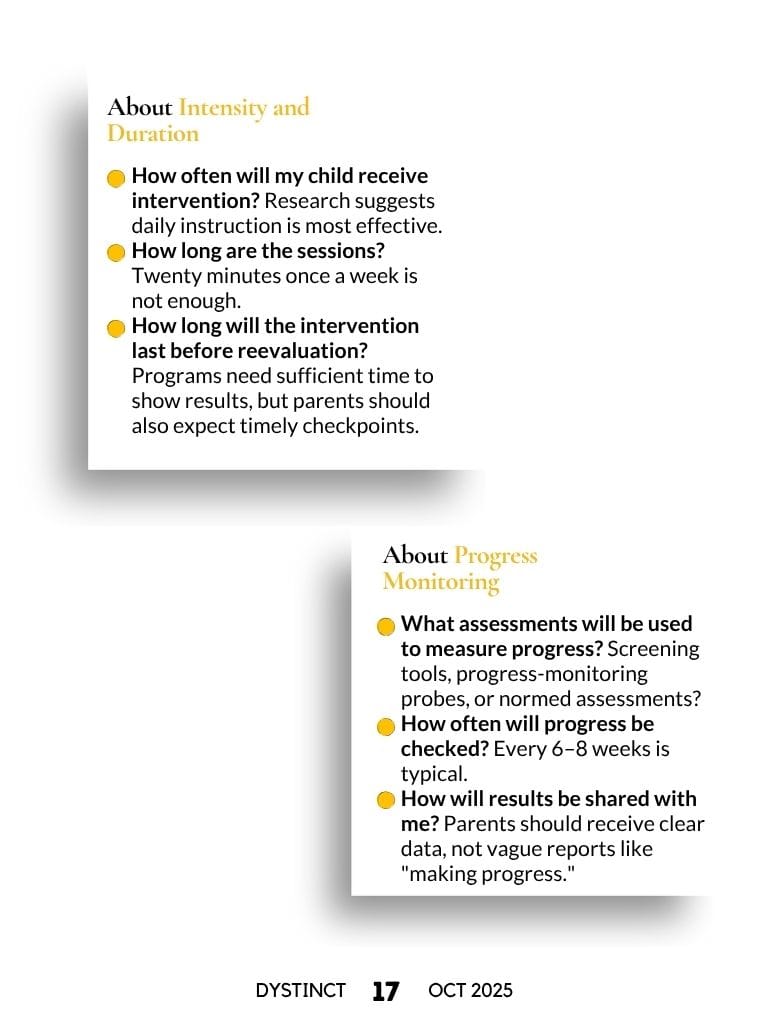
About Intensity and Duration
- How often will my child receive intervention? Research suggests daily instruction is most effective.
- How long are the sessions? Twenty minutes once a week is not enough.
- How long will the intervention last before reevaluation? Programs need sufficient time to show results, but parents should also expect timely checkpoints.
About Progress Monitoring
- What assessments will be used to measure progress? Screening tools, progress-monitoring probes, or normed assessments?
- How often will progress be checked? Every 6–8 weeks is typical.
- How will results be shared with me? Parents should receive clear data, not vague reports like "making progress."
Trusting Your Intuition
Trusting Your Intuition
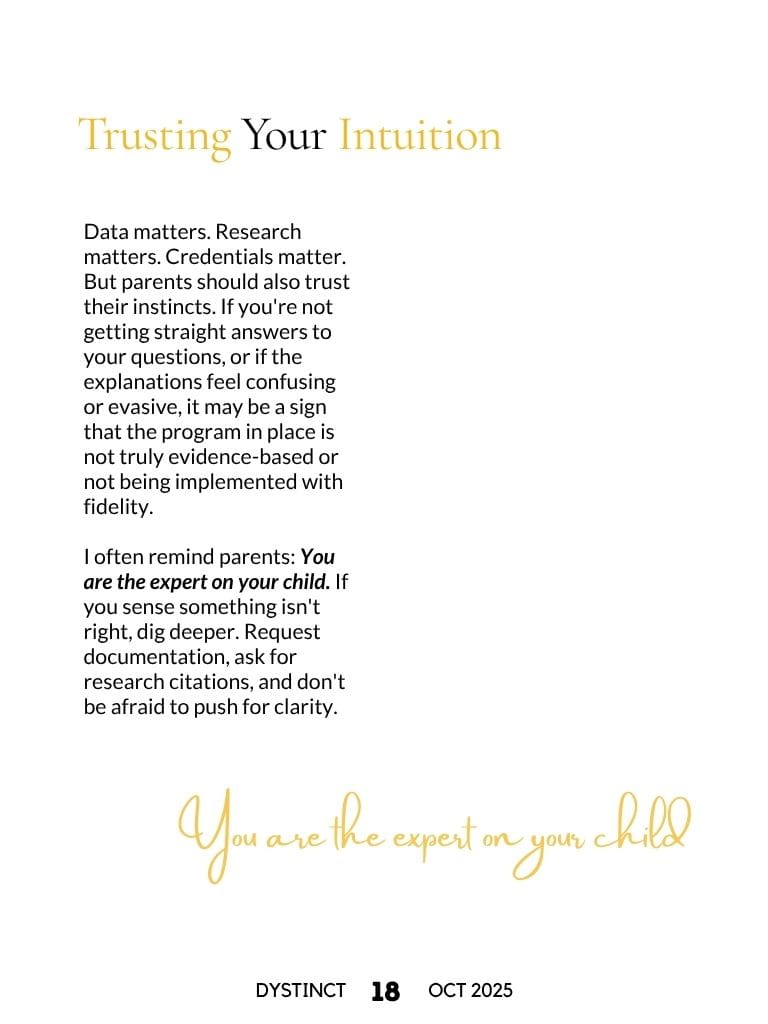
Data matters. Research matters. Credentials matter. But parents should also trust their instincts. If you're not getting straight answers to your questions, or if the explanations feel confusing or evasive, it may be a sign that the program in place is not truly evidence-based or not being implemented with fidelity.
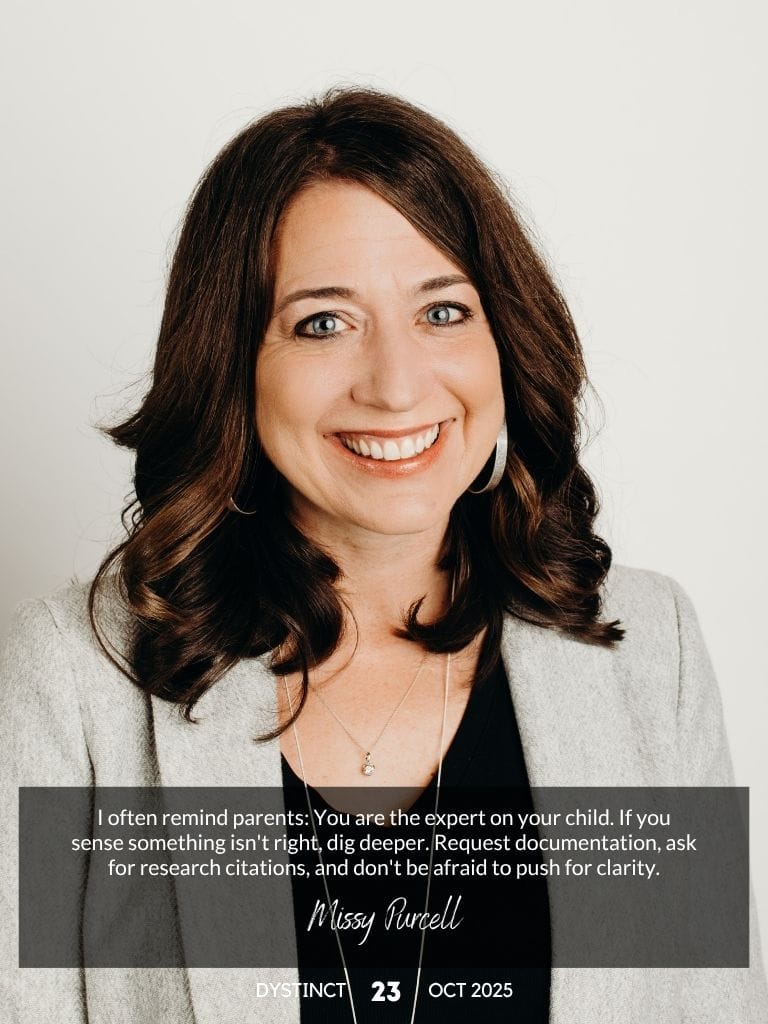
I often remind parents: You are the expert on your child. If you sense something isn't right, dig deeper. Request documentation, ask for research citations, and don't be afraid to push for clarity.
You are the expert on your child
A Note on Credentials
A Note on Credentials
It's worth pausing here to highlight just how important teacher preparation is. Many intervention programs have different tiers of training. A teacher who has attended a three-day introduction has not received the same depth of knowledge or the same ability to adjust instruction as someone who has completed months of coursework, a supervised practicum, and certification.
Parents deserve to know which level of training their child's instructor has completed. The program itself may be evidence-based, but without skilled delivery, effectiveness drops dramatically.
Practical Steps for Parents
Practical Steps for Parents
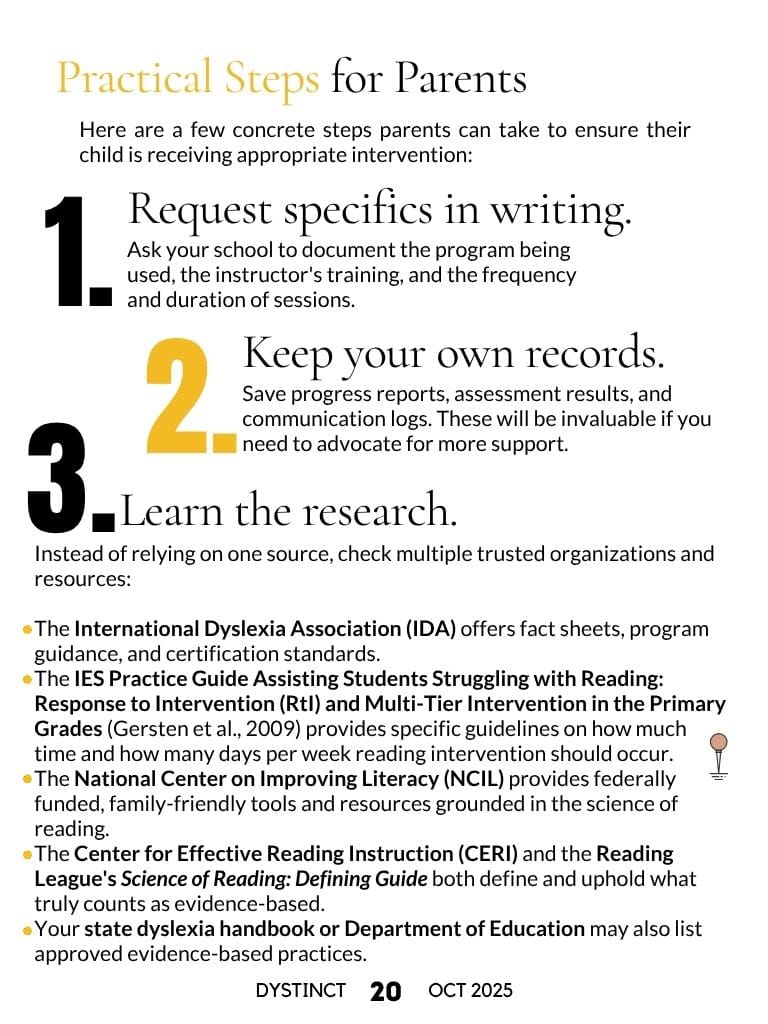
Here are a few concrete steps parents can take to ensure their child is receiving appropriate intervention:
- Request specifics in writing.
Ask your school to document the program being used, the instructor's training, and the frequency and duration of sessions. - Keep your own records.
Save progress reports, assessment results, and communication logs. These will be invaluable if you need to advocate for more support. - Learn the research.
Instead of relying on one source, check multiple trusted organizations and resources:- The International Dyslexia Association (IDA) offers fact sheets, program guidance, and certification standards.
- The IES Practice Guide Assisting Students Struggling with Reading: Response to Intervention (RtI) and Multi-Tier Intervention in the Primary Grades (Gersten et al., 2009) provides specific guidelines on how much time and how many days per week reading intervention should occur.
- The National Center on Improving Literacy (NCIL) provides federally funded, family-friendly tools and resources grounded in the science of reading.
- The Center for Effective Reading Instruction (CERI) and the Reading League's Science of Reading: Defining Guide both define and uphold what truly counts as evidence-based.
- Your state dyslexia handbook or Department of Education may also list approved evidence-based practices.
- Network with other parents.
Local advocacy groups and online communities can provide insight into which programs are being used in your district and how effective they are. - Stay engaged.
Attend meetings, ask for data, and keep communication open with teachers and administrators.
Final Word
Final Word
For children with dyslexia, time is precious. The longer they wait for effective intervention, the harder it becomes to close the gap. That's why the distinction between programs that are research-aligned and those that are truly evidence-based matters so deeply.
Parents should not settle for vague assurances. Ask for the name of the program. Ask for the research. Ask about the instructor's credentials, the intensity of the schedule, the scope and sequence, and the timeline for progress monitoring.
If answers are unclear, push for clarity. If the program doesn't measure up, push for change. Your child deserves instruction that is not just grounded in theory but proven to work.
Because when it comes to reading, every child deserves the chance to unlock the power of words, and the right intervention can make that possible.
References
References
- Gersten, R., Compton, D., Connor, C. M., Dimino, J., Santoro, L., Linan-Thompson, S., & Tilly, W. D. (2009). Assisting students struggling with reading: Response to intervention (RtI) and multi-tier intervention in the primary grades (NCEE 2009-4045). National Center for Education Evaluation and Regional Assistance, Institute of Education Sciences, U.S. Department of Education. [ies.ed.gov]
- National Reading Panel. (2000). Teaching children to read: An evidence-based assessment of the scientific research literature on reading and its implications for reading instruction (NIH Publication No. 00-4769). National Institute of Child Health and Human Development. [nichd.nih.gov]
Missy Purcell
Literacy & Inclusion Advocate | misspurcell.com | Facebook | Instagram
Missy Purcell

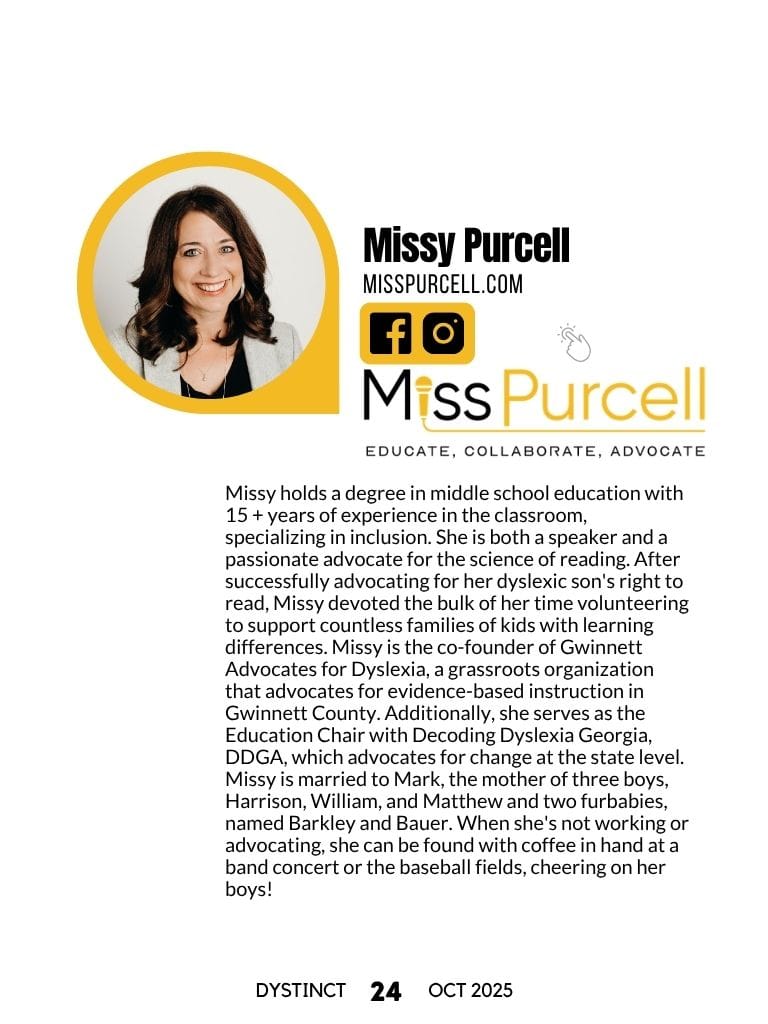
Missy holds a degree in middle school education with 15 + years of experience in the classroom, specializing in inclusion. She is both a speaker and a passionate advocate for the science of reading. After successfully advocating for her dyslexic son's right to read, Missy devoted the bulk of her time volunteering to support countless families of kids with learning differences. Missy is the co-founder of Gwinnett Advocates for Dyslexia, a grassroots organization that advocates for evidence-based instruction in Gwinnett County. Additionally, she serves as the Education Chair with Decoding Dyslexia Georgia, DDGA, which advocates for change at the state level. Missy is married to Mark, the mother of three boys, Harrison, William, and Matthew and two furbabies, named Barkley and Bauer. When she's not working or advocating, she can be found with coffee in hand at a band concert or the baseball fields, cheering on her boys!
Extracts from Dystinct Magazine
Extracts from Dystinct Magazine