Issue 24: The Vanishing Act in The Balancing Act: A Move to Reject Reading Research Is a Bad Move | Harriett Janetos
Harriett critiques the newly released The Balancing Act: An Evidence-Based Approach to Teaching Phonics, Reading and Writing by Dominic Wyse and Charlotte Hacking for advocating a return to balanced literacy practices, arguing that research overwhelmingly supports explicit, systematic phonics.

Table of Contents
I listened to Emily Hanford's podcast, Hard Words: Why Aren't Our Kids Being Taught to Read? six years ago, on the subway to Brooklyn College, where I observed Katherine Pace Miles teach her course on reading instruction. The previous day, I had met with Linnea Ehri in her Manhattan office to ask about her reading research. Traveling cross-country to talk shop with two literacy specialists is an experience I will never forget.
It's astonishing how far we've come in just six short years regarding our determination to teach all students of all backgrounds and all ability levels how to read. We know that those who cannot remember the past are condemned to repeat it, so we must never forget what reading instruction was like during the Balanced Literacy era before the science of reading became a schoolyard term. We also know that eternal vigilance is the price of liberty as well as the price of sustaining change. We have made significant shifts over the past six years: mind shifts and curriculum shifts. We now know better, and we're striving to do better—or the best that we can do under given circumstances. If we want to maintain the progress we've made, we must guard against any efforts to take us back to where we were before the reading world was reshaped by Emily Hanford's reporting.
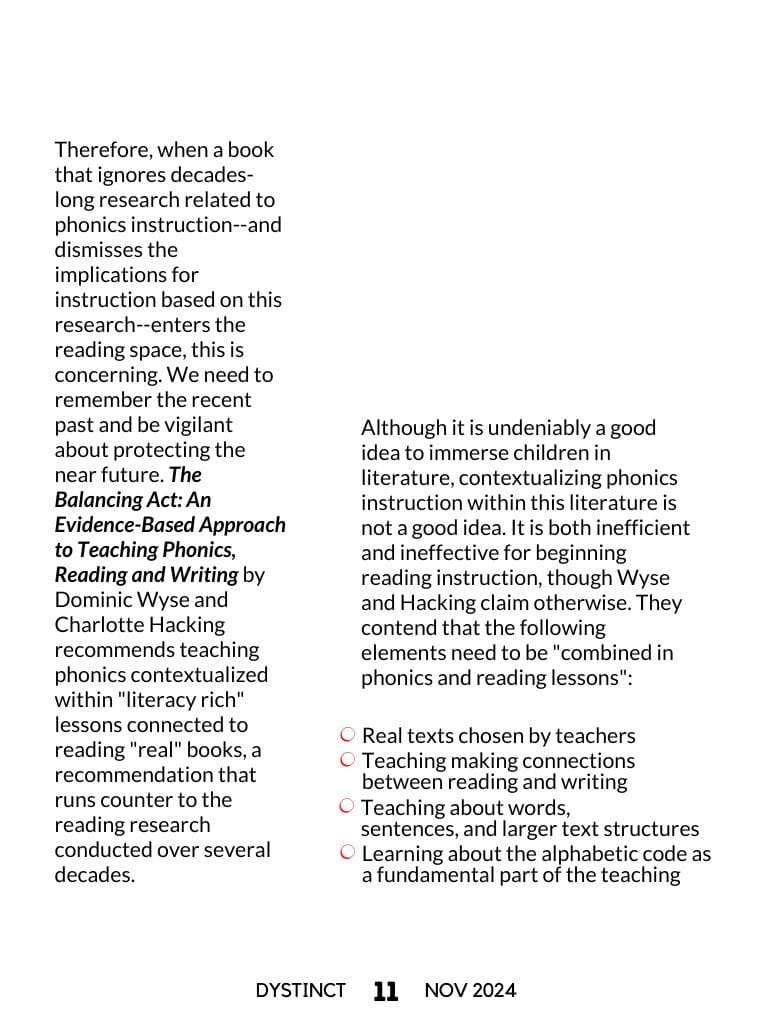
Therefore, when a book that ignores decades-long research related to phonics instruction--and dismisses the implications for instruction based on this research--enters the reading space, this is concerning. We need to remember the recent past and be vigilant about protecting the near future. The Balancing Act: An Evidence-Based Approach to Teaching Phonics, Reading and Writing by Dominic Wyse and Charlotte Hacking recommends teaching phonics contextualized within "literacy rich" lessons connected to reading "real" books, a recommendation that runs counter to the reading research conducted over several decades.
Although it is undeniably a good idea to immerse children in literature, contextualizing phonics instruction within this literature is not a good idea. It is both inefficient and ineffective for beginning reading instruction, though Wyse and Hacking claim otherwise. They contend that the following elements need to be "combined in phonics and reading lessons":
- Real texts chosen by teachers
- Teaching making connections between reading and writing
- Teaching about words, sentences, and larger text structures
- Learning about the alphabetic code as a fundamental part of the teaching
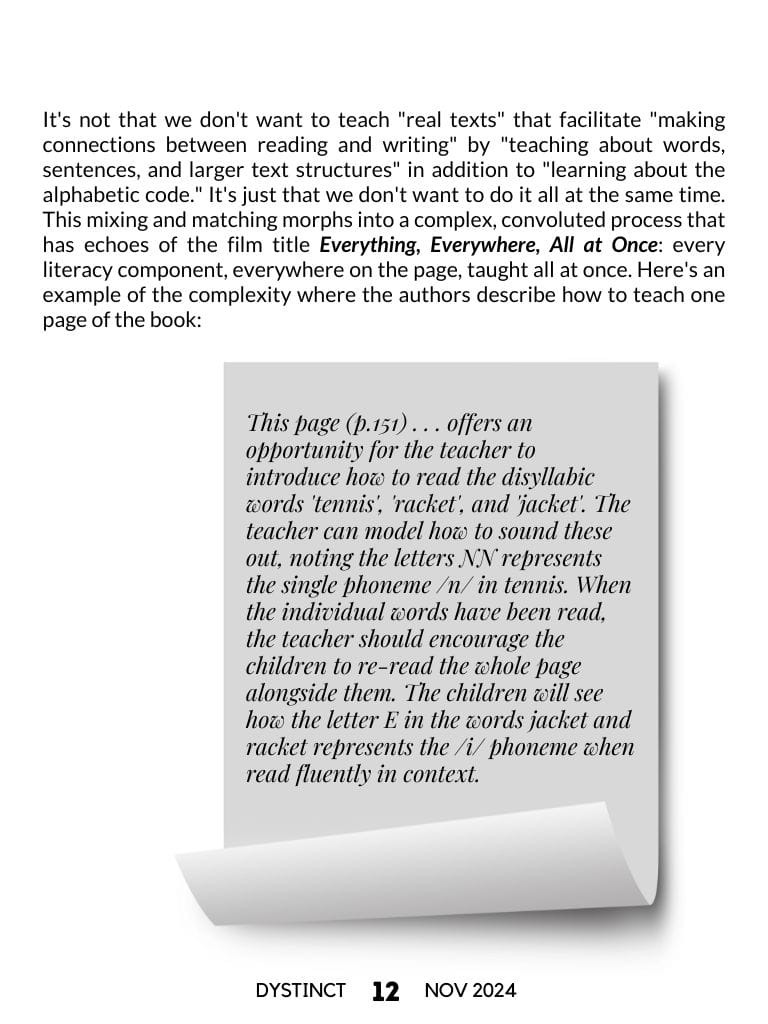
It's not that we don't want to teach "real texts" that facilitate "making connections between reading and writing" by "teaching about words, sentences, and larger text structures" in addition to "learning about the alphabetic code." It's just that we don't want to do it all at the same time. This mixing and matching morphs into a complex, convoluted process that has echoes of the film title Everything, Everywhere, All at Once: every literacy component, everywhere on the page, taught all at once. Here's an example of the complexity where the authors describe how to teach one page of the book:
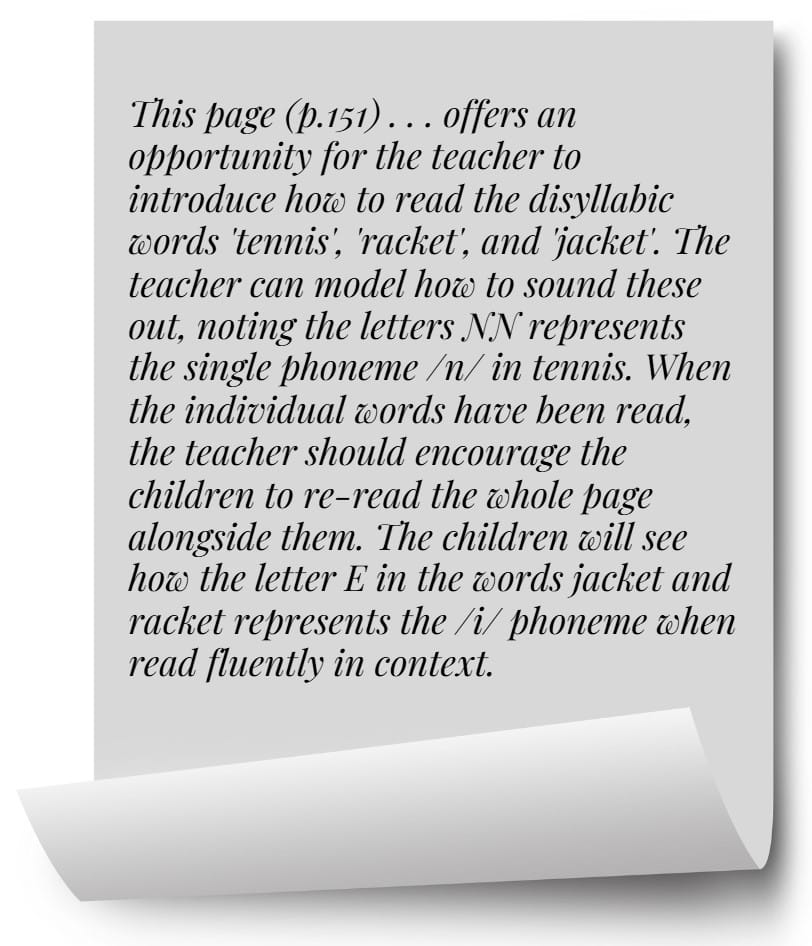
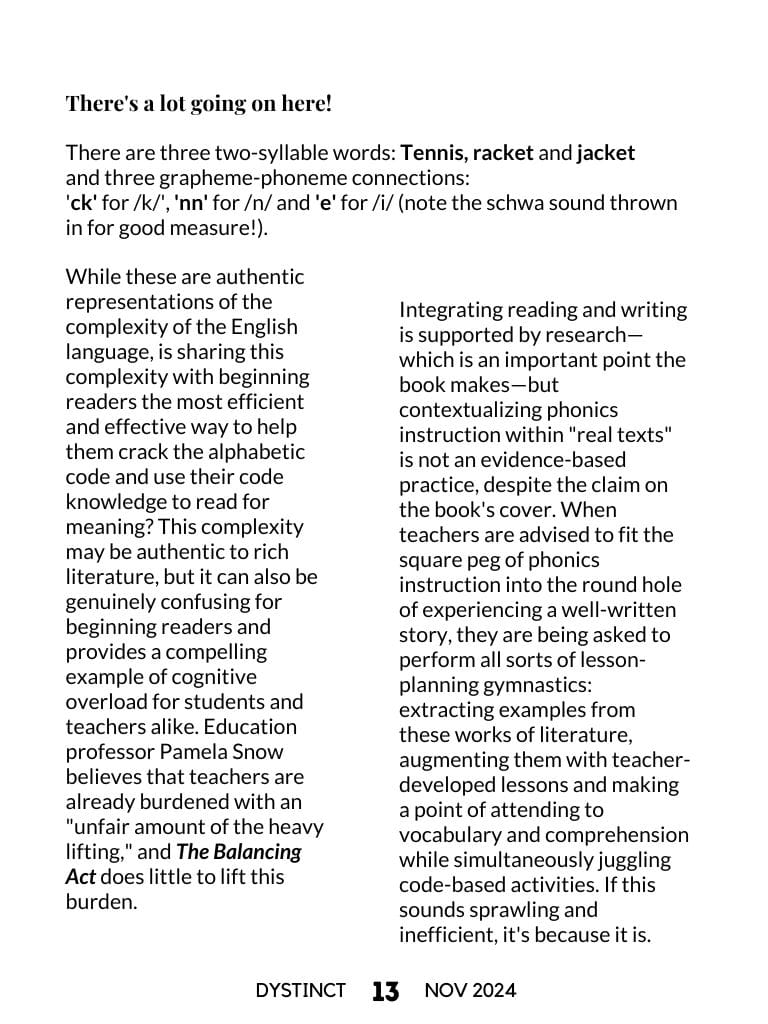
There's a lot going on here!
There are three two-syllable words: Tennis, racket and jacket and three grapheme-phoneme connections:
'ck' for /k/', 'nn' for /n/ and 'e' for /i/ (note the schwa sound thrown in for good measure!).
While these are authentic representations of the complexity of the English language, is sharing this complexity with beginning readers the most efficient and effective way to help them crack the alphabetic code and use their code knowledge to read for meaning? This complexity may be authentic to rich literature, but it can also be genuinely confusing for beginning readers and provides a compelling example of cognitive overload for students and teachers alike. Education professor Pamela Snow believes that teachers are already burdened with an "unfair amount of the heavy lifting," and The Balancing Act does little to lift this burden.
Integrating reading and writing is supported by research—which is an important point the book makes—but contextualizing phonics instruction within "real texts" is not an evidence-based practice, despite the claim on the book's cover. When teachers are advised to fit the square peg of phonics instruction into the round hole of experiencing a well-written story, they are being asked to perform all sorts of lesson-planning gymnastics: extracting examples from these works of literature, augmenting them with teacher-developed lessons and making a point of attending to vocabulary and comprehension while simultaneously juggling code-based activities. If this sounds sprawling and inefficient, it's because it is.
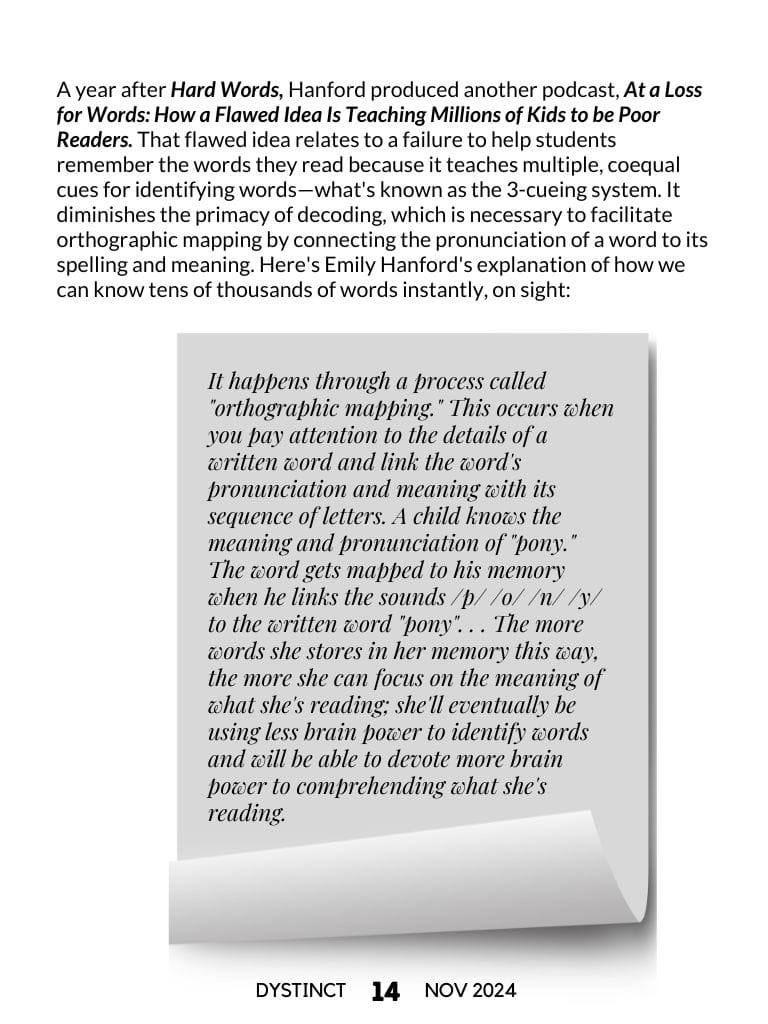
A year after Hard Words, Hanford produced another podcast, At a Loss for Words: How a Flawed Idea Is Teaching Millions of Kids to be Poor Readers. That flawed idea relates to a failure to help students remember the words they read because it teaches multiple, coequal cues for identifying words—what's known as the 3-cueing system. It diminishes the primacy of decoding, which is necessary to facilitate orthographic mapping by connecting the pronunciation of a word to its spelling and meaning. Here's Emily Hanford's explanation of how we can know tens of thousands of words instantly, on sight:
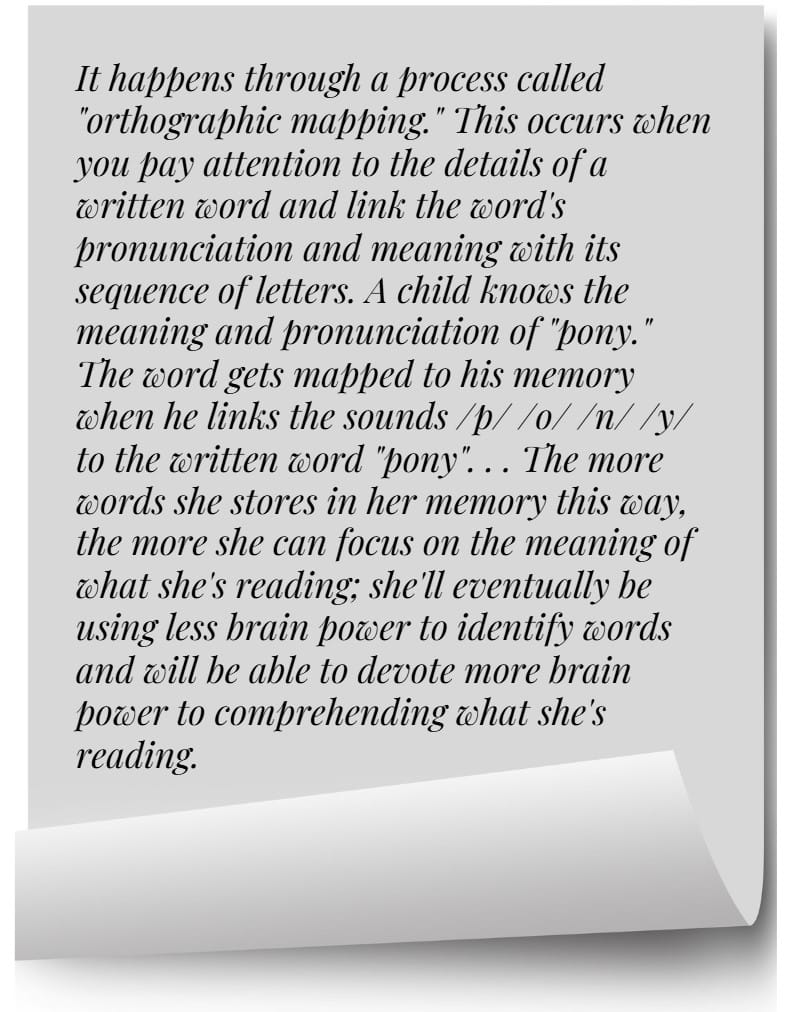
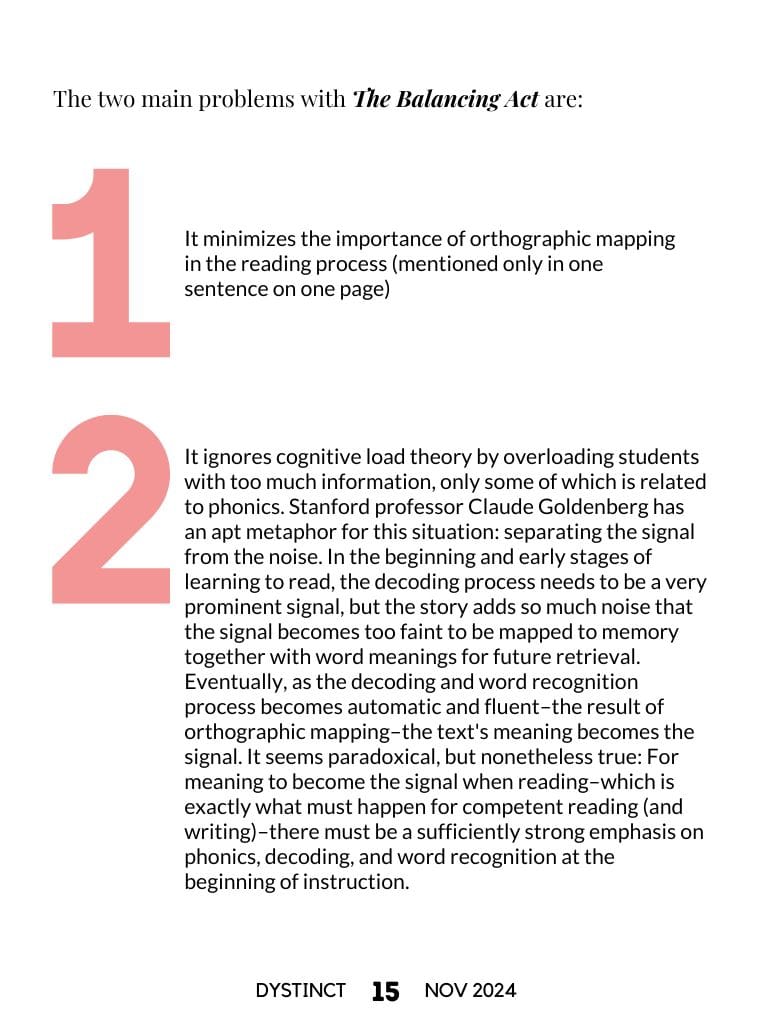
The two main problems with The Balancing Act are:
- It minimizes the importance of orthographic mapping in the reading process (mentioned only in one sentence on one page)
- It ignores cognitive load theory by overloading students with too much information, only some of which is related to phonics. Stanford professor Claude Goldenberg has an apt metaphor for this situation: separating the signal from the noise. In the beginning and early stages of learning to read, the decoding process needs to be a very prominent signal, but the story adds so much noise that the signal becomes too faint to be mapped to memory together with word meanings for future retrieval. Eventually, as the decoding and word recognition process becomes automatic and fluent–the result of orthographic mapping–the text's meaning becomes the signal. It seems paradoxical, but nonetheless true: For meaning to become the signal when reading–which is exactly what must happen for competent reading (and writing)–there must be a sufficiently strong emphasis on phonics, decoding, and word recognition at the beginning of instruction.
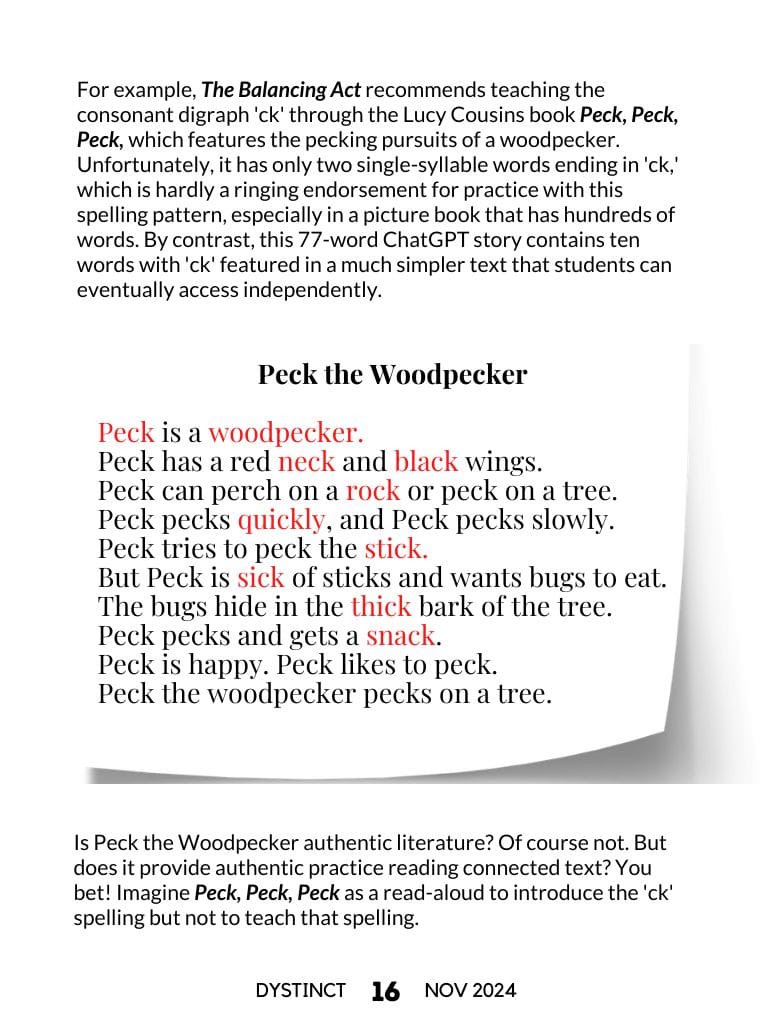
For example, The Balancing Act recommends teaching the consonant digraph 'ck' through the Lucy Cousins book Peck, Peck, Peck, which features the pecking pursuits of a woodpecker. Unfortunately, it has only two single-syllable words ending in 'ck,' which is hardly a ringing endorsement for practice with this spelling pattern, especially in a picture book that has hundreds of words. By contrast, this 77-word ChatGPT story contains ten words with 'ck' featured in a much simpler text that students can eventually access independently.
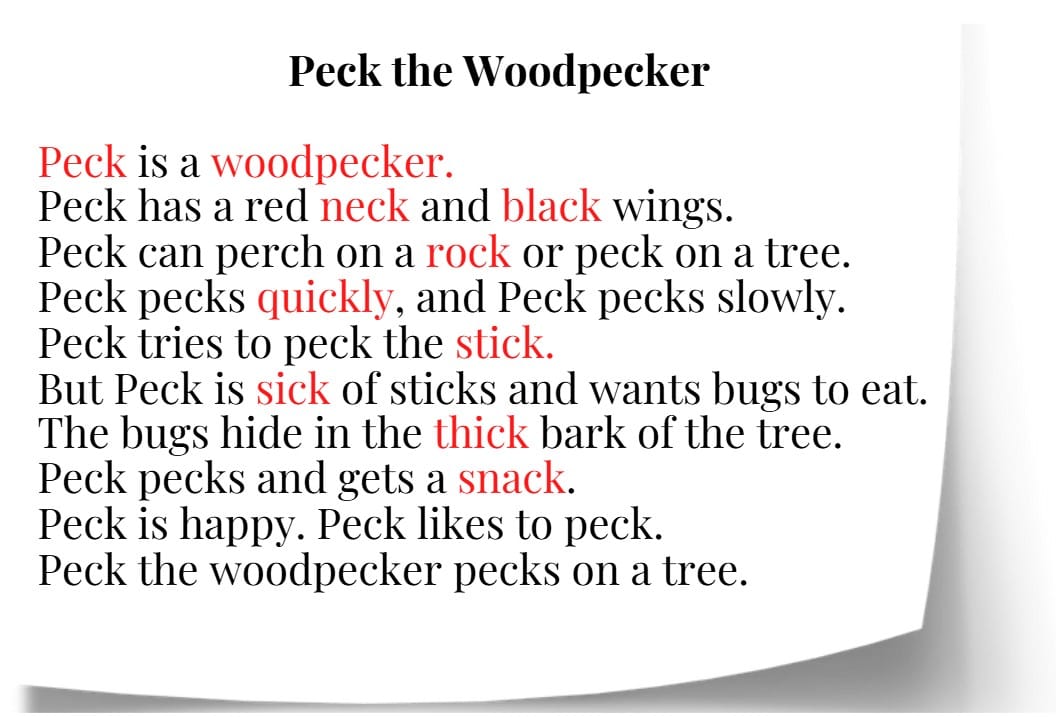
Is Peck the Woodpecker authentic literature? Of course not. But does it provide authentic practice reading connected text? You bet! Imagine Peck, Peck, Peck as a read-aloud to introduce the 'ck' spelling but not to teach that spelling.
As I read through Chapter 8, which begins by teaching 'ck' based on the word 'peck' in the title and ends with teaching 'ss' based on the word 'kiss' on the final page (with a range of suggested activities in between), I find myself lost and overwhelmed, unable to focus on what's critical for promoting reading development for my students at any given point in time. It's true that we do want to take advantage of 'teachable moments' as they present themselves, and there isn't just one way to cultivate the comprehension-building possibilities in children's literature. But please don't ask me to use my creativity to sequence my instruction of the alphabetic code! Please provide me with materials that I can readily and reliably teach so that I can help my students gain control of the code rather than haphazardly rely on a title or a tagline to teach my students the spelling patterns they need to master in order to decode, orthographically map to memory the words they've decoded, and then automatically recognize those words upon future encounters—so essential to becoming a proficient reader.
Wyse and Hacking want to guard against the perceived "drill and kill" of decontextualized phonics, failing to appreciate Anita Archer's optimistic characterization related to this type of systematic, explicit instruction—how the "thrill of skill" can foster motivation as students successfully engage with the text in front of them. It's okay—in fact, desirable—for children to read I am Sam as a first text while a more complex text like Sam Who Never Forgets is read to them. These books serve two different purposes, each engaging in its own way.
Like Sam, we must never forget that we have decades of research to support reading instruction, research that Emily Hanford reintroduced through her podcasts, most recently in the ten-part series Sold a Story: How Teaching Kids to Read Went So Wrong. Nor must we allow others to shift the focus to engagement and motivation by conjuring up faulty, ineffective, or overdone phonics instruction unsupported by any robust research. Fortunately, lessons focused on the repetition and reinforcement of the phoneme-grapheme connections children have been taught reduce their cognitive load by using text they can actually read, rewarding students with the ability to read independently. Decontextualized phonics instruction can be both engaging and motivating. But more to the point, its effective use as part of a fully "balanced"--in the actual sense of the word--literacy diet will hasten the day that students will be able to read authentic texts of any sort and with agency.
Teaching phonics contextualized within "real" books sounds appealing: Who wouldn't want children to experience the joys of reading rich literature from the outset of their education? The problem is that the way the authors of this book envision these experiences will have the perverse effect of delaying when students will actually be able to experience those joys by reading independently. The evidence is very clear that if done right, direct, explicit, and systematic phonics instruction is generally the quickest and most efficient road to reading competence, one that is "fast and painless," as neuroscientist Stanislas Dehaene asserts.
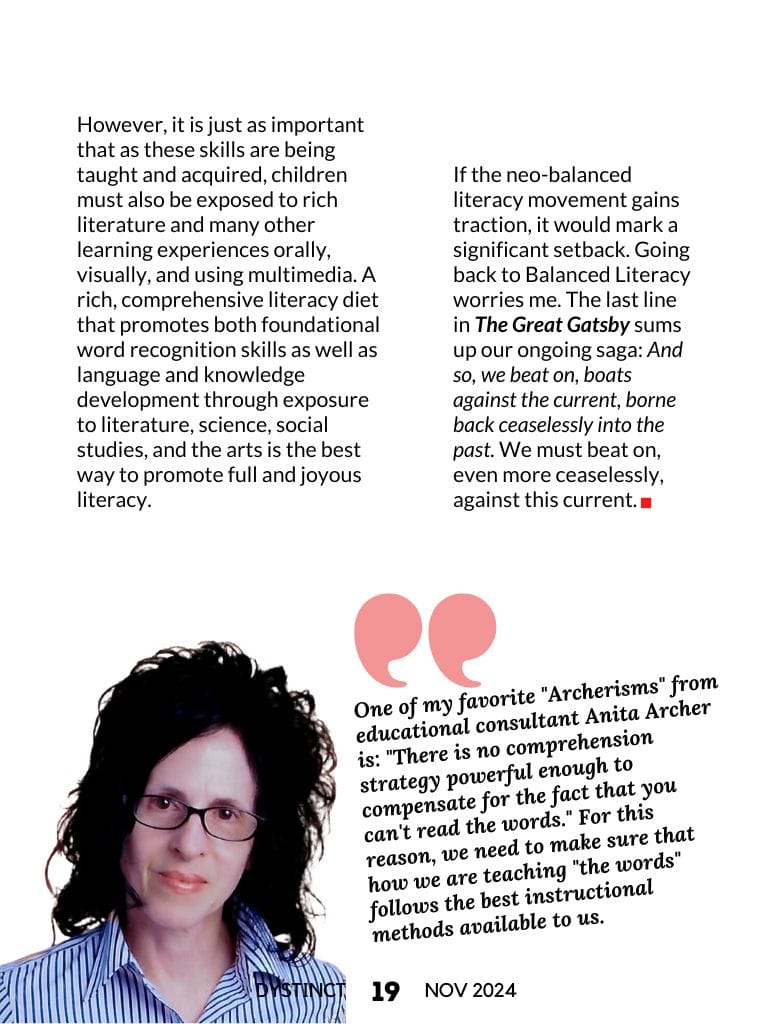
However, it is just as important that as these skills are being taught and acquired, children must also be exposed to rich literature and many other learning experiences orally, visually, and using multimedia. A rich, comprehensive literacy diet that promotes both foundational word recognition skills as well as language and knowledge development through exposure to literature, science, social studies, and the arts is the best way to promote full and joyous literacy.
If the neo-balanced literacy movement gains traction, it would mark a significant setback. Going back to Balanced Literacy worries me. The last line in The Great Gatsby sums up our ongoing saga: And so, we beat on, boats against the current, borne back ceaselessly into the past. We must beat on, even more ceaselessly, against this current.
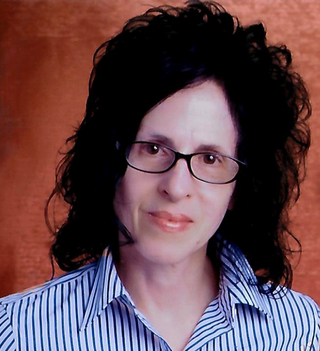
Harriett Janetos
Reading Specialist, Reading Coach & Author
Harriett Janetos
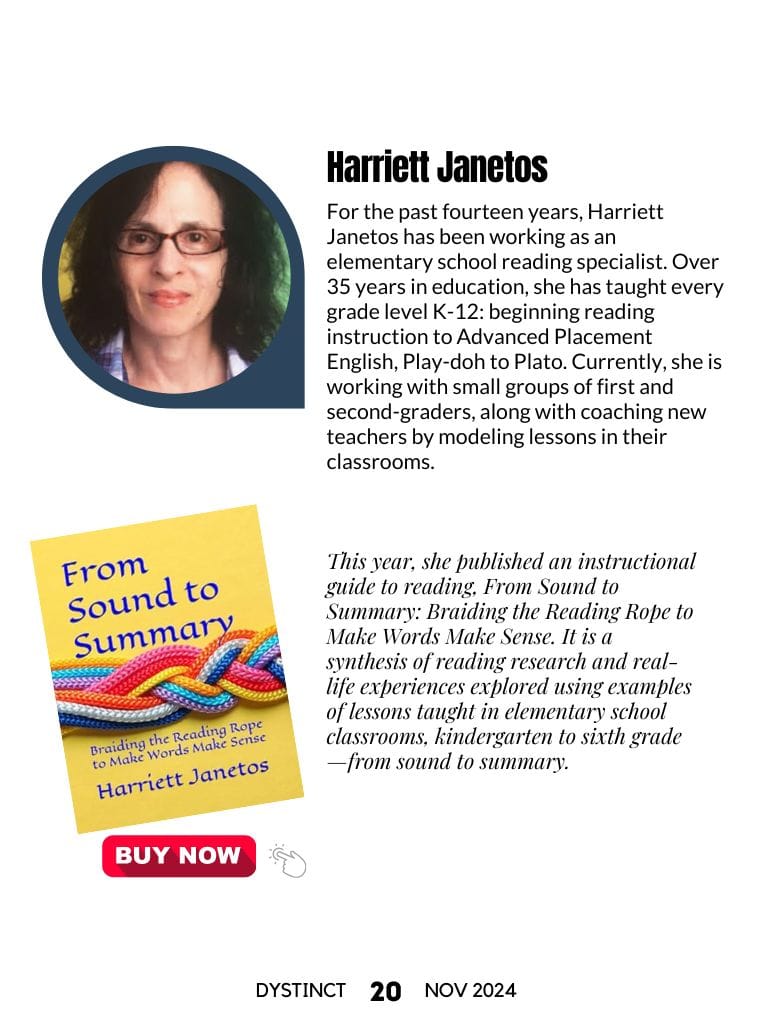
For the past fourteen years, Harriett Janetos has been working as an elementary school reading specialist. Over 35 years in education, she has taught every grade level K-12: beginning reading instruction to Advanced Placement English, Play-doh to Plato. Currently, she is working with small groups of first and second-graders, along with coaching new teachers by modeling lessons in their classrooms.
BUY BOOK
From Sound to Summary
This year, she published an instructional guide to reading, From Sound to Summary: Braiding the Reading Rope to Make Words Make Sense. It is a synthesis of reading research and real-life experiences explored using examples of lessons taught in elementary school classrooms, kindergarten to sixth grade—from sound to summary.
Extracts from Dystinct Magazine
Extracts from Dystinct Magazine