Issue 26: Universal Screening: A Temperature Check and Essential First Step in a Systematic Approach to Literacy Assessment | Dr Shelby Pollitt
Dr Shelby Pollitt outlines how universal screening serves as a crucial first step in identifying students at risk for literacy difficulties, enabling early intervention and more equitable access to support, while stressing the importance of ongoing assessment to guide effective instruction.
Table of Contents
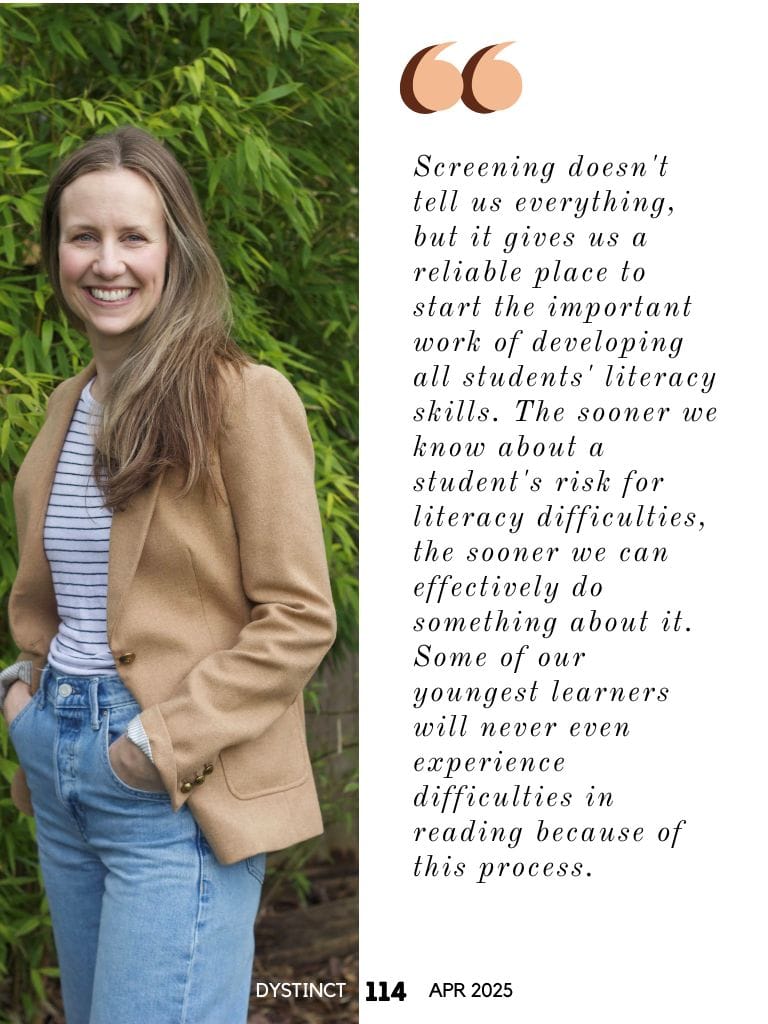
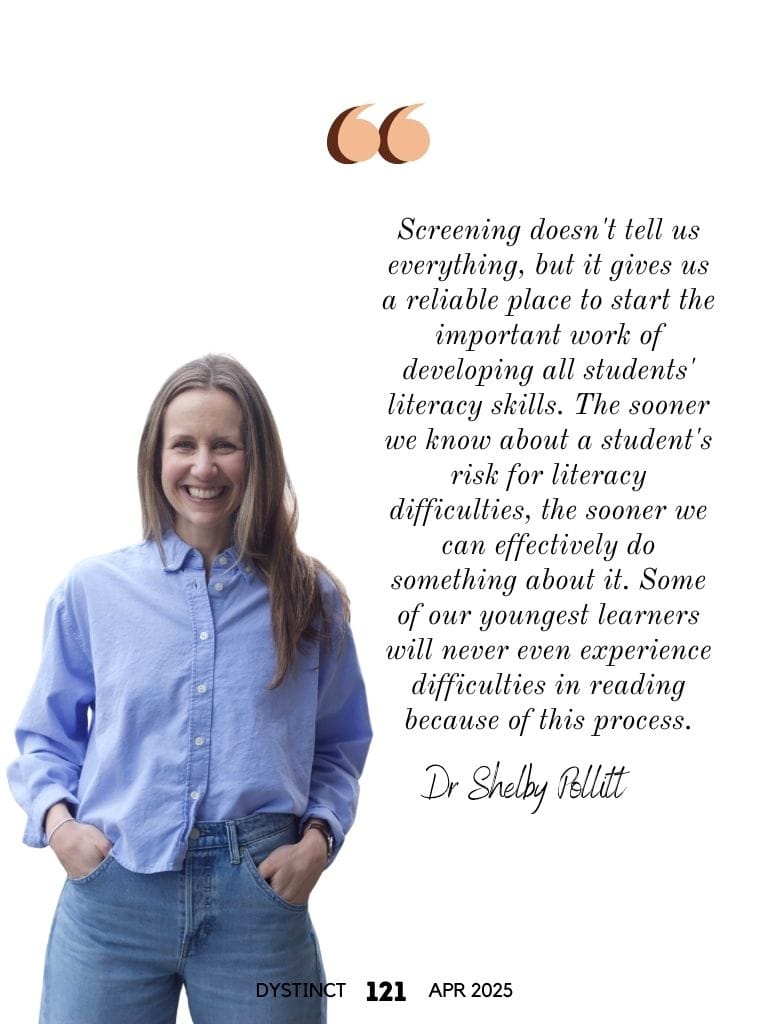
Screening doesn't tell us everything, but it gives us a reliable place to start the important work of developing all students' literacy skills. The sooner we know about a student's risk for literacy difficulties, the sooner we can effectively do something about it. Some of our youngest learners will never even experience difficulties in reading because of this process.
Universal screening has a fundamental role in multi-tiered systems of support, reducing bias and increasing equitable access to support for learners who are at risk for or currently experiencing literacy difficulties. While the value of a systematic approach to literacy assessment (including universal screening as a first step) has been well established in research for some time, every jurisdiction varies in its approach and timeline to implement this inclusive process.
What is universal screening? Why is this important?
What is universal screening? Why is this important?
Universal screening involves the administration of short, standardized, skill-focused assessment measures to every student, capturing specific literacy skills that are predictive of proficiency in literacy. For example, measuring students' phonemic awareness (i.e., the ability to isolate and manipulate the individual sounds in spoken words) in kindergarten can, with impressive accuracy, identify students at risk for future difficulties with literacy skills, even before consolidated reading and writing skills are an expectation at school. This data provides educators with the opportunity to be preventative in their approach to instruction and support, effectively avoiding challenges that can impact learning across the curriculum. Of course, some students, particularly those with a dyslexia-type profile, will benefit from ongoing, intensive intervention supplemental to comprehensive classroom instruction, but early identification through screening is key for timely intervention targeting foundational skills that will serve students moving forward.
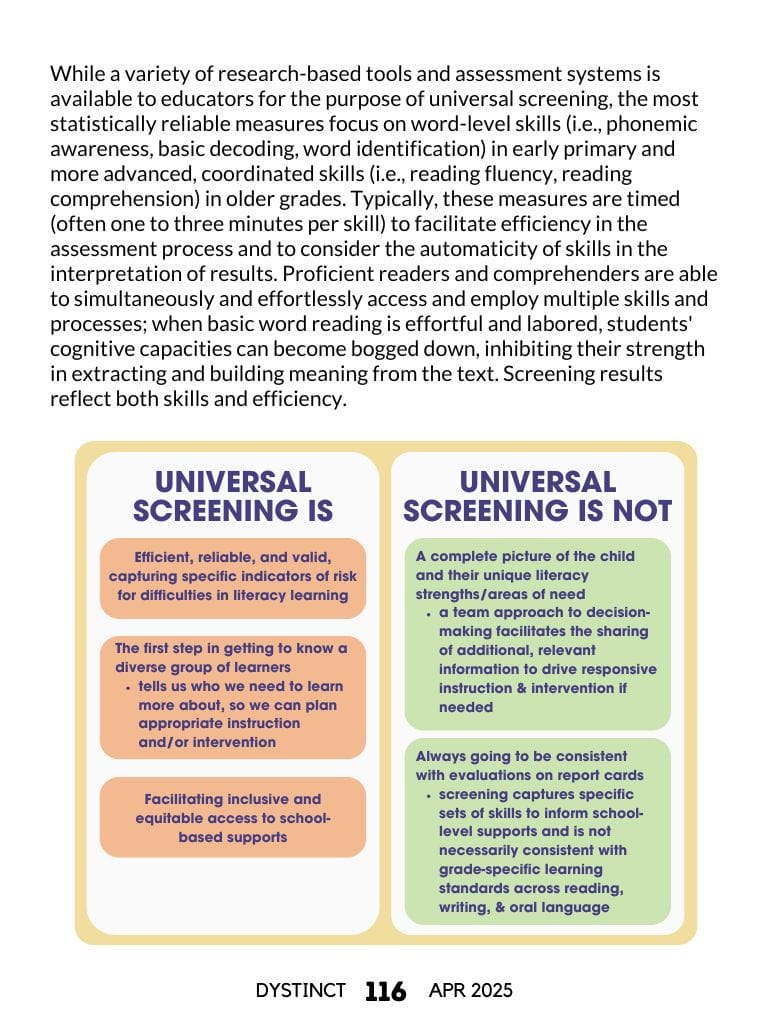
While a variety of research-based tools and assessment systems is available to educators for the purpose of universal screening, the most statistically reliable measures focus on word-level skills (i.e., phonemic awareness, basic decoding, word identification) in early primary and more advanced, coordinated skills (i.e., reading fluency, reading comprehension) in older grades. Typically, these measures are timed (often one to three minutes per skill) to facilitate efficiency in the assessment process and to consider the automaticity of skills in the interpretation of results. Proficient readers and comprehenders are able to simultaneously and effortlessly access and employ multiple skills and processes; when basic word reading is effortful and labored, students' cognitive capacities can become bogged down, inhibiting their strength in extracting and building meaning from the text. Screening results reflect both skills and efficiency.
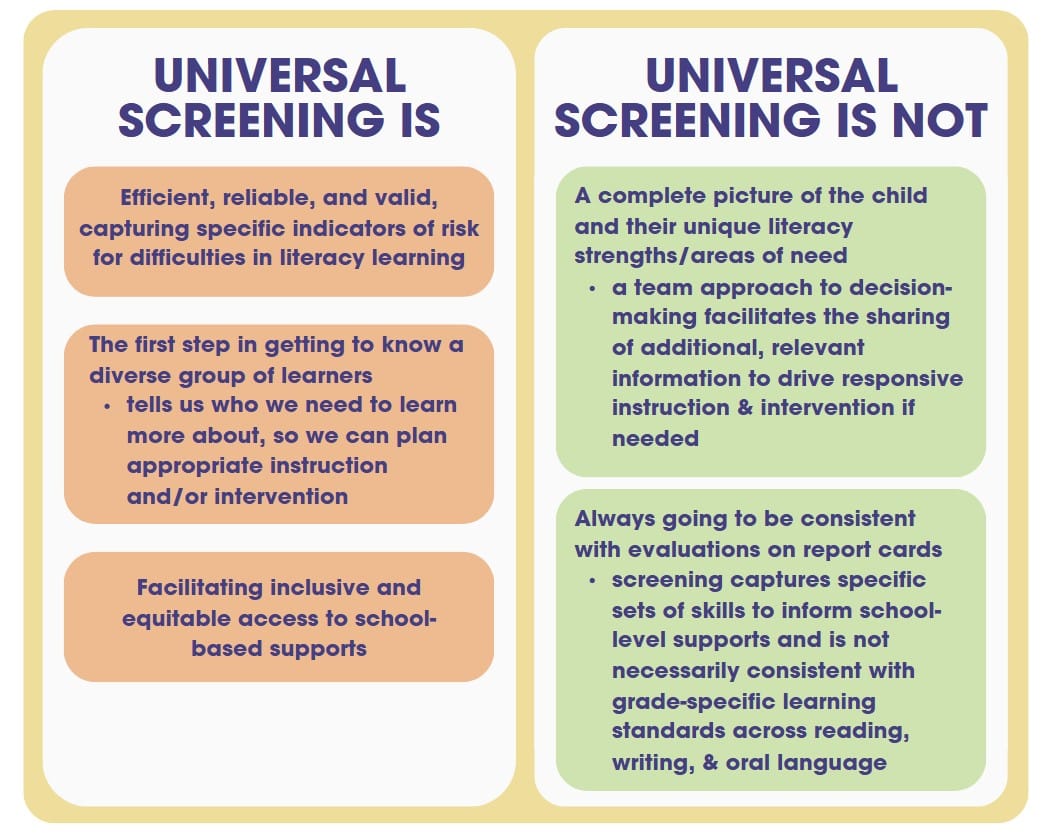
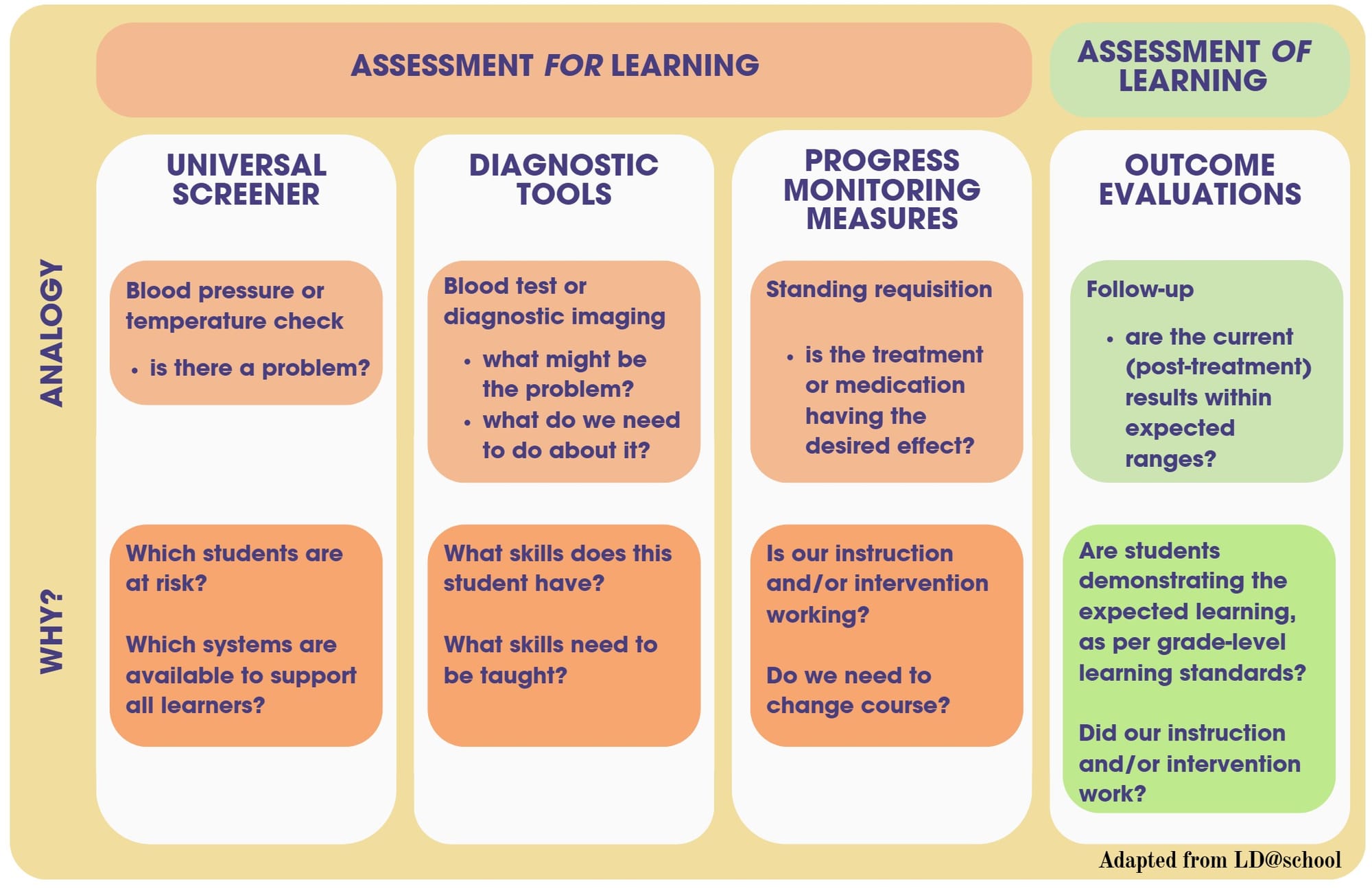
Ultimately, universal screening draws on research-based benchmarks to show educators and the school-level support team which specific students they need to learn more about (that is, students at risk for literacy difficulties), but this initial data on its own may not be as meaningful to caregivers. The subsequent steps in a systematic approach to literacy assessment allow educators to dig into the potential causes of difficulties, informing plans for responsive intervention for the students who need it most and ensuring adequate response to intervention. It is this data, the results from diagnostic and progress monitoring assessments, that can offer valuable information for families to have an active role in collaborative planning, to advocate for specific services at school, or plan for additional support at home.
Diagnostic Assessments & Progress Monitoring
Diagnostic Assessments & Progress Monitoring
For students flagged as at risk on literacy-focused universal screening measures, educators will typically follow up with diagnostic tools: assessments that examine more specific, or in some cases, more foundational, contributory skills. For example, since reading is complex and involves a variety of coordinated skills, student difficulties in this area should lead to further exploration based on the well-established body of research on reading skill development (validated across diverse groups of learners and demographics). Educators will likely follow up on a reading fluency screening measure with diagnostic tools exploring underlying decoding skills, considering phonics knowledge on a continuum from simple to complex letter-sound correspondences. These results would highlight any gaps, directly informing both instruction and intervention about where to start and what to focus on. It should also be noted that common screening measures, while valid and reliable, are imperfect. This means that, occasionally, diagnostic tools indicate that a student has strong underlying skills, deeming intervention unnecessary. Some students just need additional opportunities for practice. Scheduling universal screening at multiple points throughout the year ensures that all students' progress will continue to be monitored alongside same-age peers.
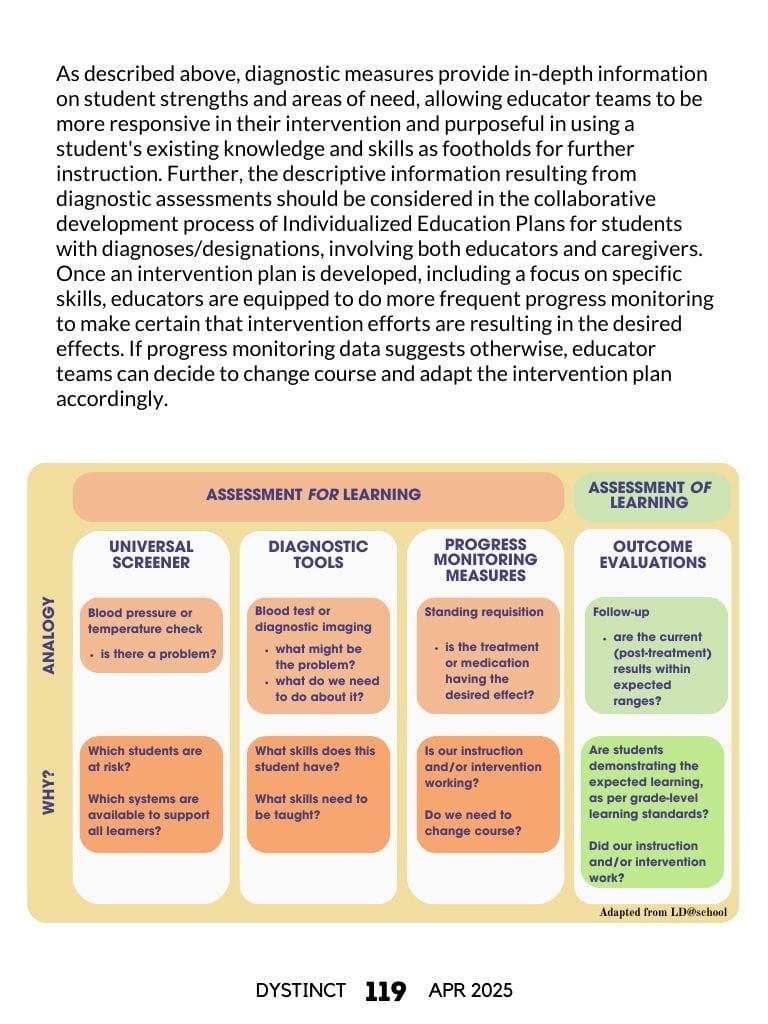
As described above, diagnostic measures provide in-depth information on student strengths and areas of need, allowing educator teams to be more responsive in their intervention and purposeful in using a student's existing knowledge and skills as footholds for further instruction. Further, the descriptive information resulting from diagnostic assessments should be considered in the collaborative development process of Individualized Education Plans for students with diagnoses/designations, involving both educators and caregivers. Once an intervention plan is developed, including a focus on specific skills, educators are equipped to do more frequent progress monitoring to make certain that intervention efforts are resulting in the desired effects. If progress monitoring data suggests otherwise, educator teams can decide to change course and adapt the intervention plan accordingly.
There is an increasing level of awareness in the field of education regarding the benefits of universal screening. While this is a hopeful shift toward equitable access to literacy for all learners, educators and school district leaders must not forget that it is only the first step in supporting learners who are at risk for or currently experiencing literacy difficulties. In places where universal screening systems are up and running, it is imperative that school district teams allocate time, training, and resources to dig into the important work of evidence-aligned instruction, intervention, and progress monitoring to ensure efficacy.
If universal screening is not happening, what are the barriers to implementation? Various organizations can help to address this challenge. For example, Dyslexia Canada offers resources to educators and caregivers, including not only information specific to that context but also letter templates that can be adapted to help facilitate advocacy for universal screening within education communities around the world. Often, awareness and knowledge building are the first place to start, and it is never too late to facilitate a shift toward equitable literacy outcomes. In fact, there is no time to waste.
Resources
Resources
- Universal Screening resource offered by Dyslexia Canada [dyslexiacanada.org]
Dr Shelby Pollitt
Educational Psychologist, Researcher & Advocate for Evidence-Aligned Literacy Instruction
Dr Shelby Pollitt
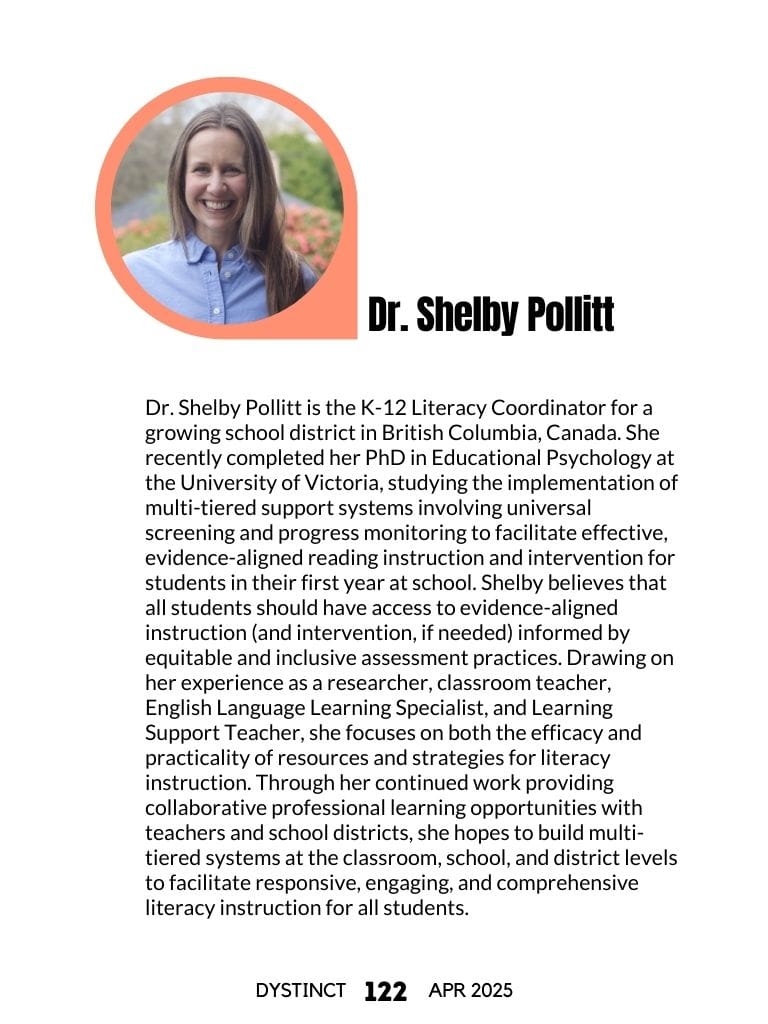
Dr. Shelby Pollitt is the K-12 Literacy Coordinator for a growing school district in British Columbia, Canada. She recently completed her PhD in Educational Psychology at the University of Victoria, studying the implementation of multi-tiered support systems involving universal screening and progress monitoring to facilitate effective, evidence-aligned reading instruction and intervention for students in their first year at school. Shelby believes that all students should have access to evidence-aligned instruction (and intervention, if needed) informed by equitable and inclusive assessment practices. Drawing on her experience as a researcher, classroom teacher, English Language Learning Specialist, and Learning Support Teacher, she focuses on both the efficacy and practicality of resources and strategies for literacy instruction. Through her continued work providing collaborative professional learning opportunities with teachers and school districts, she hopes to build multi-tiered systems at the classroom, school, and district levels to facilitate responsive, engaging, and comprehensive literacy instruction for all students.
Extracts from Dystinct Magazine
Extracts from Dystinct Magazine