Issue 14: There Are Many Stories | Dr Jennifer Petrich, Sara Lee, and Bradley Johnson
Dr Jennifer Petrich, Sara Lee, and Bradley Johnson narrate how they embarked on a journey of structured word inquiry with struggling students.
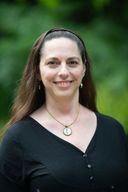

Dr Jennifer Petrich, Sara Lee, and Bradley Johnson narrate how they embarked on a journey of structured word inquiry with struggling students, thereby leading them to understand the power of the English writing system, fostering connections in the meaning and structure of words, and empowering them to rewrite their own stories with their newfound confidence and independence.
Anyone who has invested time and effort into helping children who struggle with reading has a story. Most of them start with the teacher or educational professional witnessing the pain of a struggling student that believes their struggle is because they're dumb and unable to learn. These stories often continue with hope as the student receives intervention, makes progress, and starts to read. However, that is not the end of those stories. It's only the beginning.
Many of these students who have made progress after years of phonics-based interventions find themselves starting to struggle again as they move into higher grades and on to more sophisticated written language. The reading specialists, resources teachers, and academic therapists we talk to say that they're not sure how to help these students. These students who now have high phonemic awareness scores and have finished their programs are hitting a wall when it comes to fluency and comprehension at these higher levels. We see the phonics rules they learned letting them down. We see them only able to activate meaning from print via pronunciation. They aren't able to make that leap to activating meaning directly from the text on the page. And they inevitably struggle with spelling. No one is telling that story.
We'd like to tell ours now.
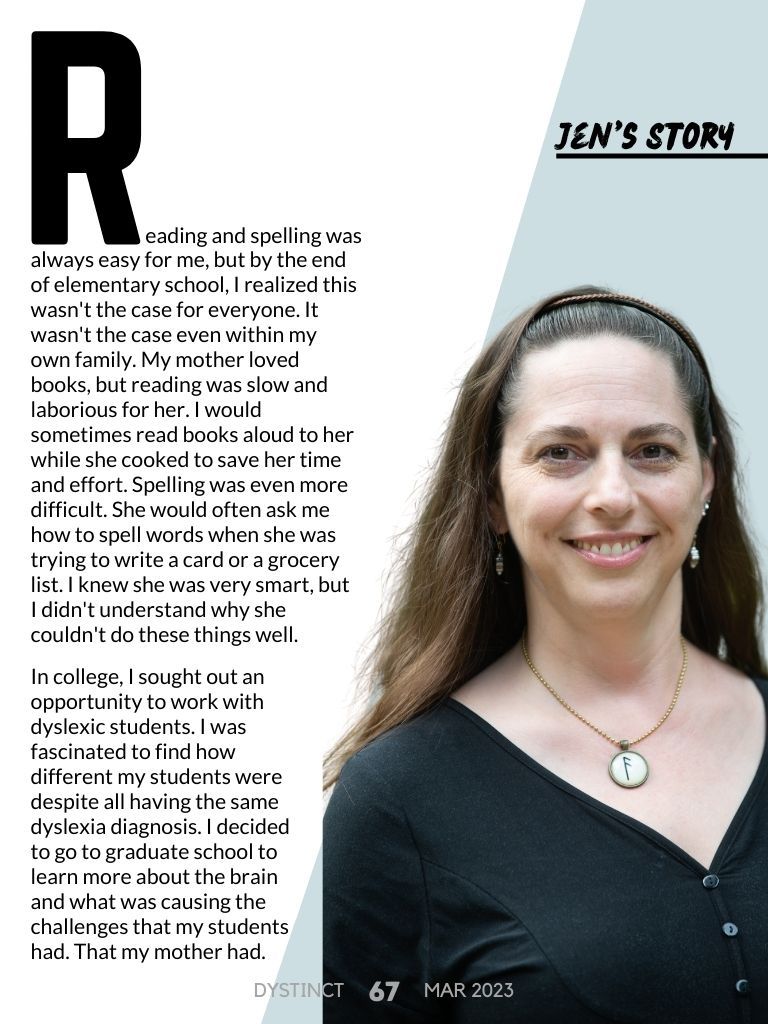
Jen's Story
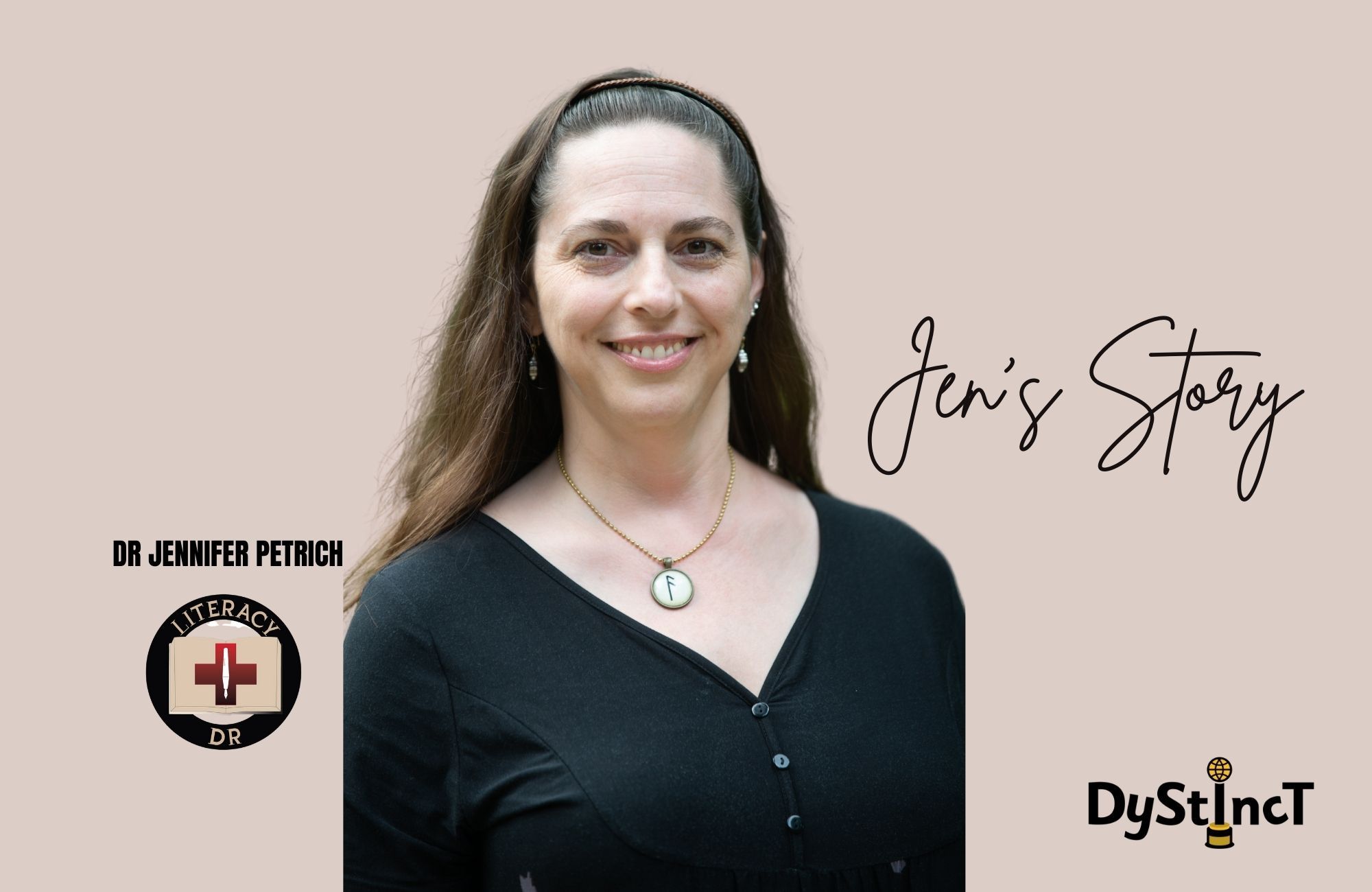
Reading and spelling was always easy for me, but by the end of elementary school, I realized this wasn't the case for everyone. It wasn't the case even within my own family. My mother loved books, but reading was slow and laborious for her. I would sometimes read books aloud to her while she cooked to save her time and effort. Spelling was even more difficult. She would often ask me how to spell words when she was trying to write a card or a grocery list. I knew she was very smart, but I didn't understand why she couldn't do these things well.
In college, I sought out an opportunity to work with dyslexic students. I was fascinated to find how different my students were despite all having the same dyslexia diagnosis. I decided to go to graduate school to learn more about the brain and what was causing the challenges that my students had. That my mother had.
While living at home and finishing my dissertation, I was reading The DaVinci Code aloud to my mother late one evening. We finished a chapter, and she remarked about how it would have taken her many hours to read that chapter on her own. By this point, I knew she was dyslexic, but I was struck by how slowly she actually read. I was inspired and amazed by the fact that she continued to read book after book despite the effort it took her. I was saddened thinking about how unfair it was that she and so many others had to try so hard to access the information contained in books.
I was inspired and amazed by the fact that she continued to read book after book despite the effort it took her.
After grad school, I worked in research labs for eight years. I love research, and I know the crucial role it plays in moving our understanding forward in any field, but I felt the need to have more direct contact with those that needed help. I left research and returned to working with dyslexic readers. One day, I was working on the word elevator with a student. He found the vowels and was using the syllabication rules I'd taught him to sound out each syllable. After multiple iterations of pronouncing each syllable, he arrived at the "correct" division pattern. Despite knowing the word, he was still not able to recognize it. I helped him move the stress around, and even when he'd gotten the right stress pattern, there was still no recognition of the word. I'd seen other students struggle in this way. I was frustrated that once my students got past one-syllable words, there were so many strategies and rules that just didn't work for reading and even less so for spelling.
In 2014, on the second day of a two-day workshop called Word Detectives, we were learning how to analyze words for meaningful parts rather than the parts we used for speech. I was fascinated by what I was learning, and so many pieces seemed to come together that day. But I noticed that many of the others in the workshop were frustrated. "What are we supposed to do with this information?" I didn't know either, but I knew I needed to know more.
It was time to stop the tips and tricks and the memorizing and start teaching the understanding.
Fast forward to the spring of 2017. All school year, I'd been working with a fifth-grade student solely on spelling. His mother had said spelling tests were a waste of time because he couldn't pass them. I suggested he work on lists that I created instead. I based his lists on the three suffixing conventions and on different morphological word families. Instead of lists that focused on words similar in their phonology, I used words related in meaning and morphology: different, conference, preferred, referee, etc. After using scientific word study on just those lists for 40 hours throughout the school year, his MAP reading percentile, which had been 38 in the fall, had climbed to 64. His progress, combined with everything I'd learned by that point, convinced me that I could finally drop my drills and prescriptive phonics and focus on the meaningful structure and history of words along with the actual phonology. It was time to stop the tips and tricks and the memorizing and start teaching the understanding.
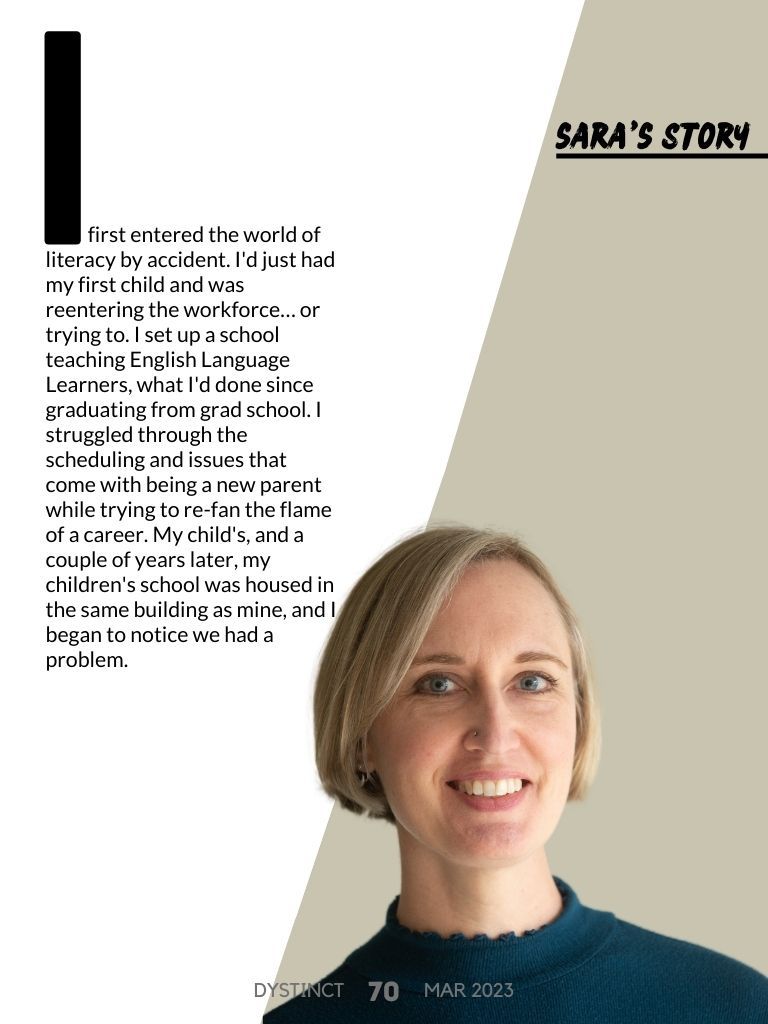
Sara's Story
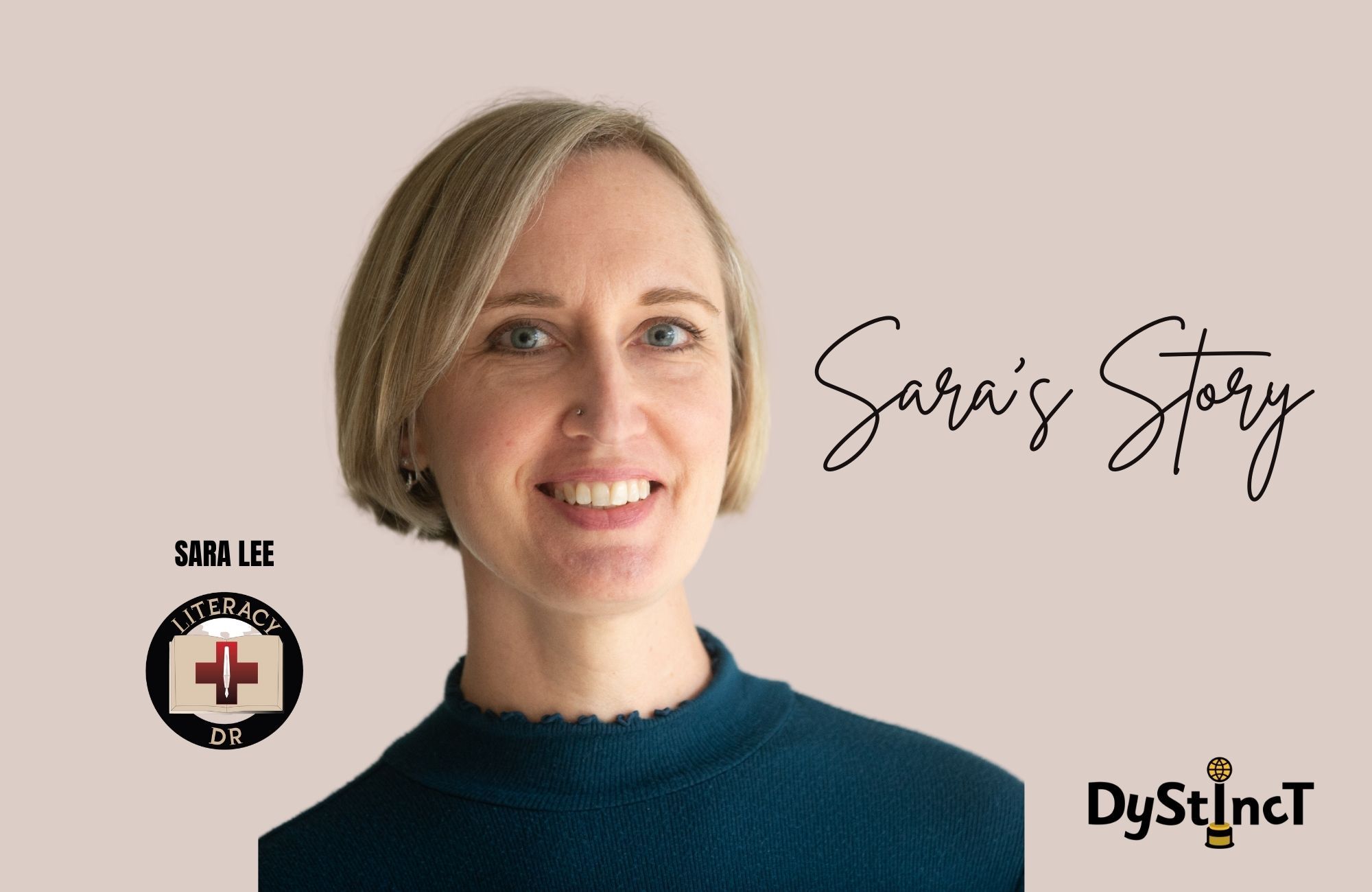
I first entered the world of literacy by accident. I'd just had my first child and was reentering the workforce… or trying to. I set up a school teaching English Language Learners, what I'd done since graduating from grad school. I struggled through the scheduling and issues that come with being a new parent while trying to re-fan the flame of a career. My child's, and a couple of years later, my children's school was housed in the same building as mine, and I began to notice we had a problem.
One day, some admins introduced me to a child who was struggling with reading, spelling, and writing. That struggle touched every part of her learning, defining every day of school for her in some way. I had no idea what I was doing. I looked up certification in something called Wilson, but none of the things I saw about Wilson made any sense to me. This child struggled with memorizing. Why would I attempt to get her to memorize a bunch of rules and exceptions to those rules? So I went it alone with what I already had: a solid and growing understanding of the English language. We read together, and we wrote together. I applied all that I knew about teaching English to ELLs. I taught her IPA and showed her how we represent different phonemes with graphemes. I worked through reading comprehension and grammar. And though the child made significant progress, formed new understandings, and gained confidence in many ways, something was missing for me. I needed a deeper understanding of English orthography than what I'd had at that time and what I was able to give to the students who came after her.
That struggle touched every part of her learning, defining every day of school for her in some way.
In 2017, a friend of mine was talking to an acquaintance of hers, Jennifer Petrich, at their neighborhood pool, and that conversation changed my life. I'd just shuttered the school I'd founded and grown. I was planning on going into corporate training and had dusted off my old business suits for pending interviews when Jen and I had a conversation about literacy. I'd called her nearly immediately when my friend told me Jen was looking for a linguist. There was someone looking for a linguist!? She told me about scientific word investigations. It was a short conversation, but the words she said and the processes she laid out were exactly what I'd needed to hear, what I didn't know I'd been looking for, and what I knew my students had needed all along. She had the missing piece. And I had pieces she needed, too. I knew how to run a business, had studied in an autism lab, had worked with the neurodivergent population, and was actively investigating the English language, its structure, and its use.
For him and for so many like him, that's something valuable they didn't have before.
Since that day, that first conversation with Jen, I've taught dozens of students, many of whom have dyslexia and some of whom do not. We learn together with me as their guide. "Let's look up the history. I think it's Greek, and that's why there's an <o> between the bases!" my fourth-grade student exclaims as he shares his screen with the Online Etymology Dictionary, already loaded and ready to go. He's come so far, and he knows he has. He has the tools to investigate spellings. For him and for so many like him, that's something valuable they didn't have before.
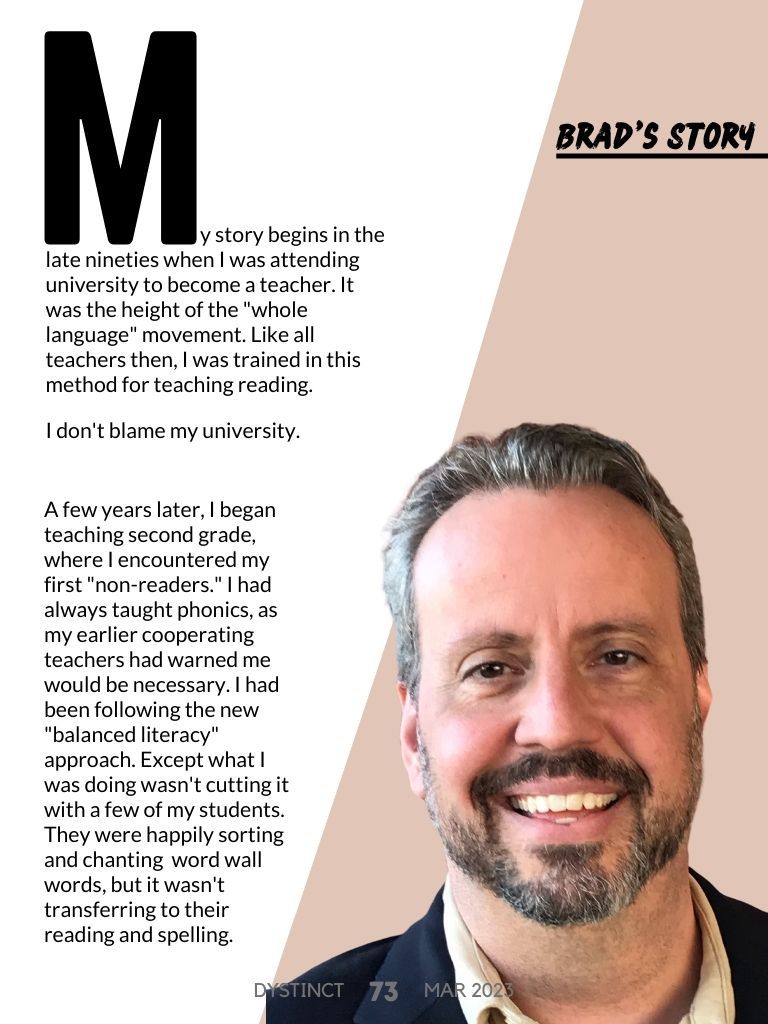
Brad's Story
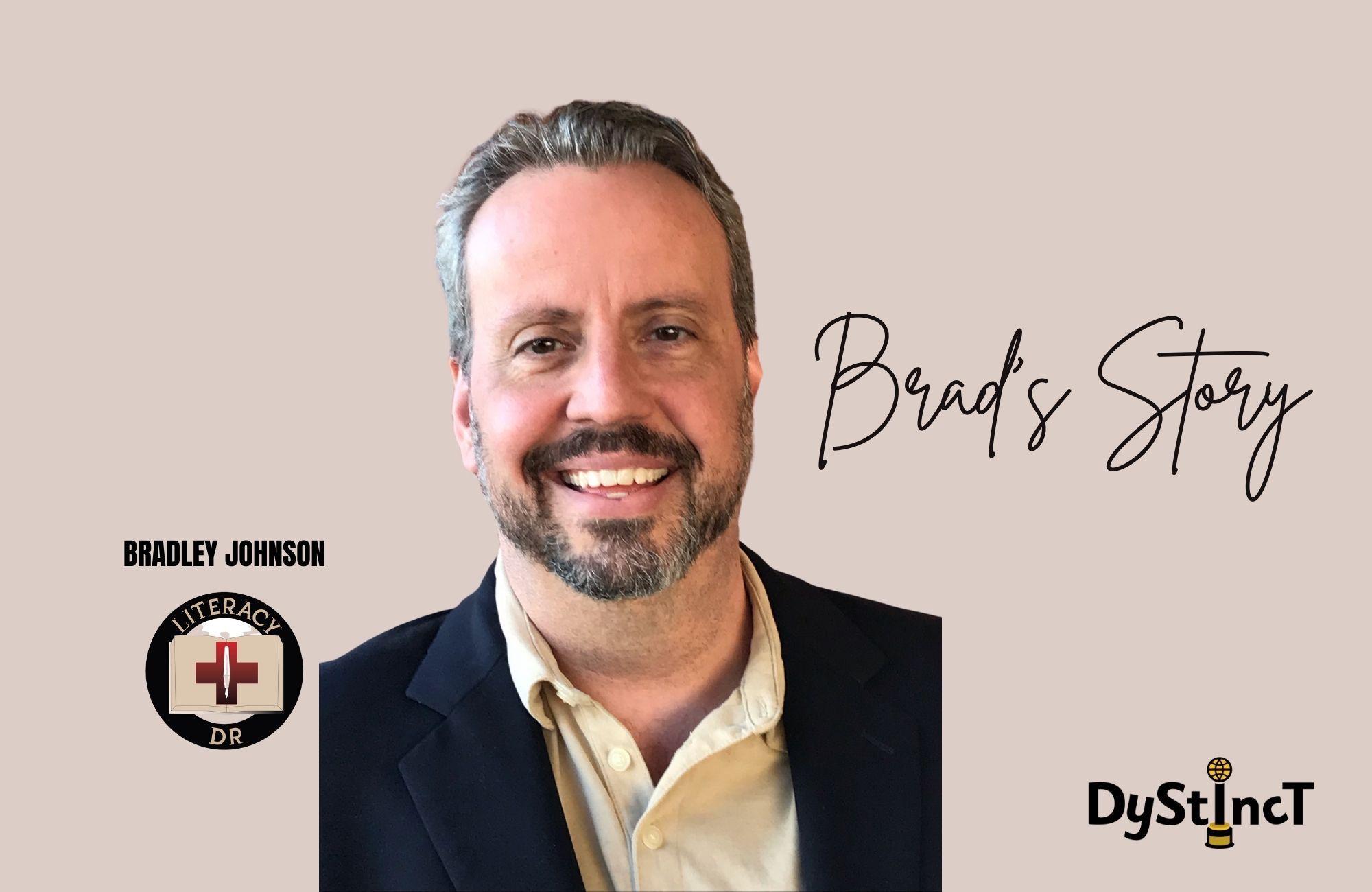
My story begins in the late nineties when I was attending university to become a teacher. It was the height of the "whole language" movement. Like all teachers then, I was trained in this method for teaching reading.
I don't blame my university.
A few years later, I began teaching second grade, where I encountered my first "non-readers." I had always taught phonics, as my earlier cooperating teachers had warned me would be necessary. I had been following the new "balanced literacy" approach. Except what I was doing wasn't cutting it with a few of my students. They were happily sorting and chantingword wall words, but it wasn't transferring to their reading and spelling.
I talked with a mentor of mine, who introduced me to authors like Marilyn Adams, Rebecca Tremain, and Richard Venezky. I became excited about the logic of phonics and incorporated more and more of it into my "word block" during the day. We would tap and finger-spell. We would manipulate letter tiles and chant our words. This wasn't "drill and kill", after all!
I wanted to share this same joy with my colleagues. I took a one-week course in an Orton-Gillingham (now known as the Structured Literacy) approach. Later as a curriculum coordinator, I sent dozens of teachers to be trained in these methods as well. We were going to reform reading instruction in my district!
There was just one issue. Everything was working fine for my primary students, but my intermediate students were still struggling with polysyllabic words. We worked tirelessly to help them make sense of syllable types and syllable division. We had hit a wall. So I went looking for something else.
I found resources and took classes that showed me these words in a different way. I learned that the English orthographic system was more than just "letters and sounds." Words were spelled according to their morphology, etymology, and meaning. I began taking classes and reading further.
I brought this new understanding to my colleagues. They were intrigued, if confused, at first. They stuck with it, though, because they were seeing even the most reluctant students engaging with words for the first time. We knew we were on to something. A student who had previously "checked out" during vocabulary or word work lessons started asking if we were going to "tear down" any words that day. Another student began making connections between the bases she was learning and the words in her reading that contained those bases.
We had rewritten the story.
Since starting on our paths toward an understanding of how our writing system works, we've joined with many students, all at different places in their own journeys. We watch them make connections in meaning and structure that not only change the way they view words but also afford them the tools they need to gain independence in their own learning. We watch the confidence and success this gives them. We watch that success lead to more than teaching them to read and write and spell.
We watch them wield the power to rewrite their own stories.
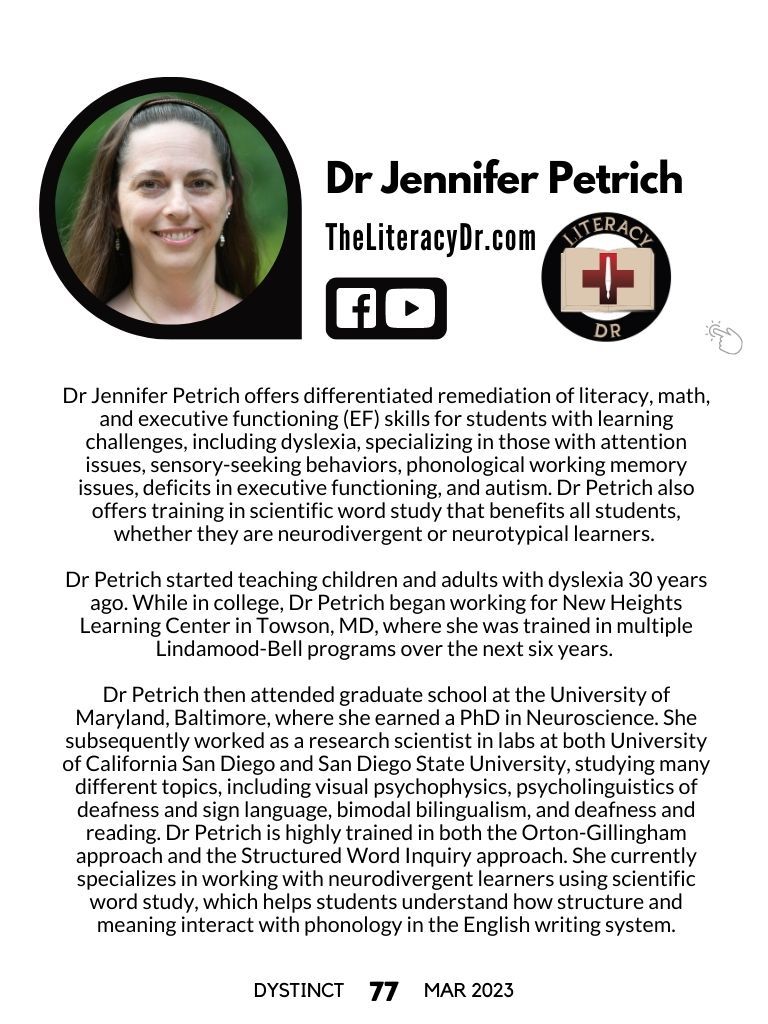
Dr Jennifer Petrich
Co-owner, The Literacy Dr
TheLiteracyDr.com | Facebook | YouTube
Dr Jennifer Petrich offers differentiated remediation of literacy, math, and executive functioning (EF) skills for students with learning challenges, including dyslexia, specializing in those with attention issues, sensory-seeking behaviors, phonological working memory issues, deficits in executive functioning, and autism. Dr Petrich also offers training in scientific word study that benefits all students, whether they are neurodivergent or neurotypical learners.
Dr Petrich started teaching children and adults with dyslexia 30 years ago. While in college, Dr Petrich began working for New Heights Learning Center in Towson, MD, where she was trained in multiple Lindamood-Bell programs over the next six years.
Dr Petrich then attended graduate school at the University of Maryland, Baltimore, where she earned a PhD in Neuroscience. She subsequently worked as a research scientist in labs at both University of California San Diego and San Diego State University, studying many different topics, including visual psychophysics, psycholinguistics of deafness and sign language, bimodal bilingualism, and deafness and reading. Dr Petrich is highly trained in both the Orton-Gillingham approach and the Structured Word Inquiry approach. She currently specializes in working with neurodivergent learners using scientific word study, which helps students understand how structure and meaning interact with phonology in the English writing system.
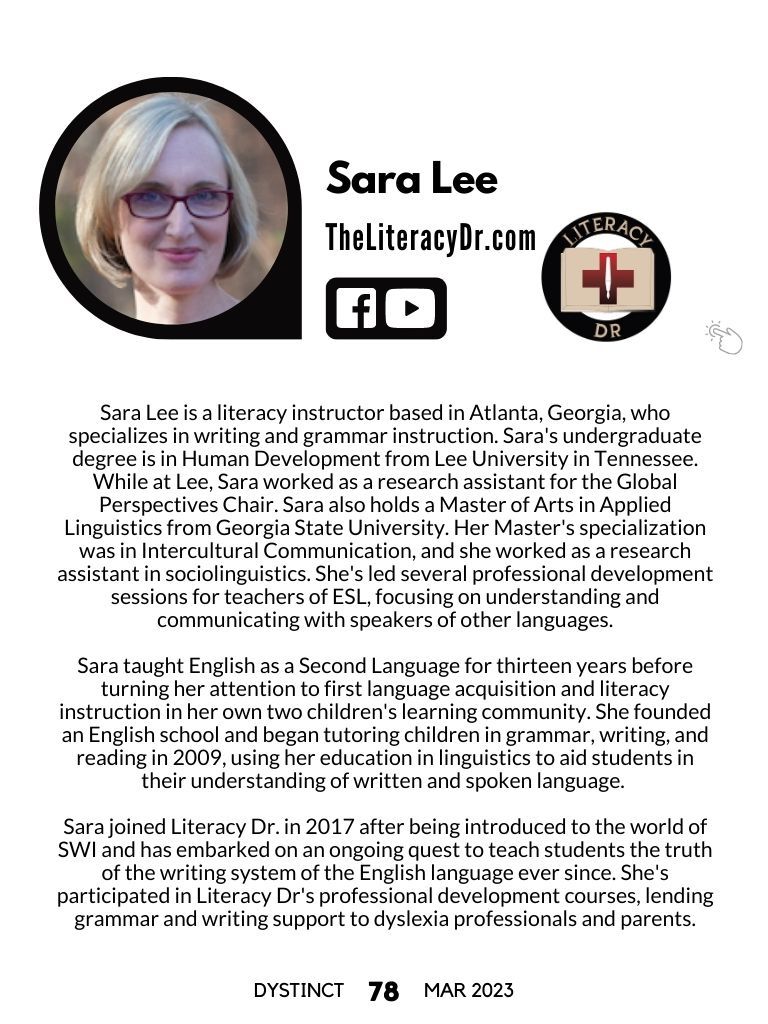
Sara Lee
Co-owner, The Literacy Dr
TheLiteracyDr.com | Facebook | YouTube
Sara Lee is a literacy instructor based in Atlanta, Georgia, who specializes in writing and grammar instruction. Sara's undergraduate degree is in Human Development from Lee University in Tennessee. While at Lee, Sara worked as a research assistant for the Global Perspectives Chair. Sara also holds a Master of Arts in Applied Linguistics from Georgia State University. Her Master's specialization was in Intercultural Communication, and she worked as a research assistant in sociolinguistics. She's led several professional development sessions for teachers of ESL, focusing on understanding and communicating with speakers of other languages.
Sara taught English as a Second Language for thirteen years before turning her attention to first language acquisition and literacy instruction in her own two children's learning community. She founded an English school and began tutoring children in grammar, writing, and reading in 2009, using her education in linguistics to aid students in their understanding of written and spoken language.
Sara joined Literacy Dr. in 2017 after being introduced to the world of SWI and has embarked on an ongoing quest to teach students the truth of the writing system of the English language ever since. She's participated in Literacy Dr's professional development courses, lending grammar and writing support to dyslexia professionals and parents.
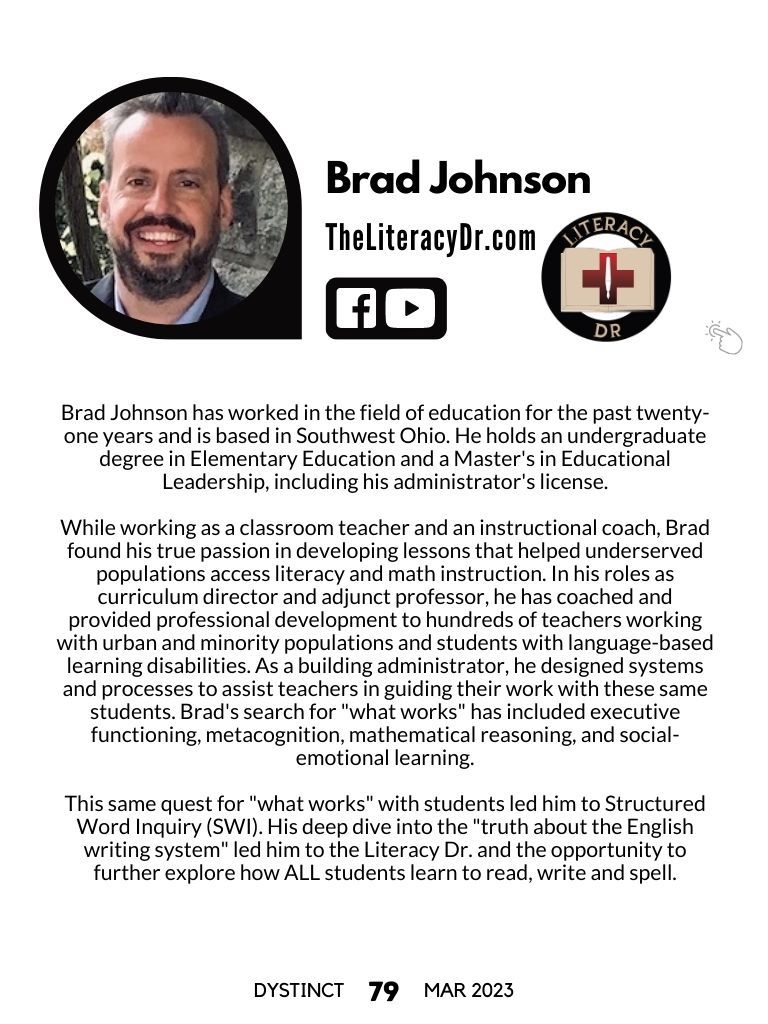
Bradley Johnson
Therapist, The Literacy Dr
TheLiteracyDr.com | Facebook | YouTube
Brad Johnson has worked in the field of education for the past twenty-one years and is based in Southwest Ohio. He holds an undergraduate degree in Elementary Education and a Master's in Educational Leadership, including his administrator's license.
While working as a classroom teacher and an instructional coach, Brad found his true passion in developing lessons that helped underserved populations access literacy and math instruction. In his roles as curriculum director and adjunct professor, he has coached and provided professional development to hundreds of teachers working with urban and minority populations and students with language-based learning disabilities. As a building administrator, he designed systems and processes to assist teachers in guiding their work with these same students. Brad's search for "what works" has included executive functioning, metacognition, mathematical reasoning, and social-emotional learning.
This same quest for "what works" with students led him to Structured Word Inquiry (SWI). His deep dive into the "truth about the English writing system" led him to the Literacy Dr. and the opportunity to further explore how ALL students learn to read, write and spell.
Extracts from Dystinct Magazine