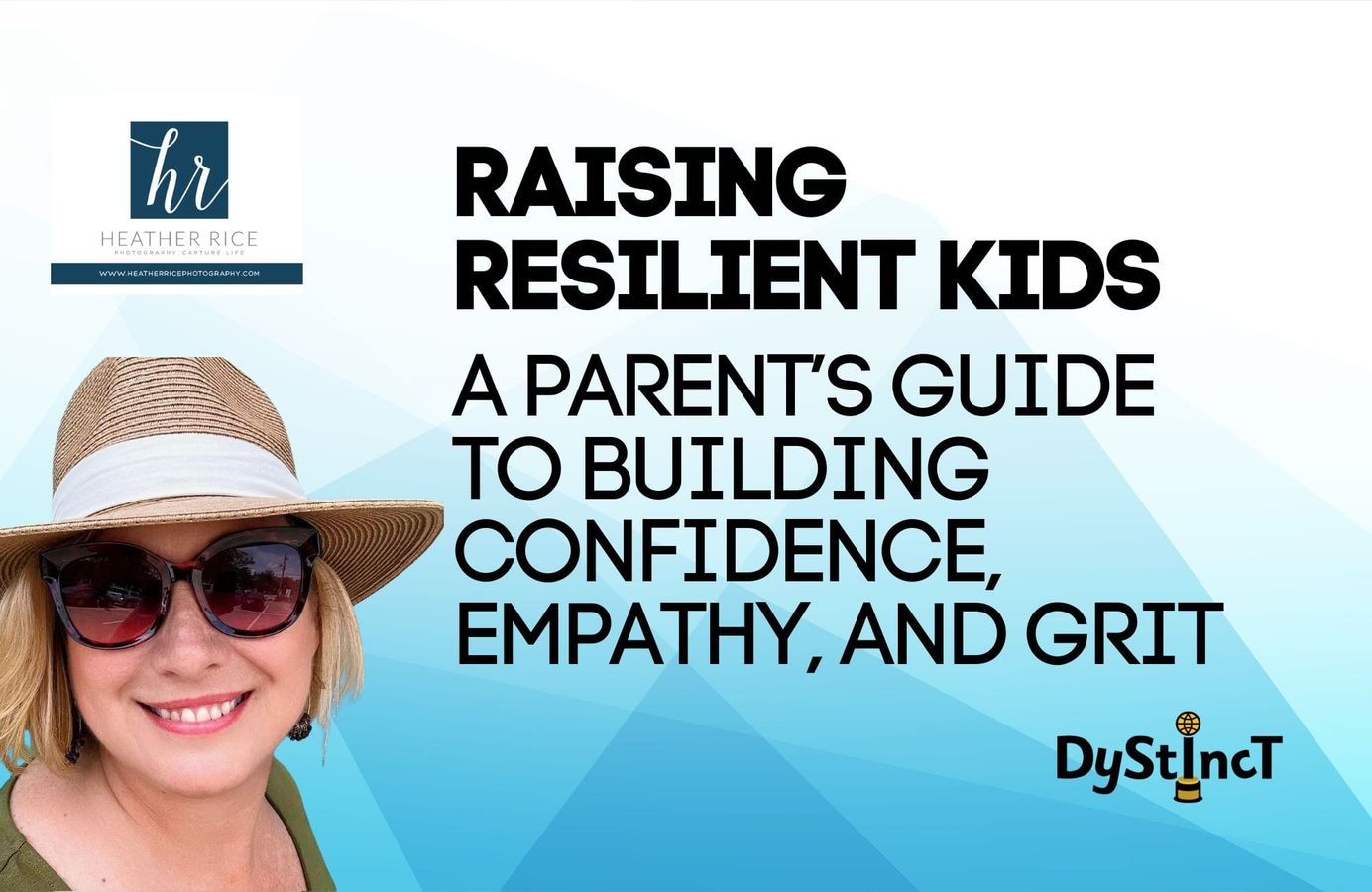
Issue 24: Raising Resilient Kids: A Parent’s Guide to Building Confidence, Empathy, and Grit | Heather Rice
Heather Rice offers practical ways to help children with learning difficulties build confidence, empathy, and resilience, encouraging parents to support their kids in taking on challenges, learning from mistakes, and valuing growth over perfection.

Table of Contents
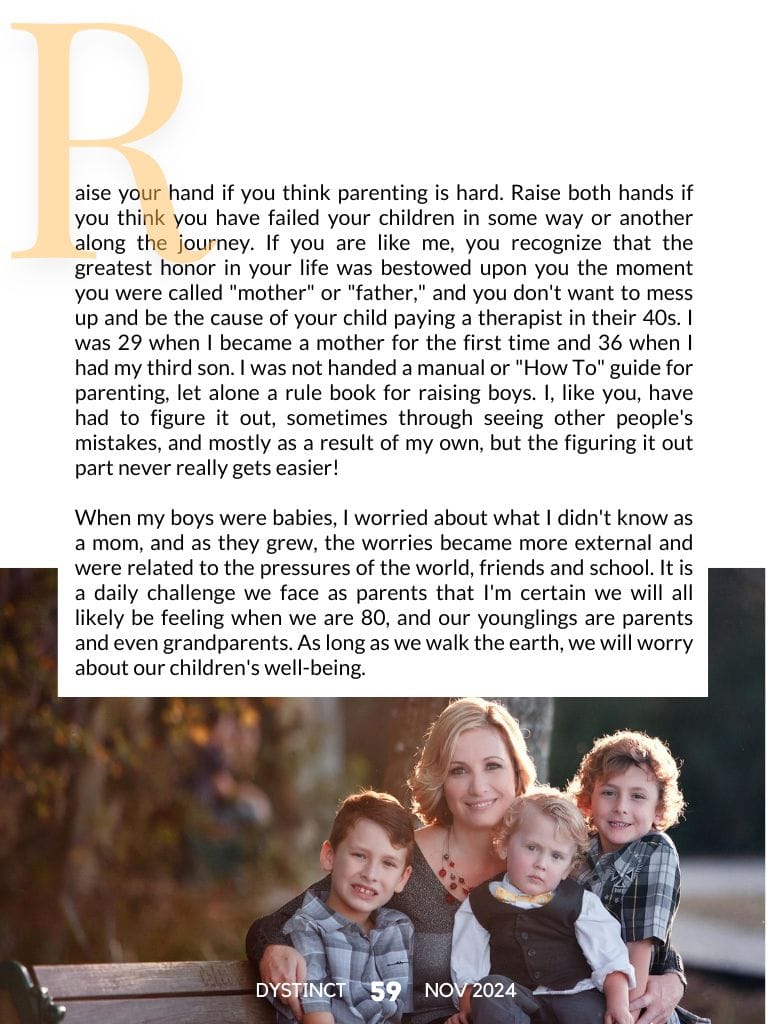
Raise your hand if you think parenting is hard. Raise both hands if you think you have failed your children in some way or another along the journey. If you are like me, you recognize that the greatest honor in your life was bestowed upon you the moment you were called "mother" or "father," and you don't want to mess up and be the cause of your child paying a therapist in their 40s. I was 29 when I became a mother for the first time and 36 when I had my third son. I was not handed a manual or "How To" guide for parenting, let alone a rule book for raising boys. I, like you, have had to figure it out, sometimes through seeing other people's mistakes, and mostly as a result of my own, but the figuring it out part never really gets easier!

When my boys were babies, I worried about what I didn't know as a mom, and as they grew, the worries became more external and were related to the pressures of the world, friends and school. It is a daily challenge we face as parents that I'm certain we will all likely be feeling when we are 80, and our younglings are parents and even grandparents. As long as we walk the earth, we will worry about our children's well-being.
Raising confident children today can feel like coaching a football team where the goalposts are constantly moving. As a mother of three boys, I've navigated countless "character-building" moments from sports injuries that lead to broken bones, years of sacrificing having nice things in a house full of rambunctious boys, power struggles during the pre-teen years, the stress of teaching boys to drive, academic challenges, friendship and relationship drama, self-esteem pep talks, and plenty of homework meltdowns. In my 20 years as a mom, my goal has been to raise them in such a way that I can instill a confidence in my sons that cannot be destroyed by life's inevitable storms.
In a world filled with uncertainty, building confidence and grit in our kids means equipping them with the tools to face challenges. They need more than the ability to survive; they need the resilience to confidently thrive as the storms brew around them. As Tom Petty once said, I want to raise kids who "won't back down" when life throws big boulders in their way.
While I do not profess to have all the answers, I did put together some practical tips that I feel will help children develop the confidence, drive, and adaptability they need to succeed, no matter what challenges they face.
Raising confident children today can feel like coaching a football team where the goalposts are constantly moving.
Teach your children that they can do hard things
Teach your children that they can do hard things
Being safe is what we are innately created to do. It is in our core to survive while caring for our physical and mental well-being, and let's face it: taking big risks can impact a person's health and safety in positive and negative ways. But when people retreat and seek the safety of shelter, never leaving to feel the sunshine on their faces, they lose their sense of adventure and exploration that is needed to find a sense of purpose for their lives. When we run away from hard things, we will never get to feel the power of being an overcomer. Imagine how boring life would be if everyone only did activities they were good at and never tried something outside of their comfort zone. Confidence is built when we succeed at something we never thought we could do.
How do you know you aren't good at hitting a baseball unless you try to swing a bat? Maybe the child who is painfully shy and lacks social skills can learn to come out of his shell by finding comradery as a member of the baseball team. Maybe his unique win will be found in a world where he feels challenged, not safe. I believe it is our job as parents not to allow our children to choose only the safety of activities that they are naturally drawn to and gifted in, but children should be coached, prodded, and encouraged to step outside of those comfortable spaces and try things that feel awkward or that they lack confidence in. Encouraging children to try new skills, activities, and things that are hard for them is important because it is in overcoming challenging things that builds confidence.
His victory wasn't just in the hit or even making it across home plate, but it was in his grit, determination, drive, and flat-out refusal to let failure define him.
I'll never forget my oldest son's decision to join a baseball team in his junior year of high school despite having never played one single game before. He had pursued culinary courses for all of high school and had not played any sports. He signed up for a recreational league and was now competing with boys who had played since tee ball. He faced criticism, was mocked by some of the boys, questioned about why he was doing this at his age, and often benched. There were Sundays that he was scheduled to play a doubleheader and only played one inning per game. He spent the rest of the time sitting on the bench, ready for the coach to call him on the field, but they called the more experienced players. Every Sunday, he showed up, worked hard, and refused to quit! After watching him sit out many games and feeling discouraged by his lack of play, I wanted to talk to the coach and advocate for him to find another league, but I sat back and allowed him to figure it out. He needed to be the biggest contributor to his own win. It was hard not to respond as a parent, especially watching your child be ignored and even mocked at times. I even got to the point that I asked him if he wanted to try and find another league, but he refused. Game after game, he stepped up to bat, determined to have his moment, get his hit, and run the bases. His persistence paid off one day when his bat connected with a ball, and he hit a line drive past second base, which resulted in him making it to third base. His victory wasn't just in the hit or even making it across home plate, but it was in his grit, determination, drive, and flat-out refusal to let failure define him. He was determined to try something new and refused to quit until he was successful. His confidence grew with every at bat. What if he stayed in the culinary kitchen and never ventured out to the baseball field? His win was waiting for him, and he would never have known.
Parents, how many times have you bought the guitar, tennis racquet, karate, or dance lessons, and your child asked to quit after one month? Maybe your child complained about a difficult course in school or a teacher your child had a hard time connecting with. What if instead of allowing them to quit, you encouraged them to stay, tough it out, and grow? The funny thing about hard things in life is that they tend to get easier when you do them repetitively. Kids grow confidence not by staying in their comfort zones but by tackling hard things. Should the dyslexic child who struggles to read have all books taken away? Should a child who is an accomplished singer not be encouraged to try to learn tap as well? Challenge your children to learn that they can do hard things. Encourage practice, require hard work, and teach them to show up and try their best. Your children can do hard things, and they have many opportunities to pursue wins and self-confidence boosters. Challenge them to do hard things and seek wins in unexpected ways!
Kids grow confidence not by staying in their comfort zones but by tackling hard things.
Empower empathy through humility
Empower empathy through humility
As the mother of three boys, ages 14, 18, and 20, parenting has taught me that there is an important connection between humility and empathy. Each of my sons is uniquely different, from my calm, rule-following eldest to my adventurous, extroverted middle child, and finally, my youngest, a creative soul with a flair for the dramatic. My husband and I sometimes joke that we aren't sure our three sons were even raised in the same home by the same two parents because they are each so unique and different. Parenting each boy requires a unique approach to every new situation, and while I don't always get it right, those moments of imperfection have become some of the most valuable teaching opportunities for my sons and for me.
When parents are willing to admit their mistakes, it sends a powerful message.
When parents are willing to admit their mistakes, it sends a powerful message. Children learn that even adults don't have all the answers and that it's okay to be wrong. More importantly, it shows them how to fix their mistakes while learning and growing in maturity in those moments. Humility fosters empathy by modeling the ability to see things from another person's perspective while trying to understand why they made the choices they did.
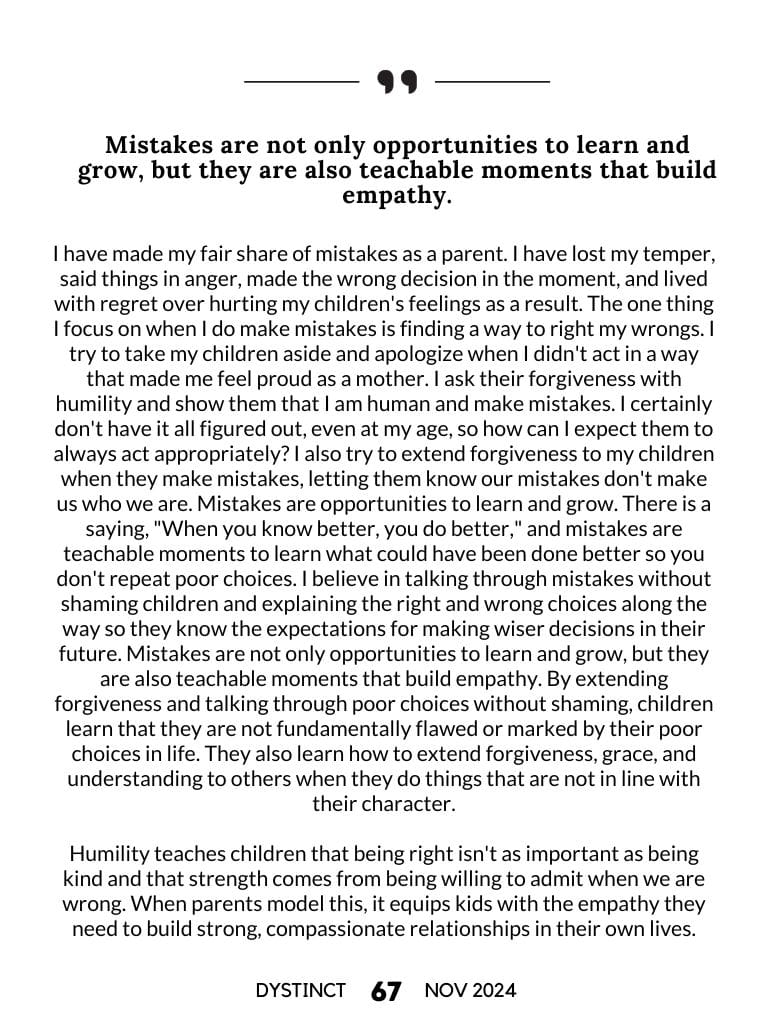
Mistakes are not only opportunities to learn and grow, but they are also teachable moments that build empathy.
I have made my fair share of mistakes as a parent. I have lost my temper, said things in anger, made the wrong decision in the moment, and lived with regret over hurting my children's feelings as a result. The one thing I focus on when I do make mistakes is finding a way to right my wrongs. I try to take my children aside and apologize when I didn't act in a way that made me feel proud as a mother. I ask their forgiveness with humility and show them that I am human and make mistakes. I certainly don't have it all figured out, even at my age, so how can I expect them to always act appropriately? I also try to extend forgiveness to my children when they make mistakes, letting them know our mistakes don't make us who we are. Mistakes are opportunities to learn and grow. There is a saying, "When you know better, you do better," and mistakes are teachable moments to learn what could have been done better so you don't repeat poor choices. I believe in talking through mistakes without shaming children and explaining the right and wrong choices along the way so they know the expectations for making wiser decisions in their future. Mistakes are not only opportunities to learn and grow, but they are also teachable moments that build empathy. By extending forgiveness and talking through poor choices without shaming, children learn that they are not fundamentally flawed or marked by their poor choices in life. They also learn how to extend forgiveness, grace, and understanding to others when they do things that are not in line with their character.
Humility teaches children that being right isn't as important as being kind and that strength comes from being willing to admit when we are wrong. When parents model this, it equips kids with the empathy they need to build strong, compassionate relationships in their own lives.
Promote progress over perfection
Promote progress over perfection
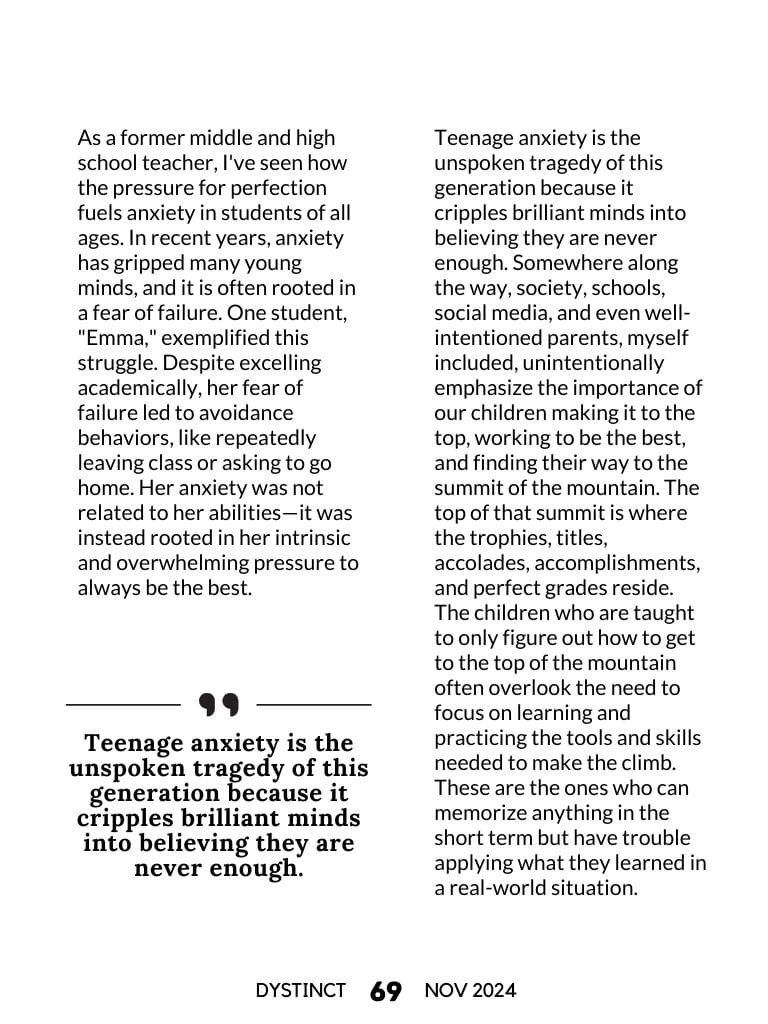
As a former middle and high school teacher, I've seen how the pressure for perfection fuels anxiety in students of all ages. In recent years, anxiety has gripped many young minds, and it is often rooted in a fear of failure. One student, "Emma," exemplified this struggle. Despite excelling academically, her fear of failure led to avoidance behaviors, like repeatedly leaving class or asking to go home. Her anxiety was not related to her abilities—it was instead rooted in her intrinsic and overwhelming pressure to always be the best.
Teenage anxiety is the unspoken tragedy of this generation because it cripples brilliant minds into believing they are never enough.
Teenage anxiety is the unspoken tragedy of this generation because it cripples brilliant minds into believing they are never enough. Somewhere along the way, society, schools, social media, and even well-intentioned parents, myself included, unintentionally emphasize the importance of our children making it to the top, working to be the best, and finding their way to the summit of the mountain. The top of that summit is where the trophies, titles, accolades, accomplishments, and perfect grades reside. The children who are taught to only figure out how to get to the top of the mountain often overlook the need to focus on learning and practicing the tools and skills needed to make the climb. These are the ones who can memorize anything in the short term but have trouble applying what they learned in a real-world situation.
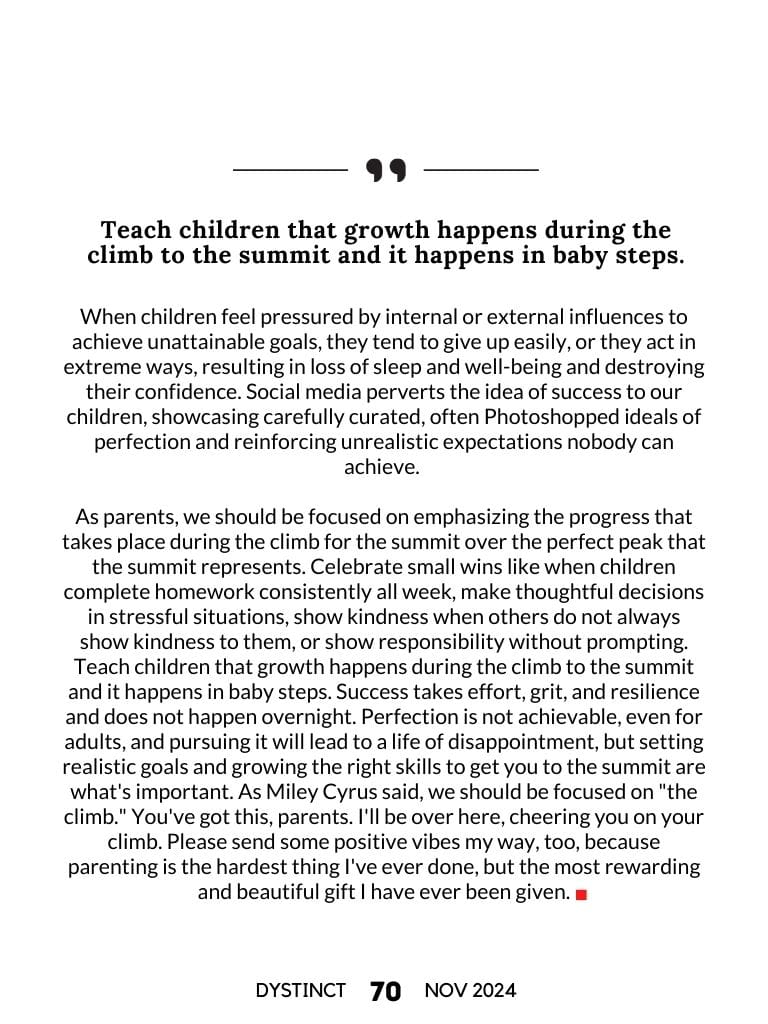
Teach children that growth happens during the climb to the summit and it happens in baby steps.
When children feel pressured by internal or external influences to achieve unattainable goals, they tend to give up easily, or they act in extreme ways, resulting in loss of sleep and well-being and destroying their confidence. Social media perverts the idea of success to our children, showcasing carefully curated, often Photoshopped ideals of perfection and reinforcing unrealistic expectations nobody can achieve.
As parents, we should be focused on emphasizing the progress that takes place during the climb for the summit over the perfect peak that the summit represents. Celebrate small wins like when children complete homework consistently all week, make thoughtful decisions in stressful situations, show kindness when others do not always show kindness to them, or show responsibility without prompting. Teach children that growth happens during the climb to the summit and it happens in baby steps. Success takes effort, grit, and resilience and does not happen overnight. Perfection is not achievable, even for adults, and pursuing it will lead to a life of disappointment, but setting realistic goals and growing the right skills to get you to the summit are what's important. As Miley Cyrus said, we should be focused on "the climb." You've got this, parents. I'll be over here, cheering you on your climb. Please send some positive vibes my way, too, because parenting is the hardest thing I've ever done, but the most rewarding and beautiful gift I have ever been given.
Heather Rice, MS Ed, IL, CJE
Educator, Administrator, Head of Global Academy Enrolment and Marketing Strategy at L3Harris Flight Academy & Photographer | HeatherRicePhotography.com | Facebook | Instagram | TikTok
Heather Rice, MS Ed, IL, CJE

Heather Rice has been an educator and administrator for more than 20 years. A dynamic dreamer and doer, Heather thrives on creativity and synergy. She currently works as the Head of Global Academy Enrollment and Marketing Strategy at L3Harris Flight Academy, where she helps train commercial pilots. She holds a Master’s degree in Educational Administration, a Bachelor’s Degree in Education and Psychology, and an Associates Degree in Commercial Art and Graphic Design.
When Heather is not training pilots, you can find her chasing after her three sons, Jackson, Preston, and Tyson (ages 20, 18, and 14) or capturing life through her camera lens as a professional photographer. She married her childhood sweetheart and has been Jerry’s girl since 1991. She’s a travel and taco enthusiast who loves music and is Justin Timberlake’s biggest fan!
Extracts from Dystinct Magazine
Extracts from Dystinct Magazine