Issue 27: Practice, the Key to Remembering | Leslee Allen
Leslee Allen explains why consistent, deliberate practice is essential for helping students remember and apply what they learn, and shares practical, research-informed strategies such as spaced practice, incremental rehearsal, and writing fluency routines that support all learners.

Table of Contents
How many times have you picked up your child after a day at school, asked them what they did that day, and promptly received the reply "Nothing" or "I can't remember"?
While, as parents, we are inclined to think they are simply avoiding the discussion, the reality is that it is very likely they have completely forgotten about it.
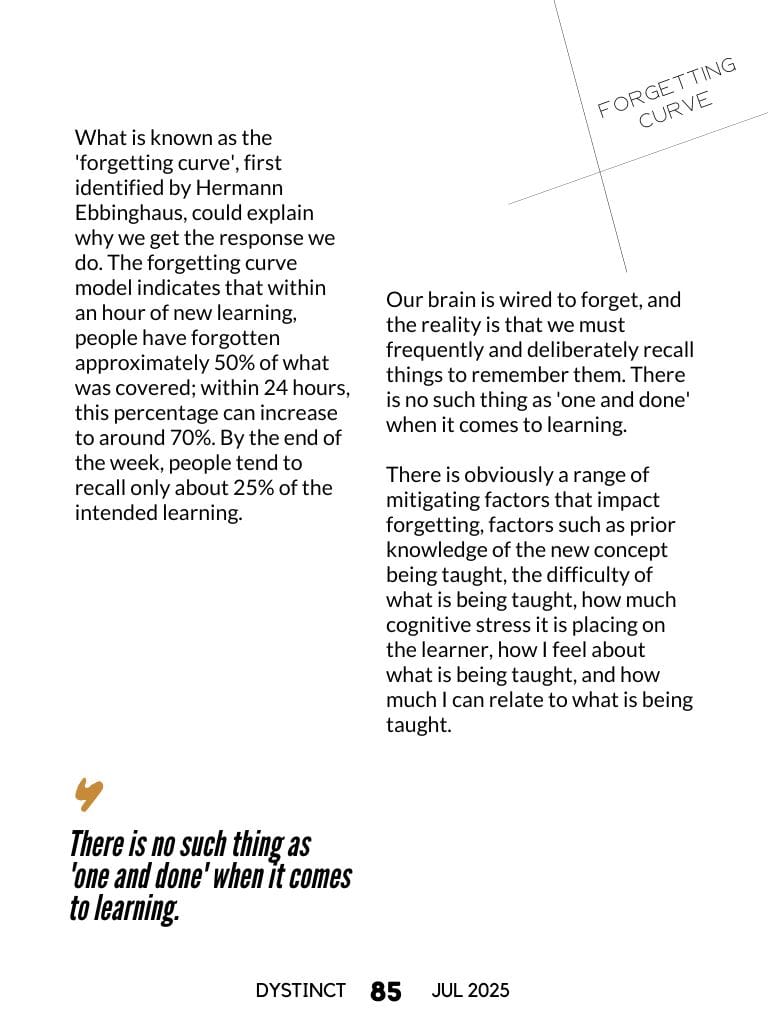
What is known as the 'forgetting curve', first identified by Hermann Ebbinghaus, could explain why we get the response we do. The forgetting curve model indicates that within an hour of new learning, people have forgotten approximately 50% of what was covered; within 24 hours, this percentage can increase to around 70%. By the end of the week, people tend to recall only about 25% of the intended learning.
Our brain is wired to forget, and the reality is that we must frequently and deliberately recall things to remember them. There is no such thing as 'one and done' when it comes to learning.
There is obviously a range of mitigating factors that impact forgetting, factors such as prior knowledge of the new concept being taught, the difficulty of what is being taught, how much cognitive stress it is placing on the learner, how I feel about what is being taught, and how much I can relate to what is being taught.
There is no such thing as 'one and done' when it comes to learning.
The fact is, we are not just taught something and then proceed to master it spontaneously. If we are taught something and not reminded of it until the next week, it is more than likely that this new knowledge will be completely forgotten.
What is even more difficult for learners who may have 'forgotten' or simply not mastered a concept is encapsulated by cognitive load theory, a theory that emerged in the late 1980s from the work of John Sweller and his colleagues. This theory suggests that our working memory is easily overloaded; it can only process a limited amount of information at any given time. Therefore, any instructional methods should avoid the overloading of the working memory. In essence, the more knowledge we have managed to transfer to long-term memory, the better. This is incredibly difficult if we are forgetting a large amount of what is being taught.
If we are taught something and not reminded of it until the next week, it is more than likely that this new knowledge will be completely forgotten.
Learning is a change in long-term memory, and therefore, it should be our goal. The key is building rich schemas of knowledge that can be called upon easily by retrieving them from long-term memory.
In the meaningful learning theory, a theory that relates to the building of knowledge schemas, Ausubel, the theorist behind this theory, states that the best predictor of what students will learn in each lesson is what they already know. This is even more problematic for learners who find mastering new concepts difficult. How do we help new learning stick over time to combat this and prevent children from simply falling further behind? These students also require numerous repetitions of concepts to embed this knowledge in long-term memory, which brings us to the importance of practice.
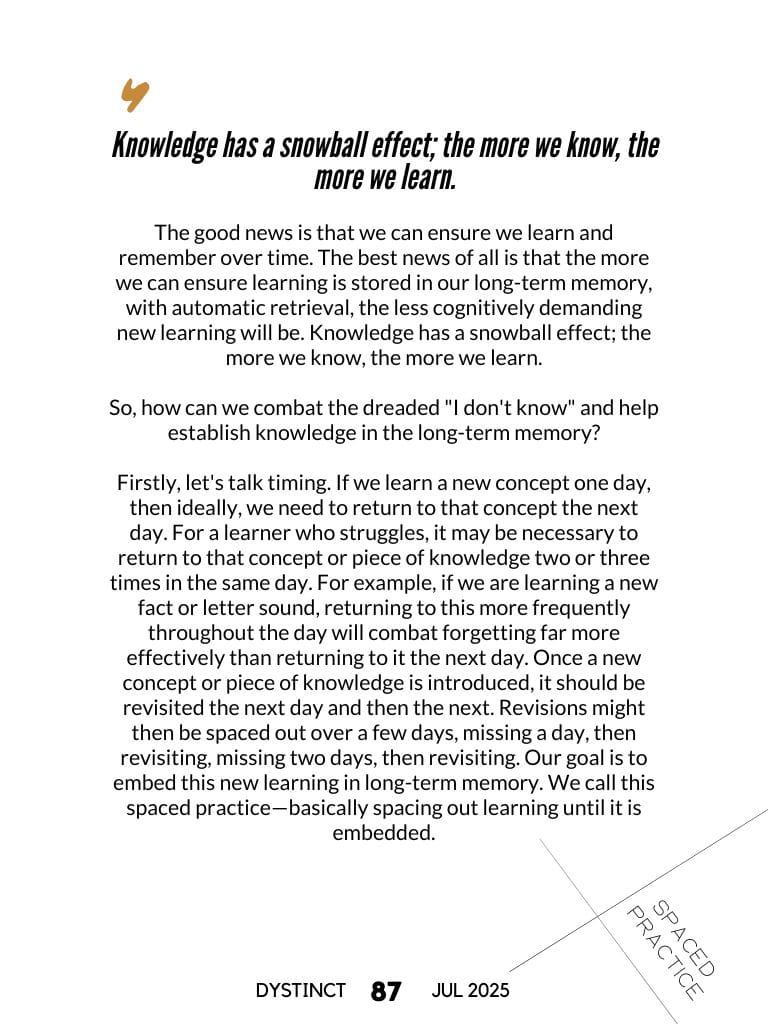
Knowledge has a snowball effect; the more we know, the more we learn.
The good news is that we can ensure we learn and remember over time. The best news of all is that the more we can ensure learning is stored in our long-term memory, with automatic retrieval, the less cognitively demanding new learning will be. Knowledge has a snowball effect; the more we know, the more we learn.
So, how can we combat the dreaded "I don't know" and help establish knowledge in the long-term memory?
Firstly, let's talk timing. If we learn a new concept one day, then ideally, we need to return to that concept the next day. For a learner who struggles, it may be necessary to return to that concept or piece of knowledge two or three times in the same day. For example, if we are learning a new fact or letter sound, returning to this more frequently throughout the day will combat forgetting far more effectively than returning to it the next day. Once a new concept or piece of knowledge is introduced, it should be revisited the next day and then the next. Revisions might then be spaced out over a few days, missing a day, then revisiting, missing two days, then revisiting. Our goal is to embed this new learning in long-term memory. We call this spaced practice—basically spacing out learning until it is embedded.
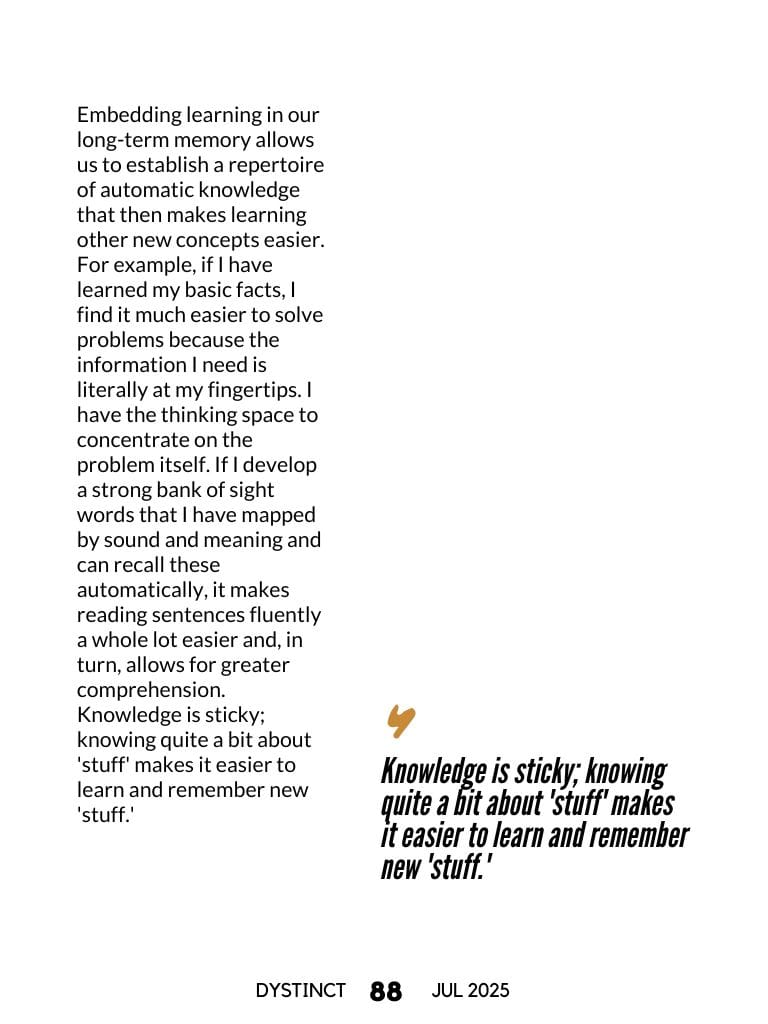
Embedding learning in our long-term memory allows us to establish a repertoire of automatic knowledge that then makes learning other new concepts easier. For example, if I have learned my basic facts, I find it much easier to solve problems because the information I need is literally at my fingertips. I have the thinking space to concentrate on the problem itself. If I develop a strong bank of sight words that I have mapped by sound and meaning and can recall these automatically, it makes reading sentences fluently a whole lot easier and, in turn, allows for greater comprehension. Knowledge is sticky; knowing quite a bit about 'stuff' makes it easier to learn and remember new 'stuff.'
Knowledge is sticky; knowing quite a bit about 'stuff' makes it easier to learn and remember new 'stuff.'
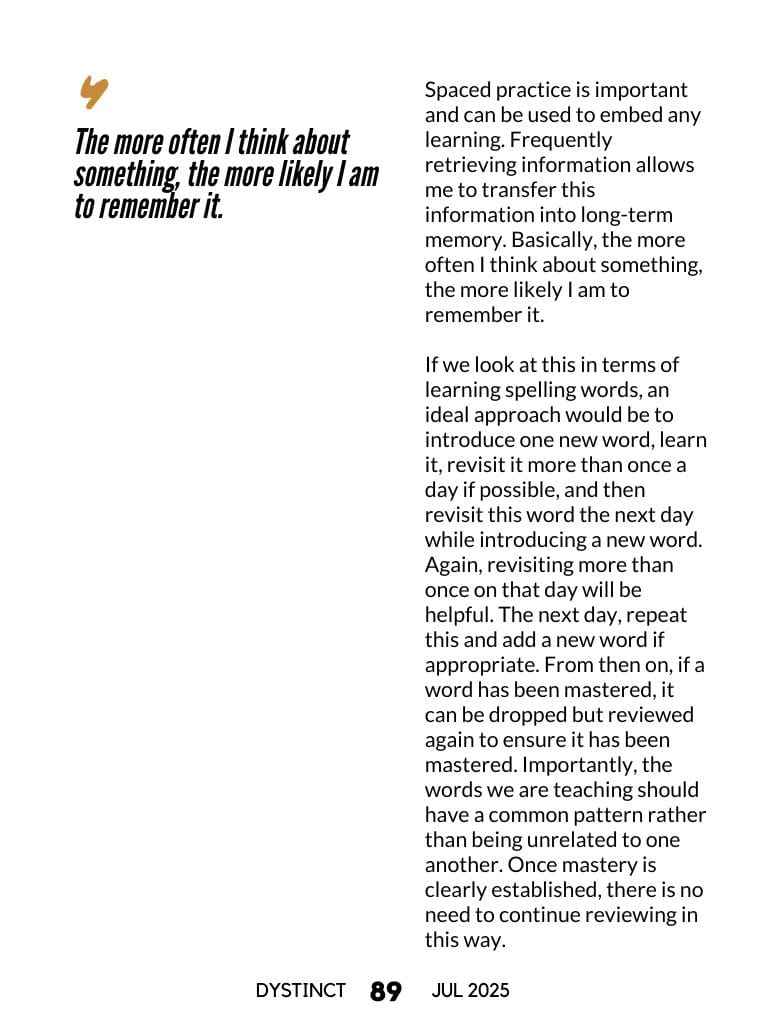
The more often I think about something, the more likely I am to remember it.
Spaced practice is important and can be used to embed any learning. Frequently retrieving information allows me to transfer this information into long-term memory. Basically, the more often I think about something, the more likely I am to remember it.
If we look at this in terms of learning spelling words, an ideal approach would be to introduce one new word, learn it, revisit it more than once a day if possible, and then revisit this word the next day while introducing a new word. Again, revisiting more than once on that day will be helpful. The next day, repeat this and add a new word if appropriate. From then on, if a word has been mastered, it can be dropped but reviewed again to ensure it has been mastered. Importantly, the words we are teaching should have a common pattern rather than being unrelated to one another. Once mastery is clearly established, there is no need to continue reviewing in this way.
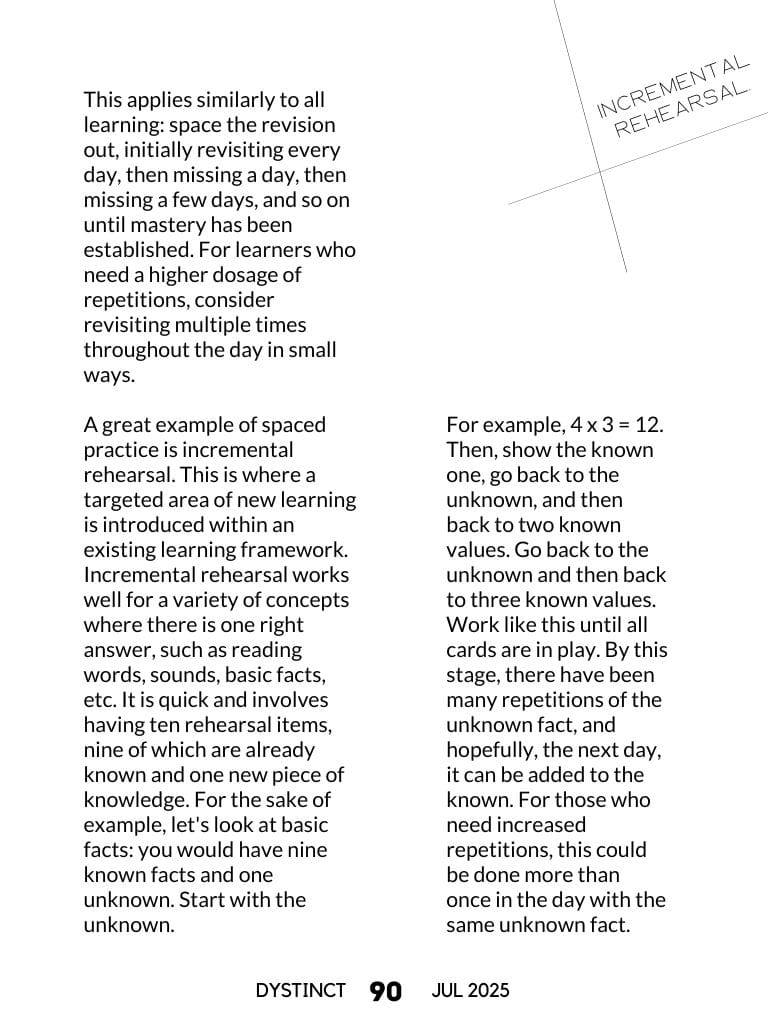
This applies similarly to all learning: space the revision out, initially revisiting every day, then missing a day, then missing a few days, and so on until mastery has been established. For learners who need a higher dosage of repetitions, consider revisiting multiple times throughout the day in small ways.
A great example of spaced practice is incremental rehearsal. This is where a targeted area of new learning is introduced within an existing learning framework. Incremental rehearsal works well for a variety of concepts where there is one right answer, such as reading words, sounds, basic facts, etc. It is quick and involves having ten rehearsal items, nine of which are already known and one new piece of knowledge. For the sake of example, let's look at basic facts: you would have nine known facts and one unknown. Start with the unknown.
For example, 4 x 3 = 12. Then, show the known one, go back to the unknown, and then back to two known values. Go back to the unknown and then back to three known values. Work like this until all cards are in play. By this stage, there have been many repetitions of the unknown fact, and hopefully, the next day, it can be added to the known. For those who need increased repetitions, this could be done more than once in the day with the same unknown fact.
A similar approach that works effectively is one that Brian Poncy shares widely when talking about fluency. Taped problems are particularly useful for maths facts. Essentially, it is a practice tool designed to build fluency. Conceptual understanding is already established, and the idea is to establish automatic recall. Aim to have around ten facts in a set, facts that you want to embed understanding of, and aim to have three or four repeats. The fact is said, and then the answer is given. In this way, there is an opportunity to answer the fact automatically and to get quick feedback, but there is also an opportunity to hear the correct answer multiple times if it is not known.
Practice can also be interleaved, meaning practising more than one topic at a time. When we interleave our practice, we need to work harder and discriminate between areas of knowledge. Many studies have shown that interleaving has more benefits than blocked practice, which is the opposite approach.
For example, when learning basic facts, interleave operations to encourage discrimination between procedures. Interleaving should not be a one-off method to 'cram' information into the long-term memory. It needs to be regular and spaced over time. To prevent this being too hard and to ensure a feeling of success, intersperse the known with the facts that are not yet fluent. Interleaving is a strategy that can be used for any type of knowledge being learned.
Writing is one of the most cognitively challenging tasks we have to learn.
Another great form of practice for writing that needs mentioning is the 21-day challenge spoken about by Lyn Stone. It can be difficult to gain fluency in writing; in fact, writing is one of the most cognitively challenging tasks we have to learn. Writing would also be one of the first areas of learning where students develop a barrier because, without key skills in place, it becomes too hard. Lyn Stone's 21-day writing challenge looks like this: every day, three specific types of practice are used to build fluency. First, start with copying. This involves copying a sentence or paragraph that has already been written. Copying is often discounted as ineffective, but in fact, copying words, sentences, and paragraphs is a great way to practice fluency and spelling. It can have a beneficial impact on all aspects of writing. After copying comes dictation, where a sentence or paragraph is dictated and then written down. Importantly, the person doing the dictating can give support and instant feedback. Thirdly, there is composing, where an original piece is composed either in sentence or paragraph form, depending on need. Not only will there be benefits in becoming a more fluent writer, but being able to write about what I know will improve comprehension and further embed knowledge.
Building a robust and connected knowledge schema is vitally important for success, and regular practice in effective ways plays a significant role in this. In fact, it is vital that we pay attention to robust strategies of practice to avoid misconceptions. Unpicking and re-learning takes a whole lot more effort than just learning it correctly in the first place.
If we are to combat forgetting and to make the learning process easier, repeated and deliberate practice is key to the storing of knowledge. As Nathaniel Swain has been quoted saying, "Knowledge is the thing that allows students to see connections between complicated and multi-faceted problems or ideas within the curriculum, and if there is no foundation of knowledge, then the future learning can't really happen. It all stops right there."
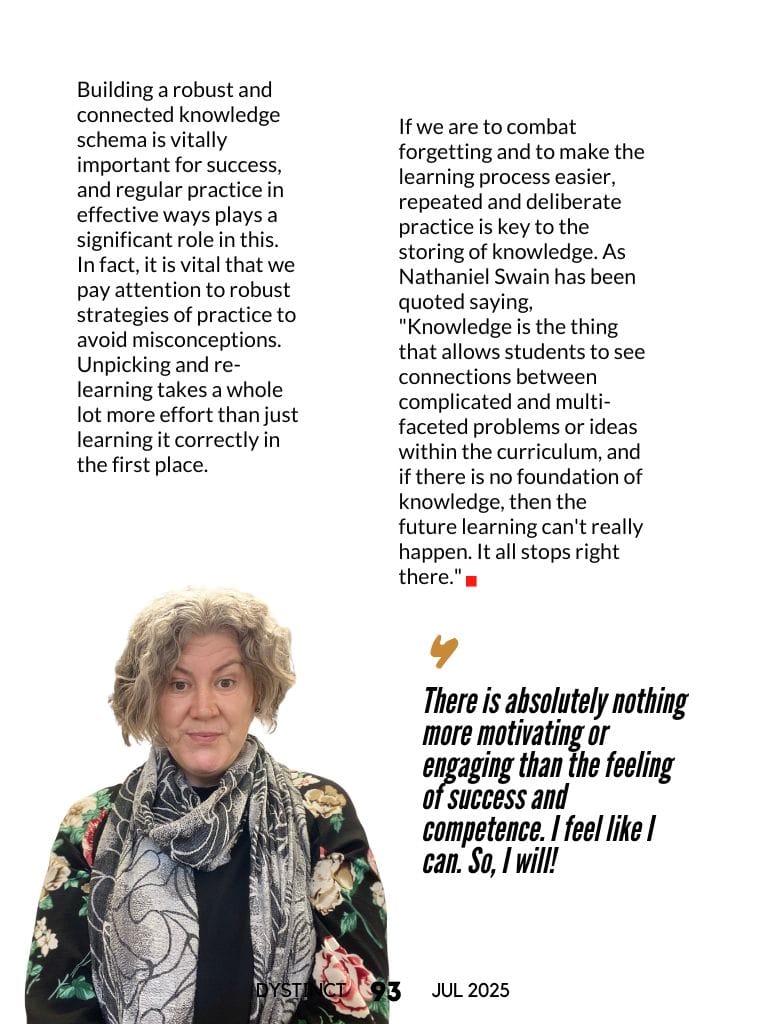
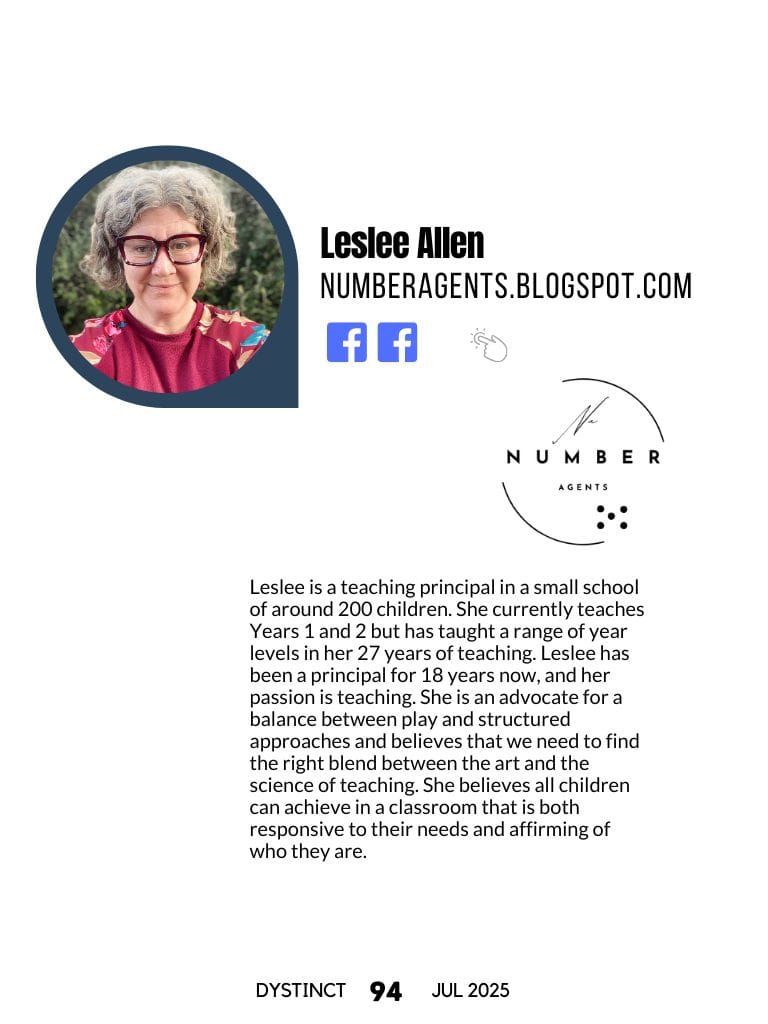
Leslee Allen
Primary School Principal & Founder | numberagents.blogspot.com | Facebook
Leslee Allen
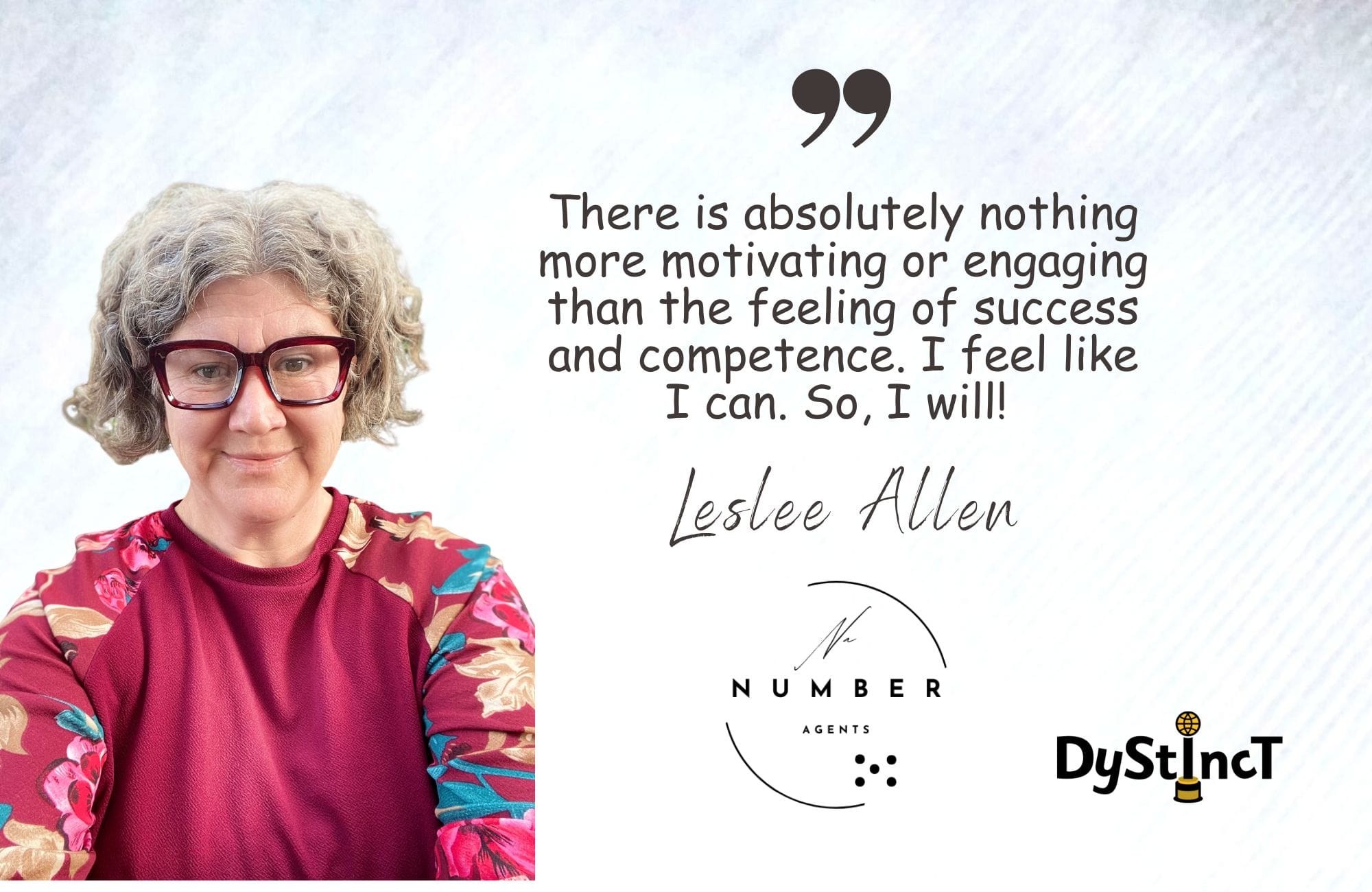
Leslee is a teaching principal in a small school of around 200 children. She currently teaches Years 1 and 2 but has taught a range of year levels in her 27 years of teaching. Leslee has been a principal for 18 years now, and her passion is teaching. She is an advocate for a balance between play and structured approaches and believes that we need to find the right blend between the art and the science of teaching. She believes all children can achieve in a classroom that is both responsive to their needs and affirming of who they are.
Extracts from Dystinct Magazine
Extracts from Dystinct Magazine