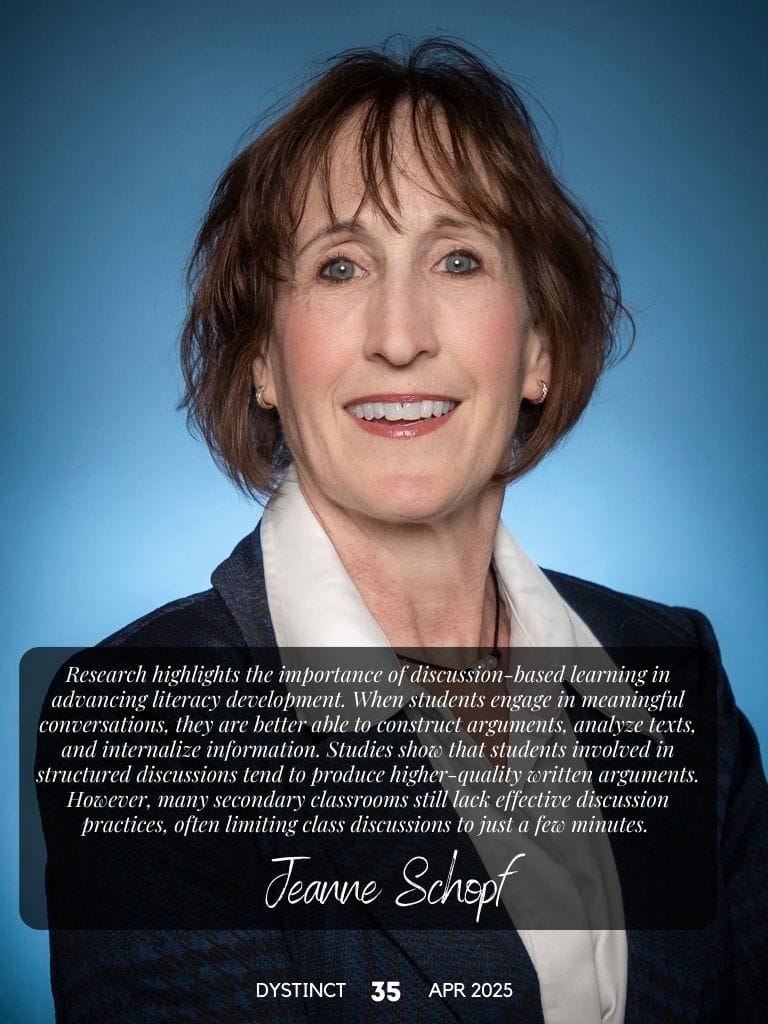
Issue 26: Oral Language: Speaking and Listening in The Secondary Classroom | Jeanne Schopf | Pathways Towards Literacy
Jeanne Schopf shares insights adapted from her upcoming book, The Science of Secondary Literacy: Research to Practice from the Voices of the Field (scheduled for release in Spring 2026), emphasising the powerful role of structured, student-led discussions in strengthening literacy development.

Table of Contents
Secondary students in grades 6-12 are expected to read, write, and comprehend complex texts while developing their language skills through various activities, including reading, writing, speaking, and listening. According to the Simple View of Reading, comprehension arises from both decoding skills and language understanding (Gough & Tunmer, 1986). Strong oral language skills, which include receptive abilities (listening and reading) and expressive abilities (speaking and writing), are crucial for improving reading comprehension and writing proficiency. According to the Council of Chief State School Officers, these standards provide a foundation for college and career readiness by encouraging students to read widely and deeply from a diverse range of high-quality, increasingly challenging literary and informational texts. (CCSSO)
To enhance literacy instruction, educators must deliberately integrate structured, accountable discussions that utilize open-ended questions to encourage deeper thinking. (Kamil, 2008) The IES Practice Guide recommends selecting engaging texts, fostering extended discourse, and implementing discussion protocols to boost comprehension and writing skills. (Kamil, 2008)
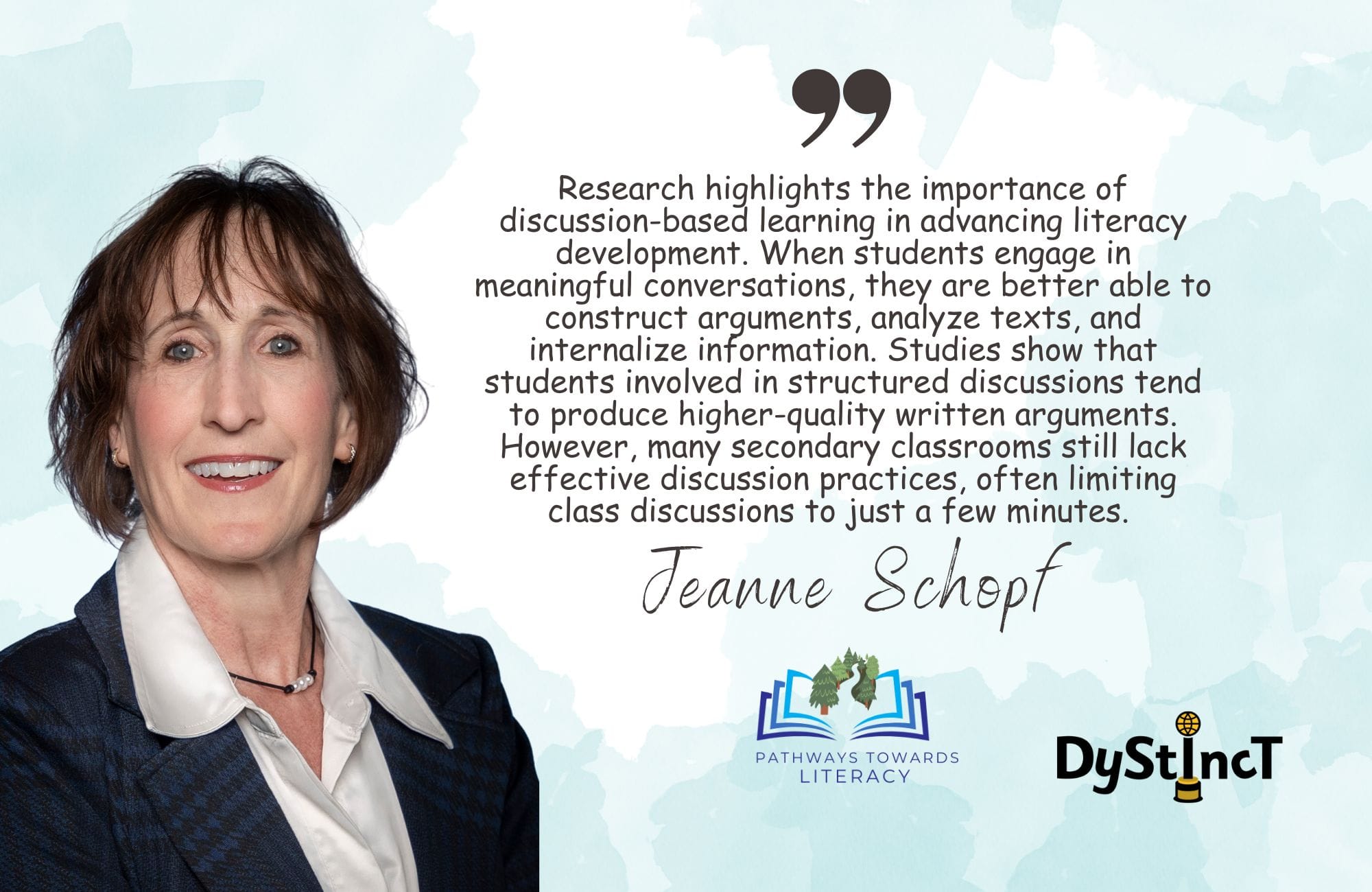
The Simple View of Reading Model, Common Core State Standards, and the IES practice guide for Improving Adolescent Literacy all highlight the significance of language skills. Classroom discourse is a vital tool for learning, allowing students to analyze texts, develop reasoning skills, and improve their writing—all of which contribute to better comprehension. In the book Visible Learning, authors Douglas Fisher, Nancy Frey, and John Hattie indicate that the effect size for classroom discussion is 0.82. However, middle and high school English class observations reveal that the average length of whole-class discussions varies from 14 to 52 seconds per period (Fisher, Frey, Hattie, 2016, p. 83). Structured conversations can foster critical thinking and engage students in meaningful dialogue, helping them construct arguments, analyze texts, and internalize content more effectively. Therefore, educators should incorporate academic discussions to strengthen students' oral language skills, enhancing their reading and writing abilities. Effective classroom discussions require a shift from teacher-directed instruction to student-led conversations. To promote meaningful dialogue, educators must cultivate a positive classroom culture where students feel safe to express their ideas.
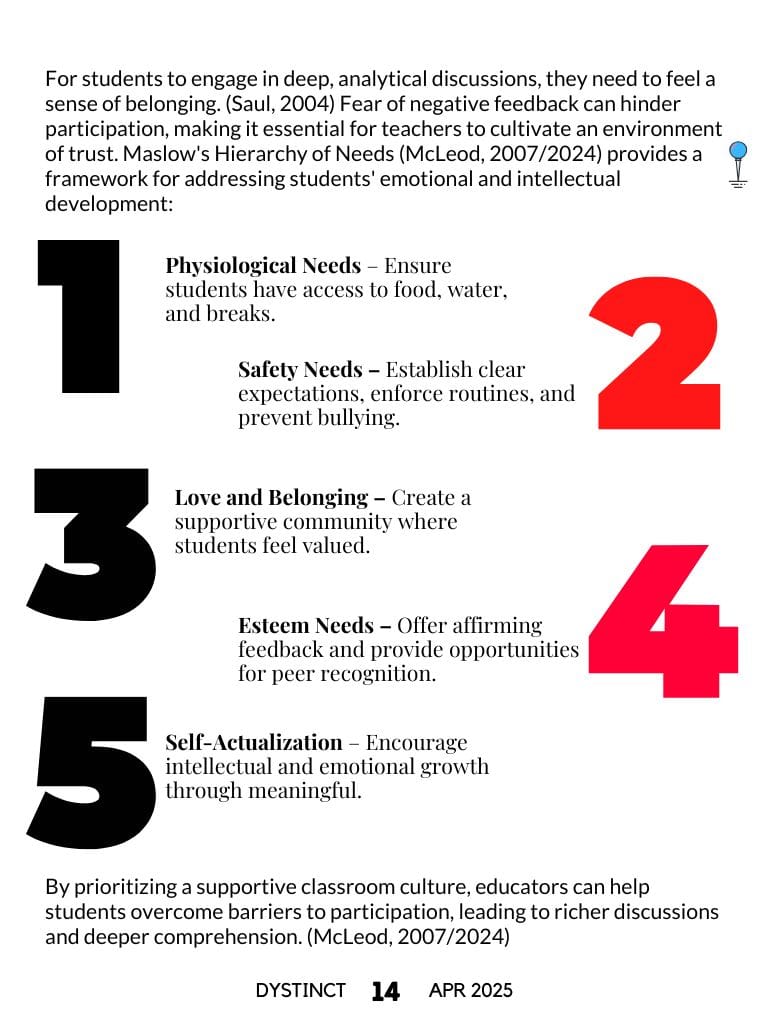
For students to engage in deep, analytical discussions, they need to feel a sense of belonging. (Saul, 2004) Fear of negative feedback can hinder participation, making it essential for teachers to cultivate an environment of trust. Maslow's Hierarchy of Needs (McLeod, 2007/2024) provides a framework for addressing students' emotional and intellectual development:
- Physiological Needs – Ensure students have access to food, water, and breaks.
- Safety Needs – Establish clear expectations, enforce routines, and prevent bullying.
- Love and Belonging – Create a supportive community where students feel valued.
- Esteem Needs – Offer affirming feedback and provide opportunities for peer recognition.
- Self-Actualization – Encourage intellectual and emotional growth through meaningful.
By prioritizing a supportive classroom culture, educators can help students overcome barriers to participation, leading to richer discussions and deeper comprehension. (McLeod, 2007/2024)
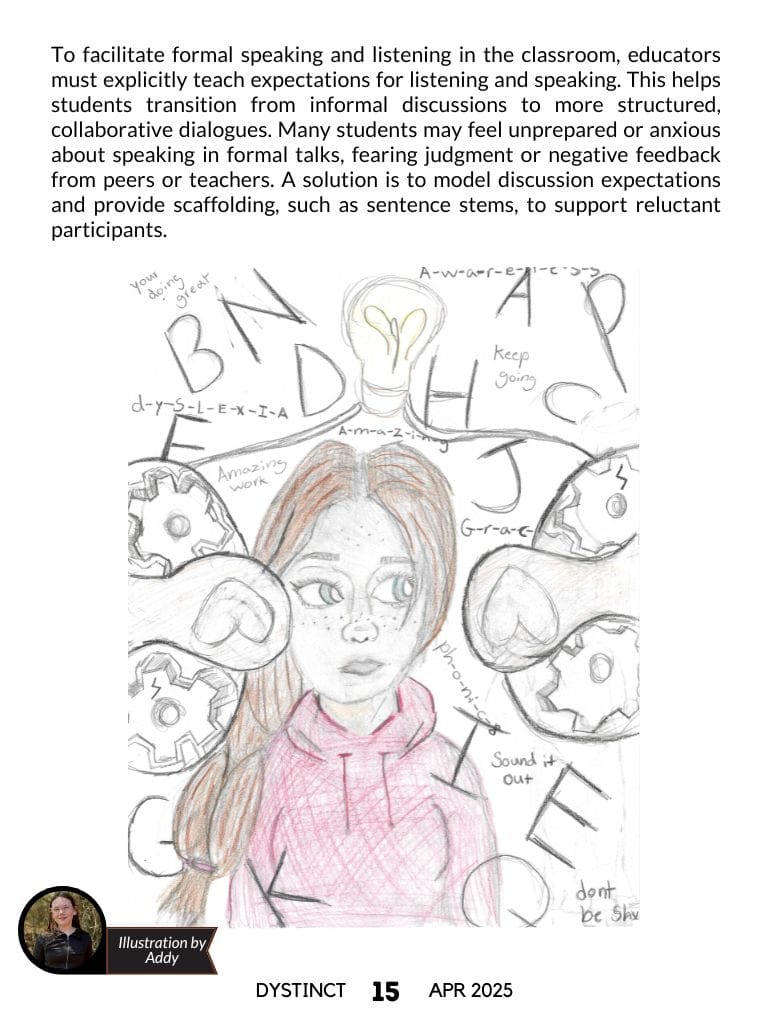
To facilitate formal speaking and listening in the classroom, educators must explicitly teach expectations for listening and speaking. This helps students transition from informal discussions to more structured, collaborative dialogues. Many students may feel unprepared or anxious about speaking in formal talks, fearing judgment or negative feedback from peers or teachers. A solution is to model discussion expectations and provide scaffolding, such as sentence stems, to support reluctant participants.
For students to effectively lead classroom discussions, they must be able to ask thoughtful questions and articulate their ideas. One effective strategy is "Questioning the Author," which empowers students to engage critically with texts and fosters a deeper understanding. Isabel Beck and her colleagues developed this strategy to encourage students to interact actively with a text by questioning the author's choices and reasoning. This approach helps students build a more profound comprehension of the material. (Beck, McKeown., et al. 1997).
The key elements of Questioning the Author are to select a grade-level appropriate text in terms of vocabulary and complexity. The teacher should use questions to prompt students to think critically about the text's meaning, such as "What is the author trying to tell you?" and "Why is the author telling you that?" "How could the author have said things more clearly?" Then, over time, the focus should shift from teacher-directed to student-led questions. This approach promotes active reading, self-monitoring, and critical thinking. Rather than simple questions that check for understanding, these Queries encourage students to explore the text's deeper meanings and collaborate with peers. This fosters a more interactive and participatory classroom culture where students become leaders in their learning. (Beck, McKeown., et al. 1997).
In many traditional secondary education classrooms, discussions often rely on a teacher asking questions and selecting individual students to answer. However, for language skills to support reading and writing development, all students must have the opportunity to participate in conversations. One effective strategy for ensuring that all students engage in discussions is to Turn and Talk. (Stewart & Swanson, 2019).
Turn and Talk is a structured classroom routine that allows all students to respond to a prompt by discussing it briefly with a peer. In this strategy, the teacher provides a question or topic for the class, and students turn to a predetermined partner to discuss the prompt. They must have at least five to six conversational turns between them—one student speaks, the partner actively listens, and then the partner asks a follow-up question. The roles switch, and both students get an opportunity to share their thoughts and deepen their understanding. (Stewart & Swanson, 2019).
This strategy can be applied across all content areas and grade levels, helping students extract meaning, apply concepts, and engage in more substantive conversations. Research shows that giving students structured opportunities to respond in teacher-directed settings leads to positive academic and behavioral outcomes (MacSuga-Gage & Simonsen, 2015). It also benefits students with behavior disorders, promoting social and academic skills (Locke & Fuchs, 1995).
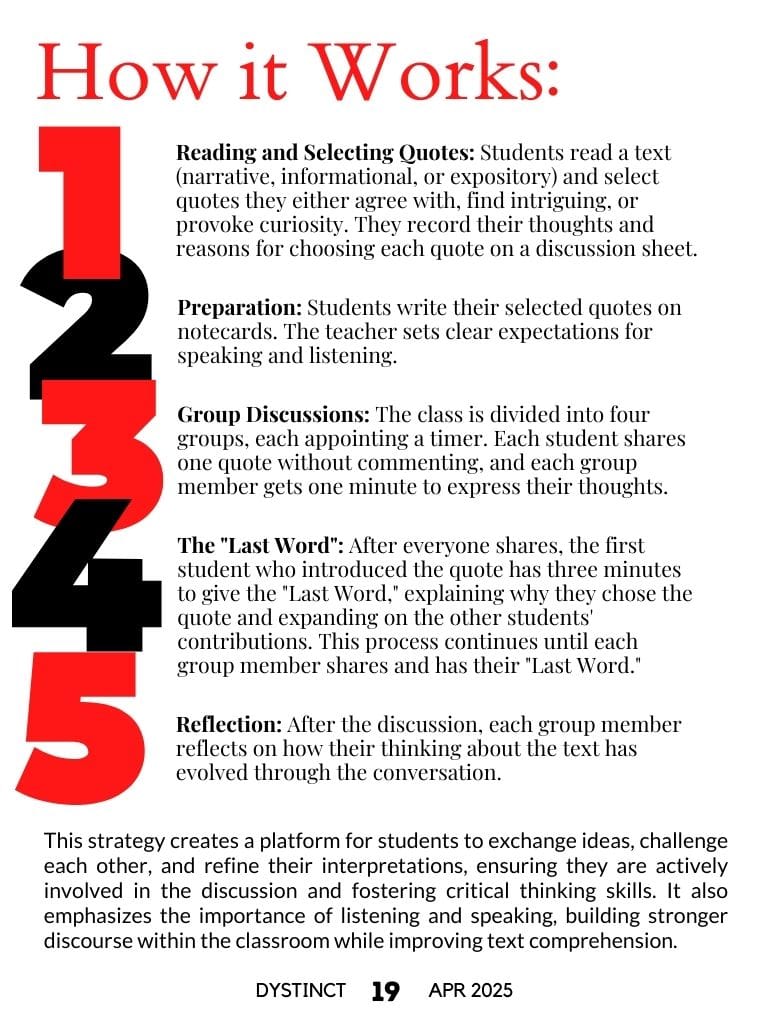
After teachers have created a culture of talk in their classrooms, the students will be ready for the next strategy, called Save the Last Word for Me, developed by Patricia Averette, Center for Leadership & Education Equity. The Save the Last Word for Me strategy promotes deeper engagement with texts through meaningful, cooperative discussions. It encourages students to express different opinions and interpretations, enhancing their understanding of the material. Rather than a debate, the goal is to build on each other's thoughts and foster a collaborative, reflective conversation.
How It Works
How It Works
- Reading and Selecting Quotes: Students read a text (narrative, informational, or expository) and select quotes they either agree with, find intriguing, or provoke curiosity. They record their thoughts and reasons for choosing each quote on a discussion sheet.
- Preparation: Students write their selected quotes on notecards. The teacher sets clear expectations for speaking and listening.
- Group Discussions: The class is divided into four groups, each appointing a timer. Each student shares one quote without commenting, and each group member gets one minute to express their thoughts.
- The "Last Word": After everyone shares, the first student who introduced the quote has three minutes to give the "Last Word," explaining why they chose the quote and expanding on the other students' contributions. This process continues until each group member shares and has their "Last Word."
- Reflection: After the discussion, each group member reflects on how their thinking about the text has evolved through the conversation.
This strategy creates a platform for students to exchange ideas, challenge each other, and refine their interpretations, ensuring they are actively involved in the discussion and fostering critical thinking skills. It also emphasizes the importance of listening and speaking, building stronger discourse within the classroom while improving text comprehension.
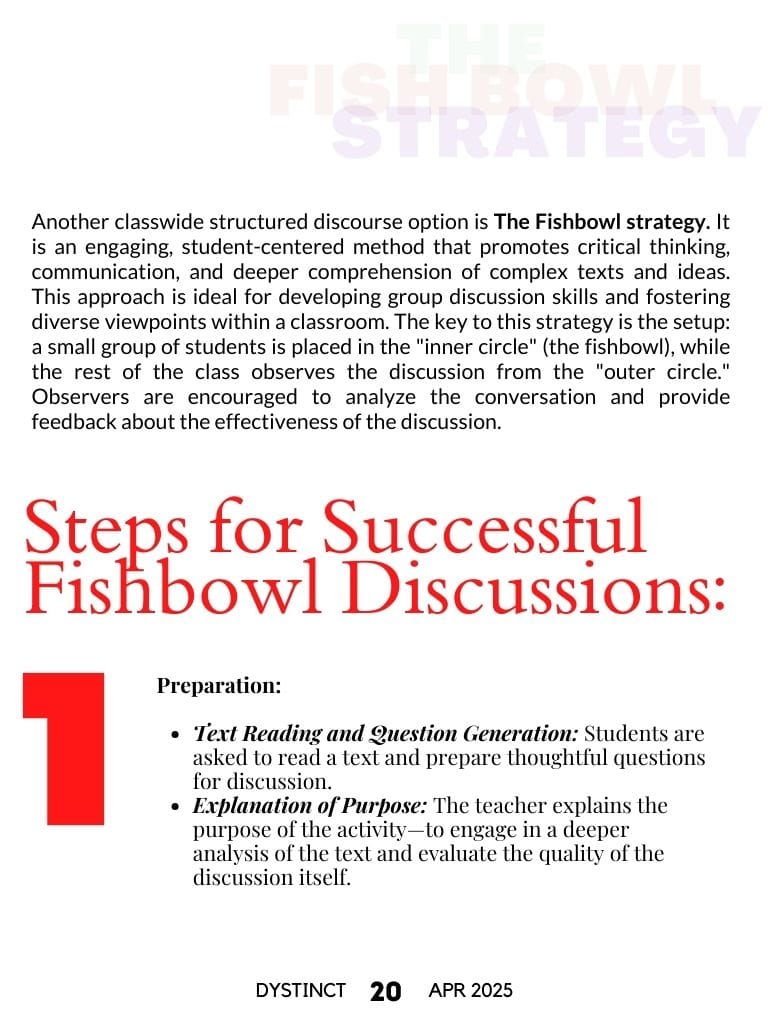
Another classwide structured discourse option is The Fishbowl strategy. It is an engaging, student-centered method that promotes critical thinking, communication, and deeper comprehension of complex texts and ideas. This approach is ideal for developing group discussion skills and fostering diverse viewpoints within a classroom. The key to this strategy is the setup: a small group of students is placed in the "inner circle" (the fishbowl), while the rest of the class observes the discussion from the "outer circle." Observers are encouraged to analyze the conversation and provide feedback about the effectiveness of the discussion.
Steps for Successful Fishbowl Discussions
Steps for Successful Fishbowl Discussions
- Preparation:
- Text Reading and Question Generation: Students are asked to read a text and prepare thoughtful questions for discussion.
- Explanation of Purpose: The teacher explains the purpose of the activity—to engage in a deeper analysis of the text and evaluate the quality of the discussion itself.
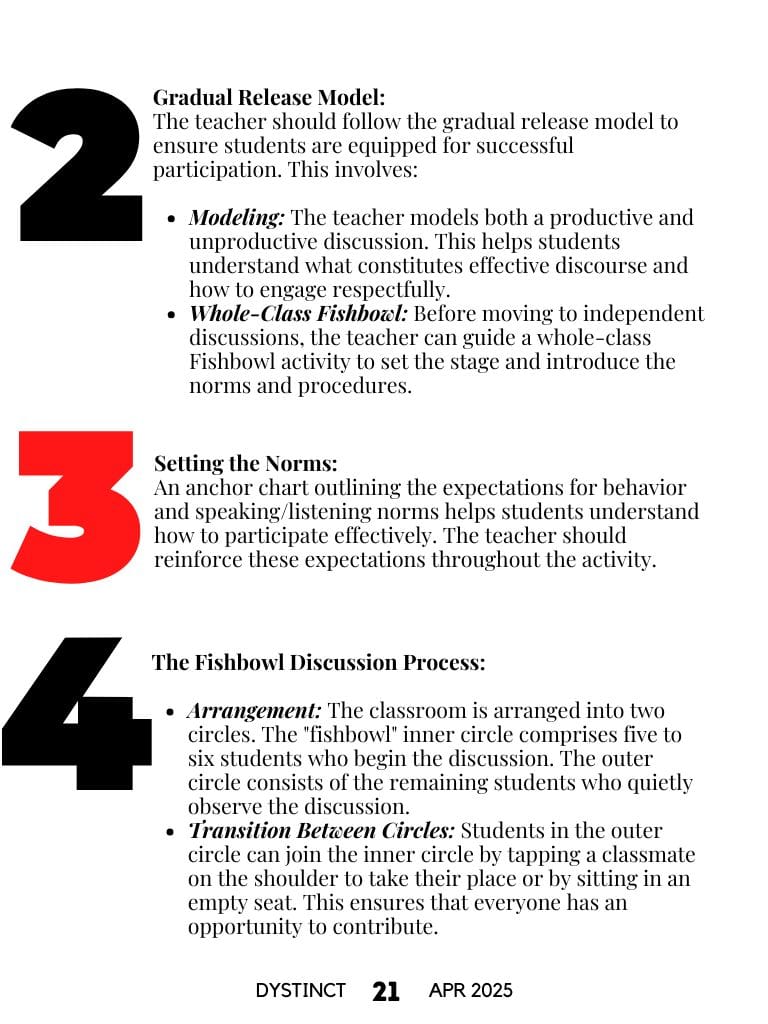
- Gradual Release Model: The teacher should follow the gradual release model to ensure students are equipped for successful participation. This involves:
- Modeling: The teacher models both a productive and unproductive discussion. This helps students understand what constitutes effective discourse and how to engage respectfully.
- Whole-Class Fishbowl: Before moving to independent discussions, the teacher can guide a whole-class Fishbowl activity to set the stage and introduce the norms and procedures.
- Setting the Norms: An anchor chart outlining the expectations for behavior and speaking/listening norms helps students understand how to participate effectively. The teacher should reinforce these expectations throughout the activity.
- The Fishbowl Discussion Process:
- Arrangement: The classroom is arranged into two circles. The "fishbowl" inner circle comprises five to six students who begin the discussion. The outer circle consists of the remaining students who quietly observe the discussion.
- Transition Between Circles: Students in the outer circle can join the inner circle by tapping a classmate on the shoulder to take their place or by sitting in an empty seat. This ensures that everyone has an opportunity to contribute.
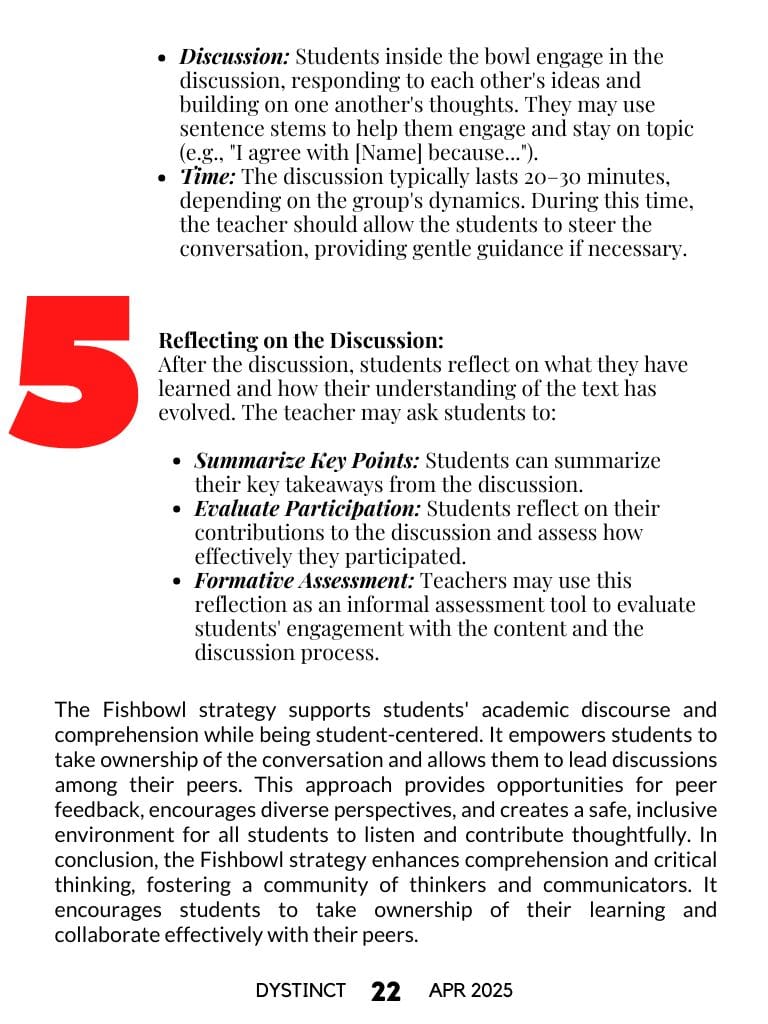
- Discussion: Students inside the bowl engage in the discussion, responding to each other's ideas and building on one another's thoughts. They may use sentence stems to help them engage and stay on topic (e.g., "I agree with [Name] because...").
- Time: The discussion typically lasts 20–30 minutes, depending on the group's dynamics. During this time, the teacher should allow the students to steer the conversation, providing gentle guidance if necessary.
- Reflecting on the Discussion: After the discussion, students reflect on what they have learned and how their understanding of the text has evolved. The teacher may ask students to:
- Summarize Key Points: Students can summarize their key takeaways from the discussion.
- Evaluate Participation: Students reflect on their contributions to the discussion and assess how effectively they participated.
- Formative Assessment: Teachers may use this reflection as an informal assessment tool to evaluate students' engagement with the content and the discussion process.
The Fishbowl strategy supports students' academic discourse and comprehension while being student-centered. It empowers students to take ownership of the conversation and allows them to lead discussions among their peers. This approach provides opportunities for peer feedback, encourages diverse perspectives, and creates a safe, inclusive environment for all students to listen and contribute thoughtfully. In conclusion, the Fishbowl strategy enhances comprehension and critical thinking, fostering a community of thinkers and communicators. It encourages students to take ownership of their learning and collaborate effectively with their peers.
A Socratic Seminar is an advanced discussion format designed to foster a deeper understanding of a text through critical and thoughtful dialogue. The philosopher Socrates inspired the approach, who believed that students could deepen their understanding of complex ideas through meaningful conversation. A Socratic Seminar's goal is to explore a text and engage with it in a way that challenges thinking and promotes open-ended dialogue.
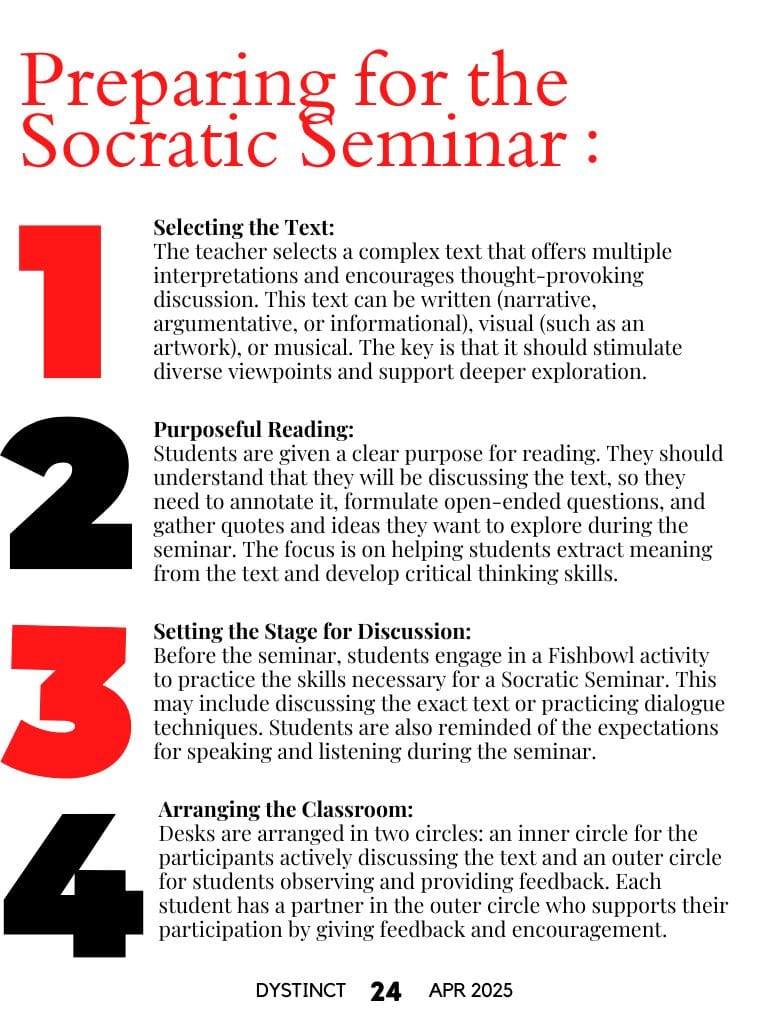
Preparing for the Socratic Seminar
Preparing for the Socratic Seminar
- Selecting the Text:
The teacher selects a complex text that offers multiple interpretations and encourages thought-provoking discussion. This text can be written (narrative, argumentative, or informational), visual (such as an artwork), or musical. The key is that it should stimulate diverse viewpoints and support deeper exploration.
- Purposeful Reading:
Students are given a clear purpose for reading. They should understand that they will be discussing the text, so they need to annotate it, formulate open-ended questions, and gather quotes and ideas they want to explore during the seminar. The focus is on helping students extract meaning from the text and develop critical thinking skills.
- Setting the Stage for Discussion:
Before the seminar, students engage in a Fishbowl activity to practice the skills necessary for a Socratic Seminar. This may include discussing the exact text or practicing dialogue techniques. Students are also reminded of the expectations for speaking and listening during the seminar.
- Arranging the Classroom:
Desks are arranged in two circles: an inner circle for the participants actively discussing the text and an outer circle for students observing and providing feedback. Each student has a partner in the outer circle who supports their participation by giving feedback and encouragement.
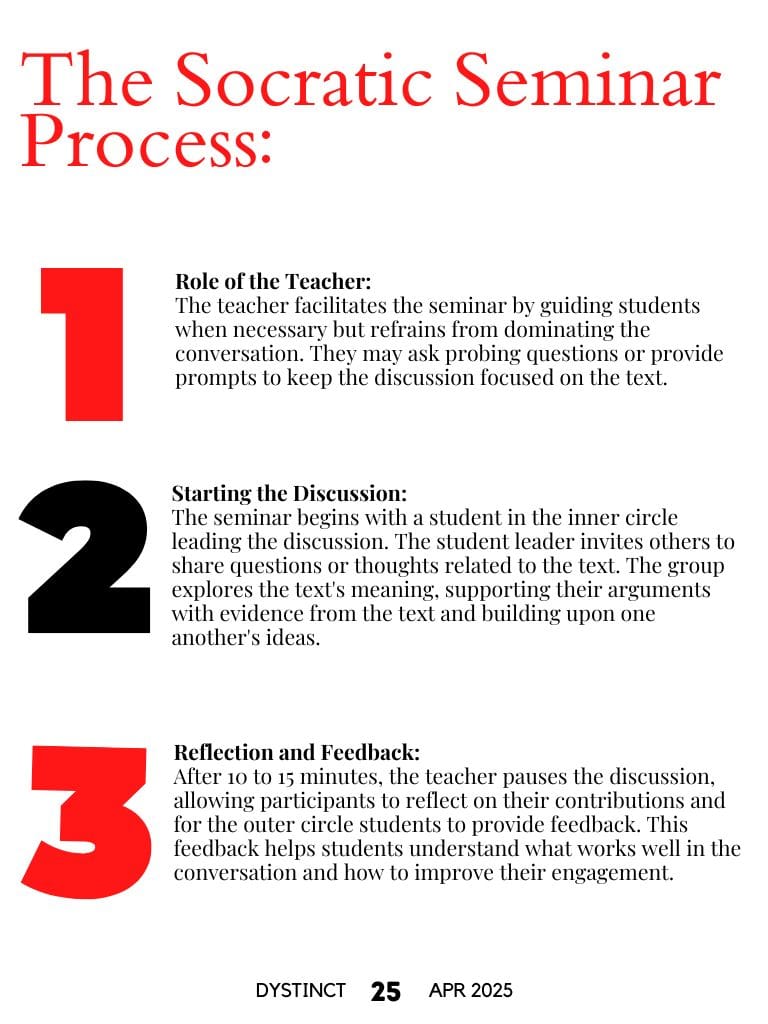
The Socratic Seminar Process
The Socratic Seminar Process
- Role of the Teacher:
The teacher facilitates the seminar by guiding students when necessary but refrains from dominating the conversation. They may ask probing questions or provide prompts to keep the discussion focused on the text.
- Starting the Discussion:
The seminar begins with a student in the inner circle leading the discussion. The student leader invites others to share questions or thoughts related to the text. The group explores the text's meaning, supporting their arguments with evidence from the text and building upon one another's ideas.
- Reflection and Feedback:
After 10 to 15 minutes, the teacher pauses the discussion, allowing participants to reflect on their contributions and for the outer circle students to provide feedback. This feedback helps students understand what works well in the conversation and how to improve their engagement.
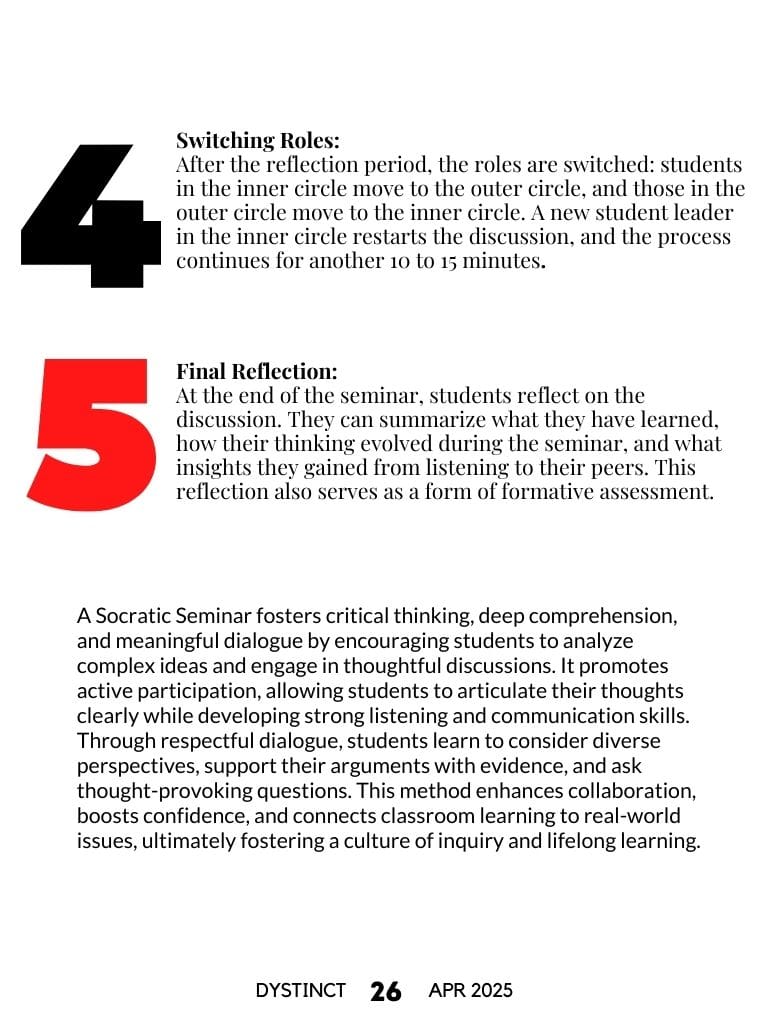
- Switching Roles:
After the reflection period, the roles are switched: students in the inner circle move to the outer circle, and those in the outer circle move to the inner circle. A new student leader in the inner circle restarts the discussion, and the process continues for another 10 to 15 minutes.
- Final Reflection:
At the end of the seminar, students reflect on the discussion. They can summarize what they have learned, how their thinking evolved during the seminar, and what insights they gained from listening to their peers. This reflection also serves as a form of formative assessment.
A Socratic Seminar fosters critical thinking, deep comprehension, and meaningful dialogue by encouraging students to analyze complex ideas and engage in thoughtful discussions. It promotes active participation, allowing students to articulate their thoughts clearly while developing strong listening and communication skills. Through respectful dialogue, students learn to consider diverse perspectives, support their arguments with evidence, and ask thought-provoking questions. This method enhances collaboration, boosts confidence, and connects classroom learning to real-world issues, ultimately fostering a culture of inquiry and lifelong learning.
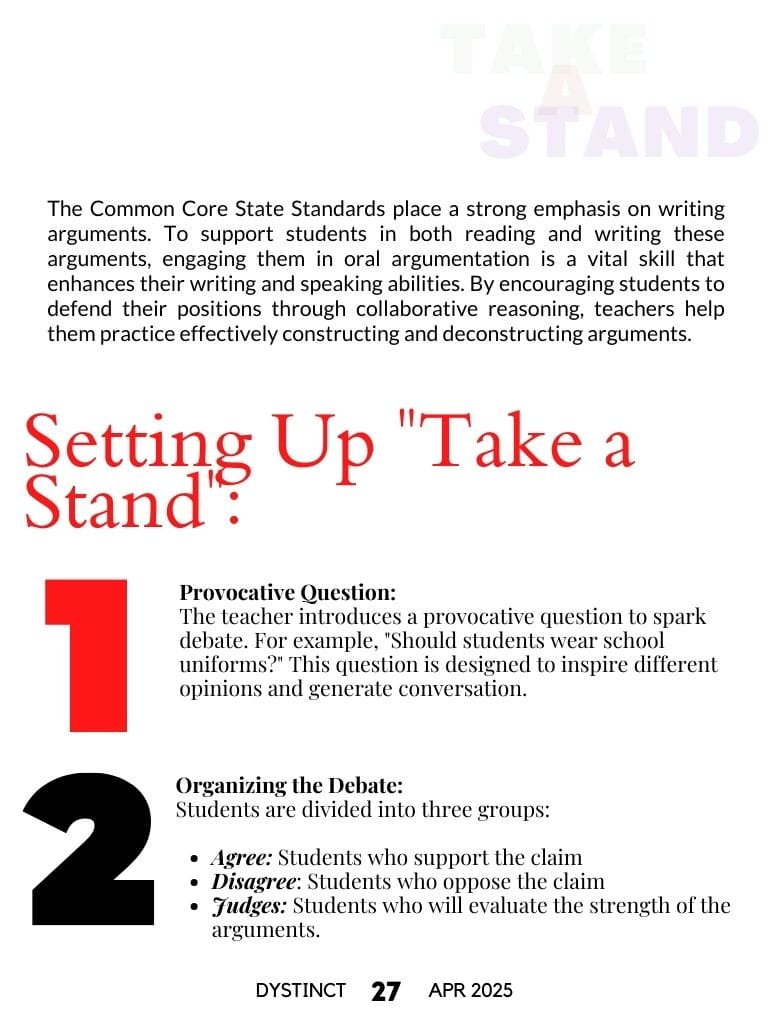
The Common Core State Standards place a strong emphasis on writing arguments. To support students in both reading and writing these arguments, engaging them in oral argumentation is a vital skill that enhances their writing and speaking abilities. By encouraging students to defend their positions through collaborative reasoning, teachers help them practice effectively constructing and deconstructing arguments.
Setting Up "Take a Stand"
Setting Up "Take a Stand"
- Provocative Question:
The teacher introduces a provocative question to spark debate. For example, "Should students wear school uniforms?" This question is designed to inspire different opinions and generate conversation.
- Organizing the Debate:
Students are divided into three groups:
- Agree: Students who support the claim
- Disagree: Students who oppose the claim
- Judges: Students who will evaluate the strength of the arguments.
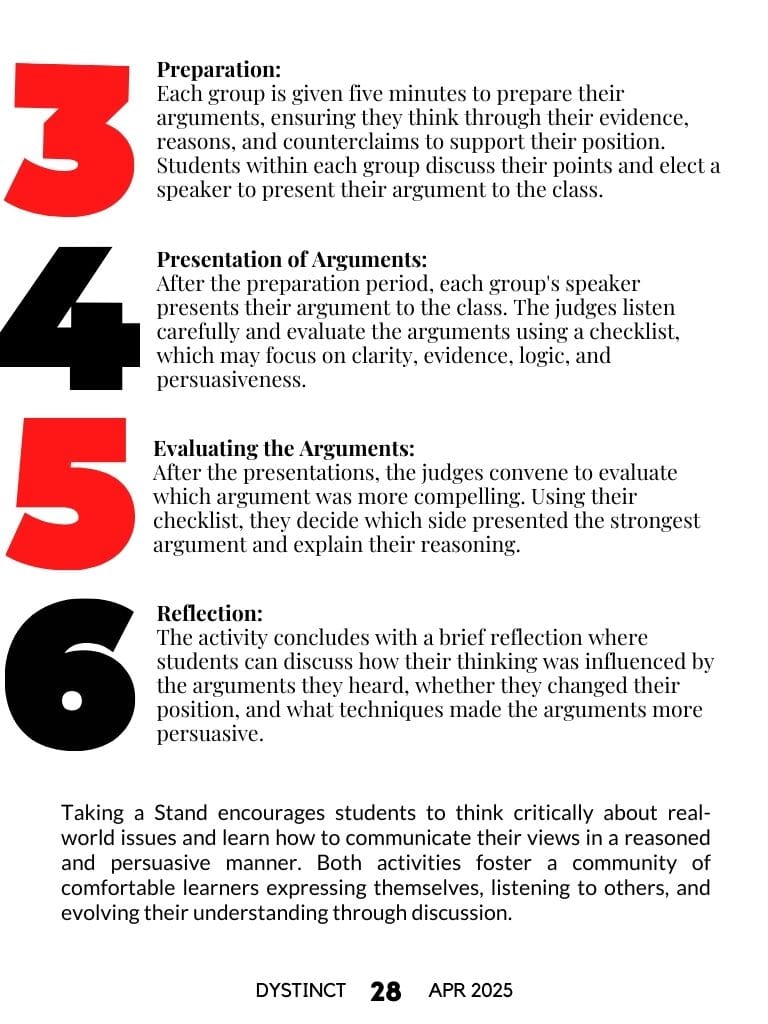
- Preparation:
Each group is given five minutes to prepare their arguments, ensuring they think through their evidence, reasons, and counterclaims to support their position. Students within each group discuss their points and elect a speaker to present their argument to the class.
- Presentation of Arguments:
After the preparation period, each group's speaker presents their argument to the class. The judges listen carefully and evaluate the arguments using a checklist, which may focus on clarity, evidence, logic, and persuasiveness.
- Evaluating the Arguments:
After the presentations, the judges convene to evaluate which argument was more compelling. Using their checklist, they decide which side presented the strongest argument and explain their reasoning.
- Reflection:
The activity concludes with a brief reflection where students can discuss how their thinking was influenced by the arguments they heard, whether they changed their position, and what techniques made the arguments more persuasive.
Taking a Stand encourages students to think critically about real-world issues and learn how to communicate their views in a reasoned and persuasive manner. Both activities foster a community of comfortable learners expressing themselves, listening to others, and evolving their understanding through discussion.
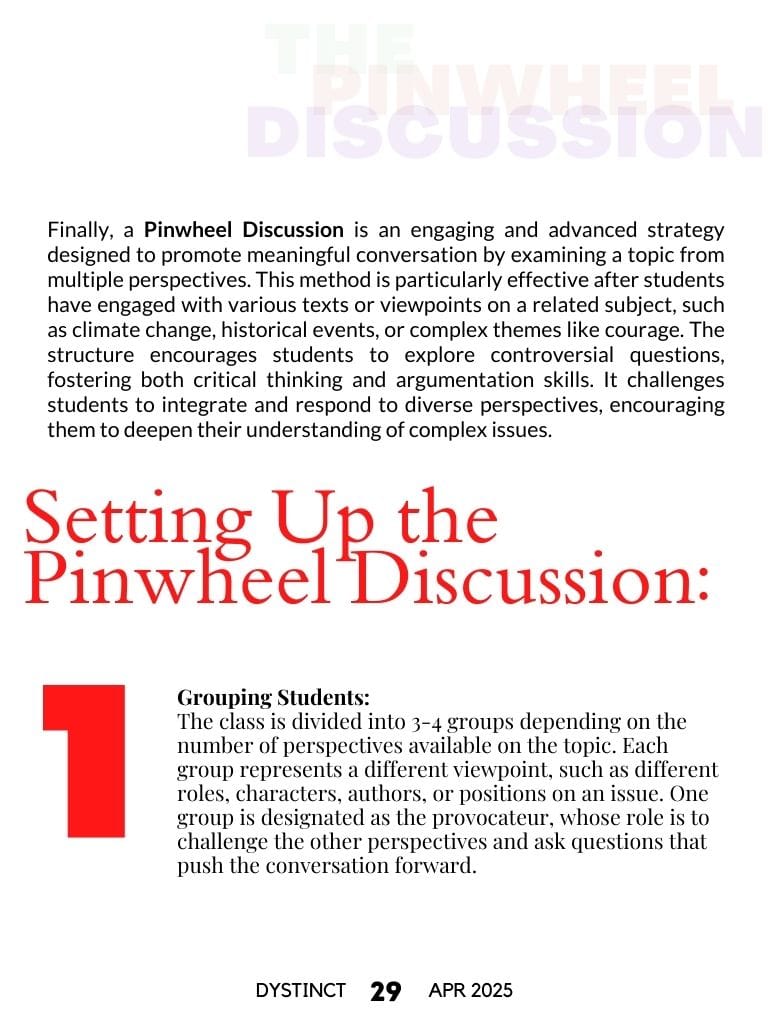
Finally, a Pinwheel Discussion is an engaging and advanced strategy designed to promote meaningful conversation by examining a topic from multiple perspectives. This method is particularly effective after students have engaged with various texts or viewpoints on a related subject, such as climate change, historical events, or complex themes like courage. The structure encourages students to explore controversial questions, fostering both critical thinking and argumentation skills. It challenges students to integrate and respond to diverse perspectives, encouraging them to deepen their understanding of complex issues.
Setting Up the Pinwheel Discussion
Setting Up the Pinwheel Discussion
- Grouping Students:
The class is divided into 3-4 groups depending on the number of perspectives available on the topic. Each group represents a different viewpoint, such as different roles, characters, authors, or positions on an issue. One group is designated as the provocateur, whose role is to challenge the other perspectives and ask questions that push the conversation forward.
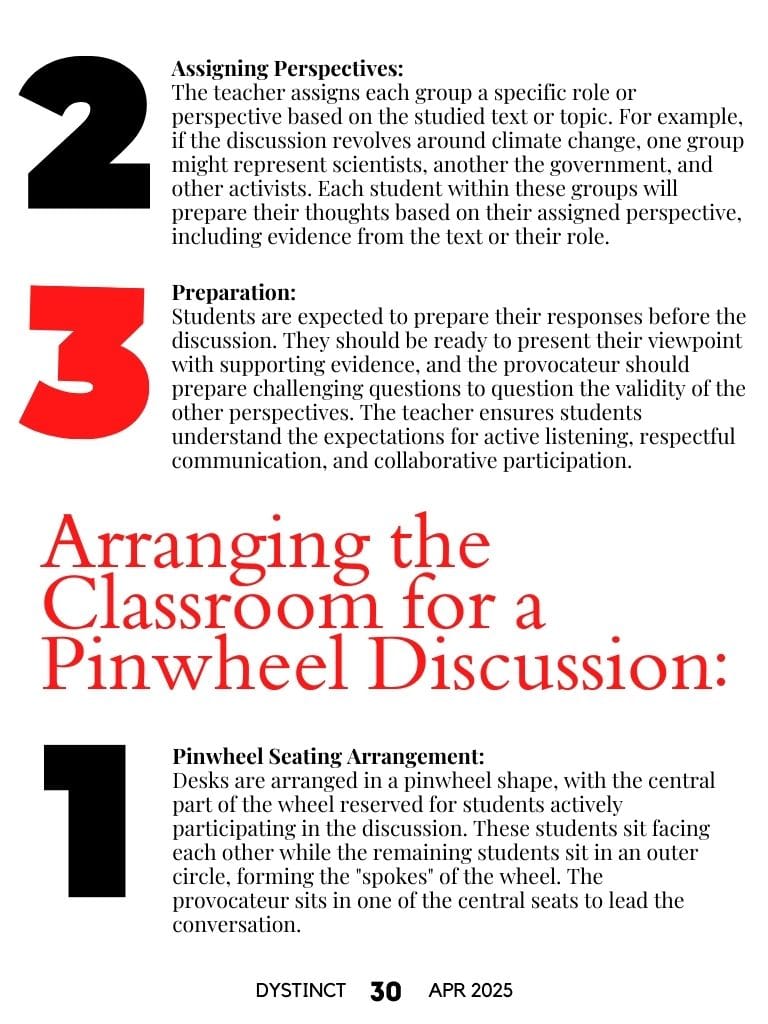
- Assigning Perspectives:
The teacher assigns each group a specific role or perspective based on the studied text or topic. For example, if the discussion revolves around climate change, one group might represent scientists, another the government, and other activists. Each student within these groups will prepare their thoughts based on their assigned perspective, including evidence from the text or their role.
- Preparation:
Students are expected to prepare their responses before the discussion. They should be ready to present their viewpoint with supporting evidence, and the provocateur should prepare challenging questions to question the validity of the other perspectives. The teacher ensures students understand the expectations for active listening, respectful communication, and collaborative participation.
Arranging the Classroom for a Pinwheel Discussion
Arranging the Classroom for a Pinwheel Discussion
- Pinwheel Seating Arrangement:
Desks are arranged in a pinwheel shape, with the central part of the wheel reserved for students actively participating in the discussion. These students sit facing each other while the remaining students sit in an outer circle, forming the "spokes" of the wheel. The provocateur sits in one of the central seats to lead the conversation.
- Starting the Discussion:
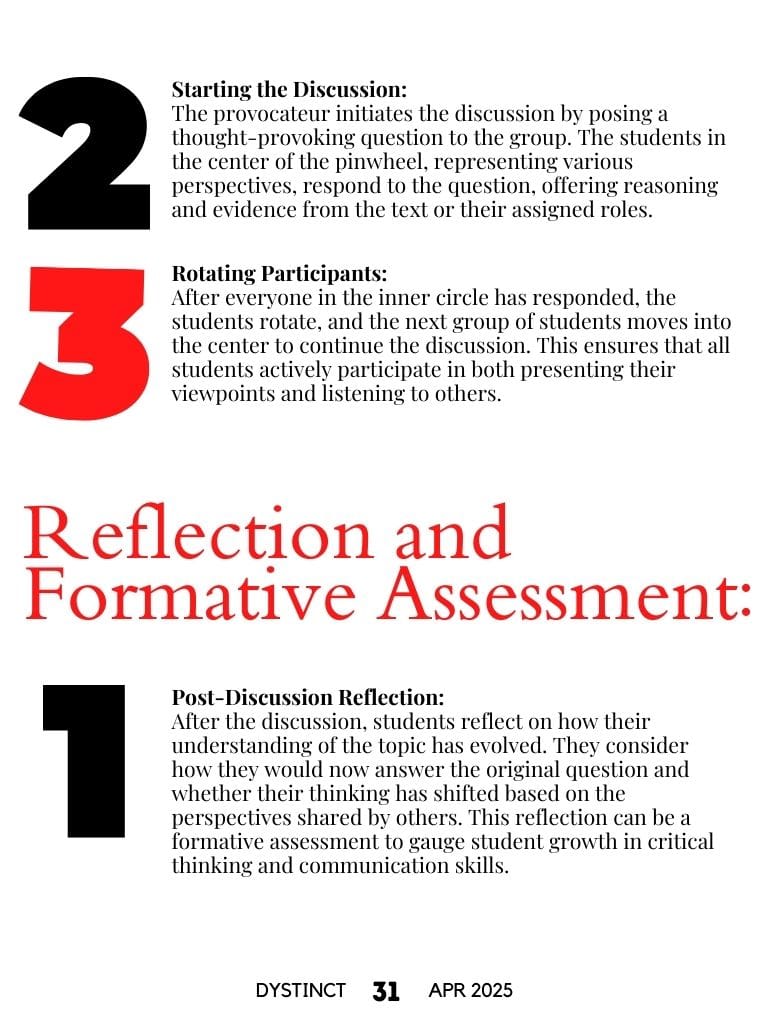
The provocateur initiates the discussion by posing a thought-provoking question to the group. The students in the center of the pinwheel, representing various perspectives, respond to the question, offering reasoning and evidence from the text or their assigned roles.
- Rotating Participants:
After everyone in the inner circle has responded, the students rotate, and the next group of students moves into the center to continue the discussion. This ensures that all students actively participate in both presenting their viewpoints and listening to others.
Reflection and Formative Assessment
Reflection and Formative Assessment
- Post-Discussion Reflection:
After the discussion, students reflect on how their understanding of the topic has evolved. They consider how they would now answer the original question and whether their thinking has shifted based on the perspectives shared by others. This reflection can be a formative assessment to gauge student growth in critical thinking and communication skills.
- Teacher's Role in Evaluation:
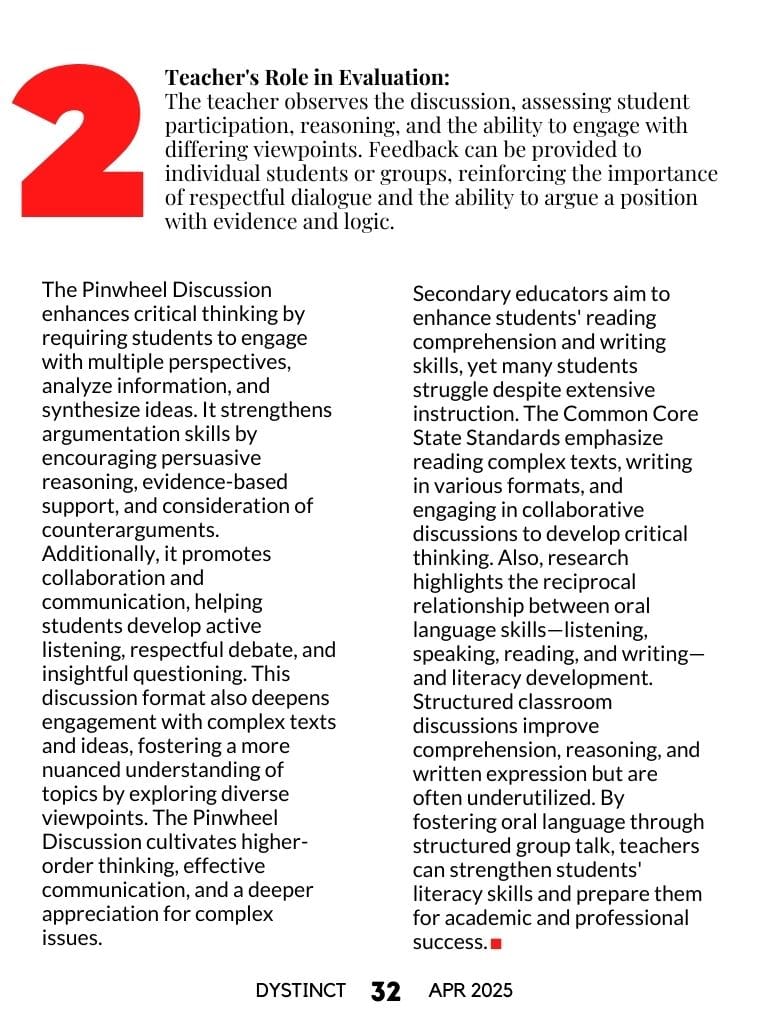
The teacher observes the discussion, assessing student participation, reasoning, and the ability to engage with differing viewpoints. Feedback can be provided to individual students or groups, reinforcing the importance of respectful dialogue and the ability to argue a position with evidence and logic.
The Pinwheel Discussion enhances critical thinking by requiring students to engage with multiple perspectives, analyze information, and synthesize ideas. It strengthens argumentation skills by encouraging persuasive reasoning, evidence-based support, and consideration of counterarguments. Additionally, it promotes collaboration and communication, helping students develop active listening, respectful debate, and insightful questioning. This discussion format also deepens engagement with complex texts and ideas, fostering a more nuanced understanding of topics by exploring diverse viewpoints. The Pinwheel Discussion cultivates higher-order thinking, effective communication, and a deeper appreciation for complex issues.
Secondary educators aim to enhance students' reading comprehension and writing skills, yet many students struggle despite extensive instruction. The Common Core State Standards emphasize reading complex texts, writing in various formats, and engaging in collaborative discussions to develop critical thinking. Also, research highlights the reciprocal relationship between oral language skills—listening, speaking, reading, and writing—and literacy development. Structured classroom discussions improve comprehension, reasoning, and written expression but are often underutilized. By fostering oral language through structured group talk, teachers can strengthen students' literacy skills and prepare them for academic and professional success.
References
References
- Beck, I. L., McKeown, M. G., Hamilton, R. L., & Kucan, L. (1998). Getting at the meaning: How to help students unpack difficult text. American Educator, 22(1-2), 66–71, 85.
- BetterLesson. (n.d.). Fishbowl discussion. BetterLesson. [teaching.betterlesson.com]
- Britton, J. (1970). Language and learning. University of Miami Press.
- California State University, Chico. (n.d.). Fish bowl strategy. California State University, Chico. [csuchico.edu]
- Charlotte Speech and Hearing Center. (2020, April 7). Receptive language: The link between listening and literacy. Charlotte Speech and Hearing Center.
- Cialdini, R. B. (2009). Influence: The psychology of persuasion (Revised edition). HarperCollins.
- Classcard. (n.d.). How Maslow's hierarchy of needs can be applied in teaching. Classcard Blog. [classcardapp.com]
- Common Core State Standards Initiative. (n.d.). Speaking & listening standards: Grades 9-10. The Core Standards CCCSO. [thecorestandards.org]
- Facing History and Ourselves. (n.d.). Fishbowl. Facing History and Ourselves. [facinghistory.org]
- Facing History and Ourselves. (n.d.). Socratic seminar. Facing History and Ourselves. [facinghistory.org]
- Fisher, D., Frey, N., & Hattie, J. (2016). Visible learning for literacy, grades K-12: Implementing the practices that work best to accelerate student learning. Corwin.
- Fuchs, D. (1995). The effects of instructional components on reading achievement: A synthesis of research. Learning Disabilities Research & Practice, 10(3), 122-133.
- Gough, P. B., & Tunmer, W. E. (1986). Decoding, Reading, and Reading Disability. Remedial and Special Education, 7(1), 6-10.
- Hattie, J., Fisher, D., & Frey, N. (2016). Visible learning for literacy: Implementing the practices that work best to accelerate student learning. Corwin.
- International Dyslexia Association. (2018). Knowledge and practice standards for teachers of reading (2nd ed.). International Dyslexia Association. [dyslexiaida.org]
- Kamil, M. L., Borman, G. D., Dole, J., Kral, C. C., Salinger, T., & Torgesen, J. (2008). Improving adolescent literacy: Effective classroom and intervention practices: A practice guide (NCEE 2008-4027). Washington, DC: National Center for Education Evaluation and Regional Assistance, Institute of Education Sciences, U.S. Department of Education. [ies.ed.gov]
- Kirby, S. N. (2003). Developing an R&D program to improve reading comprehension. RAND Corporation. [rand.org]
- Locke, W. R., & Fuchs, L. S. (1995). Effects of peer-mediated reading instruction on the on-task behavior and social interaction of children with behavior disorders. Journal of Emotional and Behavioral Disorders, 3(2), 92–99. [doi.org]
- MacSuga-Gage, A. S., & Simonsen, B. (2015). Examining the effects of teacher-directed opportunities to respond on student outcomes: A systematic review of the literature. Education and Treatment of Children, 38(2), 211–239. [doi.org]
- Maxwell, J. C. (2007). The 21 irrefutable laws of leadership: Follow them and people will follow you (10th Anniversary ed.). Thomas Nelson.
- McLeod, S. (2007, updated 2024). Maslow’s hierarchy of needs. Simply Psychology. [simplypsychology.org]
- National Council for the Social Studies. (n.d.). The Pinwheel Discussion. [socialstudies.org]
- Pasco Middle School. (2014). Socratic seminar. Pasco Middle School. [pms.pasco.k12.fl.us]
- Reading Rockets. (n.d.). Questioning the author. Reading Rockets. [readingrockets.org]
- Reading Rockets. (n.d.). The simple view of reading. Reading Rockets. [readingrockets.org]
- Stewart, A. A., & Swanson, E. (2019). Turn and talk: An evidence-based practice. Teacher’s guide. Austin, TX: The Meadows Center for Preventing Educational Risk.
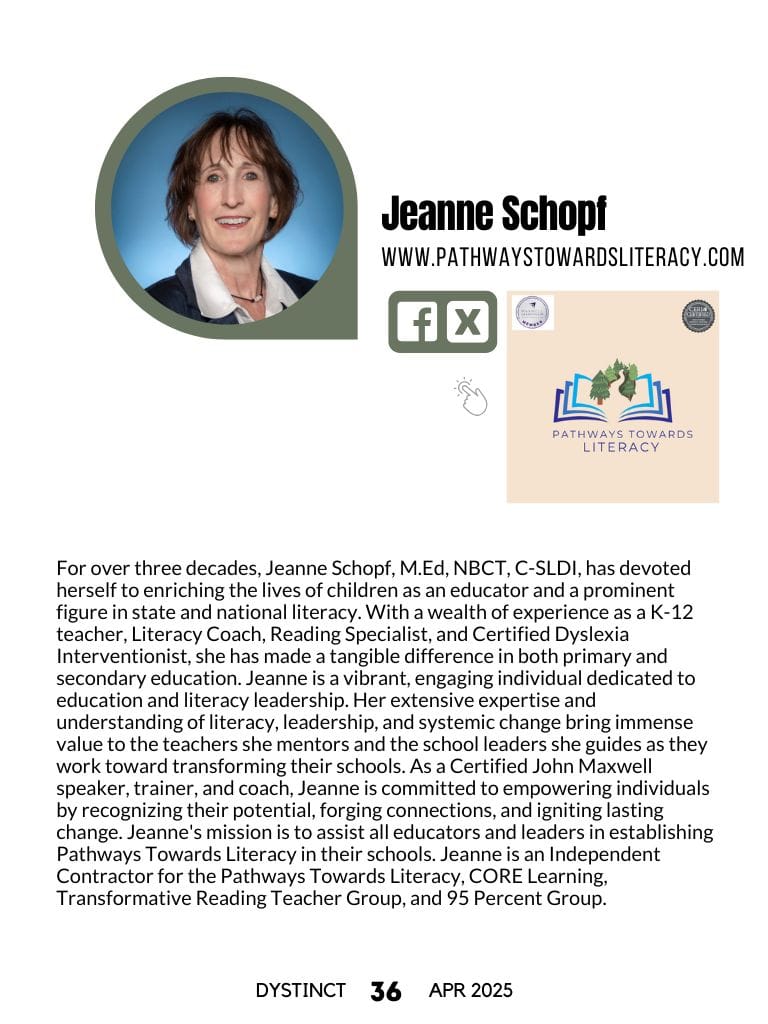
Jeanne Schopf
Literacy Consultant, Dyslexia Interventionist, Speaker, Certified Coach & Founder | pathwaystowardsliteracy.com | facebook | x
Jeanne Schopf
For over three decades, Jeanne Schopf, M.Ed, NBCT, C-SLDI, has devoted herself to enriching the lives of children as an educator and a prominent figure in state and national literacy. With a wealth of experience as a K-12 teacher, Literacy Coach, Reading Specialist, and Certified Dyslexia Interventionist, she has made a tangible difference in both primary and secondary education. Jeanne is a vibrant, engaging individual dedicated to education and literacy leadership. Her extensive expertise and understanding of literacy, leadership, and systemic change bring immense value to the teachers she mentors and the school leaders she guides as they work toward transforming their schools. As a Certified John Maxwell speaker, trainer, and coach, Jeanne is committed to empowering individuals by recognizing their potential, forging connections, and igniting lasting change. Jeanne's mission is to assist all educators and leaders in establishing Pathways Towards Literacy in their schools. Jeanne is an Independent Contractor for the Pathways Towards Literacy, CORE Learning, Transformative Reading Teacher Group, and 95 Percent Group.
Extracts from Dystinct Magazine
Extracts from Dystinct Magazine