Issue 32: On Being Yourself | Karina Kerr
Karina Kerr reflects on growing up with unrecognised learning difficulties and childhood trauma, finding her way into university and learning to challenge shame, ask for support and recognise the strengths that had been there all along.

Table of Contents
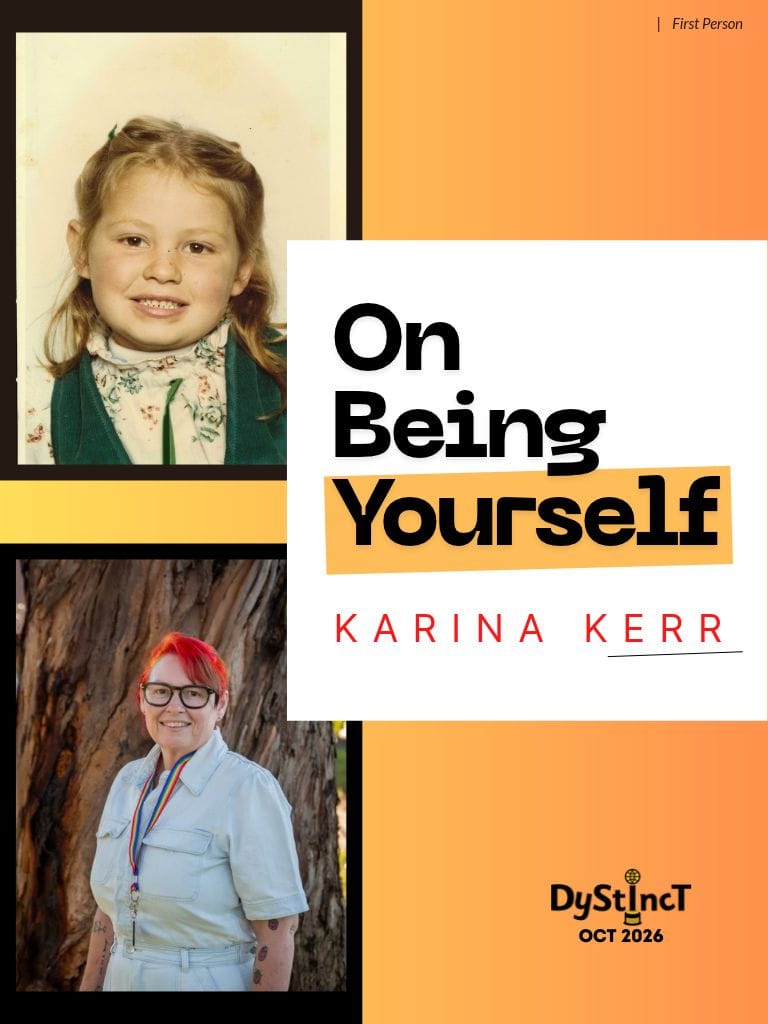
In 1819 or 1981, yes, that is how it all starts. My report card stated:
Karina can be very moody and 'mouthy' when she wants to be. A good worker when she minds her own business.
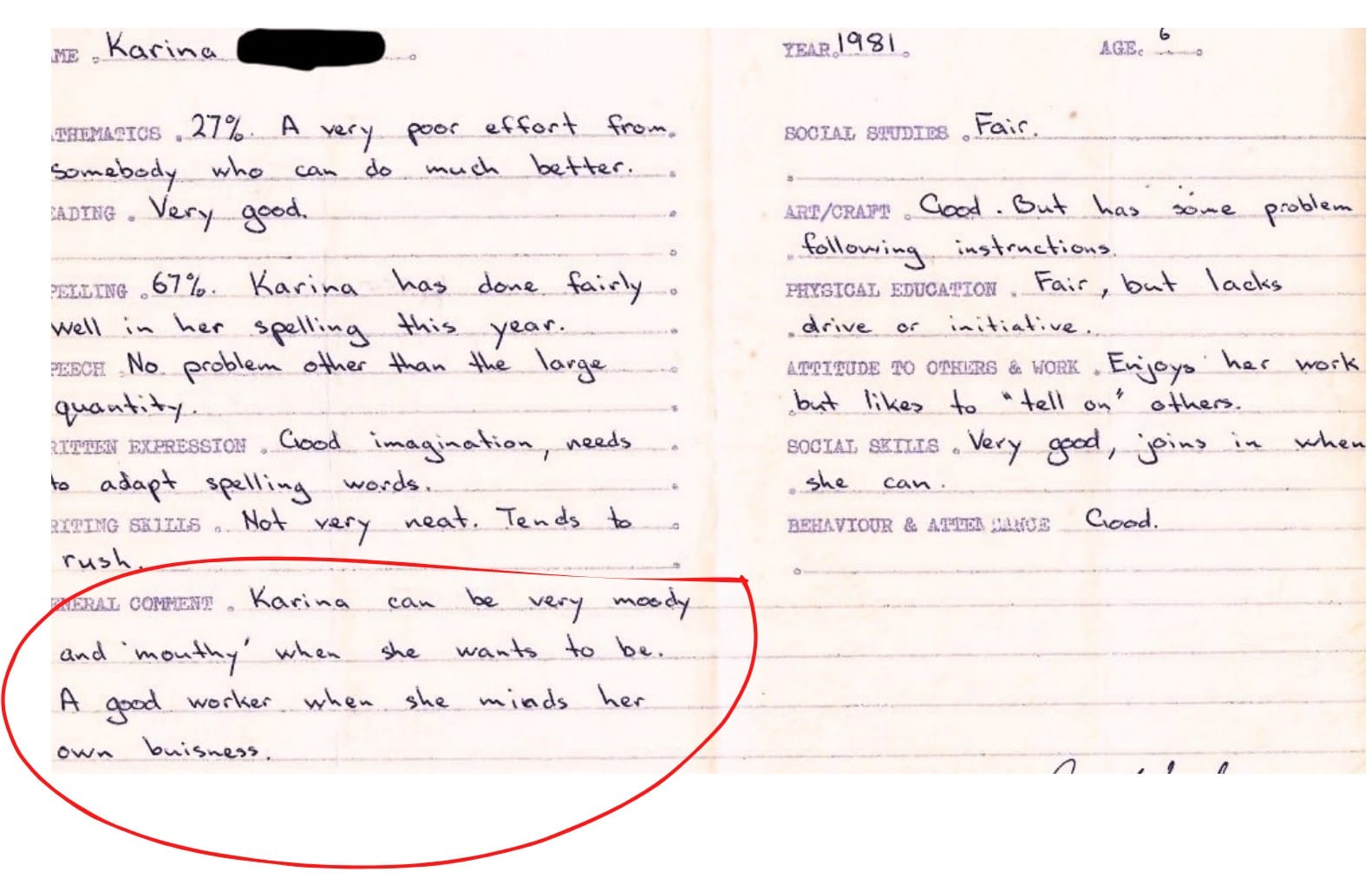
I was six years old. I got 67% for spelling, which you might think is odd for someone with dyslexia. The thing is, I could spell words out loud, and that is how they tested spelling back then. By Year 3, in 1983, I hadn't progressed well academically, and my report card recommended I repeat the year.
My school had only 28 students from Kindergarten to Year 6. Looking back at those early reports, it is clear there were signs that something was different about the way I learned, but nobody recognised them for what they were.
Through school, mathematics remained my biggest challenge. I was a D student who never mastered times tables, despite my father's persistence. Persistence might be too kind a word. If I got them wrong, I was physically punished. Eventually, it became easier to accept the belt than the endless attempts at learning something my brain wasn't going to do the same way as everyone else's.
There were signs that something was different about the way I learned, but nobody recognised them for what they were.
The signs were always there
The signs were always there
As I progressed through primary school, my report cards consistently showed that I was struggling with the written word. In Year 5, I still had not mastered writing b's and d's the right way around. It was labelled as "confusion". Personality comments remained much the same: "moody", "too social", and "problems with peers".
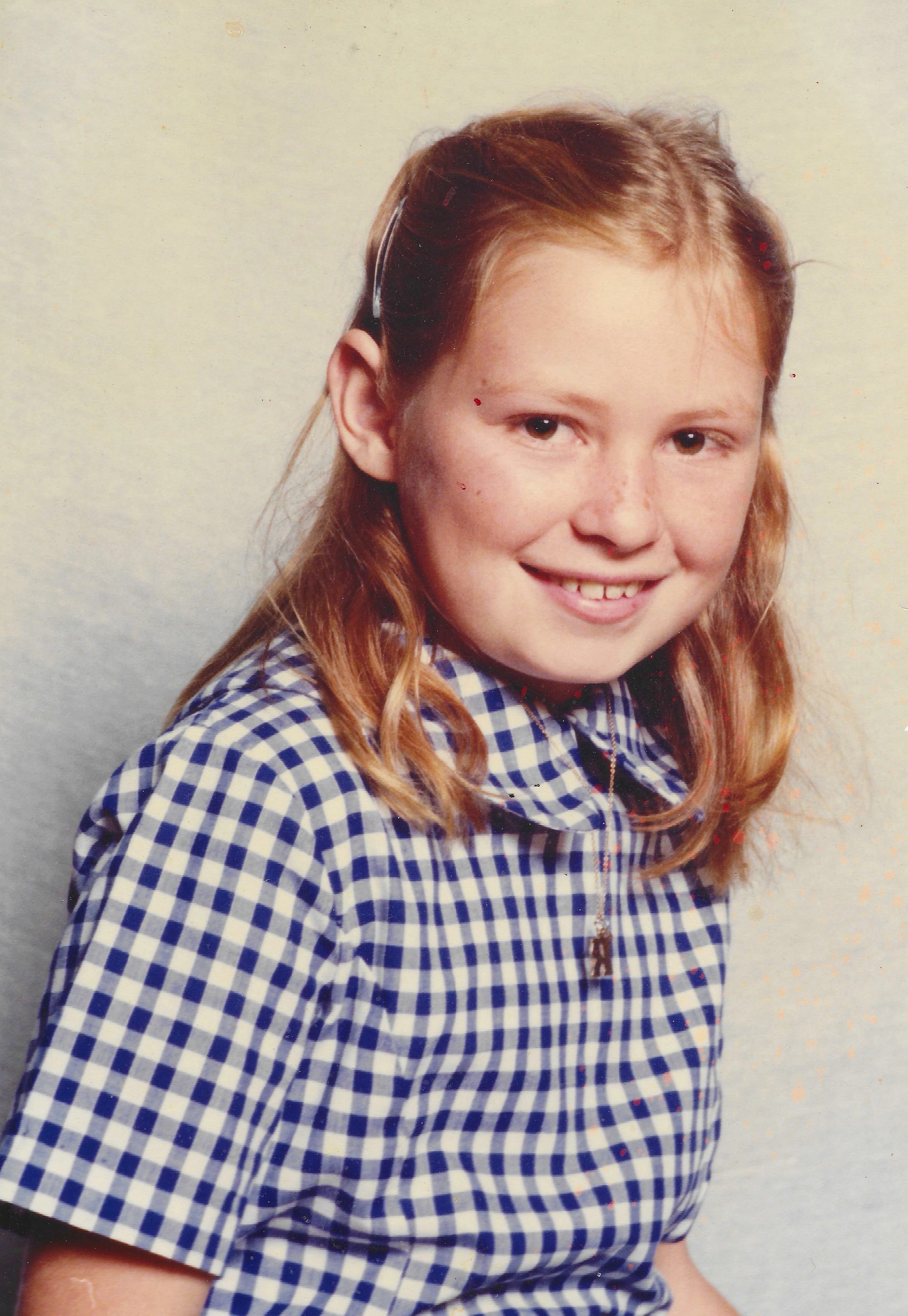
By Year 6, I was still struggling with English, but because home was chaotic, I had thrown myself into the safety of reading. It is easy to hide in a book and escape your life. I carried that love of reading into high school. Ironically, I loved books but was terrified of reading aloud. Standing in front of a class and reading felt like torture. I was not a fast reader either. I often had to reread entire pages because I would realise I had skipped a paragraph without noticing.
History and social sciences became my favourite subjects. By Year 8, my spelling and grammar had not improved, but my comprehension was strong, and so was my ability to speak publicly. Verbal assessments were where I excelled. Written assessments, particularly exams, were often a disaster.
My report cards showed academic improvement, but my home life didn't improve, and my focus gradually shifted elsewhere. My mother had bipolar disorder, and she was frequently hospitalised. Her moods swung between extreme highs, where her behaviour became unpredictable and erratic, and devastating lows that made life feel impossible.
As a child, you learn from what you see. You absorb the world around you and respond to it. It is no surprise that my personality was described as moody.
Much of the effort from both my parents and the education system was focused on correcting what they saw as important: spelling, grammar, maths, and fitting into society.
It took me many years to understand the impact of growing up surrounded by alcohol, family violence and mental illness. It also took me many years to understand how those experiences shaped my sense of self and influenced what I believed I was capable of academically.
Looking back at my school reports from primary school to high school, both my strengths and struggles were obvious. I was strong at research. My memory for facts was exceptional. I could speak up, speak publicly and communicate confidently. Yet these strengths were rarely celebrated. Instead, much of the effort from both my parents and the education system was focused on correcting what they saw as important: spelling, grammar, maths, and fitting into society.
Eventually I returned to school, determined to at least complete Year 10. And I did it.
My parents were not pleased with my school results. At one point they requested that I be moved to a stricter teacher, explaining that "it was important for a girl to do well." At no point, however, did anyone recognise that I had learning difficulties. I had become very good at masking them. My memory played an important role in that. So did a range of avoidance strategies, including spending much of Year 9 science sitting in the hallway for asking too many provocative questions.
By 1991, I had left school after being kicked out of home. I spent time living on the streets, couch surfing and learning a completely different set of skills. Not academic skills. Survival skills. My life had taken a very different direction. Those experiences led me to reflect on what I was missing, and eventually I returned to school, determined to at least complete Year 10. And I did it.
My grades were satisfactory and, if I am honest, I suspect the school was relieved to see me leave with a Year 10 certificate, so they did not have to deal with me anymore. I received mostly C's and D's and, strangely enough, a B in General Maths.
When did I know?
When did I know?
You might be wondering by now: when did I find out I was dyslexic, and probably carrying all the D's: Dyslexia, Dysgraphia and Dyscalculia?
I did not find stable accommodation until after I had a child in 1994. After having two children and surviving more than my fair share of life's challenges, I began a healing journey. Counselling was difficult, confronting and sometimes painful, but it was worth every moment.
Somewhere along the way, I decided I wanted to go to university and become a psychologist. I enrolled in a bridging course designed to prepare people for university study. It was the first time I had ever heard the word dyslexia used in a way that made sense to me.
When I submitted my first essay, the Course Director invited me to meet with them. A genuinely kind person who had noticed something. They didn't want me reading the feedback on my essay without support. The comments were brutal. The conversation, however, was anything but. It was gentle, respectful and compassionate. It began with a sentence that completely blindsided me:
"It would be helpful if you declared your disability."
Disability?
What disability?
I had absolutely no idea what they were talking about.
I then sat the psychology entry exam and missed the required score by a single point. One point! Thankfully, I am stubborn. Missing out by one point didn't deter me. I accepted an early offer into a Bachelor of Arts and began university in 2003. Looking back now, it is amazing how much effort I spent adapting, compensating, and masking without ever realising why I found some things so much harder than everyone else. That is probably why my school reports are full of comments about my behaviour rather than my learning difficulties.
Declare your disability. What disability?
Declare your disability. What disability?
To be honest, I am not sure my parents ever realised I couldn't read or write the way other people did. I can read, but my difficulty is often with pronunciation, spelling and getting the words onto paper in the right order. Letters can jumble, reverse, or appear in the wrong place. My speech can also do the same thing. Almost everything I type has at least one letter out of place. Years of practice mean I can type reasonably quickly now, but I still have a very close relationship with the backspace key.
There are days when the frustration is overwhelming. Days when I could sit at my desk and cry because I cannot respond quickly without spell check, text-to-speech, immersive reader, or grammar software. My sentences often arrive in my head backwards, with the main point at the end, which means I have to go back and rewrite them before anyone else can make sense of them.
The real challenge, though, is not the spelling. It is managing the thoughts that come with making the same mistakes over and over again. An email bounces back because a letter is in the wrong place. You ring someone three times because you entered a phone number backwards. Small mistakes become constant reminders of being different.
It's very easy to fall into a shame spiral. The silent thoughts start: "You're stupid." "How dumb can you be?" I manage this by refusing to let those thoughts stay silent. If I heard someone saying those things to another person, I would immediately challenge them. I would never tell someone they were stupid because they made a mistake. So why would I say it to myself? Hearing those thoughts out loud helps me recognise how unfair they are. It reminds me to reframe the situation, have a laugh and remember that none of these challenges has ever stopped me from moving forward.
I would never tell someone they were stupid because they made a mistake. So why would I say it to myself?
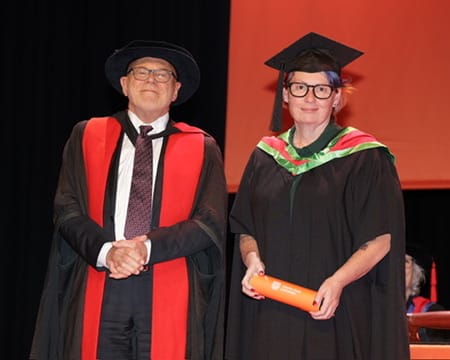
I went from getting D's at school to graduating with Distinction from a Master of Social and Organisational Leadership and receiving two Executive Dean's Awards. In addition to my first bachelor's degree, I have two master's degrees, the second one a Master of Social Work (Professional Qualifying). That does not sound like someone stupid.
If you let those silent thoughts drive your story, you never get the opportunity to explore the alternative. Sometimes the alternative is that your brain works differently.
As I got older, I discovered something else nobody had warned me about. Learning difficulties do not exist in isolation from the rest of your life. As a mature-aged woman, there was a period when my dyslexia appeared to become significantly worse. I became so concerned that I spoke to my doctor several times about dementia and other progressive cognitive conditions. Everything seemed harder. Words were more jumbled. Spelling errors increased. Sentences made sense in my head but not on the page.
As it turns out, menopause and brain fog had changed the effectiveness of the strategies I had relied on for decades. I eventually learned that I didn't need fixing. I needed different strategies.
I eventually learned that I didn't need fixing. I needed different strategies.
As an adult, managing my thoughts has become just as important as managing my dyslexia. Shame can arrive like a thunderstorm, launching negative thoughts one after another. The type of storm that makes you want to walk away from the keyboard altogether because every sentence feels like a battle.
Ironically, being asked to write this article created that exact feeling. It provoked a bolt of fear. Lucky for me, I love a good thunderstorm. These days I try to channel that energy into something useful. Reflection. Motivation. Gratitude for how far I have come. I have built a career that leans towards my strengths. Yes, I write reports, but I don't write instructions where a misplaced word could cost someone their life. I spend my time talking with people about trauma, suicidal thinking and difficult life experiences. My strengths have always been communication, curiosity and connecting with people. Spelling has never been my most important strength.
Finding what works
Finding what works
Even now, some situations make me anxious. Team chats, Mentimeter polls, online collaboration documents, live chat functions: anything that requires instant written responses can trigger that old feeling of panic. There is no time to proofread. No opportunity to run spell check. No chance to reorganise a sentence when your brain has decided the ending belongs at the beginning. Meanwhile, your colleagues are watching the words appear on the screen in real time.
Self-awareness, however, teaches you to lean into your strengths and work around your challenges. Technology has also been a game changer. Text-to-speech and speech-to-text software have transformed the way I work. In fact, I used speech-to-text while writing parts of this article.
The most influential learning experience, however, was not software. It was completing the Universal Design for Learning training through the Australian Disability Clearinghouse on Education and Training (ADCET).
Ironically, I completed the training for work. I was designing courses and wanted to understand accessibility from an educational perspective. I didn't expect how much it would teach me about myself.
The training opened my eyes to accessibility features already built into programs like Word and Outlook: features I could access immediately without needing to request additional support from an employer or university. That discovery mattered because accessing formal support isn't always straightforward.
Universities often require study access plans and supporting medical documentation before providing reasonable adjustments. While these processes have an important purpose, they can also feel intrusive, time-consuming and expensive. Formal assessments and diagnoses are often out of reach for many people due to cost alone. Sometimes the tools people need are already sitting on their computer, waiting to be discovered.
One of the most significant lessons I have learned over the years came through feedback. In a 360-degree feedback process in 2013, colleagues were asked whether I communicated effectively in writing. Some comments were thoughtful and constructive:
"When Karina is rushed or busy, her written communication can become jumbled."
Or
"Karina may get mixed up with her spelling sometimes, but I can always understand what she is trying to relay."
Those comments felt fair. They recognised the challenge without defining me by it. Other comments were harder to hear. One in particular stayed with me for years:
"This is an area for development in the management role. Spelling (or checking) and sentence structure need some work."
I remember reading that and wondering whether people thought I was choosing to spell incorrectly.
Did they think public corrections were somehow helpful?
Did they think that after decades of dyslexia, someone explaining pronunciation or spelling one more time would suddenly cure me?
Eventually I moved past the hurt and realised there was something I could control.
Honesty.
Now I tell people what I need. If I meet someone wearing a name badge, I often say, "Could you please pronounce your name for me? I have dyslexia, and there's a good chance I'll get it wrong until I learn it." If I need something spelled, I ask. Most people are accommodating once they understand. And if someone insists on teaching me how to spell, pronounce words, or structure sentences as though they have discovered the secret cure for dyslexia, that tells me more about them than it does about me.
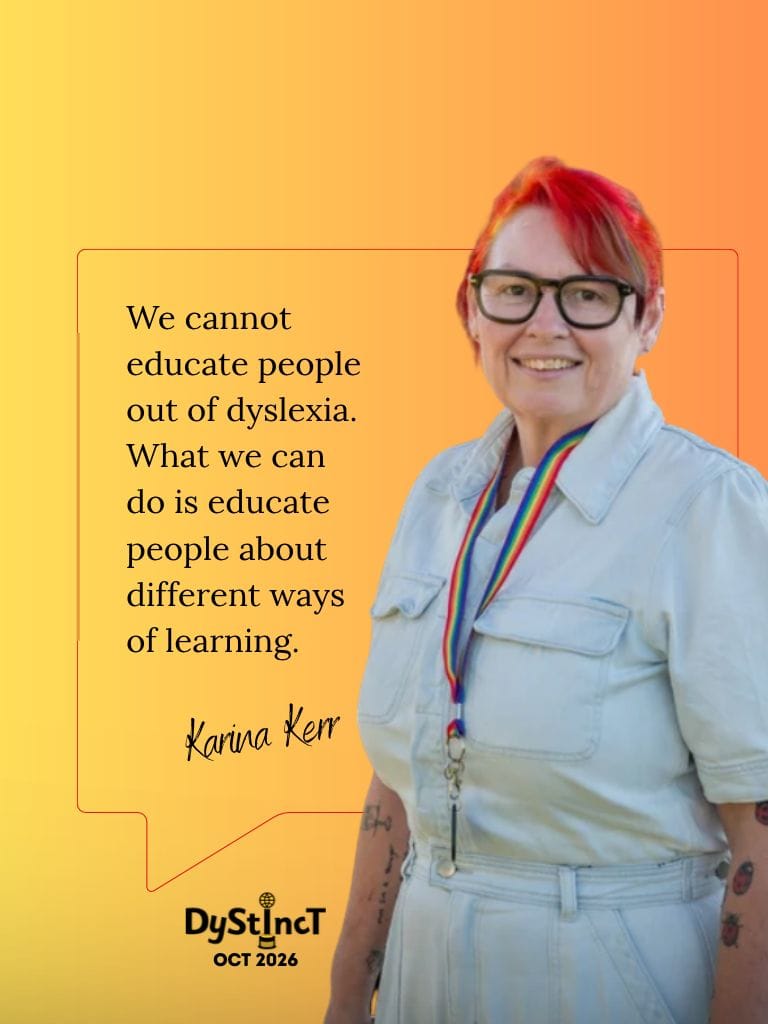
We cannot educate people out of dyslexia. What we can do is educate people about different ways of learning. Sadly, I am still surprised by how often these conversations occur in higher education, both within academic and professional environments.
Most people are accommodating once they understand.
Not all feedback has been difficult, though. Some of the most valuable feedback I have ever received was this:
"Her brain works so fast that sometimes it is difficult to keep up with her train of thought. You have to be confident enough to rein her in, even if you feel somewhere on the continuum between slow and stupid."
I loved that feedback. It helped me understand how my strengths could impact other people. From that point on, I gave people permission to stop me and say, "Slow down, we're not on the same train," or "Hang on, my brain needs a minute to catch up." I know what it feels like to think you're the slowest person in the room. I would never want someone else to feel that way because of me.
On being yourself
On being yourself
Dyslexia has been around for a very long time, and as a society, we are still learning how to understand and support different ways of learning. Over the course of my professional career, there have only been a handful of occasions where accommodations have been offered specifically to support my dyslexia. More often than not, I found my own way.
What changed my life was not a diagnosis. It was understanding. The Universal Design for Learning training changed the way I saw both education and accessibility. Looking back, I often wonder how different my experience might have been if someone had pointed me in that direction earlier. How many years of frustration, shame and self-doubt could have been avoided if I had understood that there was nothing wrong with me, but just that my brain simply worked differently?
Then again, perhaps that journey taught me something important. When I look back at those school reports, I no longer see a difficult child, a moody student, or someone who was not trying hard enough. I see a child who was doing her best with the information and support available at the time. I see someone who was curious, outspoken, determined, and constantly asking questions, even if those questions resulted in spending science lessons sitting in the hallway. I see strengths that were there all along.
For many years, I measured myself against what I couldn't do easily. The spelling mistakes. The backwards letters. The numbers that had a habit of moving around when nobody was looking. What I rarely measured were the things I could do.
The ability to connect with people.
The ability to retain information.
The ability to speak, advocate, learn and understand.
The ability to keep going.
As a small child, I had always dreamed of owning a Harley Davidson. Dreams are the foundation of goals and I have achieved mine.

Being dyslexic has frustrated me, embarrassed me, exhausted me and occasionally made me cry at my desk. It has also made me adaptable, resilient, creative and determined. Most importantly, it has taught me the value of self-awareness. Knowing yourself means recognising both your strengths and your challenges. It means using tools when you need them. Asking for support when appropriate. Laughing when you accidentally type something completely ridiculous. Most of all, it means refusing to define yourself by the things you find difficult. If I've learned one thing, it is that being yourself is much easier than spending a lifetime trying to be somebody else.
The six-year-old girl described as "moody" and "mouthy" would probably be pleased to know that I still ask too many questions, still speak my mind, and still occasionally challenge the people around me. The difference now is that I no longer see those things as flaws. I see them as part of who I am.
Being yourself is much easier than spending a lifetime trying to be somebody else.
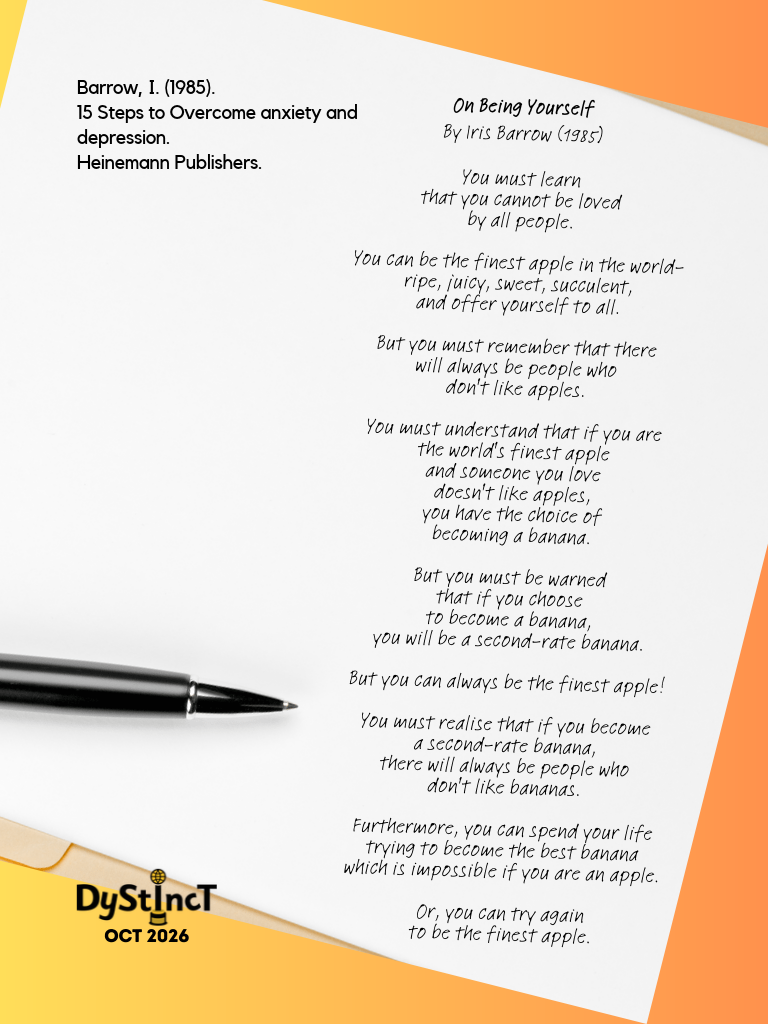
I often think about a poem a very special person gave me many years ago. A counsellor who sat with me for more than five years as I untangled the trauma of my childhood, learned to understand the impacts it had on my life, and slowly discovered who I was underneath it all.
Over the years, this poem has stayed with me. It reminds me that growth is not about becoming someone else. It is about becoming more fully yourself.
References
References
- Australian Disability Clearinghouse on Education and Training, Universal Design for Learning [adcet.edu.au]
- Barrow, I. (1985). 15 Steps to Overcome anxiety and depression. Heinemann Publishers.
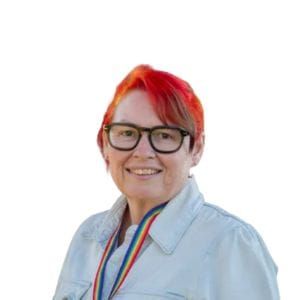
Karina Kerr
Social Worker/Relationship and Family Therapist
Karina Kerr
Buy Printed Copies of Dystinct Magazine
Buy Printed Copies on Amazon
Select the Amazon Store based on your region
Extracts from Dystinct Magazine
Extracts from Dystinct Magazine