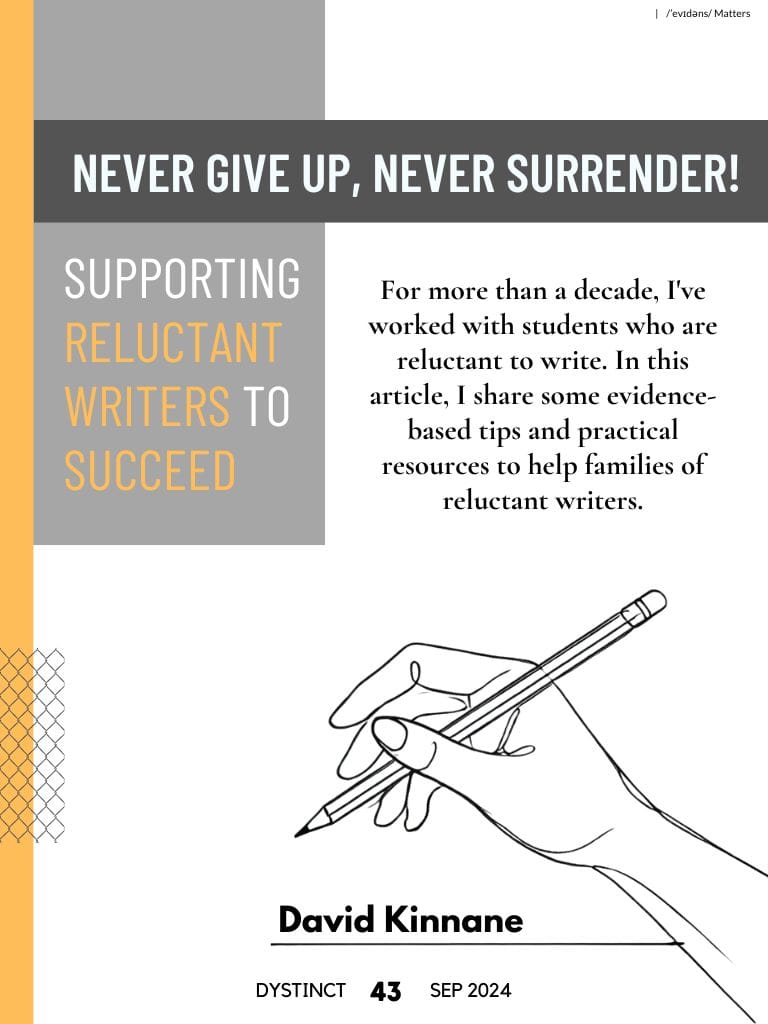
Issue 23: Never give up, never surrender! Supporting reluctant writers to succeed | David Kinnane
David Kinnane offers a detailed approach to supporting reluctant writers by understanding their challenges, fostering positive attitudes, and using explicit, scaffolded instruction to build their skills and confidence, ultimately helping them see themselves as capable and successful writers.

Table of Contents
For more than a decade, I've worked with students who are reluctant to write. In this article, I share some evidence-based tips and practical resources to help families of reluctant writers.
Writing reluctance: why does it happen?
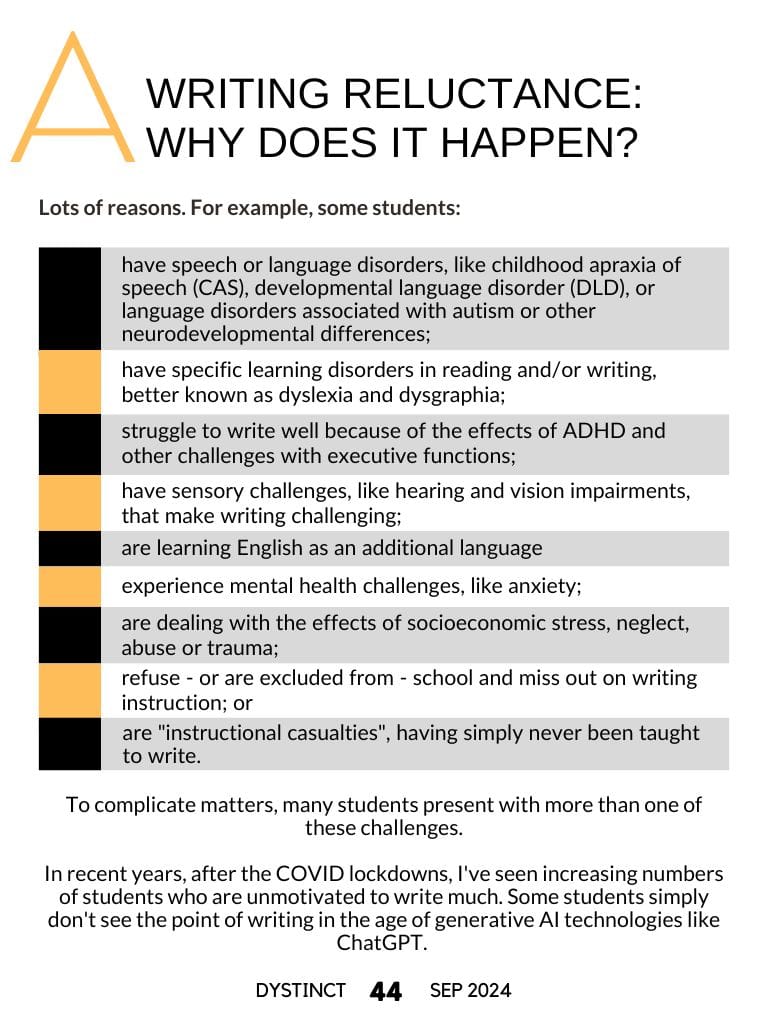
Writing reluctance: why does it happen?
Lots of reasons. For example, some students:
- have speech or language disorders, like childhood apraxia of speech (CAS), developmental language disorder (DLD), or language disorders associated with autism or other neurodevelopmental differences;
- have specific learning disorders in reading and/or writing, better known as dyslexia and dysgraphia;
- struggle to write well because of the effects of ADHD and other challenges with executive functions;
- have sensory challenges, like hearing and vision impairments, that make writing challenging;
- are learning English as an additional language
- experience mental health challenges, like anxiety;
- are dealing with the effects of socioeconomic stress, neglect, abuse or trauma;
- refuse - or are excluded from - school and miss out on writing instruction; or
- are "instructional casualties", having simply never been taught to write.
To complicate matters, many students present with more than one of these challenges.
In recent years, after the COVID lockdowns, I've seen increasing numbers of students who are unmotivated to write much. Some students simply don't see the point of writing in the age of generative AI technologies like ChatGPT.
Watch out for negative self-talk and signs of reluctance
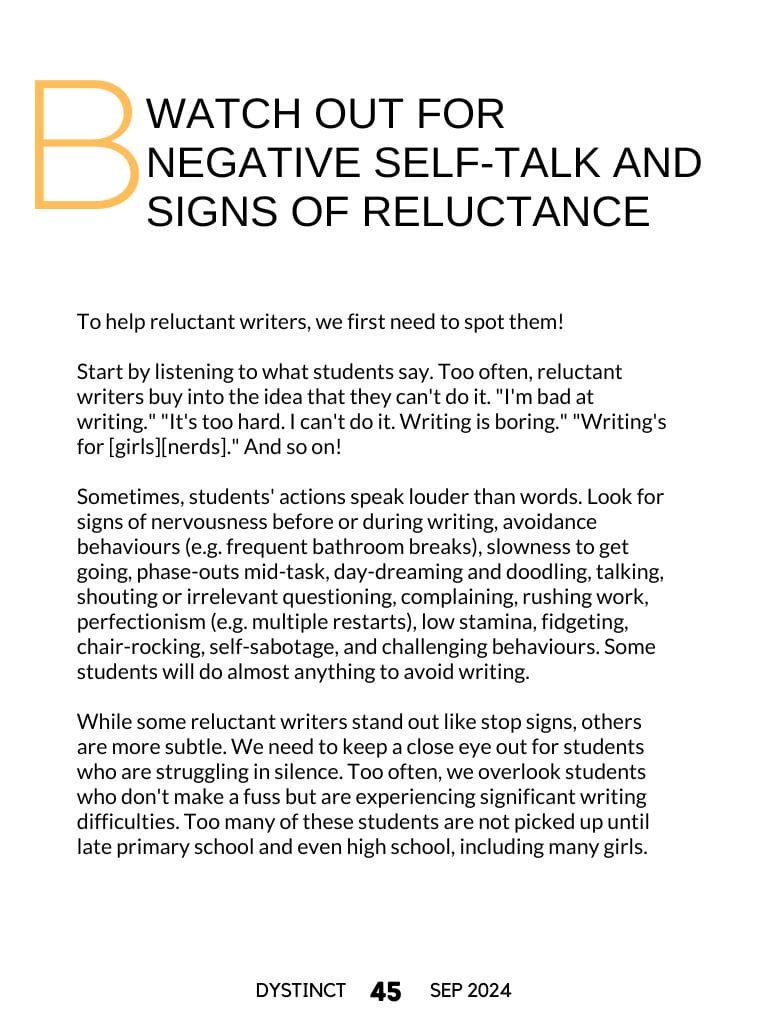
Watch out for negative self-talk and signs of reluctance
To help reluctant writers, we first need to spot them!
Start by listening to what students say. Too often, reluctant writers buy into the idea that they can't do it. "I'm bad at writing." "It's too hard. I can't do it. Writing is boring." "Writing's for [girls][nerds]." And so on!
Sometimes, students' actions speak louder than words. Look for signs of nervousness before or during writing, avoidance behaviours (e.g. frequent bathroom breaks), slowness to get going, phase-outs mid-task, day-dreaming and doodling, talking, shouting or irrelevant questioning, complaining, rushing work, perfectionism (e.g. multiple restarts), low stamina, fidgeting, chair-rocking, self-sabotage, and challenging behaviours. Some students will do almost anything to avoid writing.
While some reluctant writers stand out like stop signs, others are more subtle. We need to keep a close eye out for students who are struggling in silence. Too often, we overlook students who don't make a fuss but are experiencing significant writing difficulties. Too many of these students are not picked up until late primary school and even high school, including many girls.
Focus on direct help - not just adjustments
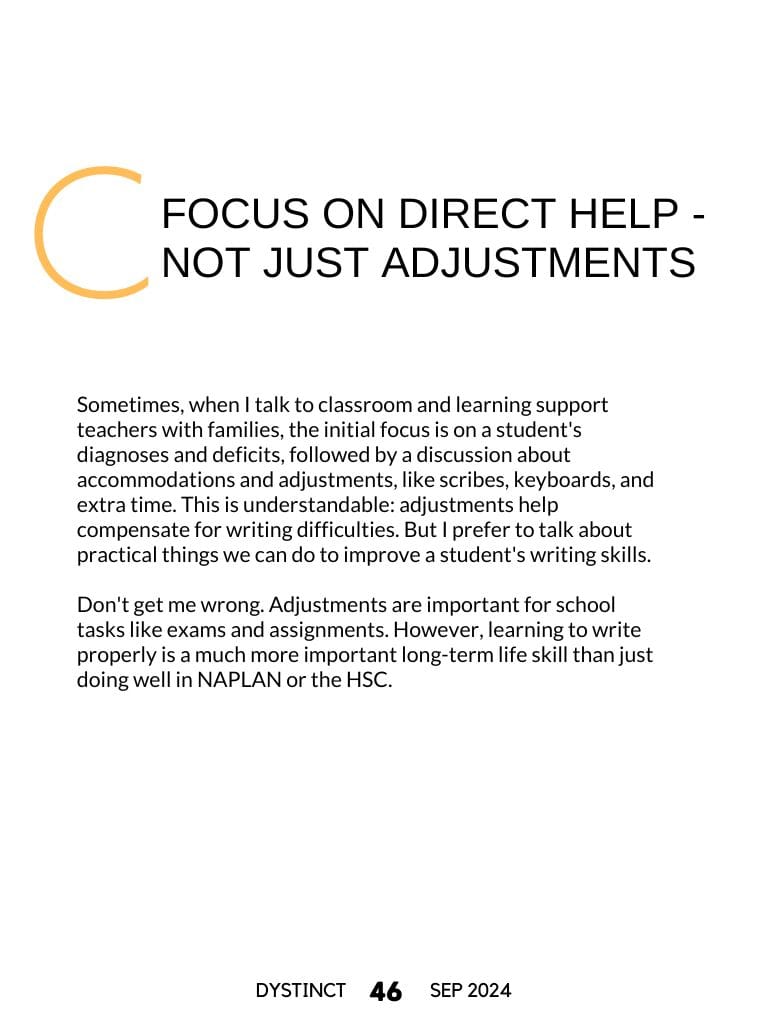
Focus on direct help - not just adjustments
Sometimes, when I talk to classroom and learning support teachers with families, the initial focus is on a student's diagnoses and deficits, followed by a discussion about accommodations and adjustments, like scribes, keyboards, and extra time. This is understandable: adjustments help compensate for writing difficulties. But I prefer to talk about practical things we can do to improve a student's writing skills.
Don't get me wrong. Adjustments are important for school tasks like exams and assignments. However, learning to write properly is a much more important long-term life skill than just doing well in NAPLAN or the HSC.
So, what can we do to help reluctant writers?
So, what can we do to help reluctant writers?
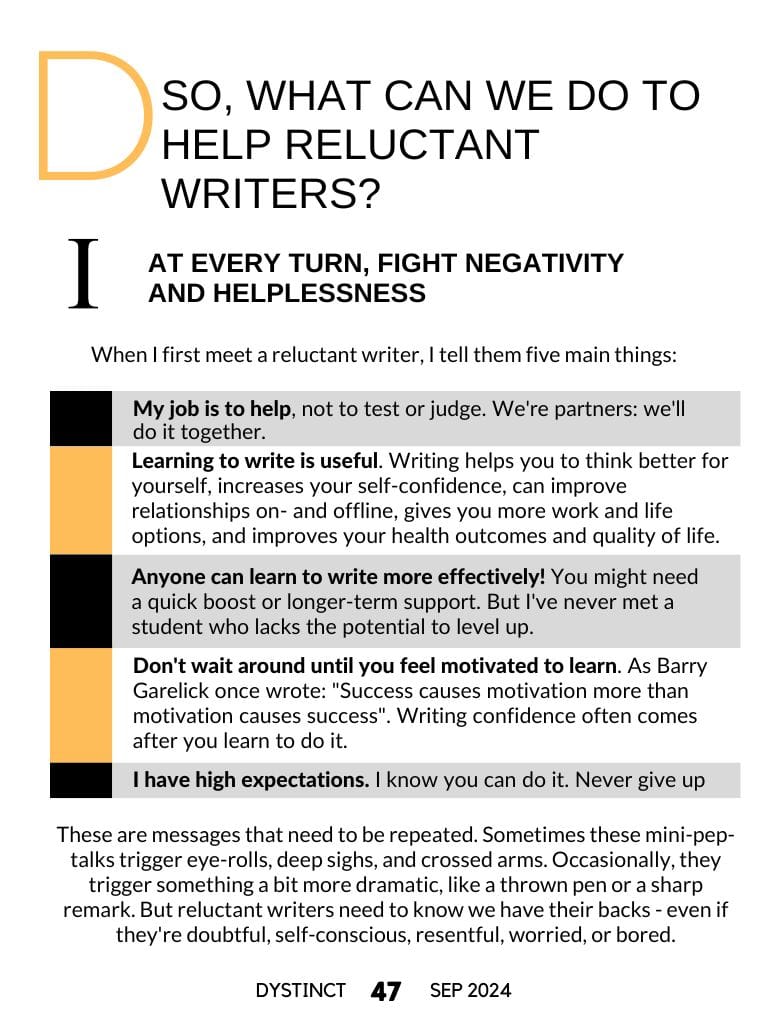
[I] At every turn, fight negativity and helplessness
When I first meet a reluctant writer, I tell them five main things:
- My job is to help, not to test or judge. We're partners: we'll do it together.
- Learning to write is useful. Writing helps you to think better for yourself, increases your self-confidence, can improve relationships on- and offline, gives you more work and life options, and improves your health outcomes and quality of life.
- Anyone can learn to write more effectively! You might need a quick boost or longer-term support. But I've never met a student who lacks the potential to level up.
- Don't wait around until you feel motivated to learn. As Barry Garelick once wrote: "Success causes motivation more than motivation causes success". Writing confidence often comes after you learn to do it.
- I have high expectations. I know you can do it. Never give up
These are messages that need to be repeated. Sometimes these mini-pep-talks trigger eye-rolls, deep sighs, and crossed arms. Occasionally, they trigger something a bit more dramatic, like a thrown pen or a sharp remark. But reluctant writers need to know we have their backs - even if they're doubtful, self-conscious, resentful, worried, or bored.
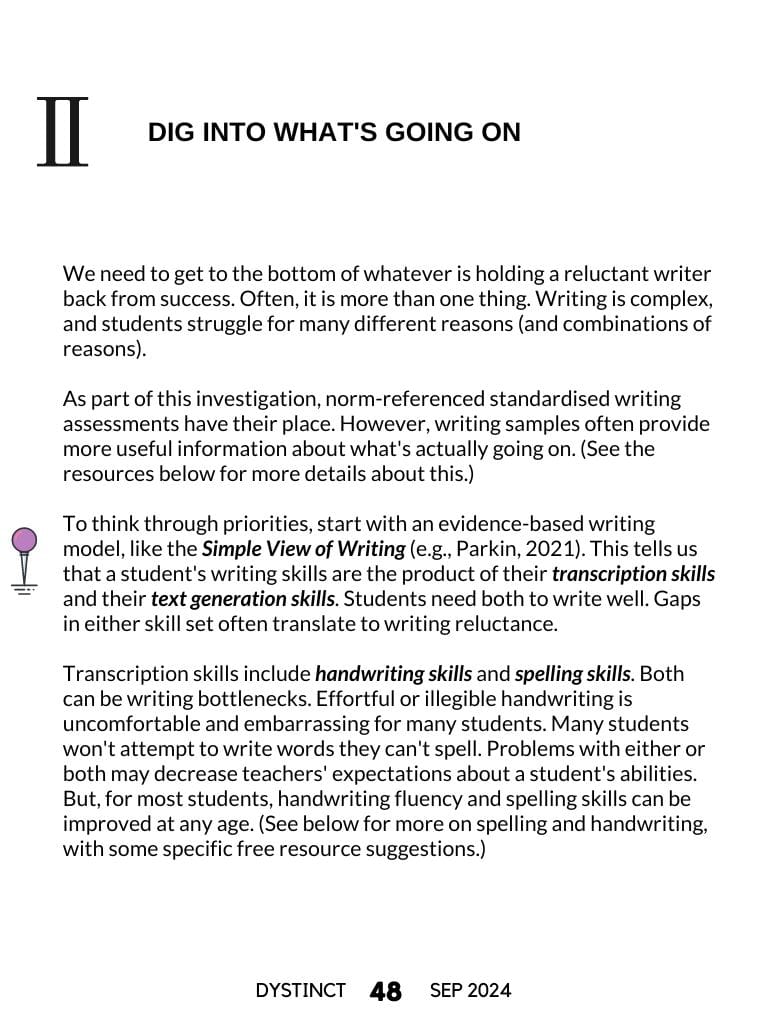
[II] Dig into what's going on
We need to get to the bottom of whatever is holding a reluctant writer back from success. Often, it is more than one thing. Writing is complex, and students struggle for many different reasons (and combinations of reasons).
As part of this investigation, norm-referenced standardised writing assessments have their place. However, writing samples often provide more useful information about what's actually going on. (See the resources below for more details about this.)
To think through priorities, start with an evidence-based writing model, like the Simple View of Writing (e.g., Parkin, 2021). This tells us that a student's writing skills are the product of their transcription skills and their text generation skills. Students need both to write well. Gaps in either skill set often translate to writing reluctance.
Transcription skills include handwriting skills and spelling skills. Both can be writing bottlenecks. Effortful or illegible handwriting is uncomfortable and embarrassing for many students. Many students won't attempt to write words they can't spell. Problems with either or both may decrease teachers' expectations about a student's abilities. But, for most students, handwriting fluency and spelling skills can be improved at any age. (See below for more on spelling and handwriting, with some specific free resource suggestions.)
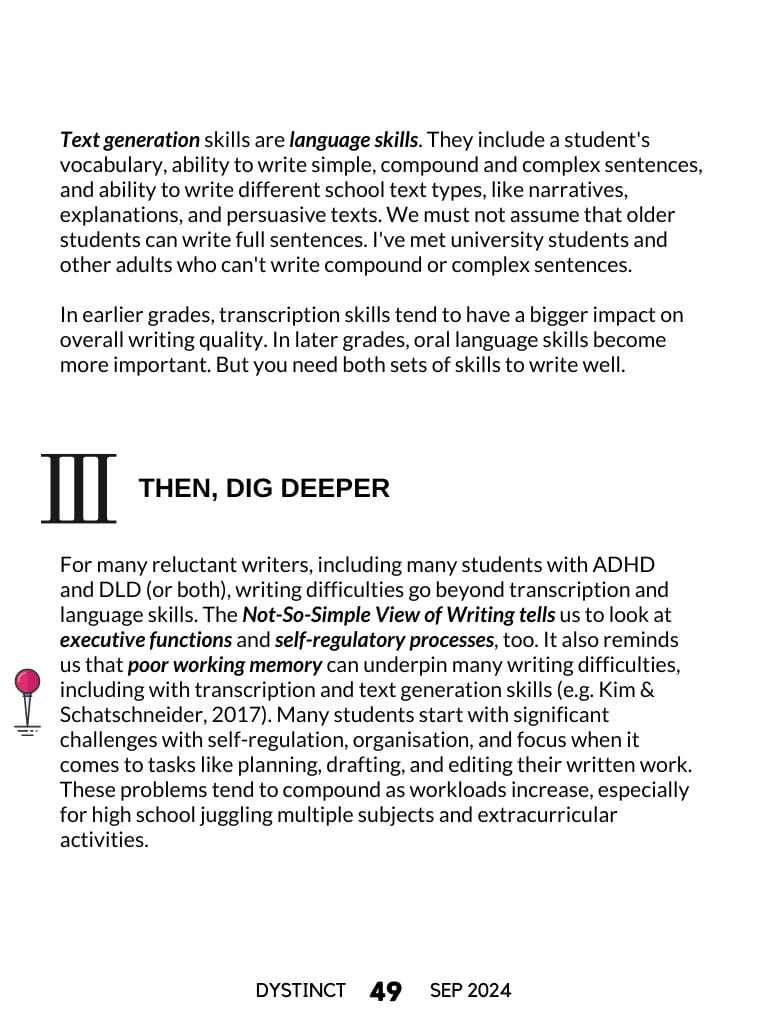
Text generation skills are language skills. They include a student's vocabulary, ability to write simple, compound and complex sentences, and ability to write different school text types, like narratives, explanations, and persuasive texts. We must not assume that older students can write full sentences. I've met university students and other adults who can't write compound or complex sentences.
In earlier grades, transcription skills tend to have a bigger impact on overall writing quality. In later grades, oral language skills become more important. But you need both sets of skills to write well.
[III] Then, Dig deeper
For many reluctant writers, including many students with ADHD and DLD (or both), writing difficulties go beyond transcription and language skills. The Not-So-Simple View of Writing tells us to look at executive functions and self-regulatory processes, too. It also reminds us that poor working memory can underpin many writing difficulties, including with transcription and text generation skills (e.g. Kim & Schatschneider, 2017). Many students start with significant challenges with self-regulation, organisation, and focus when it comes to tasks like planning, drafting, and editing their written work. These problems tend to compound as workloads increase, especially for high school juggling multiple subjects and extracurricular activities.
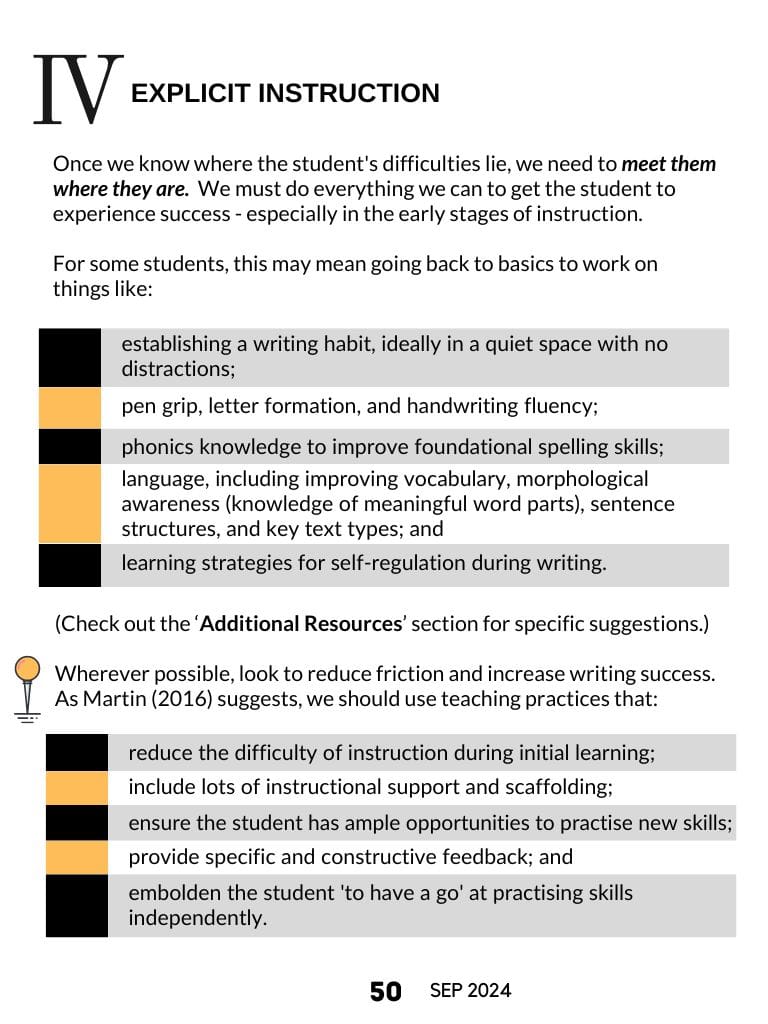
[IV] Explicit instruction
Once we know where the student's difficulties lie, we need to meet them where they are. We must do everything we can to get the student to experience success - especially in the early stages of instruction.
For some students, this may mean going back to basics to work on things like:
- establishing a writing habit, ideally in a quiet space with no distractions;
- pen grip, letter formation, and handwriting fluency;
- phonics knowledge to improve foundational spelling skills;
- language, including improving vocabulary, morphological awareness (knowledge of meaningful word parts), sentence structures, and key text types; and
- learning strategies for self-regulation during writing.
(Check out the ‘Additional Resources’ section for specific suggestions.)
Wherever possible, look to reduce friction and increase writing success. As Martin (2016) suggests, we should use teaching practices that:
- reduce the difficulty of instruction during initial learning;
- include lots of instructional support and scaffolding;
- ensure the student has ample opportunities to practise new skills;
- provide specific and constructive feedback; and
- embolden the student 'to have a go' at practising skills independently.
Explicit and scaffolded writing instruction following the well-known "I do, we do, you do" sequence works well for many reluctant writers. To start with, show students exactly what to do, step-by-step, with worked examples. Then, give the student lots of practice, initially with scaffolded support, then fade it out when you can. Finally, encourage students to have a go for themselves using the skills they have practised.
One important caveat with a back-to-basics approach: don't patronise or infantilise students. Always use age-appropriate resources and, wherever possible, link writing tasks to class content across different subjects in the student's curriculum.
This type of teaching lightens the cognitive load for a reluctant writer and increases their initial success. This, in turn, tends to increase the student's motivation to keep working at writing. As Paul Kirschner says of learning in general: "Success/achievement leads to motivation to continue and not the other way around".
[V] The goal: help students see themselves as writers
With writing instruction, it's easy to get lost in all the details: handwriting, spelling, punctuation conventions, vocabulary, word forms, sentence structures, paragraphing, text types, higher-level language skills, and all the rest. These are all essential sub-skills for effective writing. However, our real goal is for students to overcome their negative self-talk, avoidance behaviours and writing reluctance and to experience repeated success with their writing. In short, we want students to see themselves as capable writers and to prove it to themselves with lots of success.
[VI] Parents need more support, too
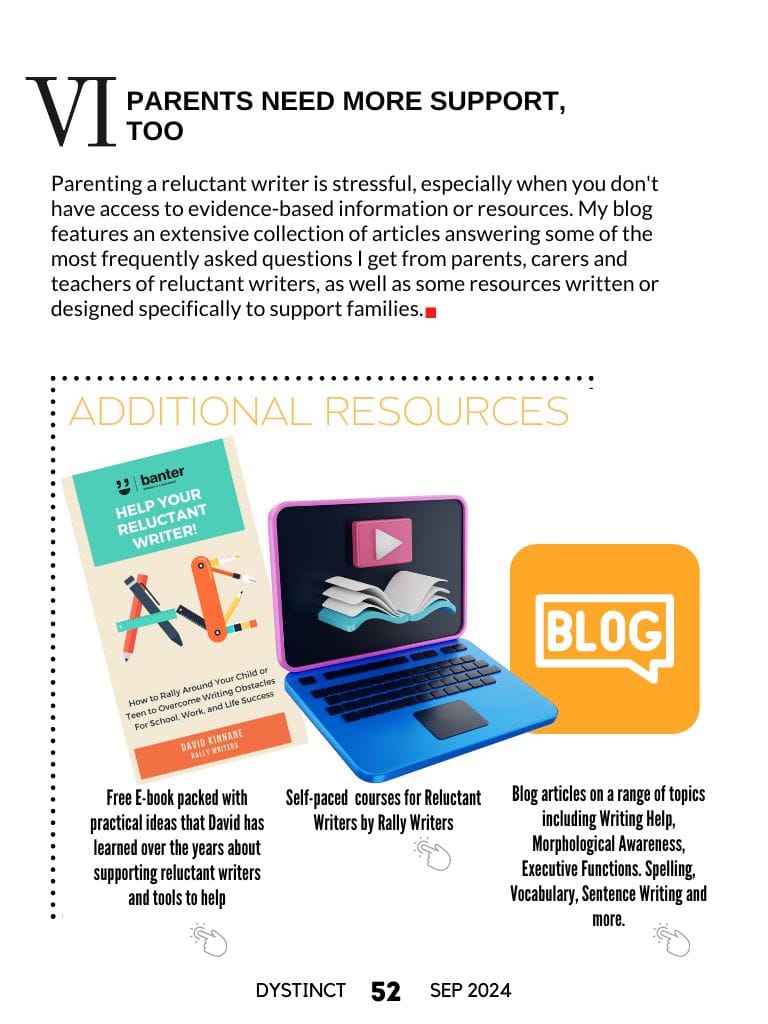
Parenting a reluctant writer is stressful, especially when you don't have access to evidence-based information or resources. My blog features an extensive collection of articles answering some of the most frequently asked questions I get from parents, carers and teachers of reluctant writers, as well as some resources written or designed specifically to support families.
Additional resources
Additional resources
- Is your child or teenager a Reluctant Writer? [banterspeech.com.au]
- Rally Writers Courses for Reluctant Writers [courses.rallywriters.com]
- Banterspeech Blog [banterspeech.com.au/blog-2/]
References
References
- Berninger, V.W., Nielsen, K.H., Abbot, R.D., Wijsman, E., & Raskind, W. (2008). Writing problems in developmental dyslexia: Under-recognised and under-treated. Journal of School Psychology, 46, 1-21.
- Kim, Y-SG, Schatschneider, C. (2017). Expanding the developmental model of writing: A Direct and indirect effects model of development of writing (DIEW). Journal of Education Psychology, 109(1), 35-50.
- Martin, A.J. (2016). Using Load Reduction Instruction (LRI) to boost motivation and engagement. Leicester, UK: British Psychological Society.
- Parkin, J.R. (2021). The Simple Views of Reading and Writing: Frameworks for Interpretation of the Woodcock-Johnson IV. Journal of Psychoeducational Assessment, online, 1-16.
David Kinnane
Certified Practising Speech Pathologist, & Founder of Rally Writers banterspeech.com.au/rally-writers/ | Instagram | Facebook | X | LinkedIn | YouTube | Pinterest
David Kinnane
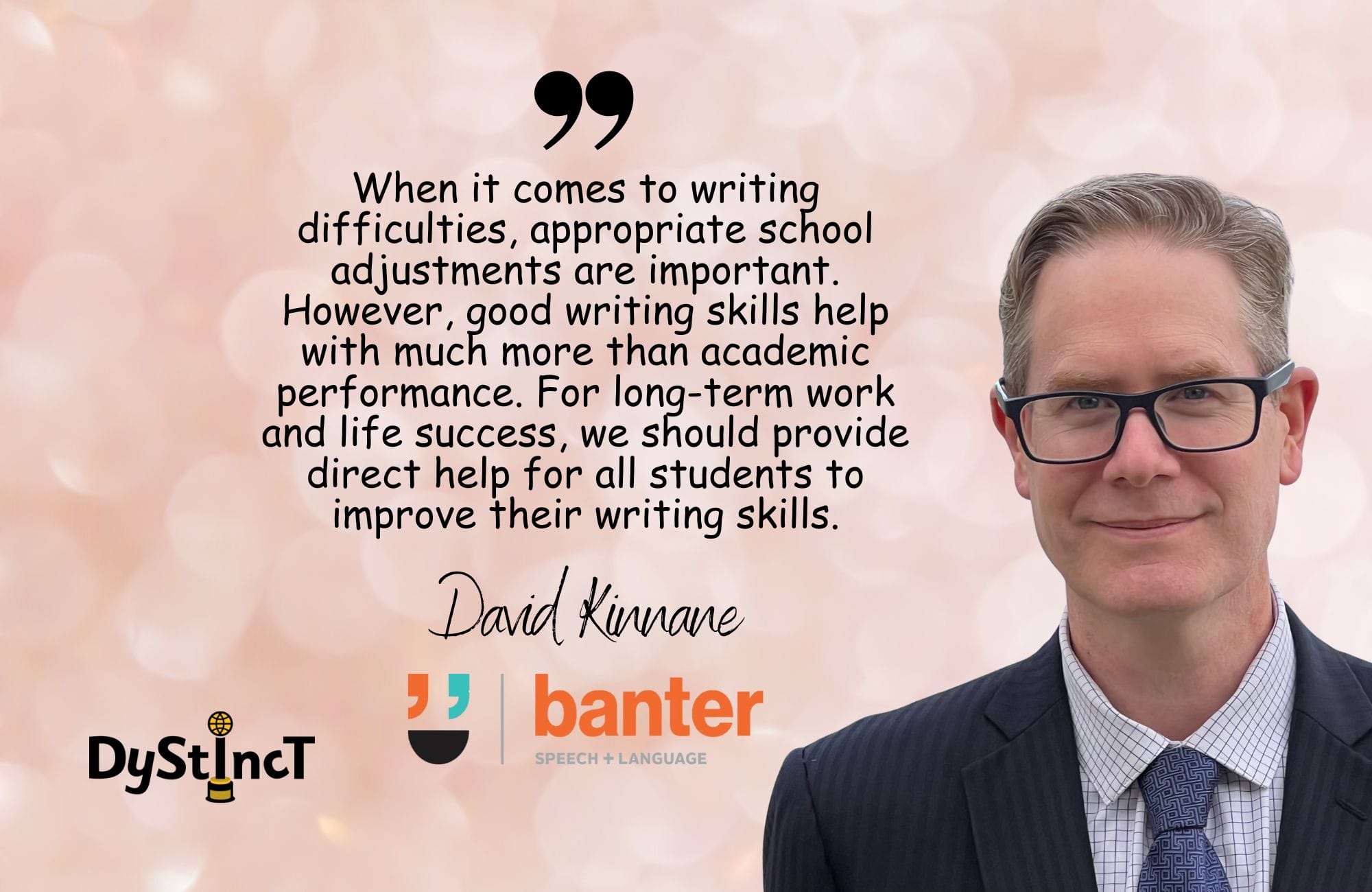
David Kinnane is the principal speech-language pathologist at Banter Speech & Language, an independent speech pathology clinic in Sydney, Australia, and the founder of Rally Writers. David is a Practising Member of Speech Pathology Australia and a Certified Practising Speech Pathologist.
For more than a decade, David has worked with reluctant writers. He's increased their confidence, motivation, and creativity by teaching them to write well.
David started Rally Writers to help busy parents of reluctant writers and teachers to help reluctant writers who would prefer to learn to write at their own pace.
Extracts from Dystinct Magazine
Extracts from Dystinct Magazine