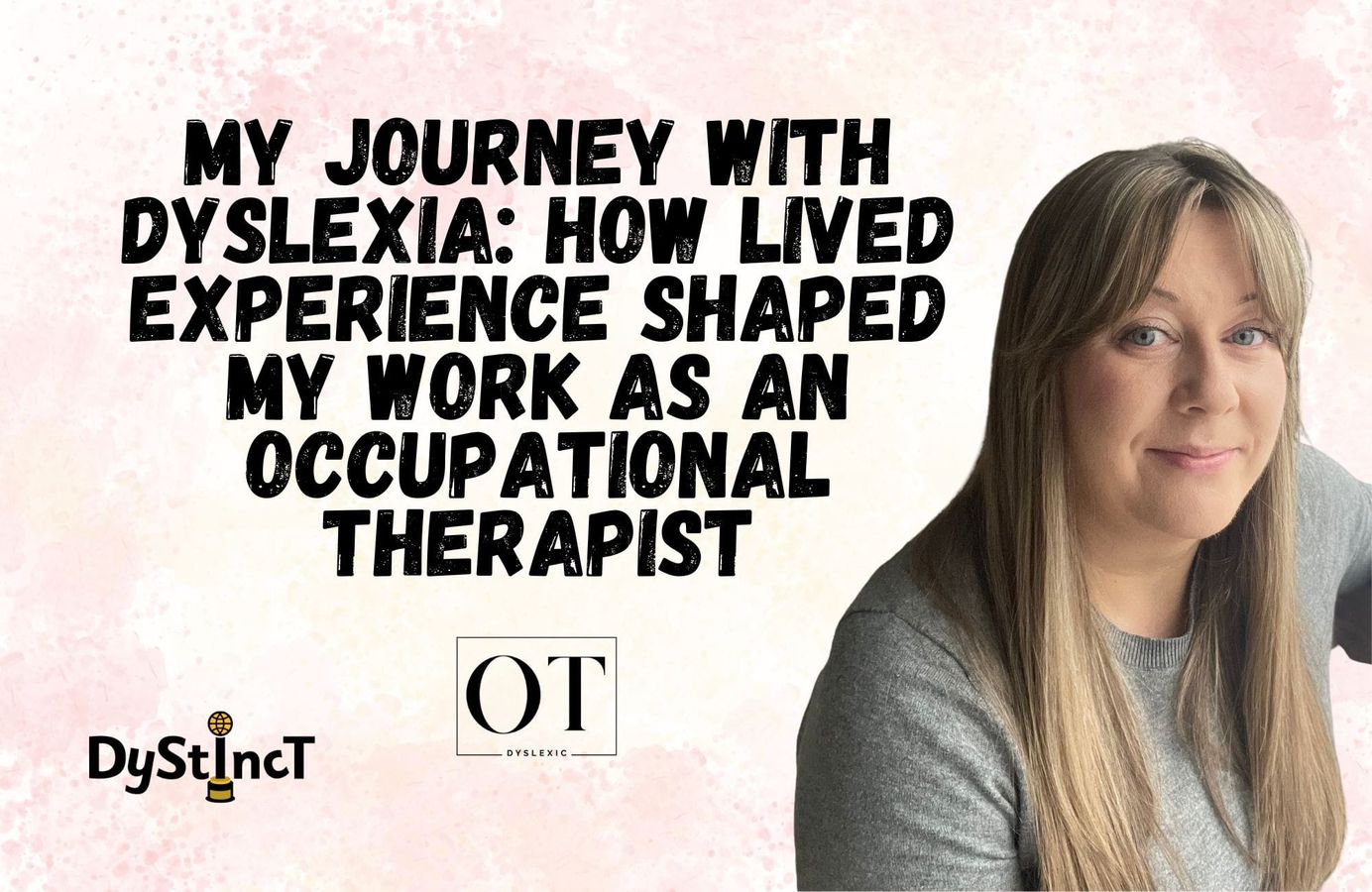
Issue 31: My Journey with Dyslexia: How lived experience shaped my work as an Occupational Therapist | Stephanie
Occupational Therapist Stephanie shares her journey with dyslexia and how it shaped the therapist she is today.

I remember being at school and noticing that I was different to my peers. They all seemed to get on with school a lot easier than I did. In secondary school, I would be taken out of class to complete work that I felt was for primary school age. Once it came to standard grades, I was advised not to take a second language. The whole school experience knocked my confidence, and that continued into my adulthood.
I later decided to give higher education a go. While studying social work, a colleague asked whether I was dyslexic. Although I didn’t yet have a diagnosis, I had long suspected it because I had received additional support at school and was aware that family members were dyslexic.
I finished the social work course and realised it wasn’t for me. After a spell of burnout, I went searching for a career that would better suit my way of working, and I came across Occupational Therapy. I knew straight away I had made the right choice. I felt like I was at home. I finally fitted in. My experience has shaped me into the Occupational Therapist I am today, and I truly feel my story supports the work I do.
Growing Up with Dyslexia
Growing Up with Dyslexia
I remember in primary school, there were different groups for reading, and I was well aware that I was in the lowest group. Living in a family that I now know are mostly dyslexic, it wasn’t overly apparent at home, but in school I did notice it. I remember as a teenager reading a bedtime story for a younger child I was looking after, and they were correcting me or saying a word I misread. That one hit hard, and I won’t lie, I felt embarrassed.
At school I didn’t study much. I shied away from it, mainly because I didn’t know how to revise in a way that suited how my brain worked. No one showed me how. When I was taken out for extra classes, I wasn’t shown how to revise in a way that suited my visual way of thinking or how to break down tasks, so I avoided it. Looking back, I wasn’t taught how to learn in a way that suited my visual thinking. Instead of adapting how I learned, I assumed I wasn’t capable.
During secondary school, I recall being the butt of jokes for pronouncing words incorrectly, and my way of coping with this was to laugh with them. It is a strategy I still use today to mask my dyslexia when I feel it is not appropriate to disclose it. Growing up, there was still not a lot known about neurodiversity, and I labelled myself as slow and just accepted that was me. But I’m not one to give up. I kept pushing my boundaries and realised that when I was upfront and honest about needing a bit of extra time to note down a telephone number or write a word, people were far more patient and much less frustrated than when I tried to hide it. When I didn’t say anything and had to ask them to slow down or repeat themselves, that’s when frustration appeared. It taught me that people are often more patient when they understand what you need, and that creating a safe space where you don’t have to mask or apologise makes a huge difference.
People are often more patient when they understand what you need.
Advocating for My Son, Discovering My Strengths
Advocating for My Son, Discovering My Strengths
I eventually got my dyslexia diagnosis at 31, and it all fell into place. The struggles through school and my working career suddenly made sense. Once I got my diagnosis, I started to see similarities in my eldest and pushed the school for more support. I did not want him to struggle through school as I did. I could see he had a lot to offer with the right support, and that’s when I started to reflect. Had I had the support I needed and been involved in conversations, would I have had a more positive outcome during my school years?
Mumma bear was in full action at this point, and I put my own needs on the back burner when it was discovered through multiple screening tools that my eldest was dyslexic. I did everything in my power to make sure he had the support he needed at school. But one thing kept repeating itself. No skills were being taught on how to revise or learn in a way that suited his thinking. I did my research and found that teachers are given minimal teaching on neurodiversity, which really surprised me, considering they are professionals who oversee the majority of children’s development. Like many parents, I found myself repeatedly explaining my son’s needs and gathering evidence to secure support. The process was exhausting, but it gave me a new perspective on my own childhood. For the first time, I realised how much of a difference understanding and the right support could have made.
As I learned about dyslexia, I stopped seeing it purely as a difficulty and began to recognise strengths that had always been there but had gone unnoticed. My visual thinking helped me solve problems differently. I could often see patterns and connections that others missed. I developed resilience because I had spent years finding different ways to succeed. Most importantly, I realised my ability to empathise with others came from knowing what it felt like to struggle without being understood. Watching my son develop his own strengths reminded me that dyslexia isn’t something that needs fixing. It needs understanding.
My ability to empathise with others came from knowing what it felt like to struggle without being understood.
Becoming an Occupational Therapist
Becoming an Occupational Therapist
I came to Occupational Therapy later in life, starting my training at 33 years old. I had my diagnosis at 31, and not long after, became quite unwell as a result of burnout, although I didn’t have a name for it back then. I knew the environment I was working in and the job were not the right fit for me, so I went searching for a role that would suit me. I completed a personality test, and Occupational Therapy appeared. I had not heard of it before, so I did some research and organised to shadow an Occupational Therapist in the community to better understand it. I loved it and was so grateful when I realised I could study for my degree in my own hometown.
I applied for the course, passed the interview, and started in September 2020. Unfortunately, my first day was not what I hoped. I wanted to walk onto campus and meet my cohort, but instead it was online while homeschooling my children through the pandemic.
I wasn’t trying to make people fit into the world. I wanted to help shape environments where people could thrive.
One of the first things we were asked to do was complete a survey to identify what type of learner we were, and no surprise, I was a visual learner.
I did well on placement but struggled with academic writing. It wasn’t taught at school, and it wasn’t taught at university. I had to work it out for myself, and I did this the hard way by failing a written assessment. I was determined that this would not be the end of the road for a career that felt like home. Occupational Therapy looks beyond a diagnosis. It focuses on the person, their strengths, their environment, and what matters to them. That approach made complete sense to me because it reflected what I had always wanted for myself. I realised that I wasn’t trying to make people fit into the world. I wanted to help shape environments where people could thrive.
This post is for subscribers only
SubscribeAlready have an account? Log in