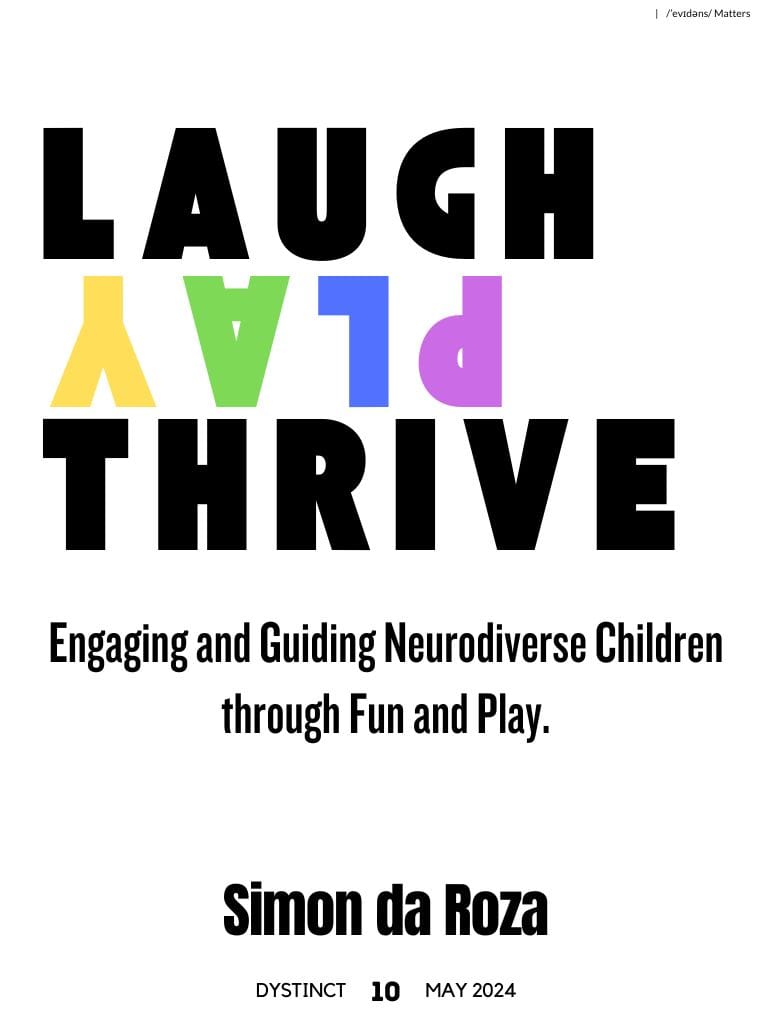
Issue 21: Laugh, Play and Thrive - Engaging and Guiding Neurodiverse Children through Fun and Play | Simon da Roza
Simon daRoza's article explores the transformative power of fun, play, and laughter in nurturing neurodiverse children's curiosity, resilience, and emotional well-being, offering practical strategies and insights for joyful parenting and family connections.

Table of Contents
The thing that can help you navigate the demands of parenting a neurodiverse child is often the very first thing that quietly slips away in the early days. The days of sleep deprivation, unknowing, loneliness and frustration that many experience. I have found that a sense of humour, creativity, laughing at myself, and distracting kids with humour or cheeky, mischievous ideas are secrets that have helped me guide and support complex and challenging kids to find the sparkle of curiosity and a sense of fun.
Joy shifts minds from that moment and emotion and connects them with the fun they have had before. Okay, insert enjoyable moments if 'fun' feels unobtainable, and that's okay.
We wear many hats: advocates, translators, interpreters, negotiators, time management experts, nurses, teachers, caregivers, problem-solvers, and the cool, calm, collected parents we expect of ourselves in the face of societal judgment. Then there are our other roles in life, such as colleagues, siblings, children, etc. Let's add in the expectations and standards we hold of ourselves.
Our time-poor lives are very serious as we manage the family's needs and concerns. It is exhausting, and underlying resentment between parents is an absolute fun and play killer. It isn't about having a super doper attitude and faking it till you make it. No, that isn't the expectation. Fun and play can be the release valve the whole family requires to reset itself. Attempting to carve out some fun or laugh at yourself is a robust emotional regulation and opportunity.
Fun is being fully present with no intentional goal. Fun is that energy you feel in which the curious mind is set free to explore. Fun is hope and possibility. It can be experienced individually or as a shared moment. There is a creative element, and something may be created, but it is not the intention and expression of the moment of the flow of imagination at play. Fun is acting on the inspiration of the moment.
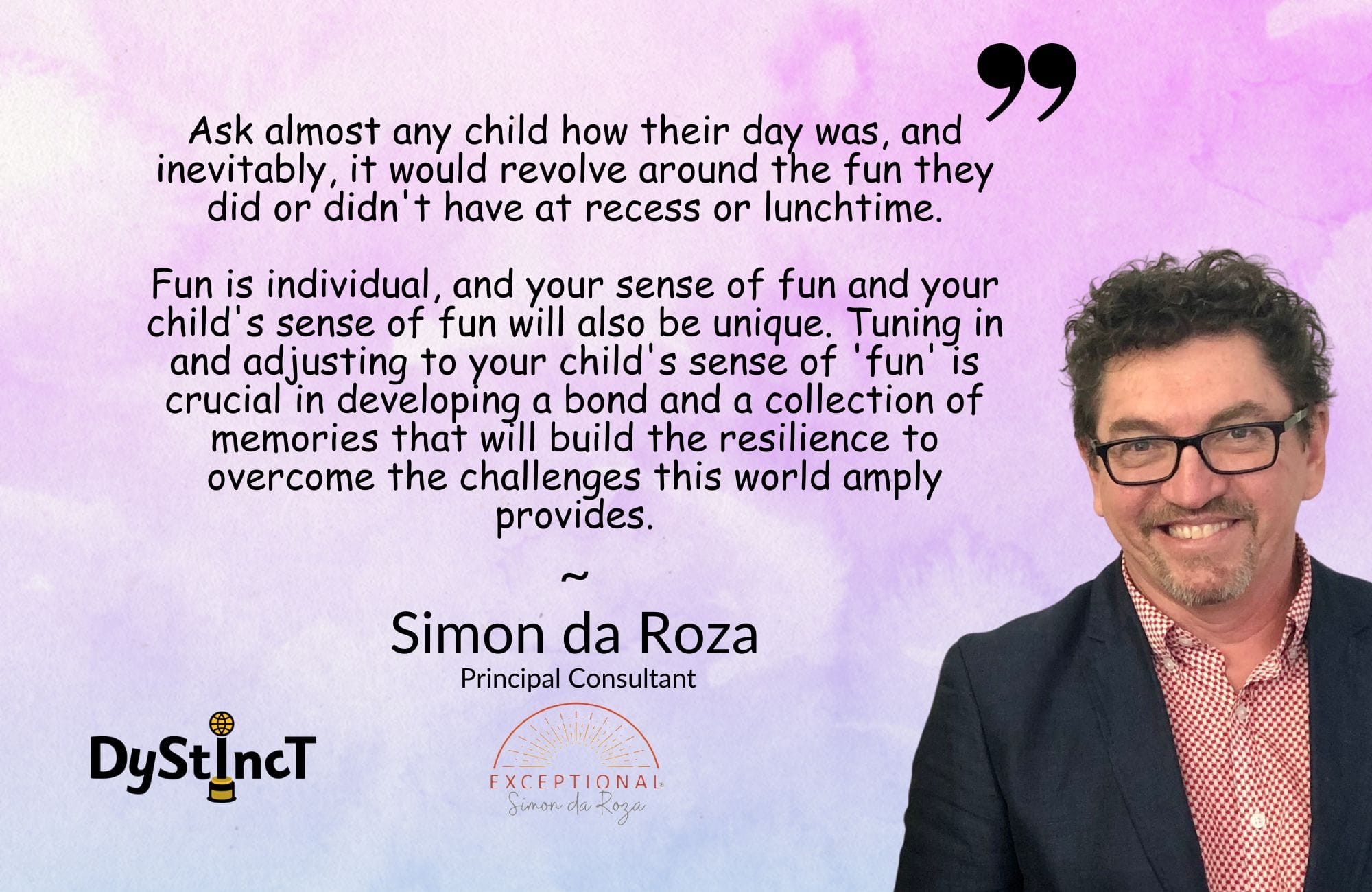
Ask almost any child how their day was, and inevitably, it would revolve around the fun they did or didn't have at recess or lunchtime.
I took photos of the giant waves crashing over the rocks at Whale Beach one windy summer day. I ventured out carefully, grabbed some slow-motion shots, and headed back, aware of the ocean's dangers. I scuttled back, peering over my shoulder at the angry ocean along the outside edge of the swimming pool. I jumped off the edge and heard myself say, "That was fun.' Those words seemed so alien to me. Now, I have fun in my profession, and I'm a bit of a mischievous, fun-loving adult, but I wondered how long it had been since I had honestly had real fun. Running ultra-marathons for me was indeed fun, though many often reminded me that I was deranged or worse, it didn't stop me. My knees stopped me, oh and maybe my ankles too.
Fun is individual, and your sense of fun and your child's sense of fun will also be unique. Tuning in and adjusting to your child's sense of 'fun' is crucial in developing a bond and a collection of memories that will build the resilience to overcome the challenges this world amply provides.
So, how do we align with our child's sense of fun? Go into their world, play in their world, their imagination without comment, judgment or boundaries. At first, it may be sitting in the same space doing individual things or playing in individual ways. No questions, sparse factual comments, or even positive comments because that involves judgment and takes away from the thing just 'being'. So worthwhile as it helps them accept who they are and what they do. There will be a shift and acceptance of your presence or the start of cooperative play in their time, not yours or the world’s, but in their time. Avoid demanding anything from the child; by that, I mean even asking questions like, 'What are you doing?' takes away from them actually doing what they want to do. Watch and observe and let the child have control of this moment. Let them set the tone, and give the instructions verbally or non-verbally through actions that invite you to participate. It may be a fleeting moment or an extended time; be there as long as you can, as often as you can and reflect upon it later in the day or week, sharing the enjoyment or moment with them or perhaps even what you may do next time. Experience their world at their pace and repeat.
Real fun and real play do not take part on a screen (maybe if it is a multiplayer game or a sandbox). The words' game', 'fun' and 'play' have been hijacked by businesses that want to keep your child's attention, and sometimes it is just easier to let them have some screen time; I get it; avoid feeling guilty, but it is missing essential elements to call it real play, real fun. For autistic individuals or those with autism, having control as they do on a screen game can help them transition and be calming. Screens may be the only thing they are engaged in; they go into that world in these situations. It isn't ideal, but it is where the kids are at. Start slowly building within your child the expectations that you will not judge but just be present. Swing that pendulum into their world, and maybe, just maybe, it will swing back towards another activity in which the process and conditions are the same.
Explorative play doesn't have goals and objectives. Products or fleeting moments are by-products of the creative spirit spontaneously being released through the magic of play.
"Let's build a sandcastle." It is as goal-orientated as play can be. How that sandcastle evolves is unique.
The difference is in the creativity and the solutions your child comes up with; they are not unique or original. They have already been predicted and coded by the creator. To that point, building Lego can be fun and playful, but genuine fun would be building from your imagination, creating something unique to the narrative of an imaginative story. In actual play, there is no control; instructions control the building of the piece, but playing with the object once completed would be more aligned with play.
While there may be a winner and a loser in board games, running games, puzzles, etc, the objective is clear to participants. In these games, the fun element is being right in the moment with another player. Competition can be fun, but it is only one aspect of games.
On-screen games and social media may allow them to think they are winning. The games and social media are crafted to 'onboard' you with early achievable success, drawing you into the game. They keep you there using variable reward systems, which release dopamine at the right time to keep you engaged. The coders and marketers manipulate their attention without your or their consent. They use behavioural science to manipulate your child into thinking they are in control.
Gamification components are making their way into more aspects of our everyday lives to change our behaviours; notice the smiley face display on the side of the road when you are below the speed limit. While the rebellion in some of us may speed just over, most of the population is 'happy' to comply, as we should, but feel good about it, triggering a dopamine response. Gamification is evident in rewards systems and frequent flyer programs. It is evident in 'likes' and 'streaks' in social media. Attention is a currency. That is not really fun, but because it may result in a release of dopamine and makes you feel momentarily good, that is not fun, and that is often more palatable as it is not perceived as a threat by the brain. Real play is a game in which the playing experience provides joy. Real fun may involve some moments of boredom, which catalyses the mind to wonder and imagine; let your kids get bored!
Fun is one of the most important and underrated ingredients in any successful venture. If you're not having fun, then it's probably time to call it quits and try something else.
-
Richard Branson.
This quote by the renowned entrepreneur emphasises the critical role of fun in any successful endeavour, highlighting its importance in maintaining passion and motivation.
If you never did, you should. These things are fun, and fun is good.
-
Dr. Seuss.
Dr Seuss, known for his whimsical and playful writing, captures the essence of fun as something inherently good and worthwhile, encouraging experimentation and trying new things.
Laugh, Play and Thrive
Laugh, Play and Thrive
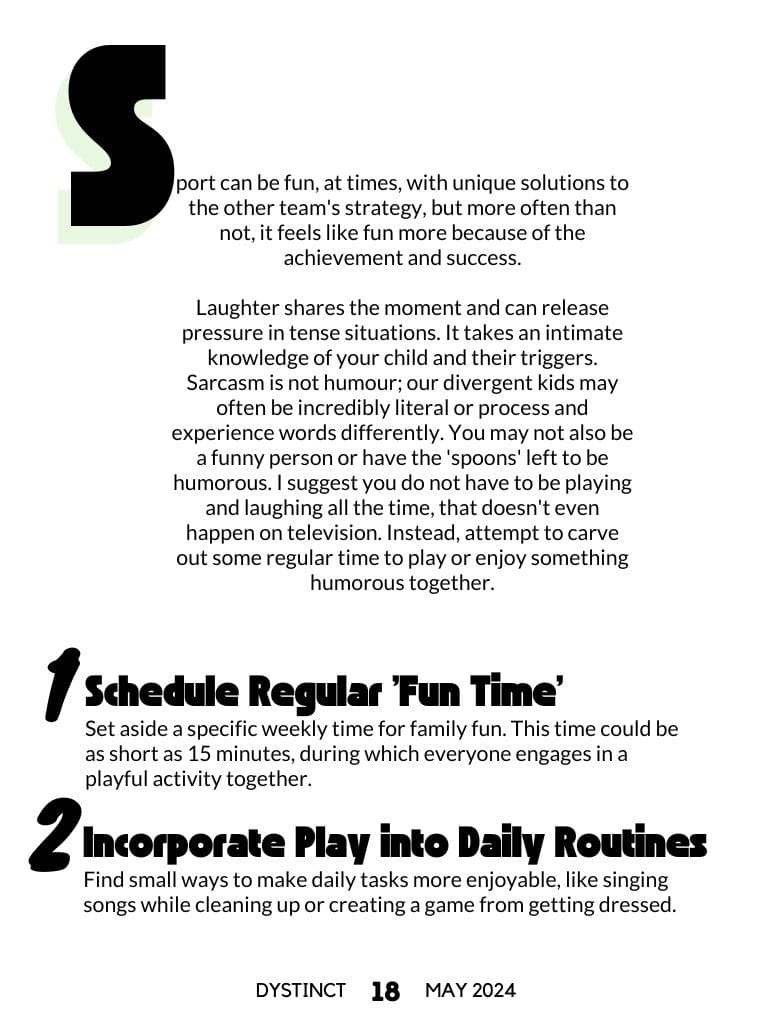
Sport can be fun, at times, with unique solutions to the other team's strategy, but more often than not, it feels like fun more because of the achievement and success.
Laughter shares the moment and can release pressure in tense situations. It takes an intimate knowledge of your child and their triggers. Sarcasm is not humour; our divergent kids may often be incredibly literal or process and experience words differently. You may not also be a funny person or have the 'spoons' left to be humorous. I suggest you do not have to be playing and laughing all the time, that doesn't even happen on television. Instead, attempt to carve out some regular time to play or enjoy something humorous together.
[1] Schedule Regular 'Fun Time'
Set aside a specific weekly time for family fun. This time could be as short as 15 minutes, during which everyone engages in a playful activity together.
[2] Incorporate Play into Daily Routines
Find small ways to make daily tasks more enjoyable, like singing songs while cleaning up or creating a game from getting dressed.
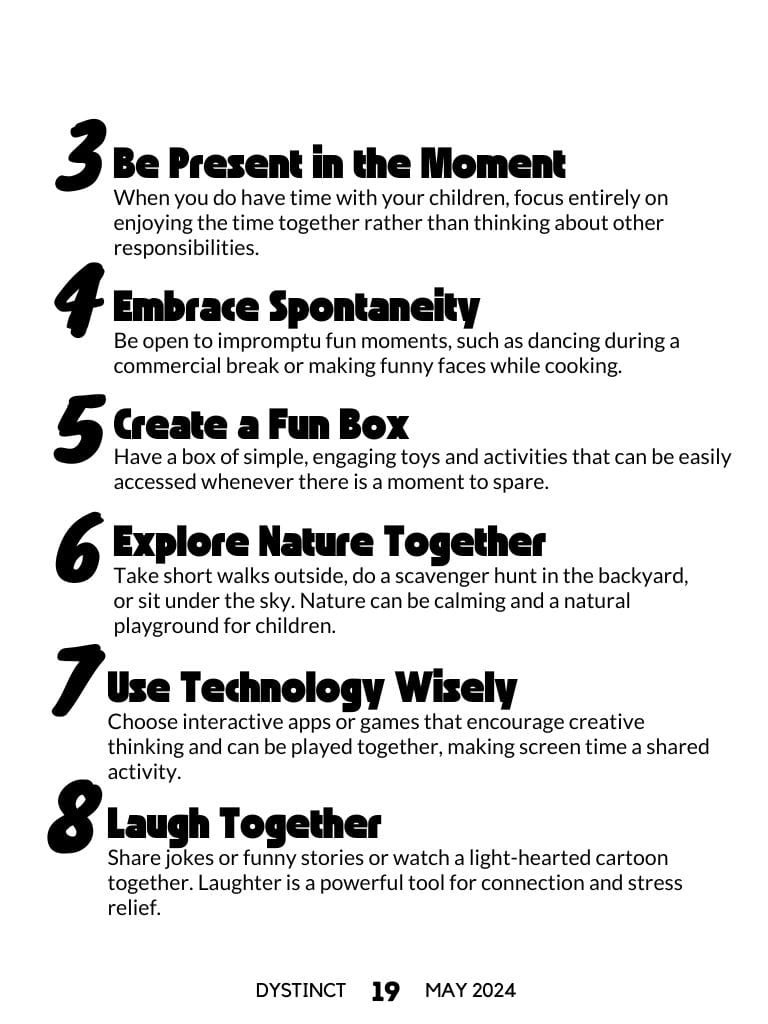
[3] Be Present in the Moment
When you do have time with your children, focus entirely on enjoying the time together rather than thinking about other responsibilities.
[4] Embrace Spontaneity
Be open to impromptu fun moments, such as dancing during a commercial break or making funny faces while cooking.
[5] Create a Fun Box
Have a box of simple, engaging toys and activities that can be easily accessed whenever there is a moment to spare.
[6] Explore Nature Together
Take short walks outside, do a scavenger hunt in the backyard, or sit under the sky. Nature can be calming and a natural playground for children.
[7] Use Technology Wisely
Choose interactive apps or games that encourage creative thinking and can be played together, making screen time a shared activity.
[8] Laugh Together
Share jokes or funny stories or watch a light-hearted cartoon together. Laughter is a powerful tool for connection and stress relief.
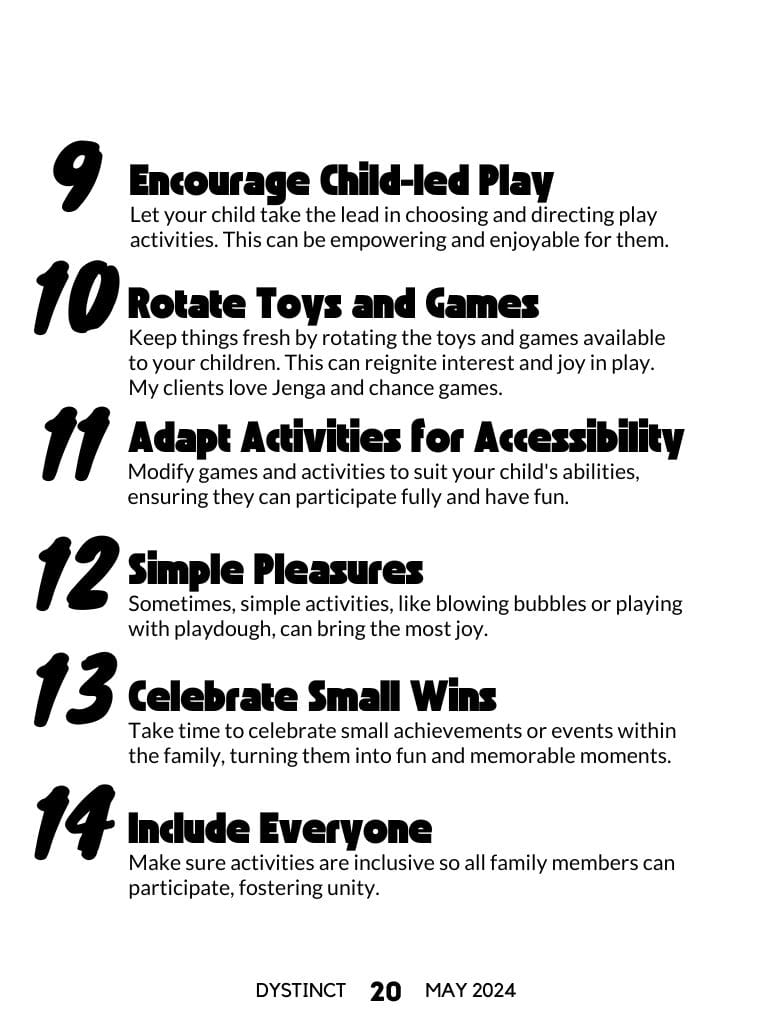
[9] Encourage Child-led Play
Let your child take the lead in choosing and directing play activities. This can be empowering and enjoyable for them.
[10] Rotate Toys and Games
Keep things fresh by rotating the toys and games available to your children. This can reignite interest and joy in play. My clients love Jenga and chance games.
[11] Adapt Activities for Accessibility
Modify games and activities to suit your child's abilities, ensuring they can participate fully and have fun.
[12] Simple Pleasures
Sometimes, simple activities, like blowing bubbles or playing with playdough, can bring the most joy.
[13] Celebrate Small Wins
Take time to celebrate small achievements or events within the family, turning them into fun and memorable moments.
[14] Include Everyone
Make sure activities are inclusive so all family members can participate, fostering unity.
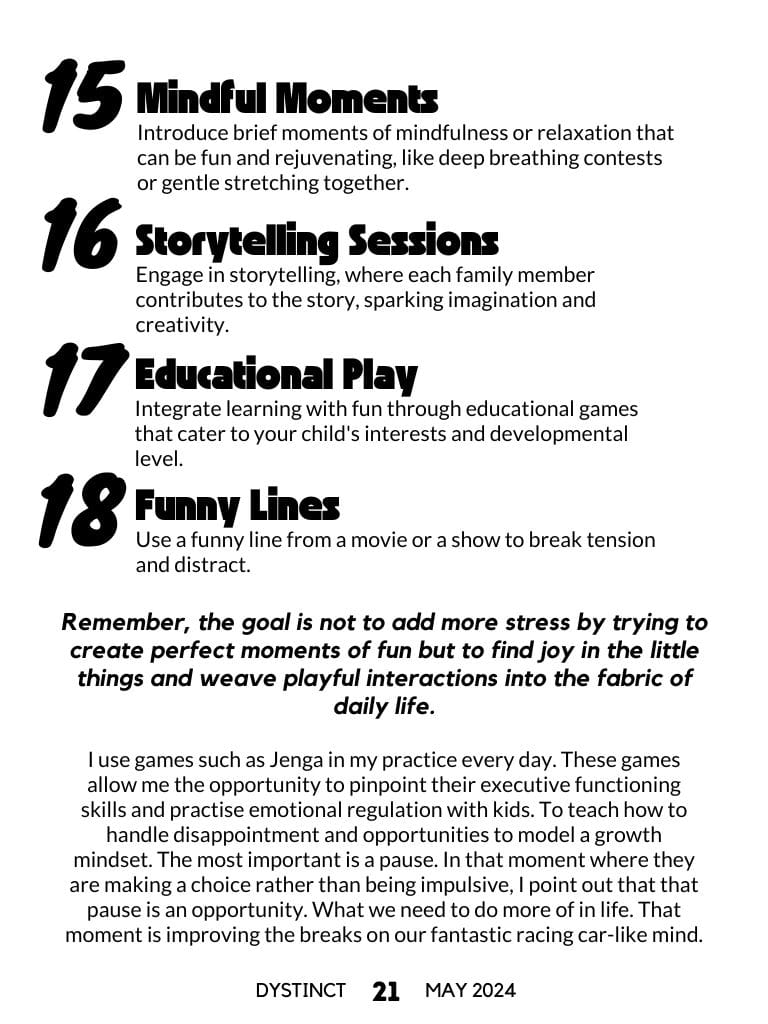
[15] Mindful Moments
Introduce brief moments of mindfulness or relaxation that can be fun and rejuvenating, like deep breathing contests or gentle stretching together.
[16] Storytelling Sessions
Engage in storytelling, where each family member contributes to the story, sparking imagination and creativity.
[17] Educational Play
Integrate learning with fun through educational games that cater to your child's interests and developmental level.
[18] Funny Lines
Use a funny line from a movie or a show to break tension and distract.
Remember, the goal is not to add more stress by trying to create perfect moments of fun but to find joy in the little things and weave playful interactions into the fabric of daily life.
I use games such as Jenga in my practice every day. These games allow me the opportunity to pinpoint their executive functioning skills and practise emotional regulation with kids. To teach how to handle disappointment and opportunities to model a growth mindset. The most important is a pause. In that moment where they are making a choice rather than being impulsive, I point out that that pause is an opportunity. What we need to do more of in life. That moment is improving the breaks on our fantastic racing car-like mind.
Finally, 'Flying Squirrel'. My extended family would often come together for Christmas. One Christmas, I came up with a frivolous game that I will reflect on as one of the sweetest moments. If you agreed to play, you were allowed to say 'flying squirrel' once anytime that day; it was okay if you didn't. When you heard the words flying squirrel, you would place your forehead on the ground or table chair and make turkey noises. Otherwise, you forfeit your turn. I have no idea why the word 'flying squirrels' I have never seen one. Of course, my family is very creative, and soon, 'Flying Squirrel' could be heard outside the home - in carparks, in restaurants, down the main street as it was yelled from a car. What was curious was that others started joining in, just random people in the vicinity. The greater the embarrassment, the better, and all played, even the less physically able grandparents. Fun is spontaneous. It is risk-taking, and fun can be a beautiful thing to see.
Look for the fun, practice gratitude for the fun in your lives, come up with bad jokes and research Chuck Norris jokes. When you look for fun, you will find it, and those fun moments and memories will strengthen you through the hard times. It will teach kids that it's okay to make mistakes, laugh, and not be so serious; life is serious enough.
How do you make a sausage roll?
Put a sausage on a slope and give it a push.
Simon Da Roza
Principal ConsultantXceptionallearners.com | Facebook | Instagram | YouTube | LinkedIn | Pinterest
Simon Da Roza
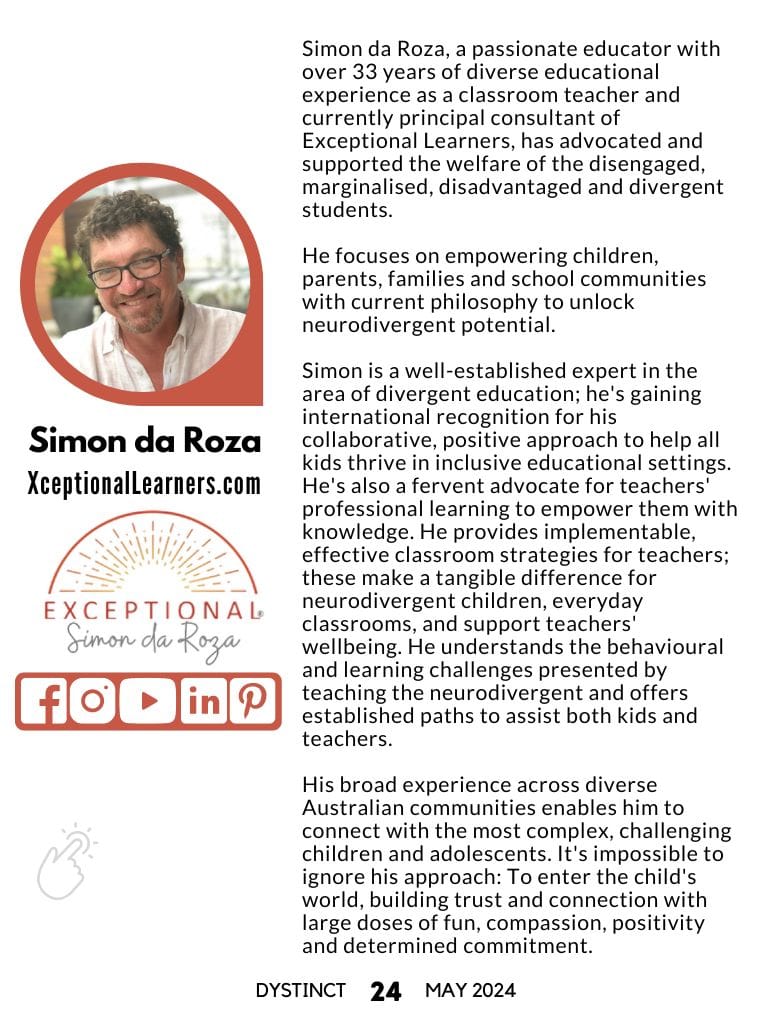
Simon da Roza, a passionate educator with over 33 years of diverse educational experience as a classroom teacher and currently principal consultant of Exceptional Learners, has advocated and supported the welfare of the disengaged, marginalised, disadvantaged and divergent students.
He focuses on empowering children, parents, families and school communities with current philosophy to unlock neurodivergent potential.
Simon is a well-established expert in the area of divergent education; he's gaining international recognition for his collaborative, positive approach to help all kids thrive in inclusive educational settings. He's also a fervent advocate for teachers' professional learning to empower them with knowledge. He provides implementable, effective classroom strategies for teachers; these make a tangible difference for neurodivergent children, everyday classrooms, and support teachers' wellbeing. He understands the behavioural and learning challenges presented by teaching the neurodivergent and offers established paths to assist both kids and teachers.
His broad experience across diverse Australian communities enables him to connect with the most complex, challenging children and adolescents. It's impossible to ignore his approach: To enter the child's world, building trust and connection with large doses of fun, compassion, positivity and determined commitment.
BUY eBook

Watch Them Shine Ebook
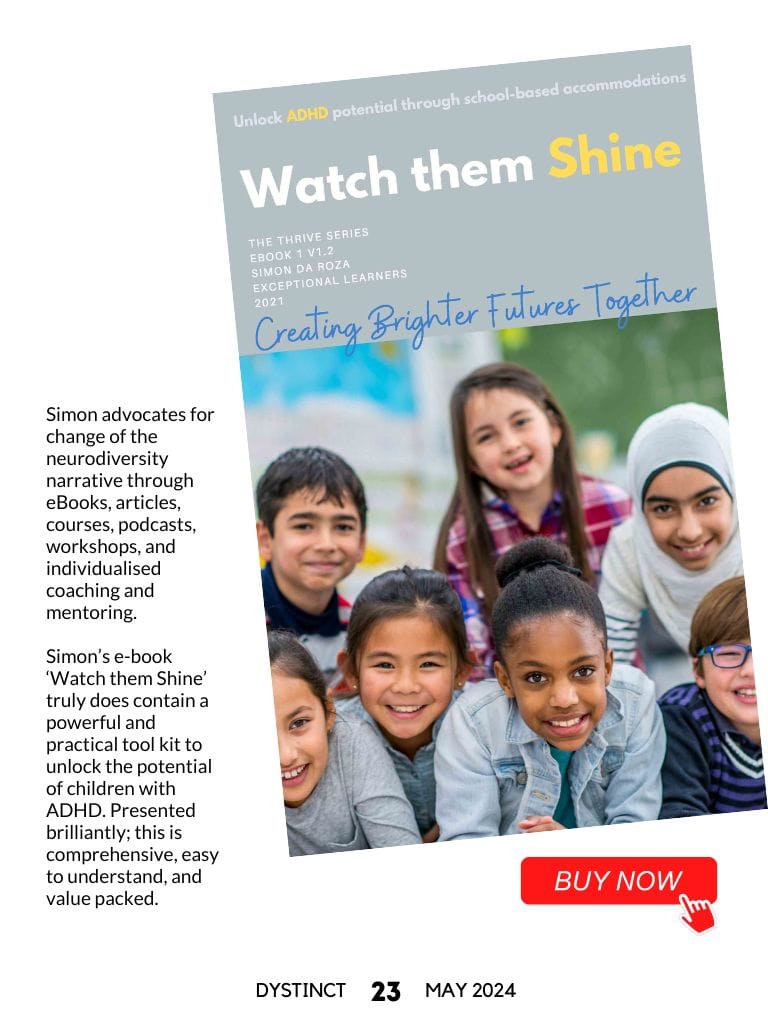
'Watch them Shine!' An introduction for educators and parents to improve the educational outcomes and guidance of children with Attention Deficit Hyperactivity Disorder (ADHD) by applying knowledge of executive functioning delays in creating effective, reasonable adjustments in the classroom.
Let Them Shine is a resource to support your teachers in supporting divergent learners. The adjustments are free and can be implemented today. These adjustments will have an immediate positive effect on students and your teachers' wellbeing. Start from a strengths-based perspective, add empathy, guidance and watch them thrive.
When you have a deep understanding of the neurology of ADHD, you will understand the effects upon the classroom and learning. Academic research of neurology and ADHD has turned our appreciation of this disability on its head. What we once thought ADHD to be is wrong. Combine this new knowledge with the realisation that each presentation is unique and therefore each solution must also be unique. However, you are the expert in your classroom and of the children in your care, add the creative solutions you and your students collaboratively implement in light of this knowledge and you will create effective reasonable adjustments.
Extracts from Dystinct Magazine
Extracts from Dystinct Magazine