Issue 32: Interoception: The Sense Your Child’s School Has Probably Never Mentioned (But Should) | Kelly Mahler
Kelly Mahler explains how interoception shapes children’s behaviour and self-regulation, and why replacing compliance with curiosity can lead to more effective, compassionate support.

Table of Contents
Have you ever felt your stomach growl in the middle of a meeting? Noticed your heart start to race right before you had to speak up in a room full of people? Felt your eyes get heavy on the drive home?
If so, you already know something about a sense most of us were never taught the name of: interoception.
It's not exactly a flashy word. It doesn't roll off the tongue. But don't let that fool you. In my 20-plus years as an occupational therapist, interoception has turned out to be one of the most important, yet most overlooked, pieces of the puzzle when it comes to how our children learn, behave, and regulate themselves at school and at home.
In this article, I want to do two things for you: explain interoception in plain, everyday language and give you some solid ground to stand on the next time you're sitting across the table from a teacher, a principal, or an IEP team.
So, What Exactly Is Interoception?
So, What Exactly Is Interoception?
Interoception is the sense that lets us notice and understand what's happening inside our bodies, like a dry mouth, relaxed muscles, a pounding head, a full bladder, or a tight feeling in the chest.
Here's how it works: your body constantly sends signals from places like your heart, lungs, stomach, bladder, muscles, and skin to your brain. Your brain takes all that raw information- is my stomach empty? tight? Gassy? tingly? and uses it as a clue to answer one simple, yet enormous question:
How do I feel right now?
That's interoception at its core. And once you see it, you can't unsee how much it touches.
Why This "Eighth Sense" Runs the Whole Show
Why This "Eighth Sense" Runs the Whole Show
For years in my own OT practice, I used all the traditional tools to help my clients regulate their emotions, and I kept falling short. My clients were making gains, sure, but something was missing, something standing between them and the kind of lasting, independent self-regulation I wanted for them.
Then, one evening (being a self-proclaimed research geek, this really is my idea of a fun night), I read an article by Dr Bud Craig about a sense called interoception, and it changed everything about how I understood regulation.
Learning about interoception changed everything about how I understood regulation.
Interoception is the foundation self-regulation is built on.
Here's what I've come to believe, backed by research: interoception is the foundation self-regulation is built on. Think about it in your own life. Noticing your stomach growl is what tells you to eat. Noticing shivers or goosebumps tells you to grab a sweater. Noticing your chest tighten and your heart pound is often what tells you that you're anxious, which might send you looking for a hug or a quiet corner.
In every one of those examples, a body signal came first, and that signal is what motivated the regulating behavior. Without a clear signal, there's nothing to act on. You cannot expect a child to "calm their body" if their body isn't giving them clear, reliable information to work with in the first place.
When the Signals Get Fuzzy
When the Signals Get Fuzzy
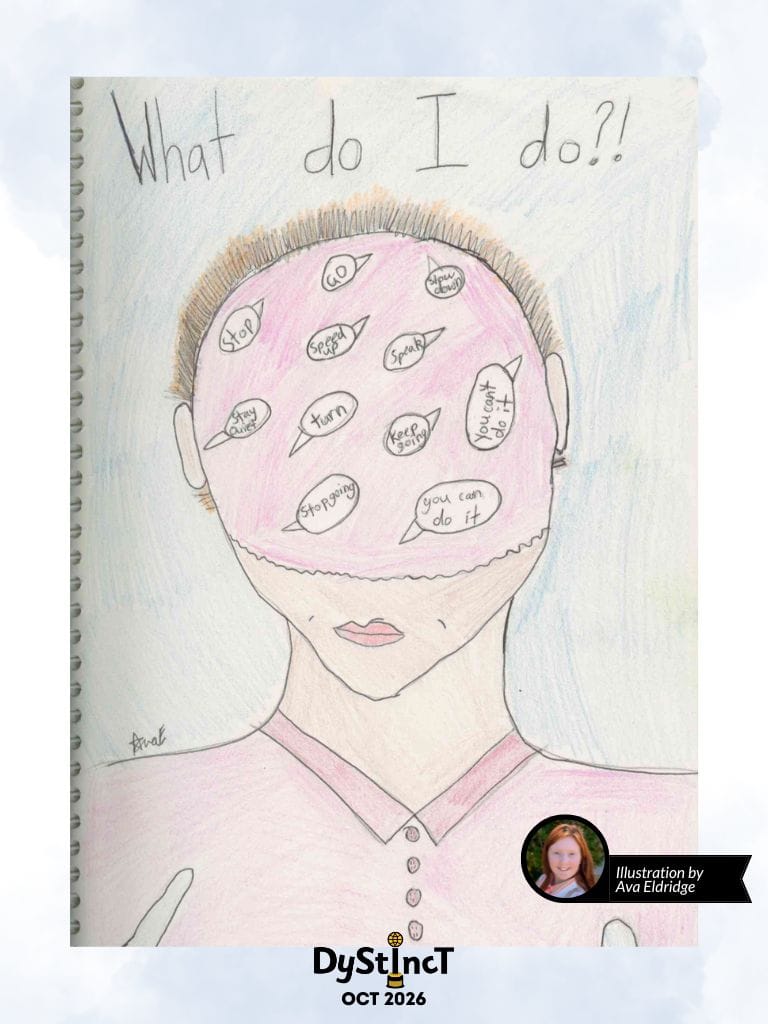
Now imagine what happens when those internal signals aren't clear. What if a child can't easily tell when they're hungry or overwhelmed, when their bladder is full, or when they're about to reach a breaking point, until everything hits at once with no warning?
For a lot of kids I work with, that is daily life. Interoception differences have been documented in autistic children and adults, as well as people with ADHD, anxiety, trauma histories, sensory processing differences, eating and toileting challenges, and children labeled as having "behavior problems." Plenty of people without any diagnosis at all struggle with this, too. Many of us grew up in environments that never encouraged us to check in with our bodies or honor what our bodies needed. In fact, they often did the opposite: taught us to ignore our bodies for the sake of pleasing other people.
Many of us grew up in environments that never encouraged us to check in with our bodies or honor what our bodies needed.
With the right kind of support, interoceptive awareness can be nurtured and strengthened at any age.
This matters enormously for how we interpret behavior at school. A child who "melts down out of nowhere" may not actually have had no warning. Their body may have been sending signals for quite a while; signals they didn't notice or interpret in time to act on. Or a child who "refuses to use coping strategies they are taught" might not be doing this out of opposition, but because they're missing the body clues that something is amiss in their body and it would be a great time to use a coping strategy.
Here's the encouraging part, and it's why I do this work: interoceptive awareness is highly changeable. With the right kind of support, it can be nurtured and strengthened at any age. I see it happen with my clients on a regular basis, and it's some of the most meaningful work I get to do.
Here's Where Schools Often Get It Backward
Here's Where Schools Often Get It Backward
Most schools are still built around compliance culture: behavior charts, reward systems, consequences, and pressure aimed at getting a child to look regulated on the outside. When a child struggles, the instinct is usually to add more of the same: more charts, bigger rewards, firmer consequences. I've watched this play out in classrooms for two decades, and I can tell you plainly that it isn't working or creating lasting change.
That's why I've become such an advocate for what I call a less compliance approach. Instead of asking, "How do we make this child comply?" it asks, "What might this child's body need right now to make participation possible?"
To be clear, less compliance doesn't mean throwing out expectations or structure. It still holds high expectations; it just changes how we help a child get there. Take a child who's struggling to finish a math worksheet. A compliance-based response focuses on keeping the child in the seat until the work is done, regardless of what's happening internally. A 'less compliance' response gets curious first:
Does this child need to move?
Is the room too loud?
Could hunger, thirst, or sensory overload be part of what's getting in the way?
Once those needs are understood, support can match the problem rather than just pressuring a child to push through it.
Constant compliance can quietly work against the very self-regulation skills we are all trying to build.
Here's another important point: I've heard from many neurodivergent adults (and the research backs this up) that teaching children to override their body's signals to perform or comply has real costs. So many describe growing up as having to mask discomfort, push through exhaustion, and hide distress just to be seen as "well-behaved." Over time, this can make it harder, not easier, for a person to notice their own body signals, trust their internal experience, or know how to regulate at all, and it's a pattern many connect to chronic stress and burnout later in life.
In other words, constant compliance can quietly work against the very self-regulation skills we are all trying to build.
Taking This Back to Your Child's School
Taking This Back to Your Child's School
You don't need a clinical degree to start this conversation. You just need language and a few good questions. Here's a starting toolkit I share with the families I work with:
- Reframe the behavior question
Instead of asking, "How do we get my child to stop doing X?" try asking the team, "What might my child's body need in this moment to make X more possible?" This one shift in language can open up an entirely different conversation. - Ask what's happening right before the behavior
Hunger, noise, transitions, sensory overwhelm, and fatigue are common, invisible triggers. A team genuinely curious about the "why" behind a behavior is doing interoception-informed work, even if they've never used that word. They are seeking to understand each child’s inner experience and how to support their bodies so that the child can do hard things.
A team genuinely curious about the ‘why’ behind a behavior is doing interoception-informed work, even if they've never used that word.
- Request body-based supports, not just behavior plans
Movement breaks, quiet spaces, reduced sensory demands, and predictable routines aren't rewards for good behavior, they're accommodations that help a dysregulated nervous system find its footing again. - Bring up interoception by name
You can say: "I've been reading about interoception, the sense that helps kids notice and understand how they feel. It doesn't start with memorizing emotion words, but rather with practice noticing and exploring the meaning behind their own unique body signals. Is this something the team has considered as part of my child's support plan?" Naming it gives the team something concrete to research and respond to. - Ask about goals, not just consequences
Building body awareness can be written directly into support plans and IEP goals, right alongside academic and behavioral goals. This shifts the target from "compliance" to genuine, lasting skill-building.
Bringing up interoception by name gives the team something concrete to research and respond to.
The Bottom Line
The Bottom Line
Your child's behavior is information, not defiance. Underneath a meltdown, a shutdown, a refusal, or an "unmotivated" attitude, there is very often a body that either can't feel what it needs or can't yet make sense of what it's feeling.
That's not a discipline problem. That's an interoceptive awareness problem, and interoceptive awareness can be nurtured and strengthened, both at school and at home with patience and the right kind of curiosity.
You don't need to have all the research memorized to start this conversation with your child's teacher or IEP team. You just need to walk in and ask one simple, powerful question on your child's behalf:
What does their body need to make this possible?
That question alone can be the beginning of a very different (and much kinder) path forward. I've seen it change classrooms. I've seen it change families. I believe it can change yours, too.
Your child's behavior is information, not defiance.
Kelly Maher, OTD, FAOTA
Occupational Therapist, Interoception Specialist, Researcher, Author & International Speaker | kelly-mahler.com | Facebook | LinkedIn | X | Pinterest | Instagram | YouTube
Kelly Maher, OTD, FAOTA
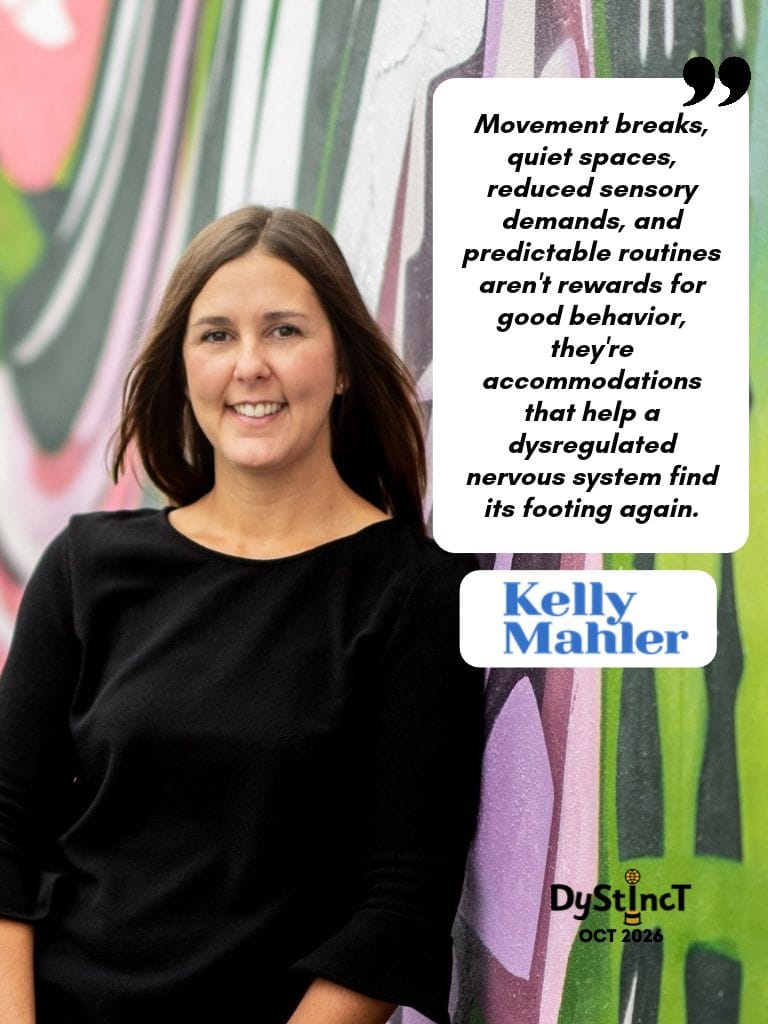
Kelly Mahler is an award-winning occupational therapist, author, and interoception groupie known for her boundless curiosity and empathetic approach. Holding a Doctorate in Occupational Therapy, she has served school-aged children and adults for over 24 years. Kelly has authored 12 resources, including The Interoception Curriculum, now used in over 30 countries worldwide, and has won multiple awards, including the 2026 American Occupational Therapy Fellow Award and the 2020 American Occupational Therapy Association Emerging and Innovative Practice Award. She enjoys speaking internationally on interoception, neuro-affirming practices, and playful strategies for inner exploration using a lens of curiosity, validation, and empathy. Her website offers free printable resources for exploring interoception.
Buy Printed Copies of Dystinct Magazine
Buy Printed Copies on Amazon
Select the Amazon Store based on your region
Extracts from Dystinct Magazine
Extracts from Dystinct Magazine