Issue 20: How Reading Trauma Became the Unknown Norm of U.S. Classrooms | Kathleen Seeman
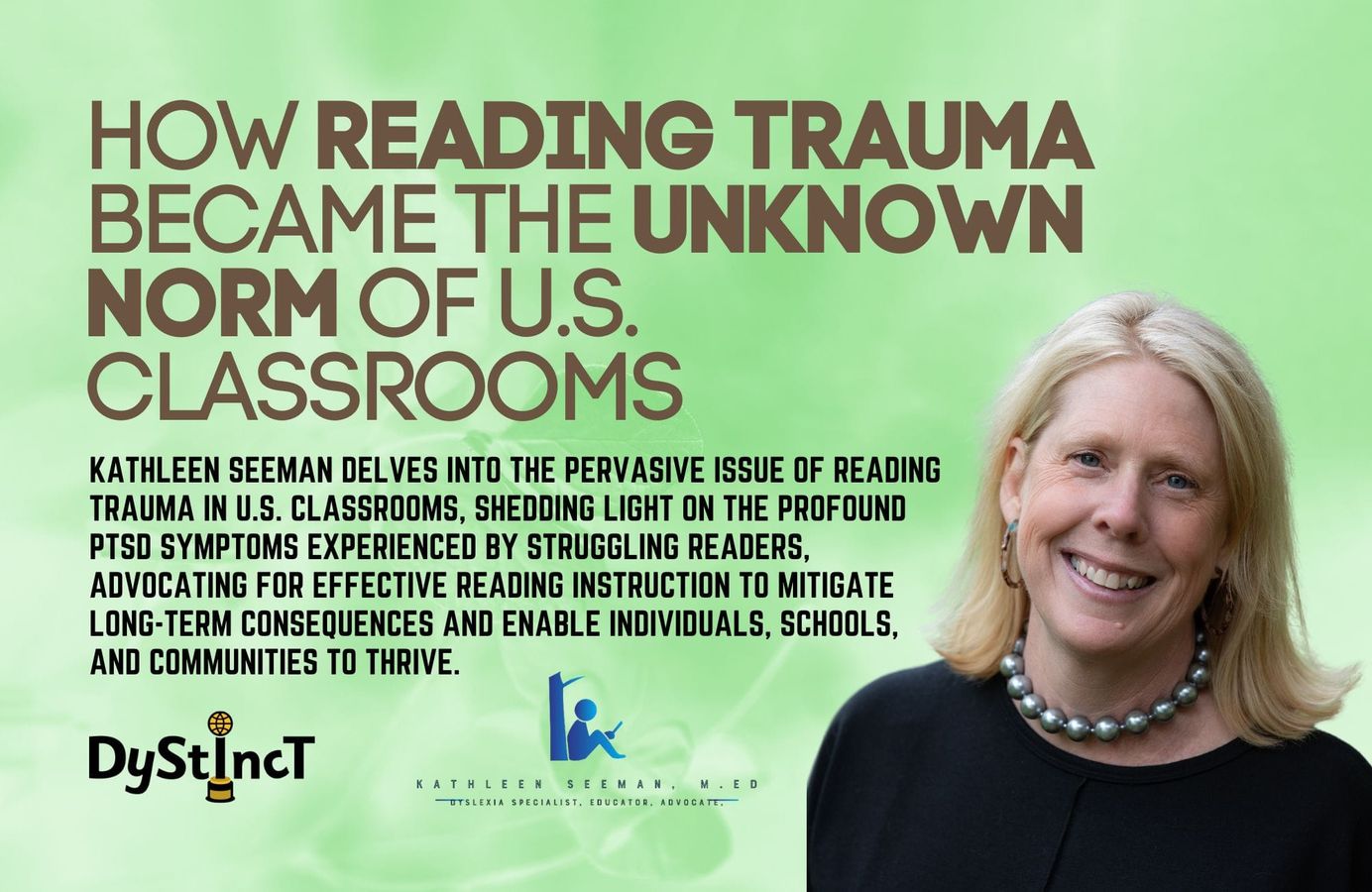
Kathleen Seeman delves into the pervasive issue of reading trauma in U.S. classrooms, shedding light on the profound PTSD symptoms experienced by struggling readers, advocating for effective reading instruction to mitigate long-term consequence.

Table of Contents
When we think of Post Traumatic Stress Disorder, the image our minds most frequently conjure up is one of a combat soldier returning from war. While many of our soldiers do feel the effects of PTSD, the other very real faces of PTSD are children and adults who struggle to read. Struggling readers wrestle with a host of emotions and reactions, many of which they themselves cannot understand or explain. These trauma responses occur in classrooms, office spaces, within relationships, and in other situations where the struggling reader is experiencing the shame and humiliation of not knowing how to read. This is reading trauma in action. These reactions can vary but are very much rooted in abject reading failure.
Post Traumatic Stress Disorder is very real for millions of Americans who struggle to read or have struggled to read in the past. The staggering truth is both these children and adults feel PTSD symptoms at the same intensity as those combat veterans returning from war. The very definition of trauma is a deeply distressing or disturbing experience that can have a profound physical and emotional impact on a person. It can be caused by a single event, such as a car accident or a natural disaster, or by repeated exposure to stressful or traumatic situations, such as child abuse or domestic violence. For many children, sitting in classrooms where they are not getting the correct reading instruction, they need to be successful readers becomes a traumatic experience day after day. Tragically, all too often, these symptoms will go undiagnosed yet plague these individuals for their entire lives.
The study, Reading Failure and Juvenile Delinquency and Dr Orton's work both showed that PTSD is present in students who struggle to read as early as kindergarten and can continue all the way through a person's senior years. Without an understanding of the effects of reading trauma, a person can spend their entire life blaming themselves for not learning how to read. The effects include lifelong low self-esteem, behavior problems, anxiety, aggression, withdrawal from friends and family, divorce, lower socio-economic status, and often a shorter life expectancy. The school-to-prison pipeline is a very real experience for struggling readers with the average reading proficiency level of both male and female prisoners at a fourth-grade level. Struggling readers very much internalize the thought process that they are "dumb", and sadly for many, this will be their inner story for their entire lives. The damage this can cause can plague families for generations.
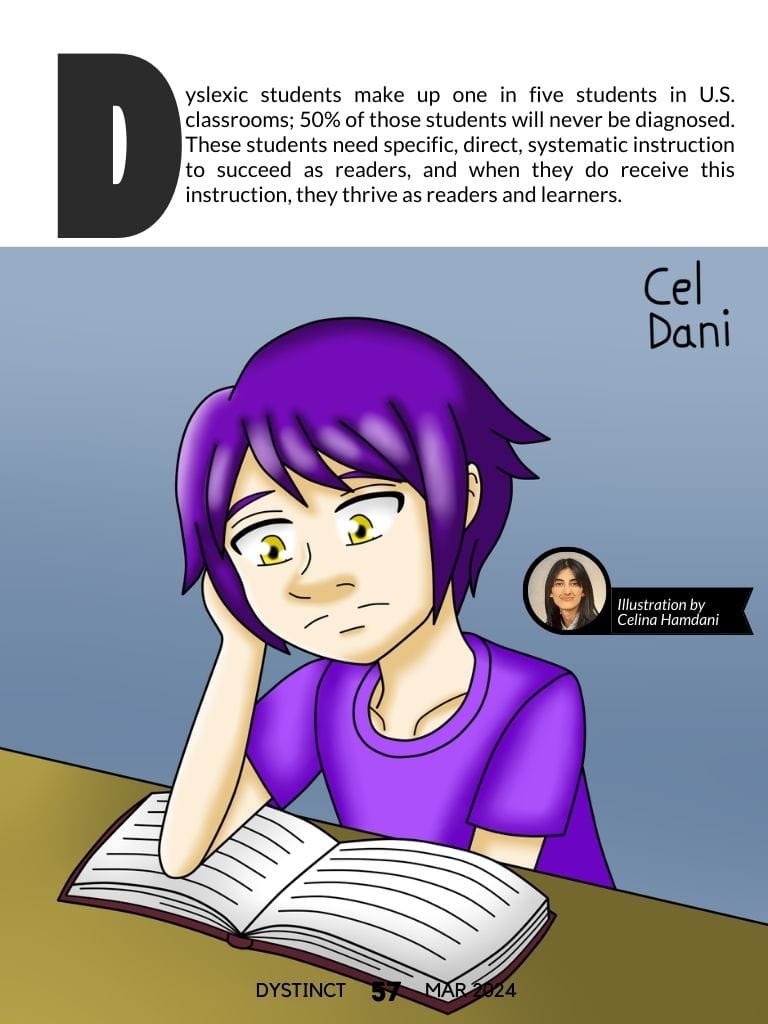
Dyslexic students make up one in five students in U.S. classrooms; 50% of those students will never be diagnosed. These students need specific, direct, systematic instruction to succeed as readers, and when they do receive this instruction, they thrive as readers and learners.

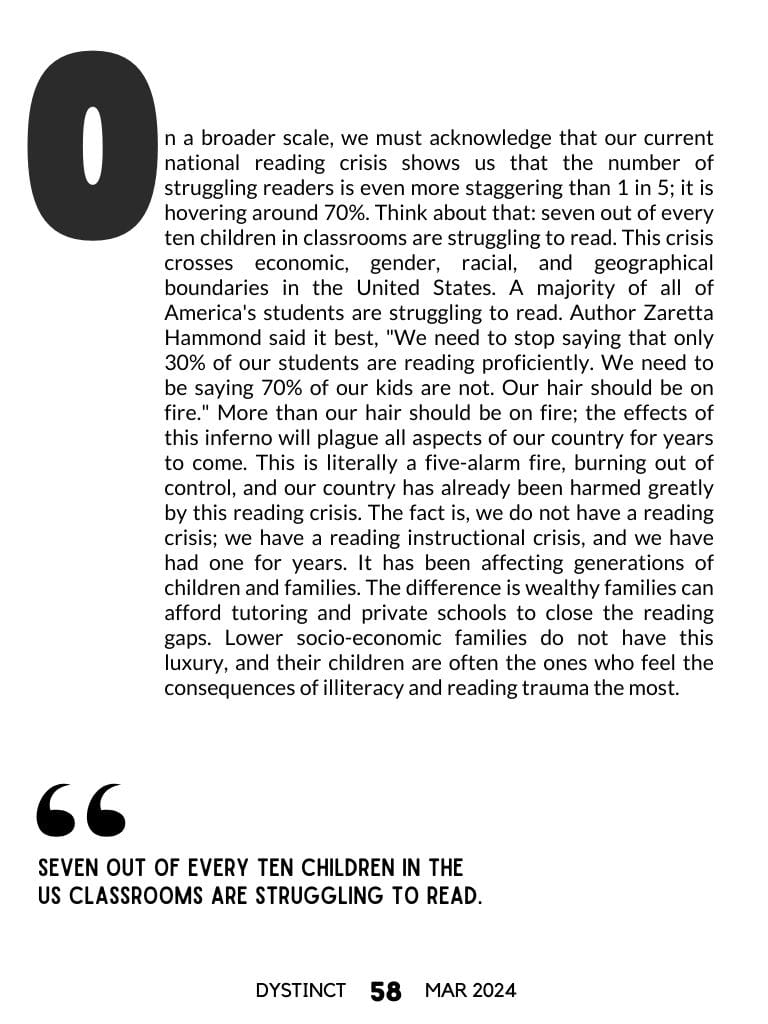
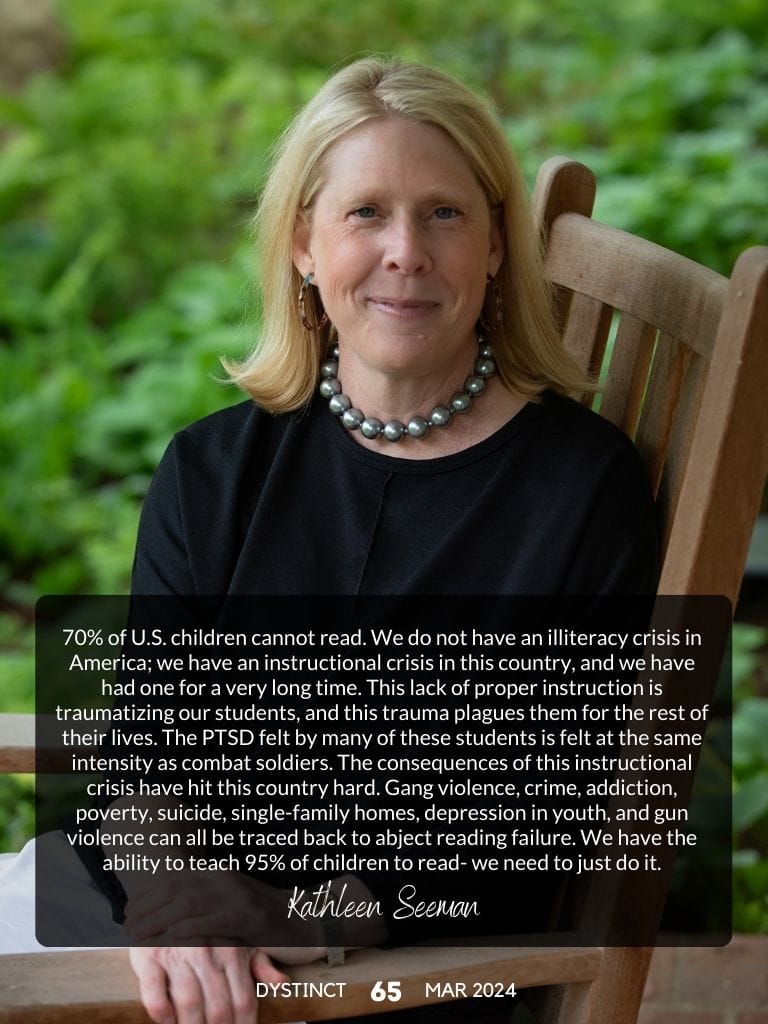
On a broader scale, we must acknowledge that our current national reading crisis shows us that the number of struggling readers is even more staggering than 1 in 5; it is hovering around 70%. Think about that: seven out of every ten children in classrooms are struggling to read. This crisis crosses economic, gender, racial, and geographical boundaries in the United States. A majority of all of America's students are struggling to read. Author Zaretta Hammond said it best, "We need to stop saying that only 30% of our students are reading proficiently. We need to be saying 70% of our kids are not. Our hair should be on fire." More than our hair should be on fire; the effects of this inferno will plague all aspects of our country for years to come. This is literally a five-alarm fire, burning out of control, and our country has already been harmed greatly by this reading crisis. The fact is, we do not have a reading crisis; we have a reading instructional crisis, and we have had one for years. It has been affecting generations of children and families. The difference is wealthy families can afford tutoring and private schools to close the reading gaps. Lower socio-economic families do not have this luxury, and their children are often the ones who feel the consequences of illiteracy and reading trauma the most.
Seven out of every ten children in The US classrooms are struggling to read.
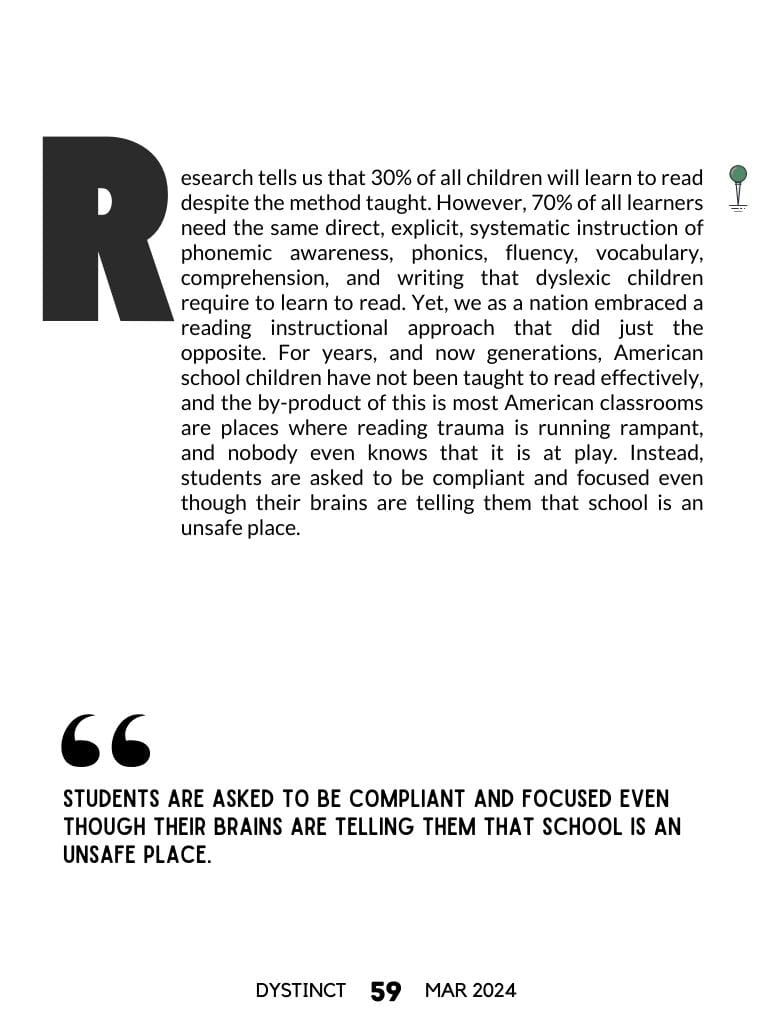
Research tells us that 30% of all children will learn to read despite the method taught. However, 70% of all learners need the same direct, explicit, systematic instruction of phonemic awareness, phonics, fluency, vocabulary, comprehension, and writing that dyslexic children require to learn to read. Yet, we as a nation embraced a reading instructional approach that did just the opposite. For years, and now generations, American school children have not been taught to read effectively, and the by-product of this is most American classrooms are places where reading trauma is running rampant, and nobody even knows that it is at play. Instead, students are asked to be compliant and focused even though their brains are telling them that school is an unsafe place.
Students are asked to be compliant and focused even though their brains are telling them that school is an unsafe place.
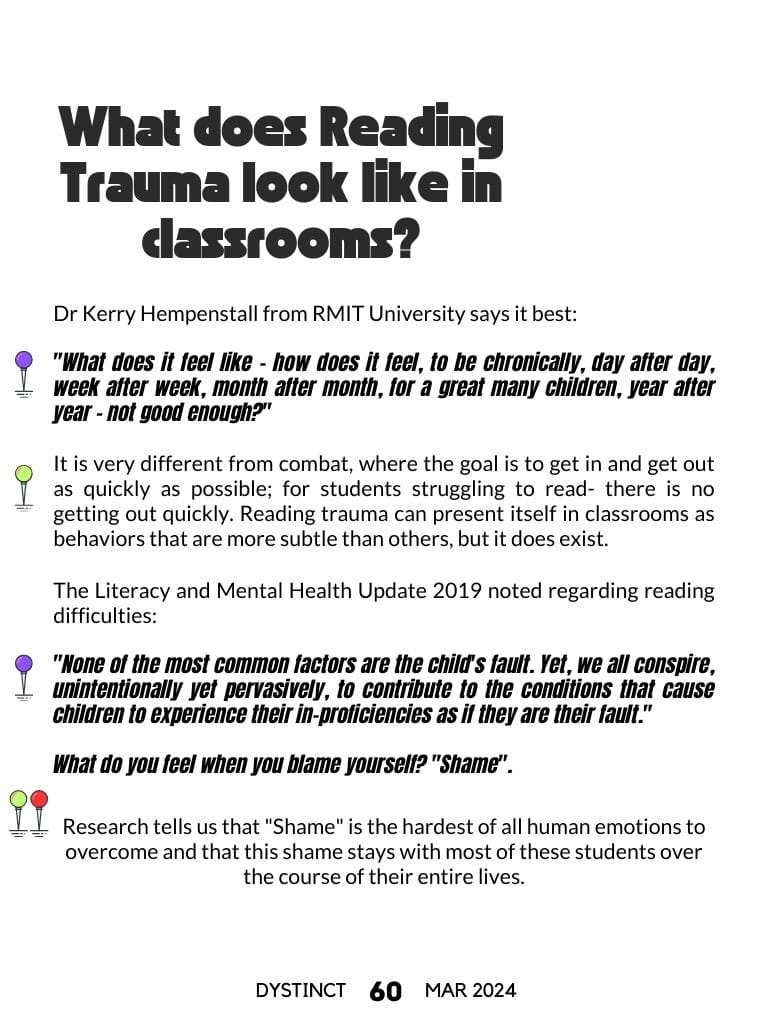
What does Reading Trauma look like in classrooms?
What does Reading Trauma look like in classrooms?
Dr Kerry Hempenstall from RMIT University says it best:
"What does it feel like – how does it feel, to be chronically, day after day, week after week, month after month, for a great many children, year after year – not good enough?"
It is very different from combat, where the goal is to get in and get out as quickly as possible; for students struggling to read- there is no getting out quickly. Reading trauma can present itself in classrooms as behaviors that are more subtle than others, but it does exist.
The Literacy and Mental Health Update 2019 noted regarding reading difficulties:
"None of the most common factors are the child's fault. Yet, we all conspire, unintentionally yet pervasively, to contribute to the conditions that cause children to experience their in-proficiencies as if they are their fault."
What do you feel when you blame yourself? "Shame".
Research tells us that "Shame" is the hardest of all human emotions to overcome and that this shame stays with most of these students over the course of their entire lives.
Our Human Brains
Our Human Brains
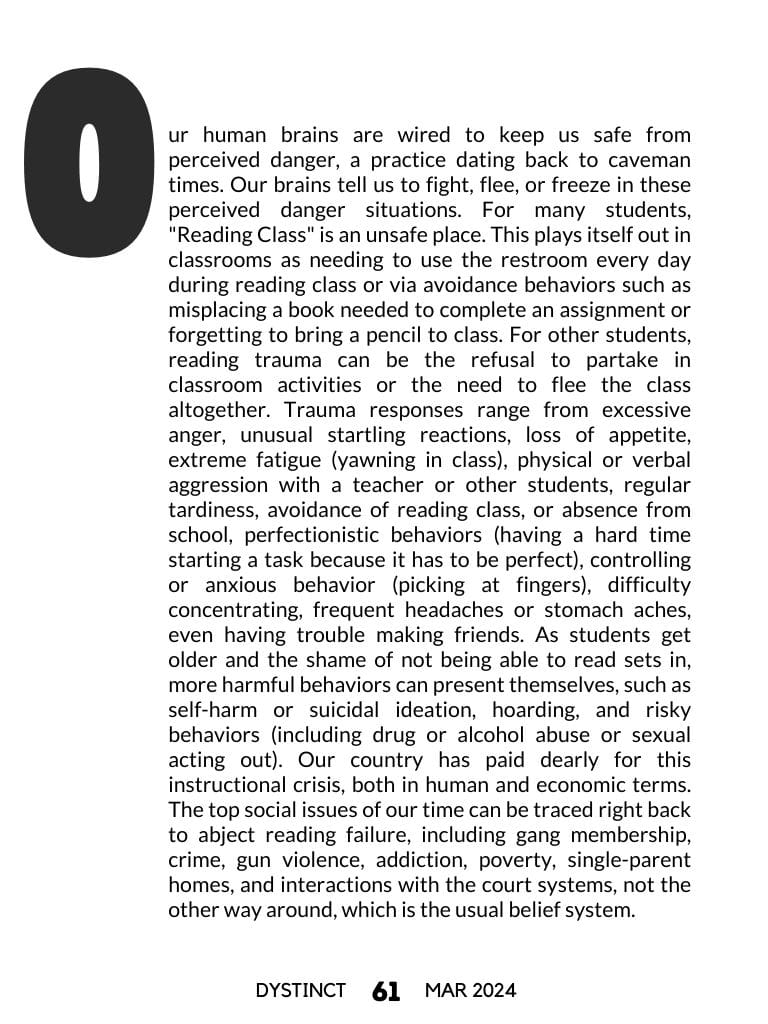
Our human brains are wired to keep us safe from perceived danger, a practice dating back to caveman times. Our brains tell us to fight, flee, or freeze in these perceived danger situations. For many students, "Reading Class" is an unsafe place. This plays itself out in classrooms as needing to use the restroom every day during reading class or via avoidance behaviors such as misplacing a book needed to complete an assignment or forgetting to bring a pencil to class. For other students, reading trauma can be the refusal to partake in classroom activities or the need to flee the class altogether. Trauma responses range from excessive anger, unusual startling reactions, loss of appetite, extreme fatigue (yawning in class), physical or verbal aggression with a teacher or other students, regular tardiness, avoidance of reading class, or absence from school, perfectionistic behaviors (having a hard time starting a task because it has to be perfect), controlling or anxious behavior (picking at fingers), difficulty concentrating, frequent headaches or stomach aches, even having trouble making friends. As students get older and the shame of not being able to read sets in, more harmful behaviors can present themselves, such as self-harm or suicidal ideation, hoarding, and risky behaviors (including drug or alcohol abuse or sexual acting out). Our country has paid dearly for this instructional crisis, both in human and economic terms. The top social issues of our time can be traced right back to abject reading failure, including gang membership, crime, gun violence, addiction, poverty, single-parent homes, and interactions with the court systems, not the other way around, which is the usual belief system.
The news isn't great when it comes to reading trauma; however, understanding the causes and the brain's defensive wiring can help children and adults tame their reactions and thrive. Understanding that reading trauma has many trauma responses associated with it is crucial. In explaining reading trauma to students and adults, providing a historical perspective is helpful and enlightening. Understanding that our brains are wired to speak, not read, thus making it easier for some children to learn to read than others, helps children understand that their reading difficulties are not their fault. Further explaining that the brain has been on high alert for danger dating all the way back to caveman times helps children to understand that the brain will perceive current-day threats in the same manner as it did when man was being chased by woolly mammoths, hence their desire to flee a class where there is much reading taking place. For many students, learning to read is their "woolly mammoth" chasing them throughout their lives. Encouraging children to name their threats and learn to talk them down helps make reading trauma less intrusive and reading instruction more attainable. Taming the Woolly Mammoth is the first step to lowering reading trauma in classrooms. Then, coupled with correct reading instruction, we can teach 95% of all students to learn to read. The bottom line is that when kids feel good, they will learn.
The bottom line is that when kids feel good, they will learn.
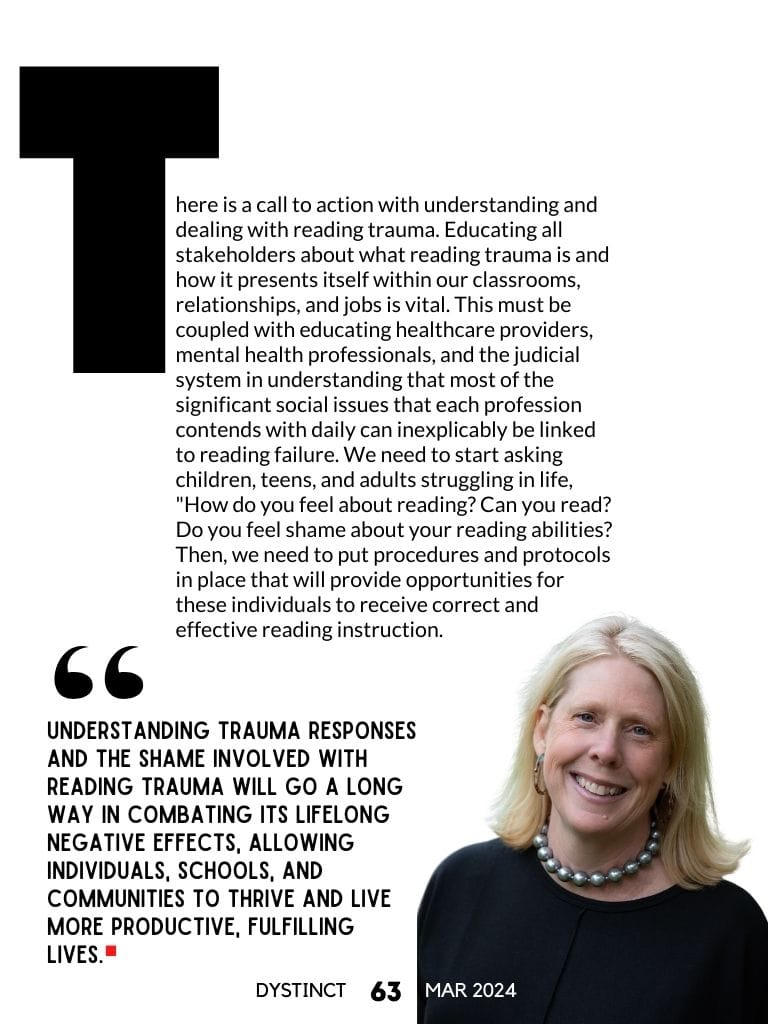
There is a call to action with understanding and dealing with reading trauma. Educating all stakeholders about what reading trauma is and how it presents itself within our classrooms, relationships, and jobs is vital. This must be coupled with educating healthcare providers, mental health professionals, and the judicial system in understanding that most of the significant social issues that each profession contends with daily can inexplicably be linked to reading failure. We need to start asking children, teens, and adults struggling in life, "How do you feel about reading? Can you read? Do you feel shame about your reading abilities? Then, we need to put procedures and protocols in place that will provide opportunities for these individuals to receive correct and effective reading instruction.
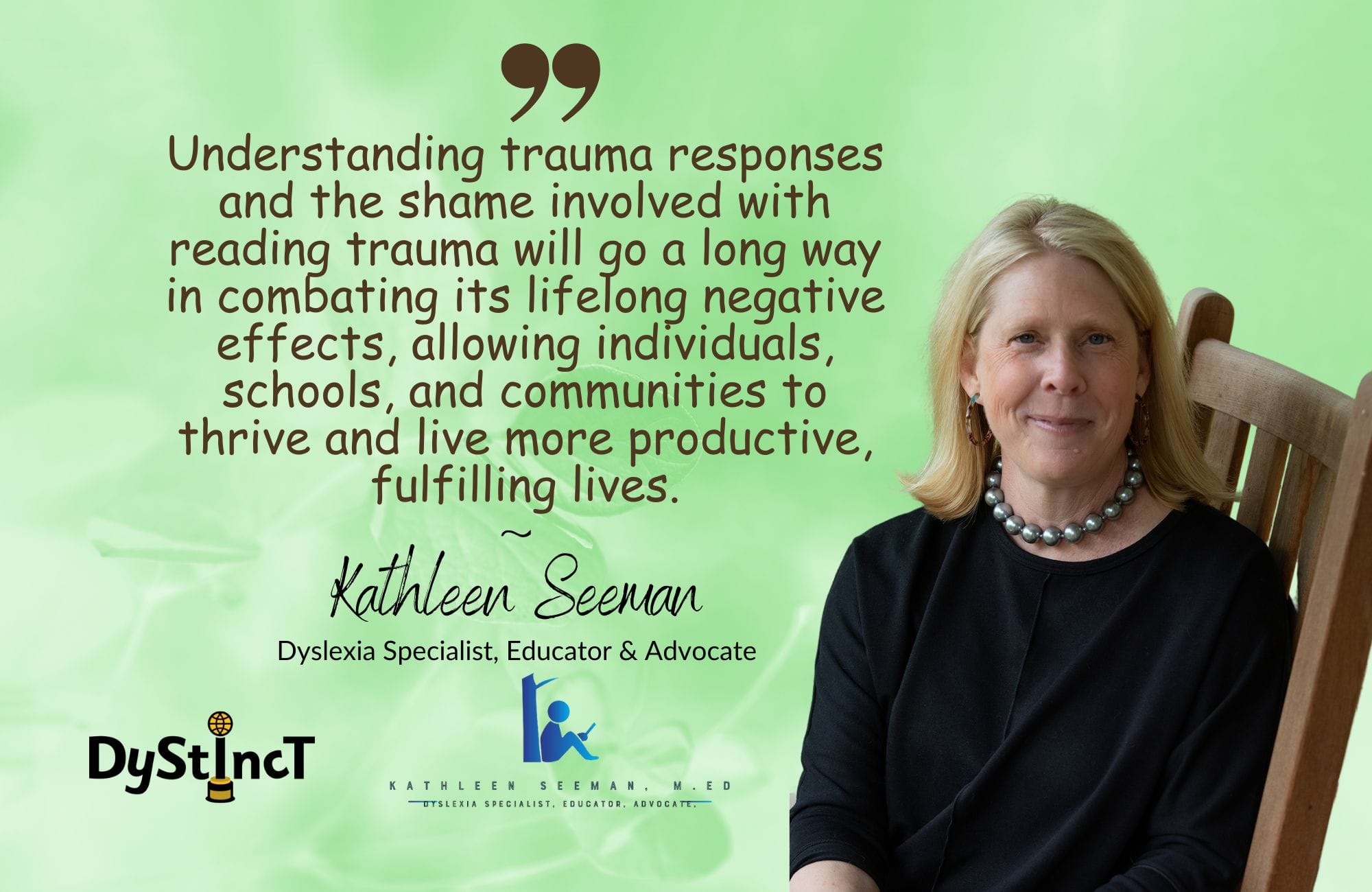
Understanding trauma responses and the shame involved with reading trauma will go a long way in combating its lifelong negative effects, allowing individuals, schools, and communities to thrive and live more productive, fulfilling lives.
References
References
- Alexander-Passe, N. (2015). Investigating Post-Traumatic Stress Disorder (PTSD) Triggered by the Experience of Dyslexia in Mainstream School Education? Journal of Psychology & Psychotherapy, 5(6), 215. DOI: 10.4172/2161-0487.1000215 [longdom.org]
- Fenkel, C. (2023, March 13). Dyslexia and anxiety. [charliehealth.com]
- Hempenstall, K. (2012, November 5). Literacy and mental health. [nifdi.org]
- Hogenson, D. L. (1974). Reading Failure and Juvenile Delinquency. Bulletin of the Orton Society, 24, 164–169. [jstor.org]
- King, J. B., & Davis, J. (2022, November 16). The science of reading: How John King plans to close the literacy gap. [the74million.org]
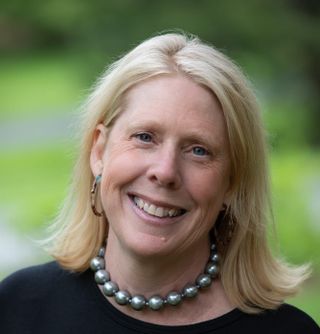
Kathleen Seeman
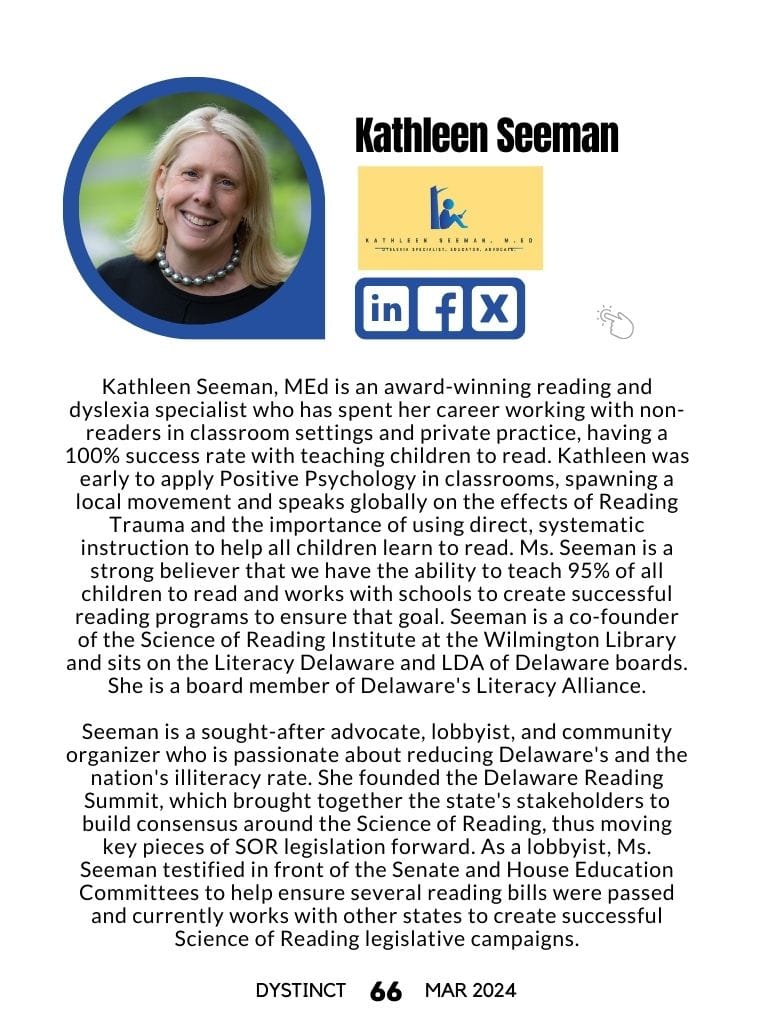
Kathleen Seeman, MEd is an award-winning reading and dyslexia specialist who has spent her career working with non-readers in classroom settings and private practice, having a 100% success rate with teaching children to read. Kathleen was early to apply Positive Psychology in classrooms, spawning a local movement and speaks globally on the effects of Reading Trauma and the importance of using direct, systematic instruction to help all children learn to read. Ms. Seeman is a strong believer that we have the ability to teach 95% of all children to read and works with schools to create successful reading programs to ensure that goal. Seeman is a co-founder of the Science of Reading Institute at the Wilmington Library and sits on the Literacy Delaware and LDA of Delaware boards. She is a board member of Delaware's Literacy Alliance.
Seeman is a sought-after advocate, lobbyist, and community organizer who is passionate about reducing Delaware's and the nation's illiteracy rate. She founded the Delaware Reading Summit, which brought together the state's stakeholders to build consensus around the Science of Reading, thus moving key pieces of SOR legislation forward. As a lobbyist, Ms. Seeman testified in front of the Senate and House Education Committees to help ensure several reading bills were passed and currently works with other states to create successful Science of Reading legislative campaigns.
Extracts from Dystinct Magazine
Extracts from Dystinct Magazine