Issue 27: How Can We Best Support Writing from the Beginning? What ALL Students Need to Know and Be Able to Do | Amy Siracusano
Amy Siracusano offers research-based insights into the foundational writing skills students need to succeed, highlighting the importance of explicit instruction in transcription skills such as handwriting and spelling, along with early support for oral language and fine motor development.

Table of Contents
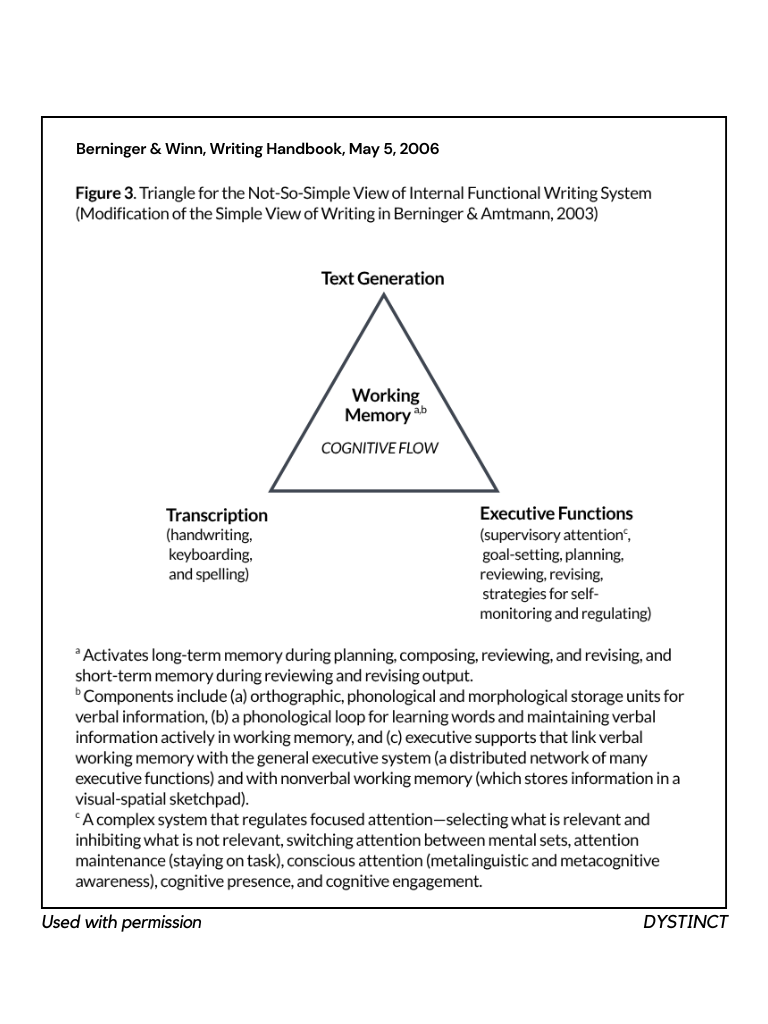
Writing can be a daunting task for both students and educators because of its complexity. The well-researched theoretical model, titled “The Not So Simple View of Writing,” introduced by Berninger and Winn in 2006, has been around for almost 20 years. Yet many educators have never heard of it, nor have they read the research. Historically, teachers in the United States have taught writing using a writing workshop model. Teachers assign a writing task, model writing, and set students off to write. Published writing using this model requires that students utilize the writing process steps: planning, drafting, revising, editing, and publishing. Although the steps are explicitly modeled to support students in successfully completing writing pieces, many students struggle to implement them effectively due to weaknesses in foundational writing skills.
What Does the Research Say?
What Does the Research Say?
To be a strong writing teacher, it is essential to understand the research that informs evidence-based classroom practices. In 1981, Dr. Flower and Dr. Hayes studied the cognitive processes of composition with college-aged students rather than elementary, middle, or even high school students. They noted that, in their model, the cognitive processes weren’t linear but moved bidirectionally —generating, planning, translating, and reviewing. The concern with using this process is that for many students, the writing process - planning, translating/drafting, reviewing, and editing to create published works isn’t enough.
It’s important to note that Flower and Hayes’ model not only included the main components of the writing process but also emphasized working memory, long-term memory, and goal setting. Several of these processes were also included in Berninger and Winn’s 2006 model as well. Based on the updated research in 2006, the instructional focus needs to shift from solely using The Writing Process to support writers to focusing first on teaching the foundational writing skills necessary to develop proficient writers.
How Does the Not So Simple View of Writing Inform Instruction?
How Does the Not So Simple View of Writing Inform Instruction?
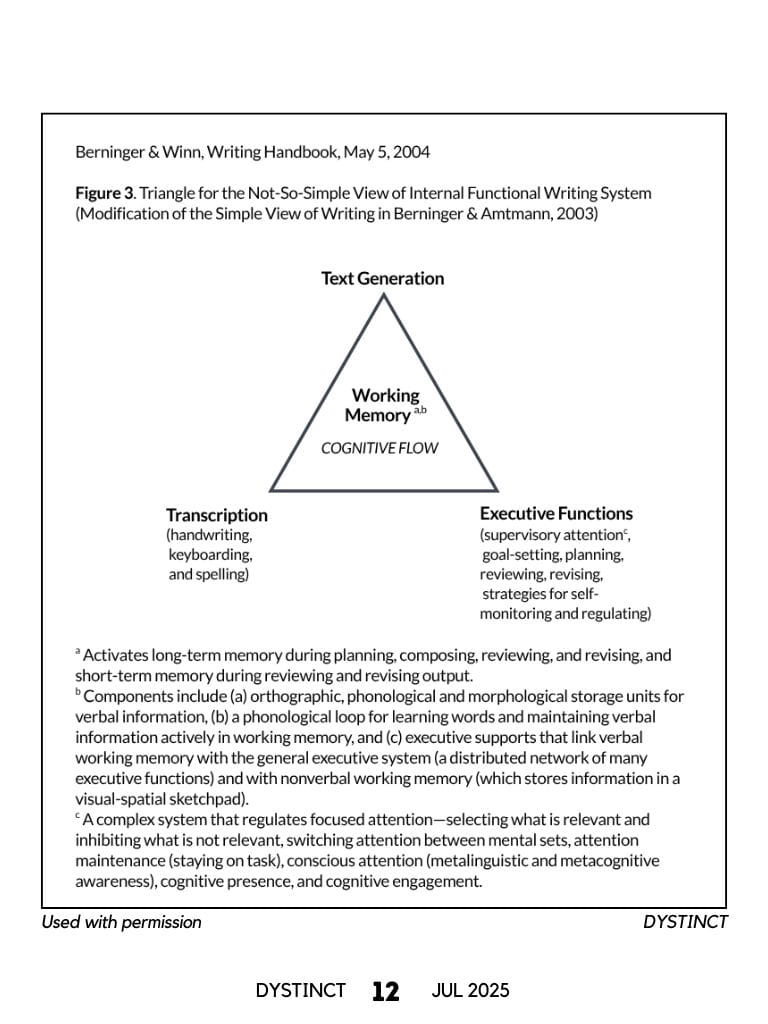
Berninger and Winn’s model, The Not So Simple View of Writing, indicates that proficient writing involves instructing students in two broad categories: transcription (foundational writing skills) and composition (text generation skills). Writing also involves both long-term and short-term working memory, also known as cognitive flow and executive functions (e.g., the ability to follow directions, stay focused on a task, and control one’s impulses). Many students get overwhelmed quickly when asked to complete a writing task, and it’s the responsibility of the educators in the classroom to support students and ensure success.
This may involve supporting executive functions through goal setting and providing checklists to help students stay on track. It also involves teaching transcription skills to automaticity. Transcription skills include handwriting, keyboarding, spelling, and spatial organization (e.g., use of margins, lines, and spacing).
Why is Handwriting Instruction so Important?
Why is Handwriting Instruction so Important?
First, we need to understand the importance of handwriting instruction as it is one of the most important building blocks in developing transcription skills (foundational writing skills). Research informs us that handwriting activates the reading brain and reinforces letter knowledge. Handwriting is the integration of three things: the orthographic codes, knowledge of the letter form or language by eye, the phonological codes, knowledge of letter names and letter sounds or language ear and mouth, and the graphomotor code (system), the ability for a student to form the written shape of a letter using a writing utensil or language by hand.
Students who have learned to recognize letter forms/shapes can point to a letter when given its name or sound. Students who know phonological codes can sing the alphabet song and produce the sound for a letter when asked aurally. The automaticity of these skills needed for foundational writing does not happen overnight, as it takes a lot of systematic, explicit instruction as well as practice. So, where do we begin?
How Can We Support Handwriting Instruction?
How Can We Support Handwriting Instruction?
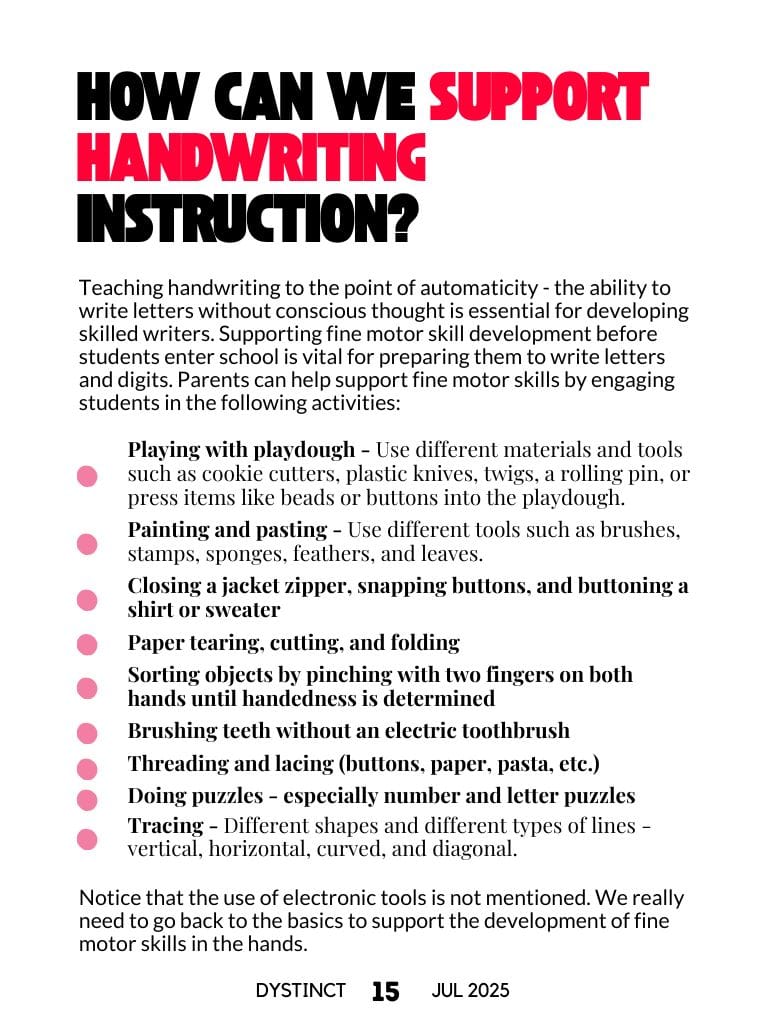
Teaching handwriting to the point of automaticity - the ability to write letters without conscious thought is essential for developing skilled writers. Supporting fine motor skill development before students enter school is vital for preparing them to write letters and digits. Parents can help support fine motor skills by engaging students in the following activities:
- Playing with playdough - Use different materials and tools such as cookie cutters, plastic knives, twigs, a rolling pin, or press items like beads or buttons into the playdough.
- Painting and pasting - Use different tools such as brushes, stamps, sponges, feathers, and leaves.
- Closing a jacket zipper, snapping buttons, and buttoning a shirt or sweater
- Paper tearing, cutting, and folding
- Sorting objects by pinching with two fingers on both hands until handedness is determined
- Brushing teeth without an electric toothbrush
- Threading and lacing (buttons, paper, pasta, etc.)
- Doing puzzles - especially number and letter puzzles
- Tracing - Different shapes and different types of lines - vertical, horizontal, curved, and diagonal.
Notice that the use of electronic tools is not mentioned. We really need to go back to the basics to support the development of fine motor skills in the hands.
Another thing that caretakers and educators can do to prepare students for writing is to ensure that students can correctly sing the alphabet song. Be sure to pay attention to how students say the letters l, m, n, o, p (make sure they aren’t smushing the letters together) and make sure that students know that between the letters y ‘and’ z, there is a word in the song, not another letter. By addressing these things early on, caretakers and educators can help to avoid confusion later. The same can be done to support math by teaching kids to count digits between 0 and 10 orally. This may seem easy, but it’s only the beginning, and it provides the start of a strong foundation. In addition, ensure that students have appropriate writing utensils, such as short, thin writing utensils (e.g., golf pencils, broken and thin crayons). These are the best tools for little hands.
Educating students on spatial concepts like up, down, left, and right will also aid in formal handwriting instruction.
Part of formal handwriting instruction includes learning the strokes: vertical, horizontal, curved, and diagonal. Students should be provided with 5-10 minutes of daily handwriting instruction. When students practice forming a letter, they should be guided to either say the sound the letter spells or to say the name of the letter, as this helps cement this knowledge into long-term memory.
By the end of kindergarten, students should be able to write the upper- and lower-case letters independently. Research informs us that automatic letter writing by hand is the best unique predictor of later composition length. Students receiving explicit handwriting instruction perform better in writing tasks compared to those who do not receive systematic instruction. Therefore, data collection in foundational writing skills throughout kindergarten is essential to identify students who may need further support.
And, What About Keyboarding?
And, What About Keyboarding?
You may be asking, “What about keyboarding?” It is important to understand that handwriting reinforces alphabetic knowledge and decoding. Keyboarding, however, is a motor memory task that requires touch typing using two hands. This requires both hemispheres of the brain to work and communicate at the same tim - a skill that, for most students, isn’t developmentally ready for until around the age of adolescence (11 years old). While keyboarding has its place, writing by hand remains crucial to reinforcing reading development.
Handwriting reinforces alphabetic knowledge and decoding.
While there is an efficiency to keyboarding, there is a time and place for its use, just like there is a time and place for writing by hand. Our tech companies know this, too. In fact, when a rather large tech company released the now common laptop that folded back like a notebook and came with a stylus, they stated in a published article, “when writing or drawing by hand, different parts of the brain are activated and in different ways…it is the physical movement of the pen that makes the difference. The movement is picked up by the senses and, due to their involvement, results in different neural activity that governs all higher-level cognitive processing and learning. This difference in activity is really significant. It tells us that using a pen to take notes means that the brain is able to process learning in a much more effective way (The Pen Is Mightier Than the Keyboard, 2017b).”
Using a pen to take notes means that the brain is able to process learning in a much more effective way.
Our tech companies had their hands on brain research and knew the importance of writing by hand, yet our schools not only lacked this knowledge, but they continue to require students to do things that may not make sense regarding brain development. Why is that? Certainly, we can do better for our students. In fact, rather than having third graders touch type responses on a state assessment, we could have our students write their extended responses using a stylus on a digital screen until they are developmentally ready to learn to touch type.
How Do Transcription Skills and Composition Skills Come Together?
How Do Transcription Skills and Composition Skills Come Together?
Transcription skills or foundational writing skills take years of systematic, explicit instruction and practice for automatization. Equally important are composition skills, beginning with sentence level instruction built on oral language. Parents and educators can support this work by having intentional conversational exchanges and modeling speaking in complete sentences.
To support composition skills, it is important to teach students how to ask and answer questions orally. This can happen during informal conversations at the dinner table, while playing a board game, doing a puzzle together, or listening to a story being read aloud. As an adult reads a story to a young child, stop at critical points and ask who, what, where, and when type questions. Then, model how to turn the question into a response using a complete sentence and have the child repeat. The more children learn how to do this orally early on, the more success they will find when asked to respond to text-dependent questions in print later in elementary school.
Writing is a complex set of cognitive processes involving cognitive flow (working memory and long-term memory), executive functions, transcription, and composition skills. Beginning with foundational writing instruction, such as handwriting and fine motor skill development, and supporting students in building strong oral language skills will help put all students on a path to becoming proficient writers.
Open-source resources for parents and educators
Open-source resources for parents and educators
- Handwriting support tools from the University of Iowa:
- Research-based reading guidance: [ReadingUniverse.org]
References
References
- Ahmed, Y, Kent, S, Cirino, P.T., & Keller-Margulis, M. (2021). The Not-So-Simple View of Writing in Struggling Readers/Writers. Reading & Writing Quarterly
- Berninger, V. W., & Winn, W. D. (2006). Implications of Advancements in Brain Research and Technology for Writing Development, Writing Instruction, and Educational Evolution. In C. A. MacArthur, S. Graham, & J. Fitzgerald (Eds.), Handbook of writing research (p. 96–114). The Guilford Press.
- Berninger, V. W. (2012). Strengthening the Mind's Eye. Principal, 91(5), 28-31
- Berninger, V.W. (May-June 2012). Strengthening the Mind’s Eye: The Case for Continued Handwriting Instruction in the 21st Century. Principal, 28-31.
- Berninger, V.W. (March 2013). Educating Students in the Computer Age to Be Multilingual by Hand. Commentaries (National Association of State Boards of Education), 19 (1).
- Berninger, V., B. Wolf, & R.D. Abbott (2016). Effective beginning handwriting instruction: multi-modal, consistent format for 2 years, and linked to spelling and composing. Dordrecht, Netherlands: Springer Publishing.
- Berninger, V., & Wolf, B. (2019). Teaching students with dyslexia, dysgraphia, OWL LD, and dyscalculia: Lessons from teaching and science, Second Edition. Baltimore: Paul H. Brookes.
- Flower, L., & Hayes, J. R. (1981). A cognitive process theory of writing. College Composition and Communication, 32(4), 365–387. [doi.org]
- MacArthur, C. A., Graham, S., & Fitzgerald, J. (2016). Handbook of Writing Research, Second edition. Guilford Publications.
- The pen is mightier than the keyboard. (2017, September 5). Microsoft News Centre Europe. [news.microsoft.com]
- Van Cleave, W. (n.d.). Handwriting in a Modern World: Why it matters & What to do about it. [wvced.com]
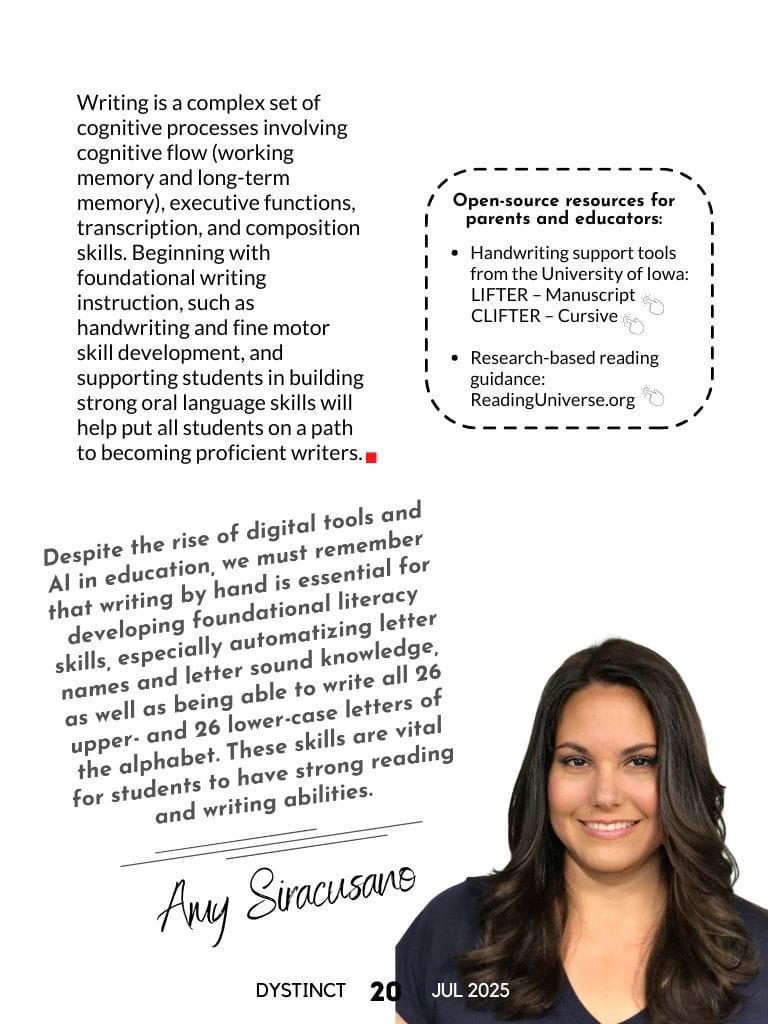
Amy Siracusano
National Literacy Consultant & Founder | knowbetterdobetterliteracy.com
Amy Siracusano
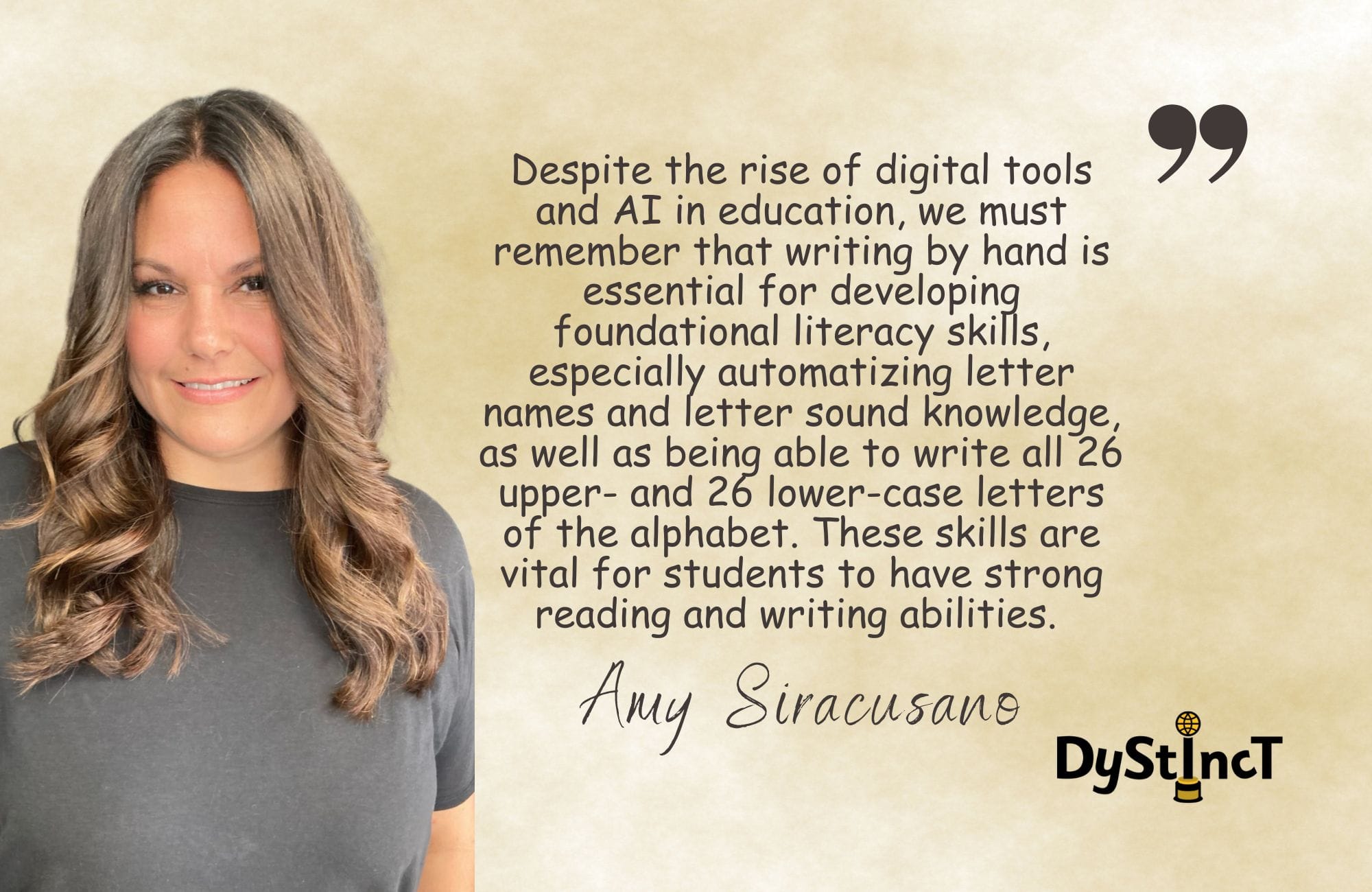
Amy Siracusano, MS Ed., founder and owner of Know Better Do Better Literacy, LLC., worked in public education for 25 years before becoming a national literacy consultant. Her career has included many positions: classroom teacher, Title I teacher, vice principal, literacy specialist for the board of education, and adjunct professor. She has presented nationally on various literacy topics, including assessment, dyslexia, reading, and writing. Amy is on the board of directors for The Reading League National and an adjunct professor for the Reading Science Advanced Certificate at Brooklyn College in New York City. She is determined to support national efforts in making sure teachers are equipped with deep knowledge of language systems and teaching approaches to ensure all students leave second grade with proficient reading and writing skills. Amy lives in Southern Maryland with her husband Joe and their two daughters: Lucia (17) and Isabella (15).
Extracts from Dystinct Magazine
Extracts from Dystinct Magazine