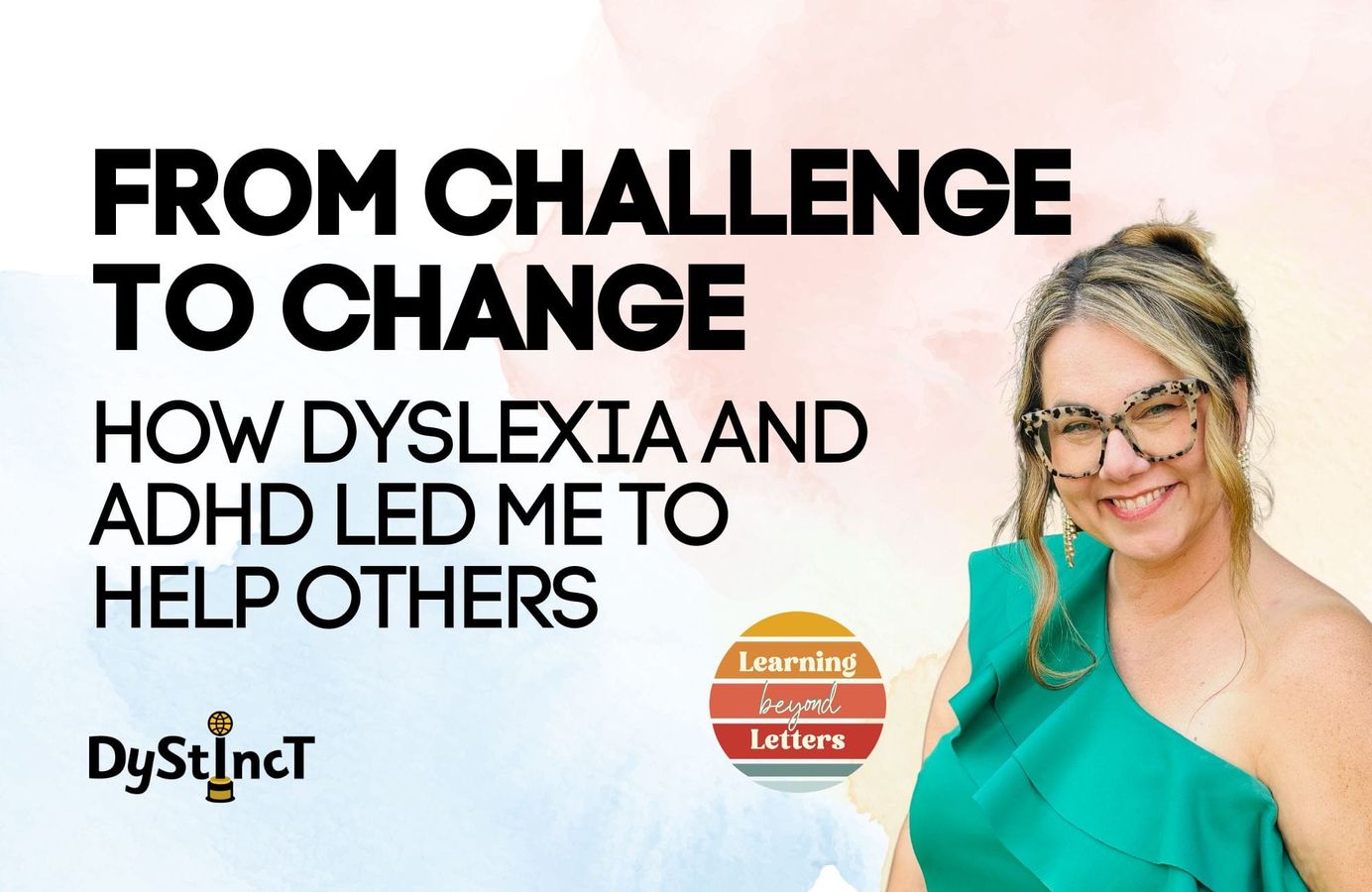
Issue 24: From Challenge to Change: How Dyslexia and ADHD Led Me to Help Others | Laura Webb
Laura Webb reflects on her journey from navigating the challenges of undiagnosed dyslexia and ADHD in her school years to becoming an Educational Therapist dedicated to helping neurodivergent students.


Table of Contents
Fourth grade is when things went south for me. From kindergarten all the way through third grade, my days were filled with art, nature, and fun. I lived in a small mountain town in California, and we spent most of the time in the glorious outdoors. But by the fourth grade, I felt like I was drowning in schoolwork for the first time.
As an adult, I have built a career out of helping kids with dyslexia and ADHD find the best practices for their brains. Then, I encourage them to apply those ideas to everyday life. In contrast, my own experience finding out how my brain actually works differently was long and arduous. I love to go through the process of helping parents tell their children that they have dyslexia, for instance. After all of the questions are answered and a child has absorbed what it really means to be dyslexic, there is an ownership over it. There is a happy acceptance when they realize what an amazing brain they actually have. They get to feel that EARLY on. They get to absorb and process that information sometimes before the dreaded fourth grade.
Mr Cook's fourth-grade class was THE class at my elementary school. I was happy to be part of it, and I got so excited in class. I was seated next to a new friend and discovered belly laughs for the first time. I had never had so much fun with another person. My favorite thing in the world was to talk and laugh with her. But… I had a male teacher for the first time, and his booming voice scared me. I didn't want to get in trouble, but I couldn't resist. I marched in every day, looking forward to seeing my friends and laughing with them in secret. I remember furiously playing four-square at recess as I was better than anyone else. I relied on that recess time. It felt like air, like I could breathe.
Book reports were the worst for me as a kid. In 5th grade, as any deadline approached, I became more and more panicked. I remember one Friday after school telling my parents that I had a book report due Monday, and I had not read any of the book. Tears welled up in my eyes as I knew that the task was now impossible. While my parents were sympathetic, their solution was to cancel any plans for the weekend and support me in binge-reading the book. Afterwards, my dad helped me type the report on an old Amiga computer. He typed, and I told him what I thought the book was about. We finally got it done. This occurred anytime there was a due date or a big project. Science projects, book reports, state reports, you name it, and I procrastinated it. I powered through this way.
My teachers were unaware of my struggle at home. My parents were unaware of the struggle at school.
As high school ensued, I became less and less interested in the subjects and content we were studying and more interested in survival. When they added letters to math, I was horrified, and I did everything I could to do well in math class, which now felt like a foreign language. I'm sorry to say that cheating was one of my coping mechanisms. It made me feel terrible, but I already felt like I was missing a key component that everyone else had. I had to do what I had to do.
Doesn’t everyone?
In my junior year of high school, as I attempted to prepare for the SAT and ACT tests, my eyes began to water, and my headaches increased. My brain was rejecting the amount of reading that was necessary for these tasks. I had to walk out of one of the three-hour-long pretests because my eyes were watering, and I just couldn't do it. Defeated, I finally told my mom how hard it was, and my parents decided to take me to the eye doctor. There, we discovered that I had something called convergence insufficiency. My eyes were not teaming up to track left to right. The muscles were weak. I had to have what they called PRISM therapy three times a week for a few months. It helped, and I remember being relieved that there was something medically wrong explaining what was going on with my reading problem. By that time, the feelings that came up when I had so much studying to do were intense. The pit of my stomach would turn, and I would try to avoid the work at all costs.
I smiled on the outside, but I sank further down.
Reluctantly, I went to a small college in town with my best friend as my dorm mate. College taught me more about my brain and how we acquire language, and I was fascinated. Armed with my coping mechanisms and a boatload of coffee, I had white-knuckled through and made it out on top. Big shout out to the Chi Omega sorority house for letting me study with them and use their copies of old tests. I did my best work pulling all-nighters and hitched my ride with other girls in my program who operated the same way. I learned to scrape and survive at all costs, partying in between all-night study sessions.
I was absolutely spent. Should I take the GRE and go to grad school? Hell no. Not me. I'm done! I felt like I needed out. Like I needed to get far away and find freedom.
I graduated with an undergraduate degree in speech-language pathology and loved working with smaller kids, as I had when I was a nanny. Babysitting smaller kids had always been my gig for extra money. I liked to help kids learn. That's all I knew. There had to be a better way for kids to learn to read and understand the world…without me having to go to grad school and take another TEST. Bleck.
I got a tutoring job at a literacy center, and they started me off teaching Algebra One to high schoolers for $15 an hour. I had to relearn the dreaded algebra alongside my students, but I taught myself one chapter at a time, using colored whiteboard markers and tiles. My students liked the fact that I didn't know some of the answers. I was like them. I missed some of the letters and numbers and sometimes came up with the wrong answer. We would figure it out together as a team. As soon as a new student saw that I, too, struggled with letters and numbers, they would drop their guard and settle into a space where they could learn.
Not every student on my caseload had been diagnosed with dyslexia or ADHD. In fact, back then, it was very uncommon to have a student who had been properly diagnosed at all. I just had some very creative little people who thought in different ways. Some were similar to me, and some were opposite.
You want to doodle the whole time we are working together and draw the story we're reading?
Great!
You want to hide under the table for the first 10 sessions and snuggle with our therapy dog?
Cool!
You want to walk around the property in the majestic redwood grove while I write what you dictate?
Of course!
With the freedom to be creative and to work in different ways, my students excelled. I wanted to know more about these little brains that I saw improving under my watch. Eventually, I got curious enough to tip-toe into a graduate program in Educational Therapy at the University of California Santa Cruz. I took one weekend class at a time while continuing to work one-on-one with students during the week. With the freedom to focus on just one college-level concept and with my newfound skills of how to attack a subject, it turned out I really LIKED learning. I loved studying about learning differences and HOW to teach different brains. I thrived in this small setting that finally allowed for brain functioning outside the norm. One class and one weekend at a time, along with the amazing faculty and professors' help, I eventually finished the program.
However, as an adult, I still found that a familiar feeling creeps up anytime I have a deadline. The urge to "ostrich" or "put my head in the sand" is so strong. I want to hide in bed from the pressure, but even under the covers, the stress is not relieved. When I finally learned about fawn/ freeze, I had a wave of relief. I thought, 'IT has a name?' For me, I eventually realized the whole 'IT' included ADHD.
ADHD in girls is often quite different than it is in boys. I did not have the noticeable hyperactivity that some of my male peers did. I could make my body still. My brain was the thing buzzing with activity, and I definitely did my share of talking in class. I often relied on my classmates to figure out what we were doing because I would miss the teacher's verbal instructions. Reading social cues was how I managed to stay on track and survive academically. I was well-liked, and any number of my laughing partners would happily reiterate what we were supposed to do.
In the past, rather than investigate further and possibly diagnose girls with ADHD, we were just labeled a Chatty Cathy. Constantly being shushed or told to be quiet and never being allowed to be as loud and rambunctious as I wanted to be took a toll. I never felt I could be my full, unbound self at school.
In addition, because of my underlying and undiagnosed dyslexia, I avoided reading chapter books altogether, so the assignments would pile up until all of a sudden, we were supposed to be finished with a book. Then the urgency and the deadline of the due date would turn my family upside down for a weekend of all hands on deck.
"This is due Monday?!" I smiled while drowning at the same time.
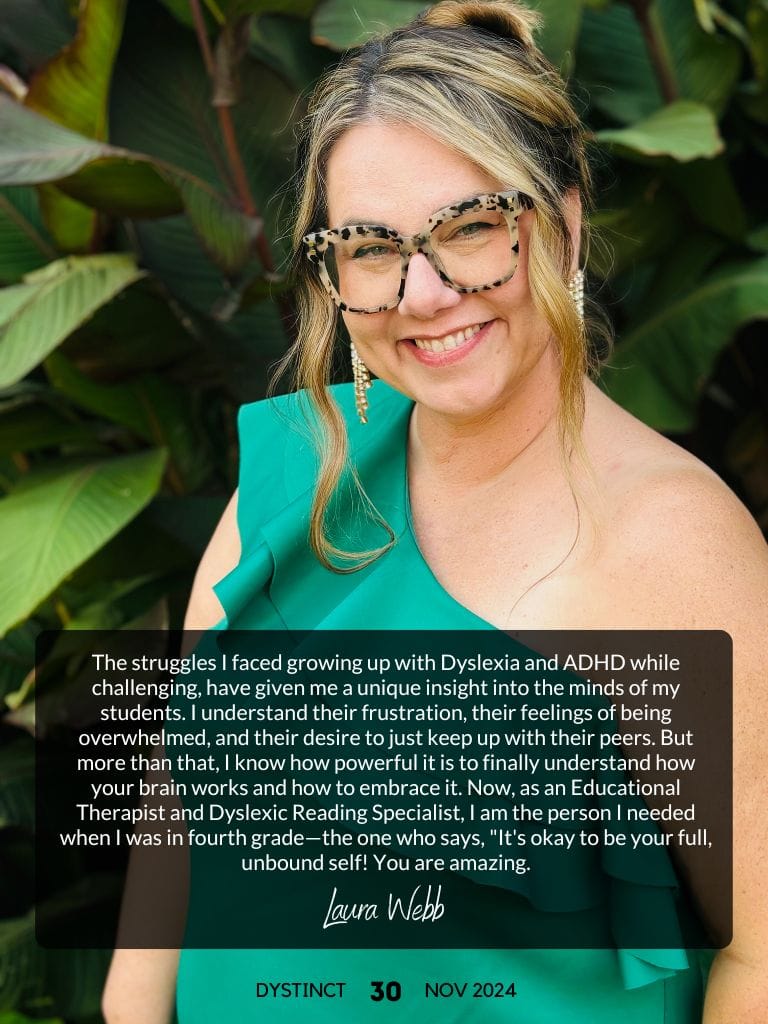
My experiences as a child have shaped the way I approach my work today. The struggles I faced with dyslexia and ADHD, while challenging, have given me a unique insight into the minds of my students. I understand their frustration, their feelings of being overwhelmed, and their desire to just keep up with their peers. But more than that, I know how powerful it is to finally understand how your brain works and to embrace it.
As an Educational Therapist and Dyslexic Reading Specialist, I am the person I needed when I was in fourth grade—the one who says, "It's okay to be fully you! You are amazing." I guide students and their families toward acceptance, helping them realize that a diagnosis is not a limitation but a gateway to new possibilities. Every time I see a student light up with the realization that their brain is incredible, it reminds me why I do this work.
My hope is that none of my students will have to hide their struggles or feel like they are just "surviving" school. Instead, I want them to be their full, unbound selves—equipped with the tools, understanding, and confidence to navigate their unique paths. Ultimately, I strive to empower them not just academically but in life.
Laura Webb
Educational Therapist | learningbeyondletters.com | Facebook | Instagram | YouTube | TikTok | LinkedIn
Laura Webb
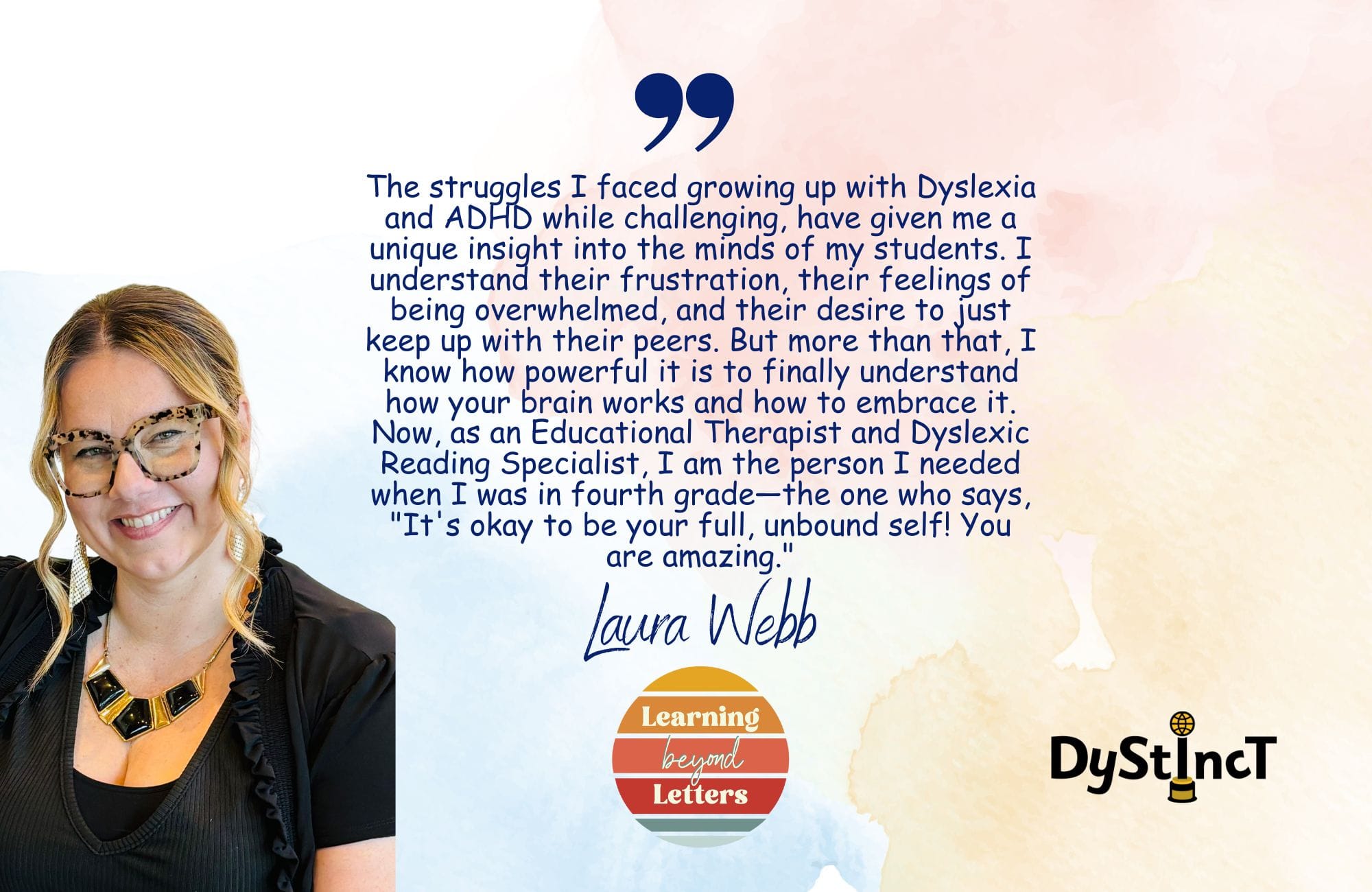
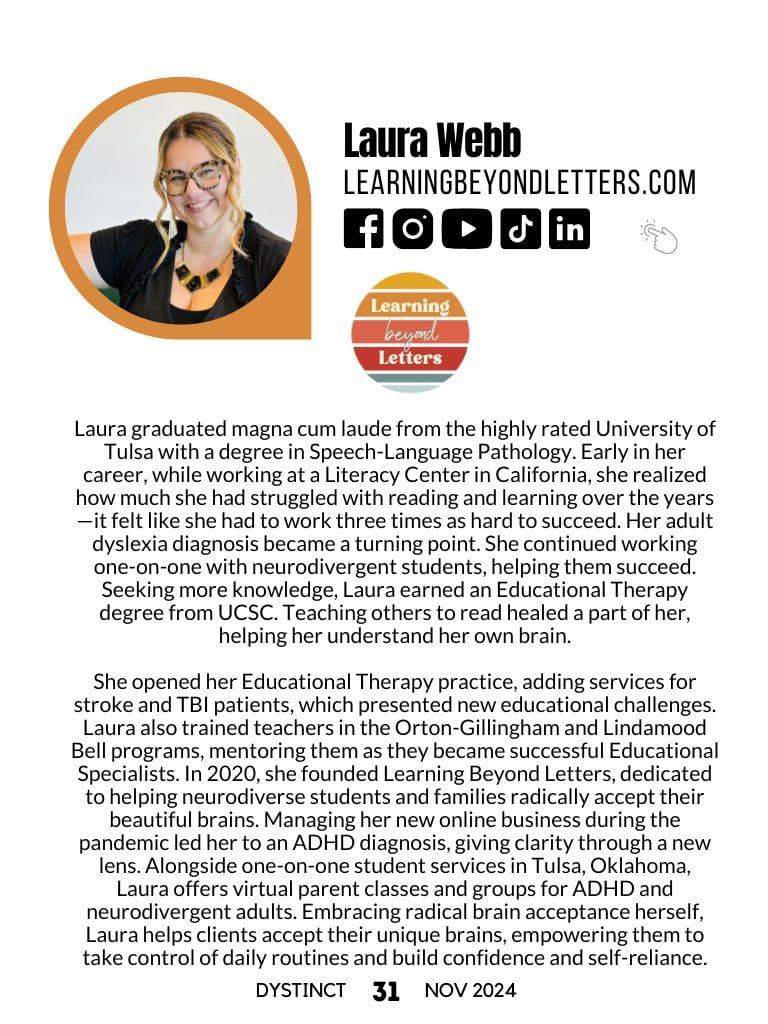
Laura graduated magna cum laude from the highly rated University of Tulsa with a degree in Speech-Language Pathology. Early in her career, while working at a Literacy Center in California, she realized how much she had struggled with reading and learning over the years—it felt like she had to work three times as hard to succeed. Her adult dyslexia diagnosis became a turning point. She continued working one-on-one with neurodivergent students, helping them succeed. Seeking more knowledge, Laura earned an Educational Therapy degree from UCSC. Teaching others to read healed a part of her, helping her understand her own brain.
She opened her Educational Therapy practice, adding services for stroke and TBI patients, which presented new educational challenges. Laura also trained teachers in the Orton-Gillingham and Lindamood Bell programs, mentoring them as they became successful Educational Specialists. In 2020, she founded Learning Beyond Letters, dedicated to helping neurodiverse students and families radically accept their beautiful brains. Managing her new online business during the pandemic led her to an ADHD diagnosis, giving clarity through a new lens. Alongside one-on-one student services in Tulsa, Oklahoma, Laura offers virtual parent classes and groups for ADHD and neurodivergent adults. Embracing radical brain acceptance herself, Laura helps clients accept their unique brains, empowering them to take control of daily routines and build confidence and self-reliance.
Extracts from Dystinct Magazine
Extracts from Dystinct Magazine