Issue 32: Dystinct Report – Interview with Liina Turtonen | Bartek Pilarski
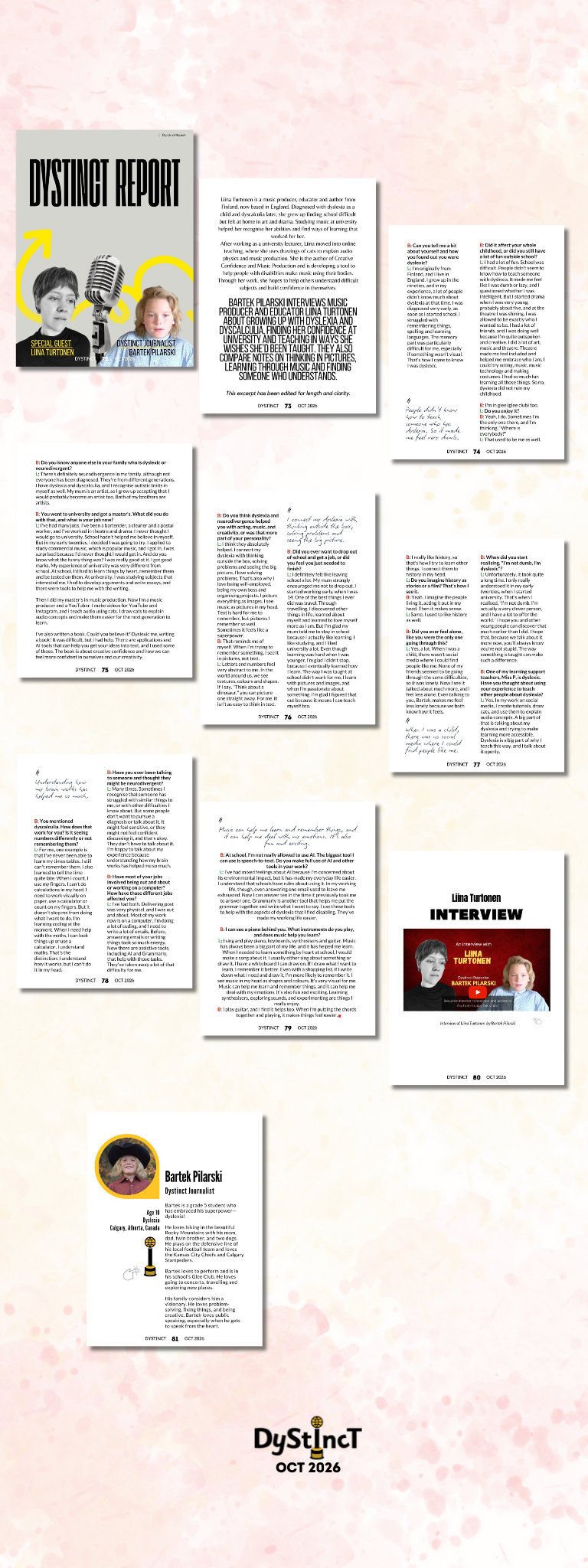
Dystinct Journalist Bartek Pilarski interviews music producer, educator, and author Liina Turtonen about dyslexia, dyscalculia, and finding confidence in her abilities, as they share their experiences of thinking in pictures, learning through music, and feeling understood.

Table of Contents
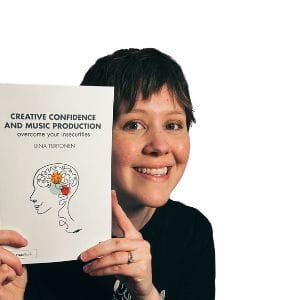
Liina Turtonen is a music producer, educator and author from Finland, now based in England. Diagnosed with dyslexia as a child and dyscalculia later, she grew up finding school difficult but felt at home in art and drama. Studying music at university helped her recognise her abilities and find ways of learning that worked for her.
After working as a university lecturer, Liina moved into online teaching, where she uses drawings of cats to explain audio physics and music production. She is the author of Creative Confidence and Music Production and is developing a tool to help people with disabilities make music using their bodies. Through her work, she hopes to help others understand difficult subjects and build confidence in themselves.
Questions and Answers
Questions and Answers
BARTEK: Can you tell me a bit about yourself and how you found out you were dyslexic?
LIINA: I'm originally from Finland, and I live in England. I grew up in the nineties, and in my experience, a lot of people didn't know much about dyslexia at that time. I was diagnosed very early, as soon as I started school. I struggled with remembering things, spelling and learning languages. The memory part was particularly difficult for me, especially if something wasn't visual. That's how I came to know I was dyslexic.
BARTEK: Did it affect your whole childhood, or did you still have a lot of fun outside school?
LIINA: I had a lot of fun. School was difficult. People didn't seem to know how to teach someone with dyslexia. It made me feel like I was dumb or lazy, and I questioned whether I was intelligent. But I started drama when I was very young, probably about five, and at the theatre I was shining. I was allowed to be exactly who I wanted to be. I had a lot of friends, and I was doing well because I'm quite outspoken and creative. I did a lot of art, music and theatre. Theatre made me feel included and helped me embrace who I am. I could try acting, music, music technology and making costumes. I had so much fun learning all those things. So no, dyslexia did not ruin my childhood.
BARTEK: I'm in glee (glee club) too.
LIINA: Do you enjoy it?
BARTEK: Yeah, I do. Sometimes I'm the only one there, and I'm thinking, "Where is everybody?"
LIINA: That used to be me as well.
BARTEK: Do you know anyone else in your family who is dyslexic or neurodivergent?
LIINA: There's definitely neurodivergence in my family, although not everyone has been diagnosed. They're from different generations.
I have dyslexia and dyscalculia, and I recognise autistic traits in myself as well. My mum is an artist, so I grew up accepting that I would probably become an artist too. Both of my brothers are artists.
BARTEK: You went to university and got a master's. What did you do with that, and what is your job now?
LIINA: I've had many jobs. I've been a bartender, a cleaner and a postal worker, and I've worked in theatre and drama. I never thought I would go to university. School hadn't helped me believe in myself. But in my early twenties, I decided I was going to try. I applied to study commercial music, which is popular music, and I got in. I was surprised because I'd never thought I would get in. And do you know what the funny thing was? I was really good at it. I got good marks. My experience of university was very different from school. At school, I'd had to learn things by heart, remember them and be tested on them. At university, I was studying subjects that interested me. I had to develop arguments and write essays, and there were tools to help me with the writing.
Then I did my master's in music production. Now I'm a music producer and a YouTuber. I make videos for YouTube and Instagram, and I teach audio using cats. I draw cats to explain audio concepts and make them easier for the next generation to learn.
I've also written a book. Could you believe it? Dyslexic me, writing a book! It was difficult, but I had help. There are applications and AI tools that can help you get your ideas into text, and I used some of those. The book is about creative confidence and how we can feel more confident in ourselves and our creativity.
BARTEK: Do you think dyslexia and neurodivergence helped you with acting, music, and creativity, or was that more part of your personality?
LIINA: I think they absolutely helped. I connect my dyslexia with thinking outside the box, solving problems and seeing the big picture. I love solving problems. That's also why I love being self-employed, being my own boss and organising projects. I picture everything as images. I see music as pictures in my head. Text is hard for me to remember, but pictures I remember so well. Sometimes it feels like a superpower.
BARTEK: That reminds me of myself. When I'm trying to remember something, I see it in pictures, not text.
LIINA: Letters and numbers feel very abstract to me. In the world around us, we see textures, colours and shapes. If I say, "Think about a dinosaur," you can picture one straight away. For me, it isn't as easy to think in text.
I connect my dyslexia with thinking outside the box, solving problems and seeing the big picture.
BARTEK: Did you ever want to drop out of school and get a job, or did you feel you just needed to finish?
LIINA: I definitely felt like leaving school a lot. My mum strongly encouraged me not to drop out. I started working early, when I was 14. One of the best things I ever did was travel. Through travelling, I discovered other things in life, learned about myself and learned to love myself more as I am. But I'm glad my mum told me to stay in school because I actually like learning. I like studying, and I liked university a lot. Even though learning was hard when I was younger, I'm glad I didn't stop, because I eventually learned how I learn. The way I was taught at school didn't work for me. I learn with pictures and images, and when I'm passionate about something. I'm glad I figured that out because it means I can teach myself too.
BARTEK: I really like history, so that's how I try to learn other things. I connect them to history in my head.
LIINA: Do you imagine history as stories or a film? That's how I see it.
BARTEK: Yeah. I imagine the people living it, acting it out in my head. Then it makes sense.
LIINA: Same. I used to like history as well.
BARTEK: Did you ever feel alone, like you were the only one going through this?
LIINA: Yes, a lot. When I was a child, there wasn't social media where I could find people like me. None of my friends seemed to be going through the same difficulties, so it was lonely. Now I see it talked about much more, and I feel less alone. Even talking to you, Bartek, makes me feel less lonely because we both know how it feels.
When I was a child, there was no social media where I could find people like me.
BARTEK: When did you start realising, "I'm not dumb, I'm dyslexic"?
LIINA: Unfortunately, it took quite a long time. I only really understood it in my early twenties, when I started university. That's when I realised, "I'm not dumb. I'm actually a very clever person, and I have a lot to offer the world." I hope you and other young people can discover that much earlier than I did. I hope that, because we talk about it more now, you'll always know you're not stupid. The way something is taught can make such a difference.
BARTEK: One of my learning support teachers, Miss P, is dyslexic. Have you thought about using your experience to teach other people about dyslexia?
LIINA: Yes. In my work on social media, I create tutorials, draw cats, and use them to explain audio concepts. A big part of that is talking about my dyslexia and trying to make learning more accessible. Dyslexia is a big part of why I teach this way, and I talk about it openly.
Understanding how my brain works has helped me so much.
BARTEK: You mentioned dyscalculia. How does that work for you? Is it seeing numbers differently or not remembering them?
LIINA: For me, one example is that I've never been able to learn my times tables. I still can't remember them. I also learned to tell the time quite late. When I count, I use my fingers. I can't do calculations in my head. I need to work visually on paper, use a calculator or count on my fingers. But it doesn't stop me from doing what I want to do. I'm learning coding at the moment. When I need help with the maths, I can look things up or use a calculator. I understand maths. That's the distinction: I understand how it works, but I can't do it in my head.
BARTEK: Have you ever been talking to someone and thought they might be neurodivergent?
LIINA: Many times. Sometimes I recognise that someone has struggled with similar things to me, or with other difficulties I know about. But some people don't want to pursue a diagnosis or talk about it. It might feel sensitive, or they might not feel confident discussing it, and that's okay. They don't have to talk about it. I'm happy to talk about my experience because understanding how my brain works has helped me so much.
BARTEK: Have most of your jobs involved being out and about or working on a computer? How have those different jobs affected you?
LIINA: I've had both. Delivering post was very physical, and I was out and about. Most of my work now is on a computer. I'm doing a lot of coding, and I need to write a lot of emails. Before, answering emails or writing things took so much energy. Now there are assistive tools, including AI and Grammarly, that help with those tasks. They've taken away a lot of that difficulty for me.
Music can help me learn and remember things, and it can help me deal with my emotions. It's also fun and exciting.
BARTEK: At school, I'm not really allowed to use AI. The biggest tool I can use is speech-to-text. Do you make full use of AI and other tools in your work?
LIINA: I've had mixed feelings about AI because I'm concerned about its environmental impact, but it has made my everyday life easier. I understand that schools have rules about using it. In my working life, though, even answering one email used to leave me exhausted. Now I can answer ten in the time it previously took me to answer one. Grammarly is another tool that helps me put the grammar together and write what I want to say. I use these tools to help with the aspects of dyslexia that I find disabling. They've made my working life easier.
BARTEK: I can see a piano behind you. What instruments do you play, and does music help you learn?
LIINA: I sing and play piano, keyboards, synthesisers and guitar. Music has always been a big part of my life, and it has helped me learn. When I needed to learn something by heart at school, I would make a song about it. I usually either sing about something or draw it. I have a whiteboard I can draw on. If I draw what I want to learn, I remember it better. Even with a shopping list, if I write down what I need and draw it, I'm more likely to remember it. I see music in my head as shapes and colours. It's very visual for me. Music can help me learn and remember things, and it can help me deal with my emotions. It's also fun and exciting. Learning synthesisers, exploring sounds, and experimenting are things I really enjoy.
BARTEK: I play guitar, and I find it helps too. When I'm putting the chords together and playing, it makes things feel easier.
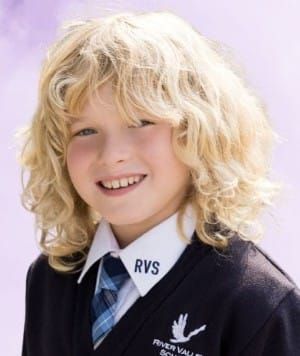
Bartek Pilarski
Dystinct Journalist | Age 10 | Dyslexia | Calgary, Alberta, Canada
Bartek Pilarski
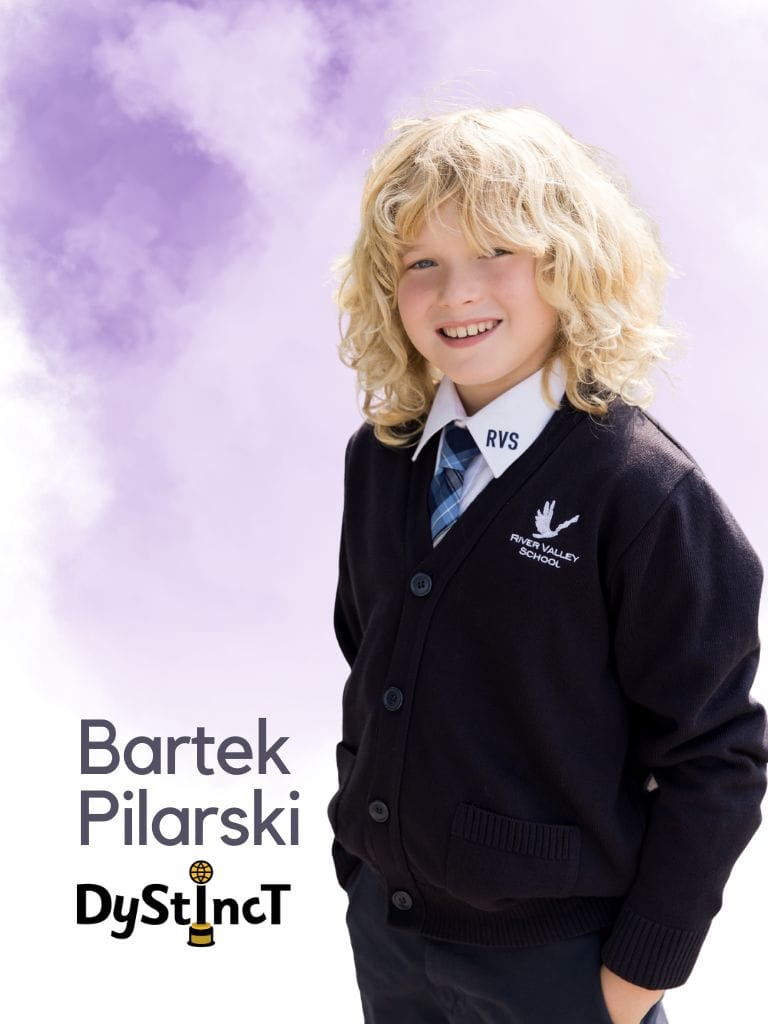
Bartek is a grade 5 student who has embraced his superpower - dyslexia!
He loves hiking in the beautiful Rocky Mountains with his mom, dad, twin brother, and two dogs. He plays on the defensive line of his local football team and loves the Kansas City Chiefs and Calgary Stampeders.
Bartek loves to perform and is in his school's Glee Club. He loves going to concerts, travelling and exploring new places.
His family considers him a visionary. He loves problem-solving, fixing things, and being creative. Bartek loves public speaking, especially when he gets to speak from the heart.
Extracts from Dystinct Magazine
Extracts from Dystinct Magazine