Issue 27: Dyspraxia in PE lessons | Anne Vize
Anne shares practical strategies for making Physical Education lessons more inclusive for students with dyspraxia, showing how a thoughtful ‘notice and adjust’ approach from warmups and skill-building activities to cool downs can help PE teachers create supportive and engaging environments.

Table of Contents
When I first sat down to write about dyspraxia, I found myself thinking back to some of my early career teaching experiences. I initially trained as a Physical Education teacher before working in specialist and inclusive education – and I’m sure there’s still part of me that loves being outdoors, active and moving more than anything! When I first trained in Physical Education, I realised that many of the people I was learning alongside were highly skilled at their chosen sports, and they tended to pick up new movement skills quickly and easily. They moved from the cognitive stage of motor skill acquisition to the mastery stage quickly. They responded quickly and effectively to feedback about their movement skills and could apply that feedback to refine their movements. Once mastered, their new skills tended to remain in place as they moved on to new skills in other sports. The pace of skills-based learning was rapid, and the underlying assumption was that everyone learnt in the same way and at a similar speed. Years later, I reflected upon how the skills of this group of upcoming PE teachers may have impacted the approach they took to their teaching. Lacking any lived experience of movement difficulties and without specific training in dyspraxia built into teacher education courses, it is highly likely that at least some of these up-and-coming PE teachers went into schools assuming everyone learnt new activities in the same way – quickly and easily.
An important role
An important role
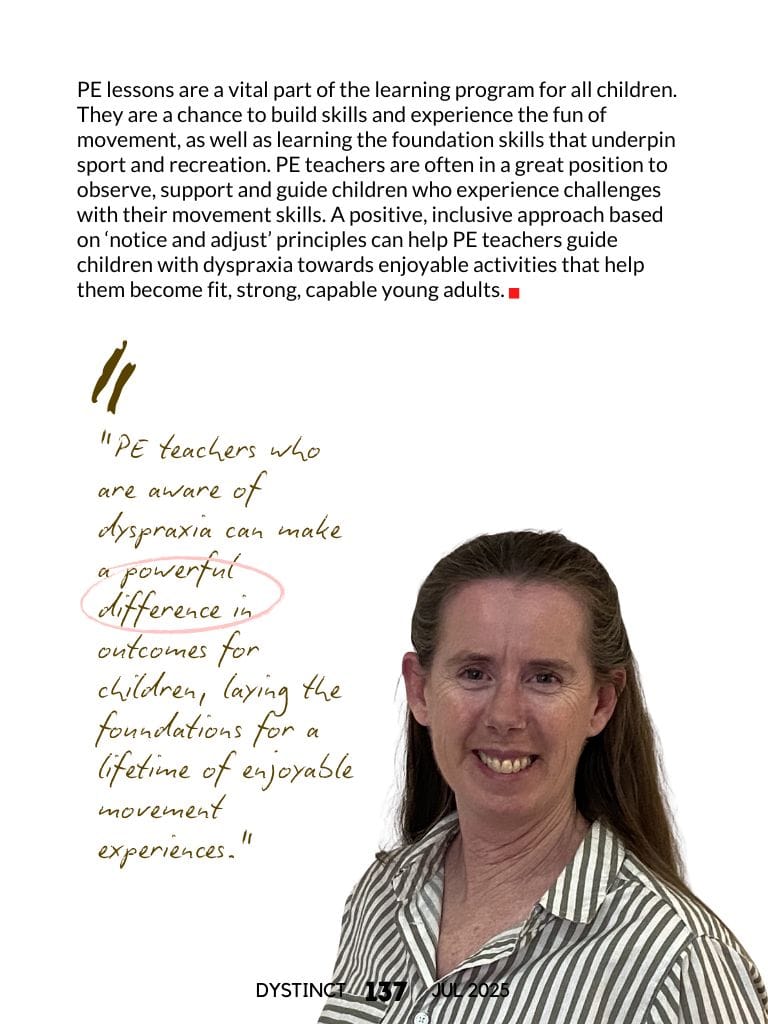
For children who have dyspraxia, their PE teacher can play a pivotal role in their lives. The PE teacher is someone who sees gross and fine motor skills as the backbone of any sporting activity. They pay close attention to them and think carefully about how to provide feedback and structure activities to help children achieve mastery. They observe many children learning and performing motor skills at similar ages and stages, allowing them to identify when there is a significant difference in learning pathways and progress over time. With training in fundamental motor skills, movement patterns and skill acquisition, the PE teacher is in an ideal position to notice what is happening with a child’s movement skills. They are also in an ideal position to adjust the teaching so that learning experiences are successful and positive. PE teachers who are aware of dyspraxia can make a powerful difference in outcomes for children, laying the foundations for a lifetime of enjoyable movement experiences.
The P.E teacher is in an ideal position to adjust the teaching so that learning experiences are successful and positive.
Notice and adjust
Notice and adjust
The ’notice and adjust’ approach to teaching can be applied as readily to PE classes as it applies to early literacy, maths or science. It’s about building a supportive scaffold that lasts as long as a child needs it. The adjustments can be applied in ways that are relevant to the skill being learnt and to the current needs of the child. Notice and adjust means being observant and using tools like a task analysis checklist, video, and motor skills assessment to keep track of how children are progressing. The information a PE teacher collects can sit alongside notes from a classroom teacher and others in a school setting to help health professionals unpack what is happening for a child experiencing movement difficulties.
Notice and adjust means making a change to ‘business as usual’ when the teacher observes that a child is struggling with their motor skills. This is where an informed and trained PE teacher can really come into their own. The adjustments they make to the scope and sequence of their teaching program, the way they share information and the type and amount of feedback they provide can all make a significant difference to how a child who has dyspraxia learns and succeeds. Although it may seem like PE is a setting that just doesn’t work for children who have dyspraxia, in fact, there are many ways that teachers can adjust what they do to tilt the balance towards success.
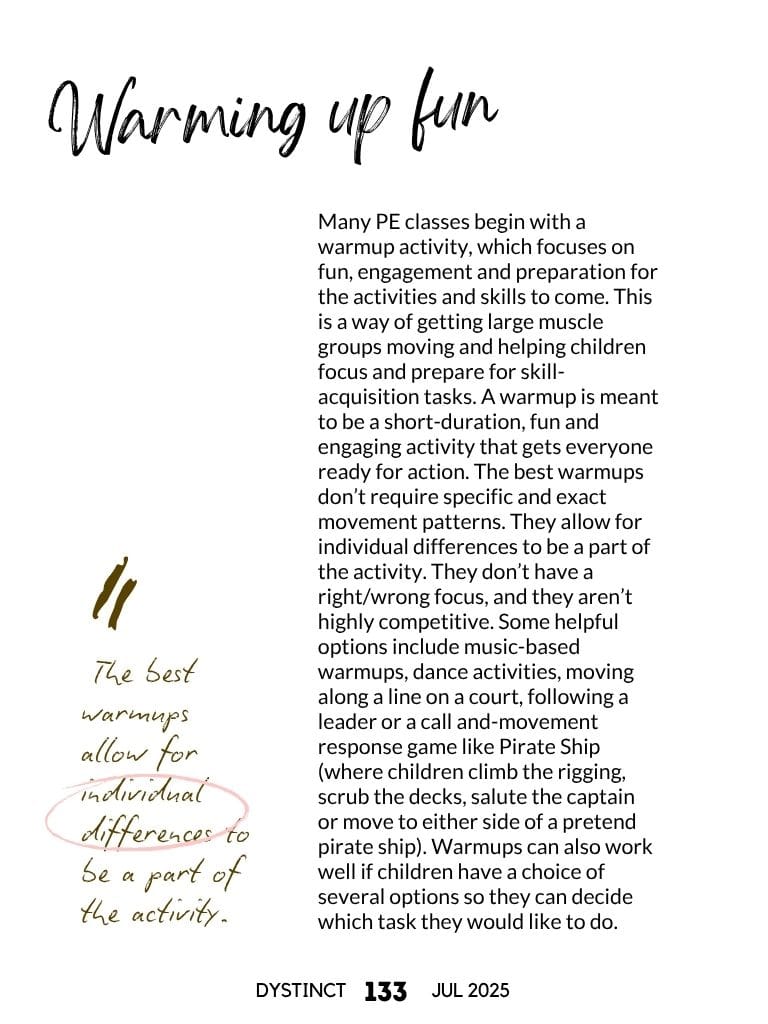
Warming up fun
Warming up fun
Many PE classes begin with a warmup activity, which focuses on fun, engagement and preparation for the activities and skills to come. This is a way of getting large muscle groups moving and helping children focus and prepare for skill-acquisition tasks. A warmup is meant to be a short-duration, fun and engaging activity that gets everyone ready for action. The best warmups don’t require specific and exact movement patterns. They allow for individual differences to be a part of the activity. They don’t have a right/wrong focus, and they aren’t highly competitive. Some helpful options include music-based warmups, dance activities, moving along a line on a court, following a leader or a call and-movement response game like Pirate Ship (where children climb the rigging, scrub the decks, salute the captain or move to either side of a pretend pirate ship). Warmups can also work well if children have a choice of several options so they can decide which task they would like to do.
The best warmups allow for individual differences to be a part of the activity.
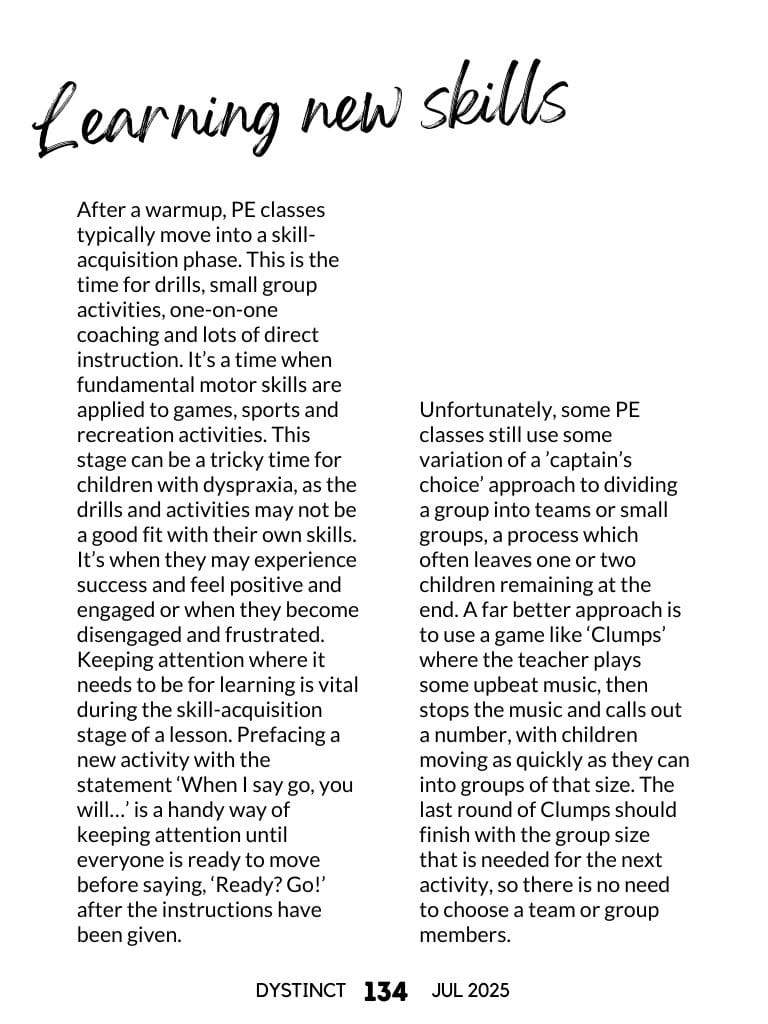
Learning new skills
Learning new skills
After a warmup, PE classes typically move into a skill-acquisition phase. This is the time for drills, small group activities, one-on-one coaching and lots of direct instruction. It’s a time when fundamental motor skills are applied to games, sports and recreation activities. This stage can be a tricky time for children with dyspraxia, as the drills and activities may not be a good fit with their own skills. It’s when they may experience success and feel positive and engaged or when they become disengaged and frustrated. Keeping attention where it needs to be for learning is vital during the skill-acquisition stage of a lesson. Prefacing a new activity with the statement ‘When I say go, you will…’ is a handy way of keeping attention until everyone is ready to move before saying, ‘Ready? Go!’ after the instructions have been given.
Unfortunately, some PE classes still use some variation of a ’captain’s choice’ approach to dividing a group into teams or small groups, a process which often leaves one or two children remaining at the end. A far better approach is to use a game like ‘Clumps’ where the teacher plays some upbeat music, then stops the music and calls out a number, with children moving as quickly as they can into groups of that size. The last round of Clumps should finish with the group size that is needed for the next activity, so there is no need to choose a team or group members.
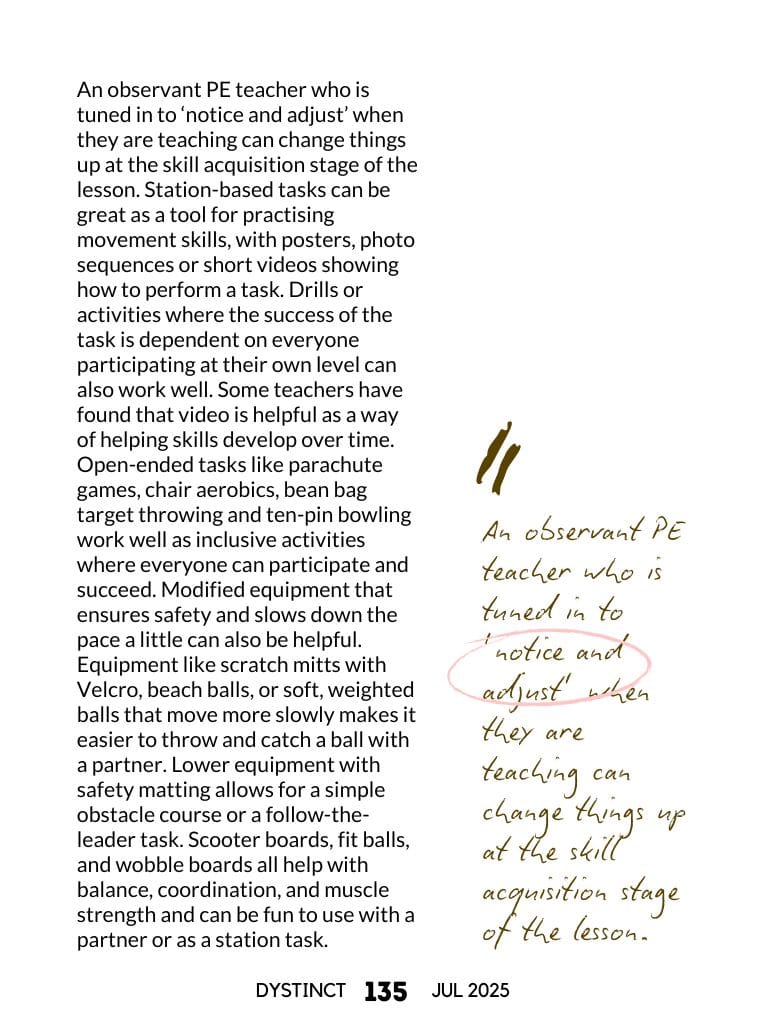
An observant PE teacher who is tuned in to ‘notice and adjust’ when they are teaching can change things up at the skill acquisition stage of the lesson. Station-based tasks can be great as a tool for practising movement skills, with posters, photo sequences or short videos showing how to perform a task. Drills or activities where the success of the task is dependent on everyone participating at their own level can also work well. Some teachers have found that video is helpful as a way of helping skills develop over time. Open-ended tasks like parachute games, chair aerobics, bean bag target throwing and ten-pin bowling work well as inclusive activities where everyone can participate and succeed. Modified equipment that ensures safety and slows down the pace a little can also be helpful. Equipment like scratch mitts with Velcro, beach balls, or soft, weighted balls that move more slowly makes it easier to throw and catch a ball with a partner. Lower equipment with safety matting allows for a simple obstacle course or a follow-the-leader task. Scooter boards, fit balls, and wobble boards all help with balance, coordination, and muscle strength and can be fun to use with a partner or as a station task.
An observant PE teacher who is tuned in to ‘notice and adjust’ when they are teaching can change things up at the skill acquisition stage of the lesson.
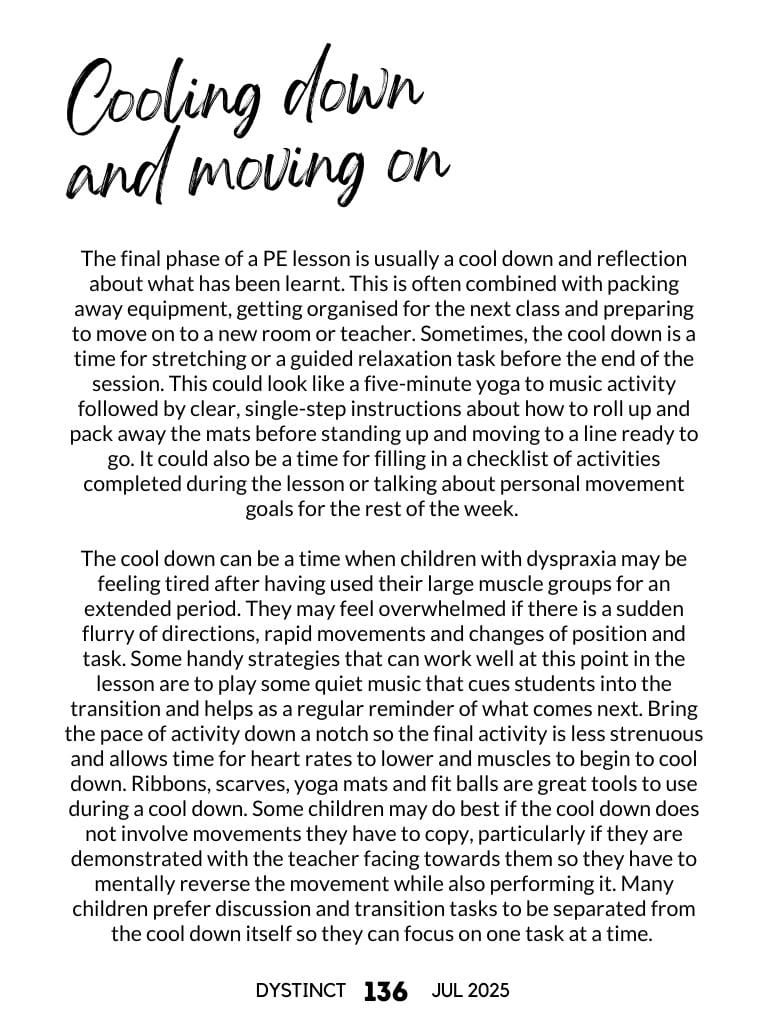
Cooling down and moving on
Cooling down and moving on
The final phase of a PE lesson is usually a cool down and reflection about what has been learnt. This is often combined with packing away equipment, getting organised for the next class and preparing to move on to a new room or teacher. Sometimes, the cool down is a time for stretching or a guided relaxation task before the end of the session. This could look like a five-minute yoga to music activity followed by clear, single-step instructions about how to roll up and pack away the mats before standing up and moving to a line ready to go. It could also be a time for filling in a checklist of activities completed during the lesson or talking about personal movement goals for the rest of the week.
The cool down can be a time when children with dyspraxia may be feeling tired after having used their large muscle groups for an extended period. They may feel overwhelmed if there is a sudden flurry of directions, rapid movements and changes of position and task. Some handy strategies that can work well at this point in the lesson are to play some quiet music that cues students into the transition and helps as a regular reminder of what comes next. Bring the pace of activity down a notch so the final activity is less strenuous and allows time for heart rates to lower and muscles to begin to cool down. Ribbons, scarves, yoga mats and fit balls are great tools to use during a cool down. Some children may do best if the cool down does not involve movements they have to copy, particularly if they are demonstrated with the teacher facing towards them so they have to mentally reverse the movement while also performing it. Many children prefer discussion and transition tasks to be separated from the cool down itself so they can focus on one task at a time.
PE lessons are a vital part of the learning program for all children. They are a chance to build skills and experience the fun of movement, as well as learning the foundation skills that underpin sport and recreation. PE teachers are often in a great position to observe, support and guide children who experience challenges with their movement skills. A positive, inclusive approach based on ‘notice and adjust’ principles can help PE teachers guide children with dyspraxia towards enjoyable activities that help them become fit, strong, capable young adults.
Anne Vize
Education Writer, Specialist Teacher and Author | annevizewriting.com | Facebook | LinkedIn | TeachersPayTeachers
Anne Vize
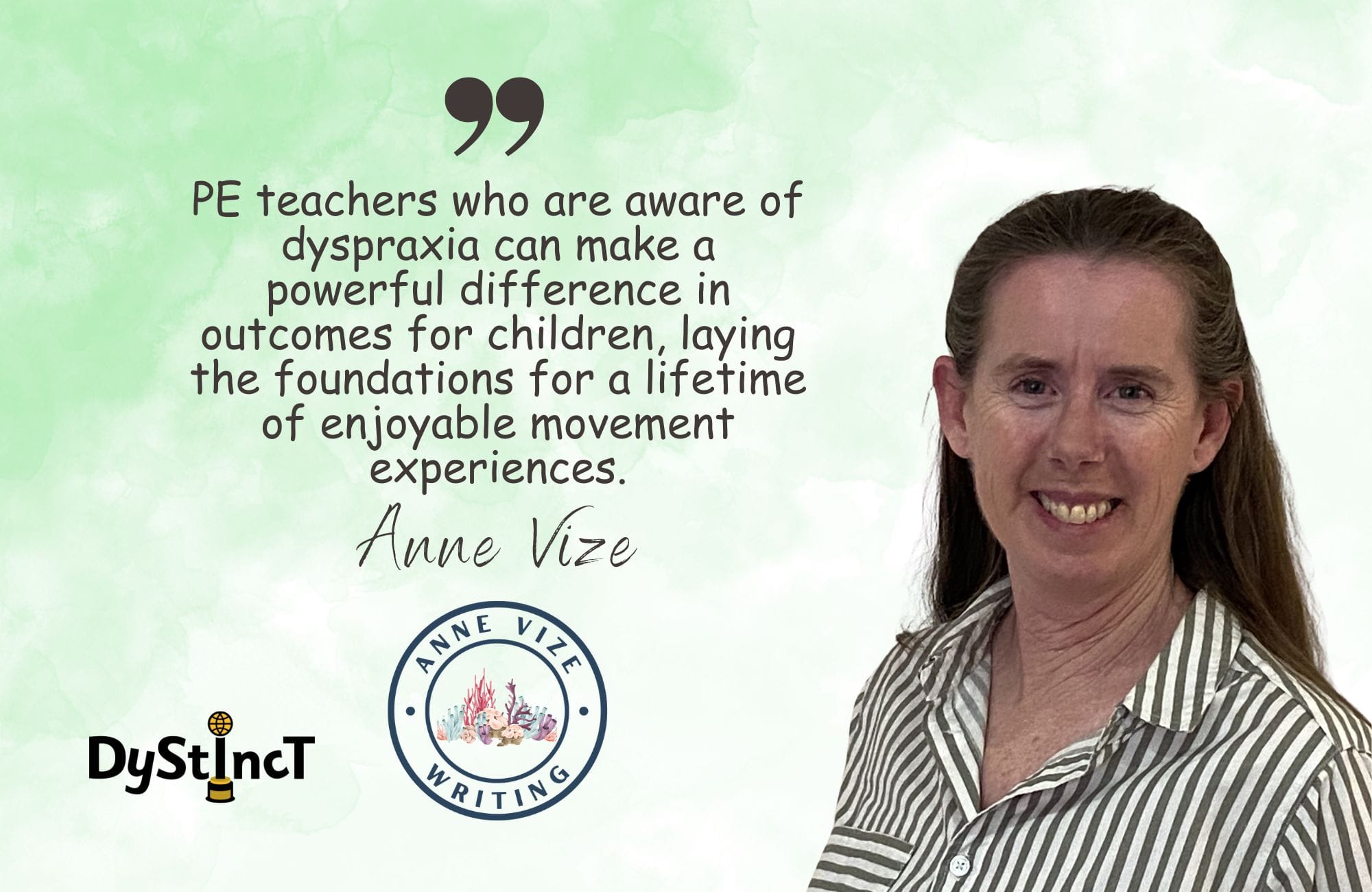
As an education writer and specialist teacher, I love creating books, resources and articles that meet the needs of students with unique learning needs and their teachers. Many of the students who use my work have learning differences or disability that affect how they engage with text and visual information. This means they often prefer texts that are straightforward and clear, with strong visual cues. They enjoy stories that unfold logically, with a few characters in a setting that makes sense to them. Developing real-world texts that help students participate in everyday activities in the community, find and succeed at work and access health, sports, and civics information is a vital part of my work. My work is published in Australia and New Zealand by Essential Resources and online through my store
BUY BOOK
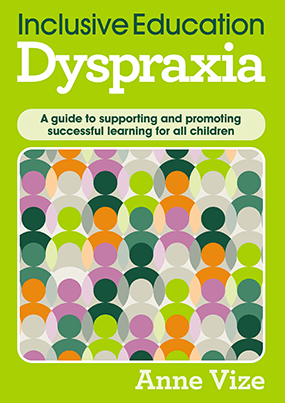
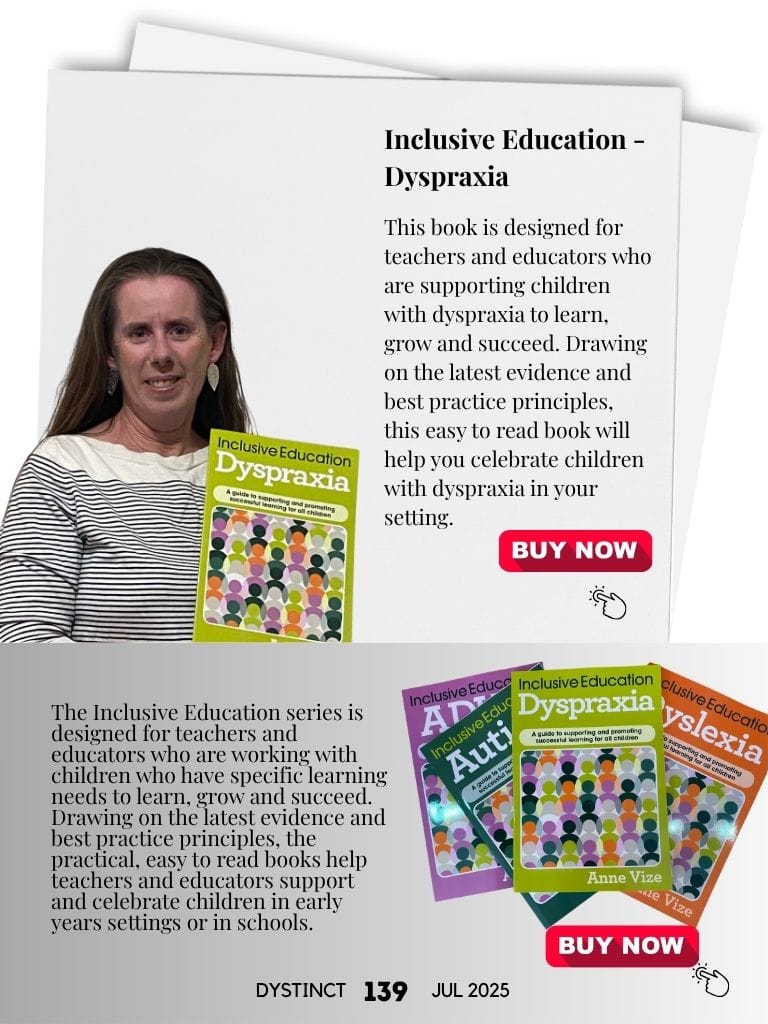
Inclusive Education - Dyspraxia
This book is designed for teachers and educators who are supporting children with dyspraxia to learn, grow and succeed. Drawing on the latest evidence and best practice principles, this easy to read book will help you celebrate children with dyspraxia in your setting.
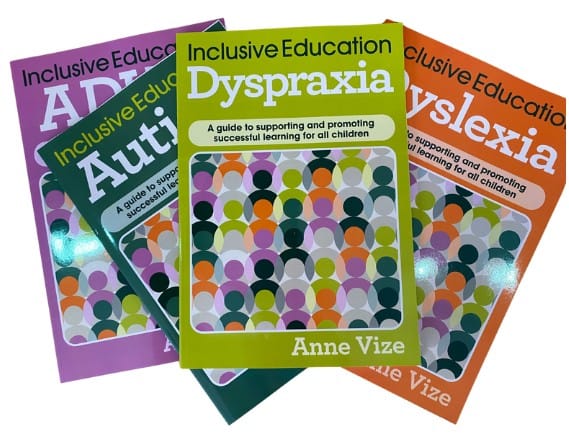
Inclusive Education series
The Inclusive Education series is designed for teachers and educators who are working with children who have specific learning needs to learn, grow and succeed. Drawing on the latest evidence and best practice principles, the practical, easy to read books help teachers and educators support and celebrate children in early years settings or in schools.
Extracts from Dystinct Magazine
Extracts from Dystinct Magazine