Issue 26: Debunking Three-Cueing: What I Got Wrong About Teaching Reading | Anna Geiger | The Measured Mom
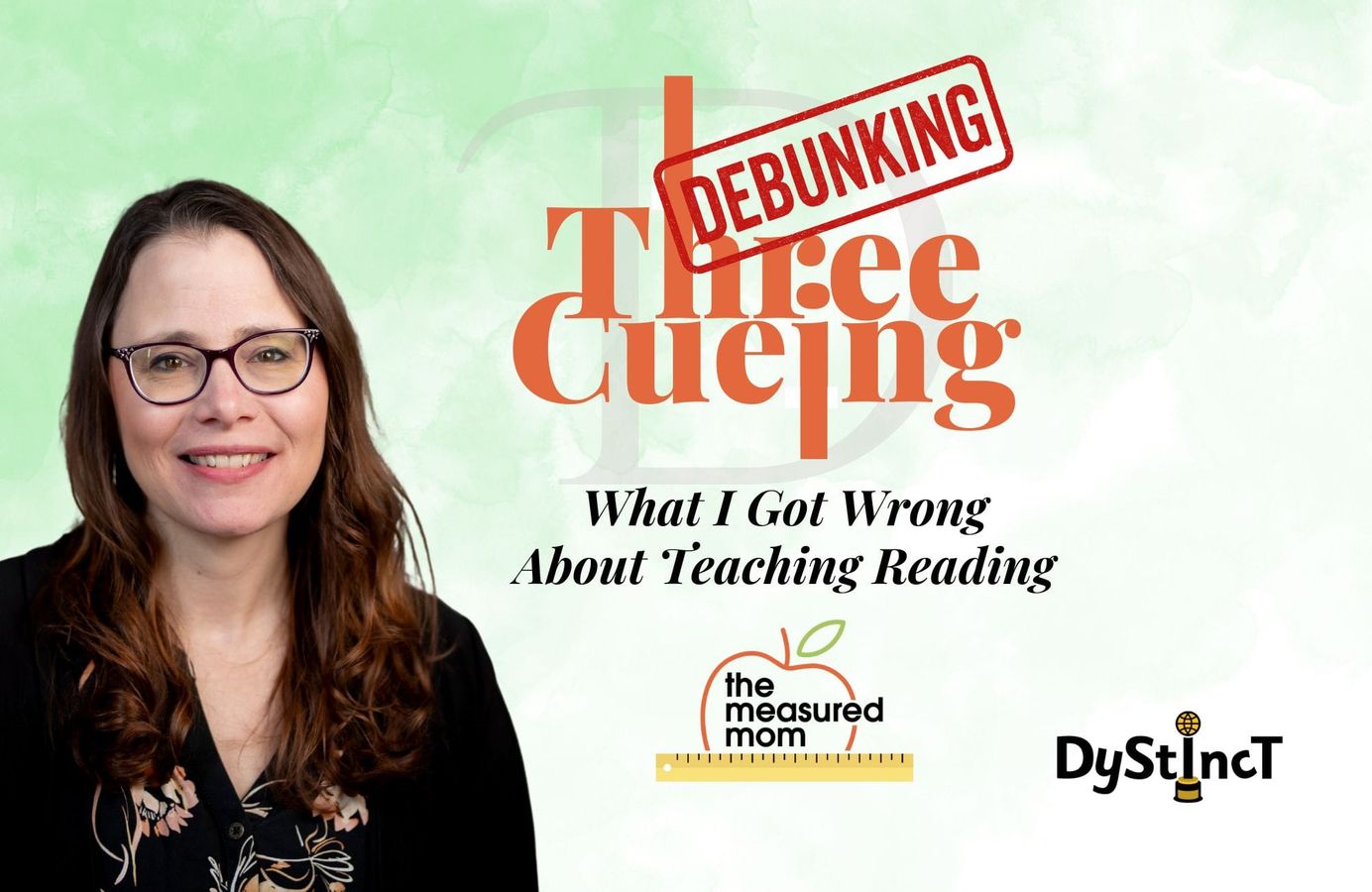
Anna Geiger, the founder of The Measured Mom, reflects on how she once relied on the widely accepted but flawed three-cueing model to teach reading until she discovered it was not grounded in research. She shares the evidence that debunks three-cueing and offers practical guidance.

Table of Contents
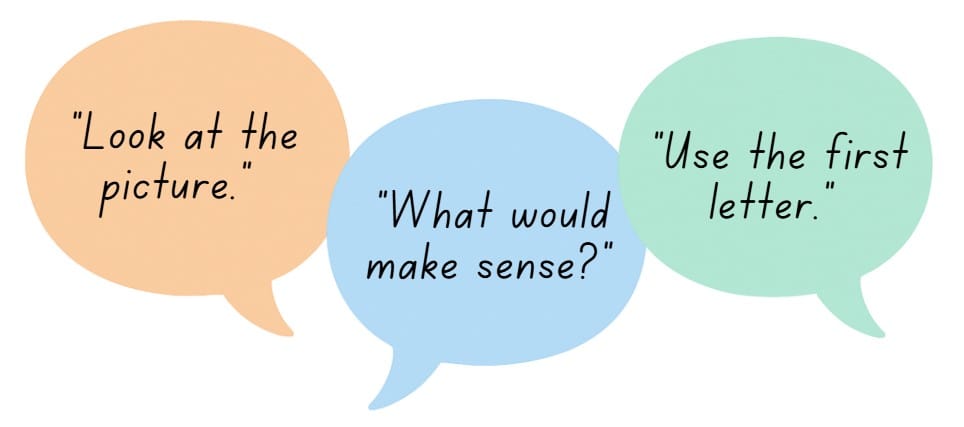
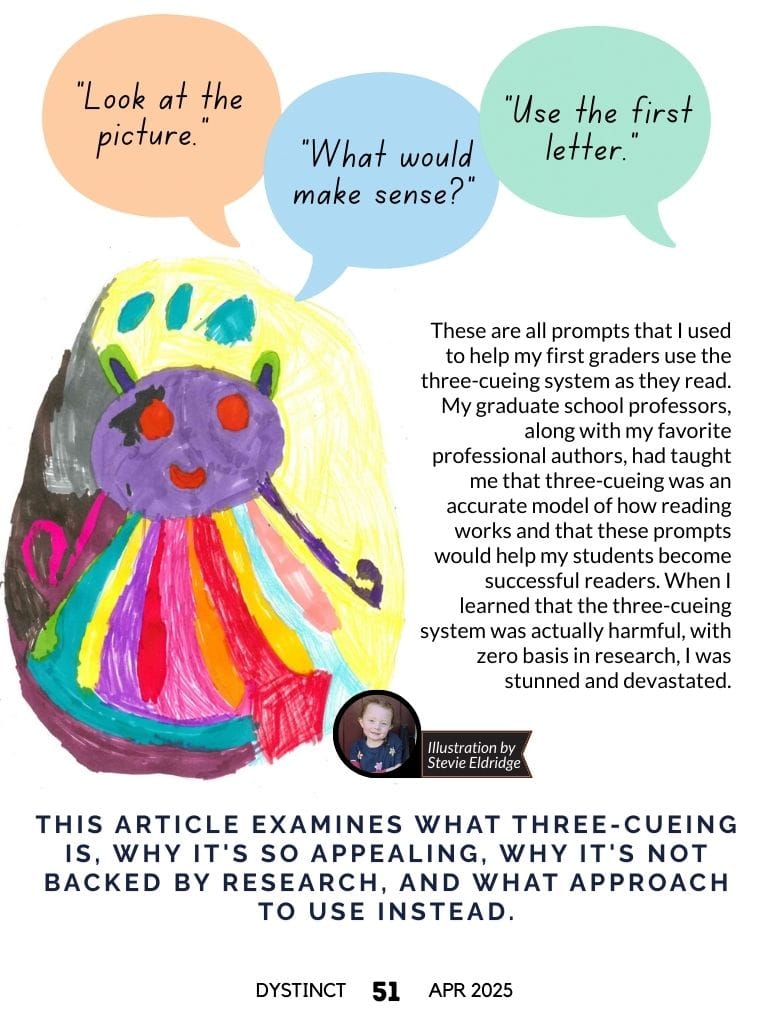
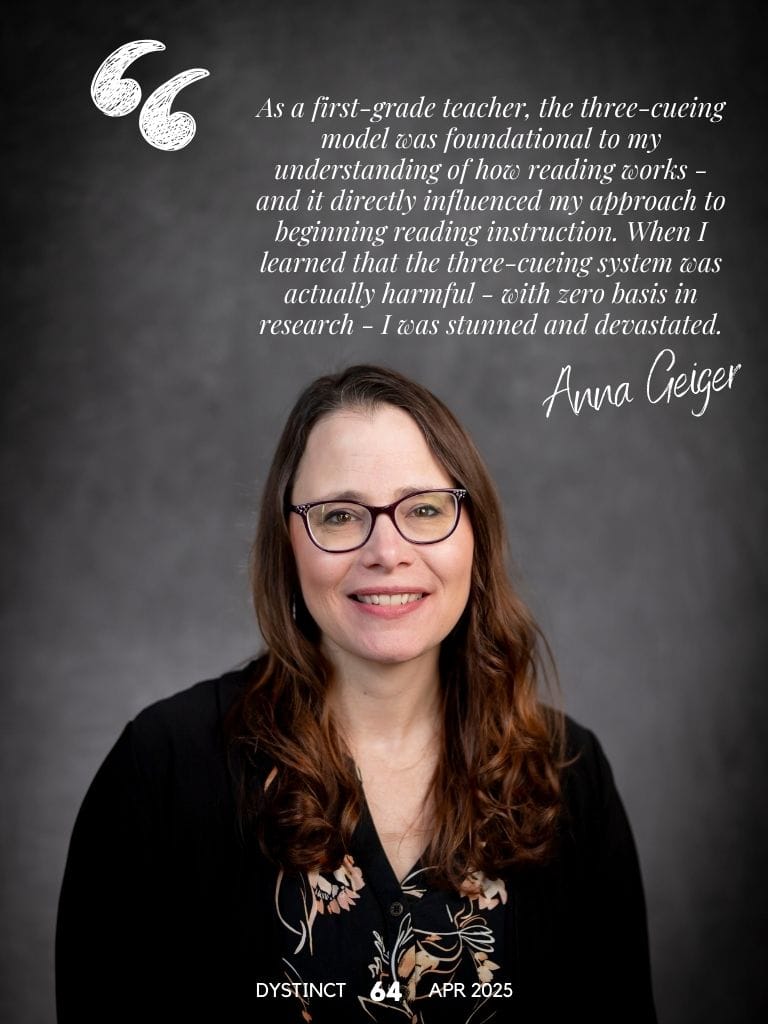
These are all prompts that I used to help my first graders use the three-cueing system as they read. My graduate school professors, along with my favorite professional authors, had taught me that three-cueing was an accurate model of how reading works and that these prompts would help my students become successful readers. When I learned that the three-cueing system was actually harmful, with zero basis in research, I was stunned and devastated.
What is Three-Cueing?
What is Three-Cueing?
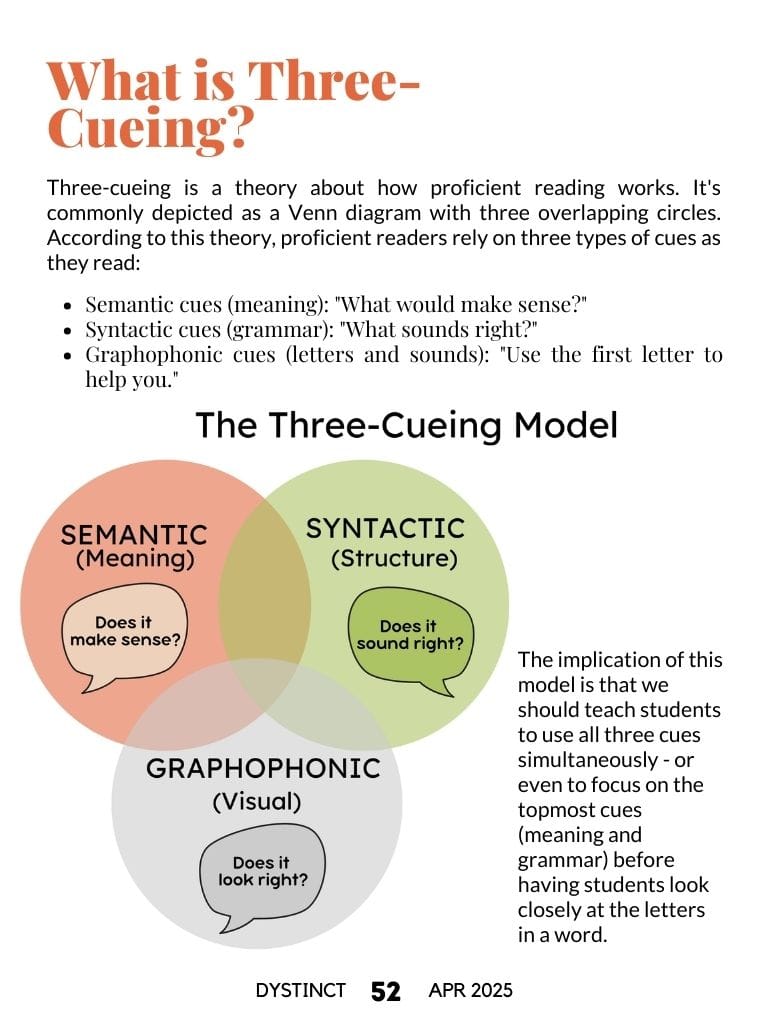
Three-cueing is a theory about how proficient reading works. It's commonly depicted as a Venn diagram with three overlapping circles. According to this theory, proficient readers rely on three types of cues as they read:
- Semantic cues (meaning): "What would make sense?"
- Syntactic cues (grammar): "What sounds right?"
- Graphophonic cues (letters and sounds): "Use the first letter to help you."
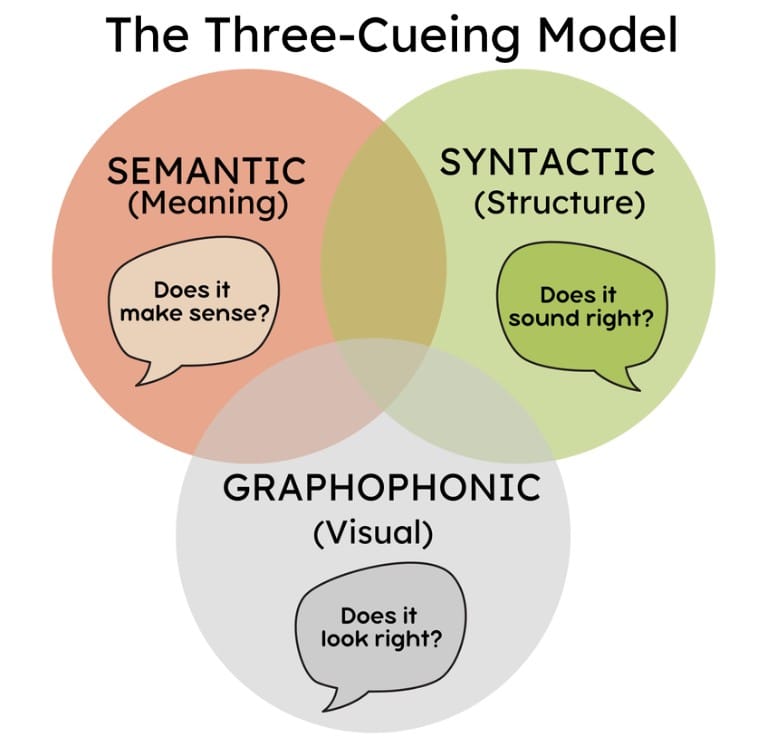
The implication of this model is that we should teach students to use all three cues simultaneously - or even to focus on the topmost cues (meaning and grammar) before having students look closely at the letters in a word.
As a first-grade teacher, the three-cueing model was foundational to my understanding of how reading works - and it directly influenced my approach to beginning reading instruction. Here's how that looked in practice: I gave my beginning readers leveled predictable books that allowed them to use the picture or context to identify words. I would help my students read the title of a pattern book, such as "I Wash the Car," and then show them how to use the pictures, context, and partial phonics to identify the final word on each page. "I wash the windows. I wash the door. I wash the headlights." My students learned these patterns quickly. When they had adequate vocabulary, they "read" the books fluently and understood the text. I was teaching them to be strategic readers—or so I thought.
Why is Three-Cueing So Appealing?
Why is Three-Cueing So Appealing?
Let's be honest - the theory of three-cueing just feels right. When we read, it doesn't seem like we're processing every letter. It feels like we're using context and making smart predictions. And yes, context does help us confirm what we're reading and catch our mistakes. But what feels like prediction is actually lightning-fast word recognition that is so automatic we hardly have to think about it.
Another reason three-cueing is so appealing is that using it makes kids sound like fluent readers - and what teacher doesn't love to hear fluent reading? I remember conducting individual reading conferences, pleased with how smoothly my students breezed through their predictable books. I felt a bit smug when I heard students from other classes sounding out every single word. My students were fluent. What I didn't understand was that being able to land on the correct words using pictures and context wasn't truly reading - especially when my students couldn't have read the words in isolation. I didn't understand that true fluency rests on automaticity at the word level. Many of my students only had fake fluency—a performance of reading rather than actual reading.
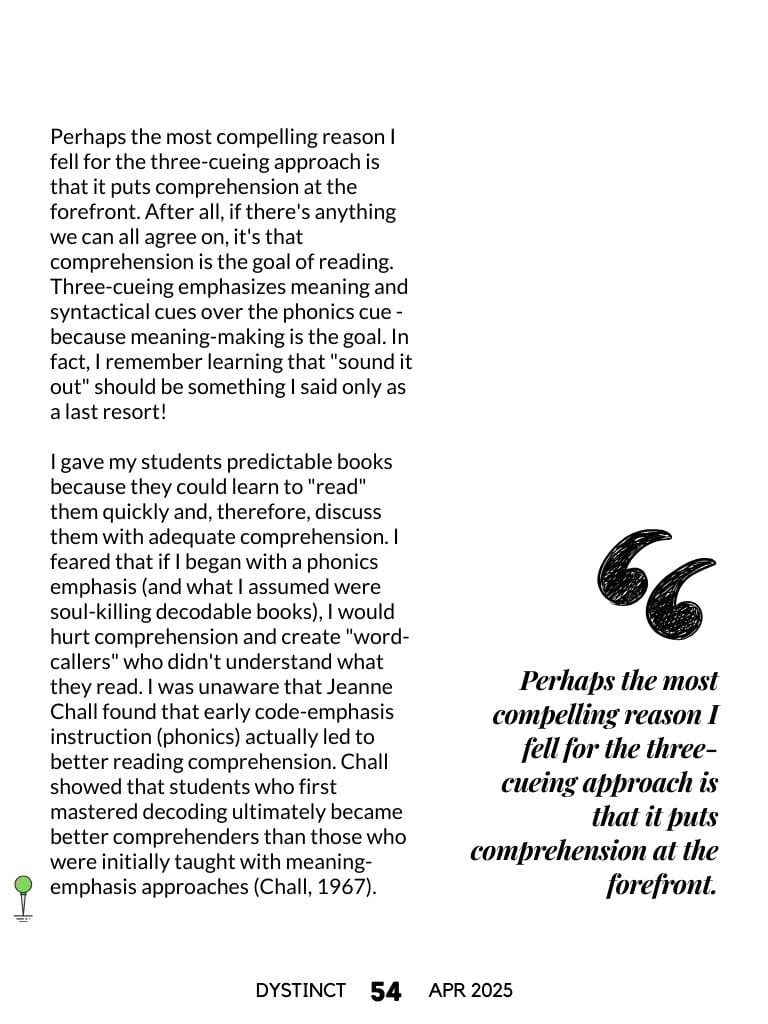
Perhaps the most compelling reason I fell for the three-cueing approach is that it puts comprehension at the forefront. After all, if there's anything we can all agree on, it's that comprehension is the goal of reading. Three-cueing emphasizes meaning and syntactical cues over the phonics cue - because meaning-making is the goal. In fact, I remember learning that "sound it out" should be something I said only as a last resort!
I gave my students predictable books because they could learn to "read" them quickly and, therefore, discuss them with adequate comprehension. I feared that if I began with a phonics emphasis (and what I assumed were soul-killing decodable books), I would hurt comprehension and create "word-callers" who didn't understand what they read. I was unaware that Jeanne Chall found that early code-emphasis instruction (phonics) actually led to better reading comprehension. Chall showed that students who first mastered decoding ultimately became better comprehenders than those who were initially taught with meaning-emphasis approaches (Chall, 1967).
Perhaps the most compelling reason I fell for the three-cueing approach is that it puts comprehension at the forefront.
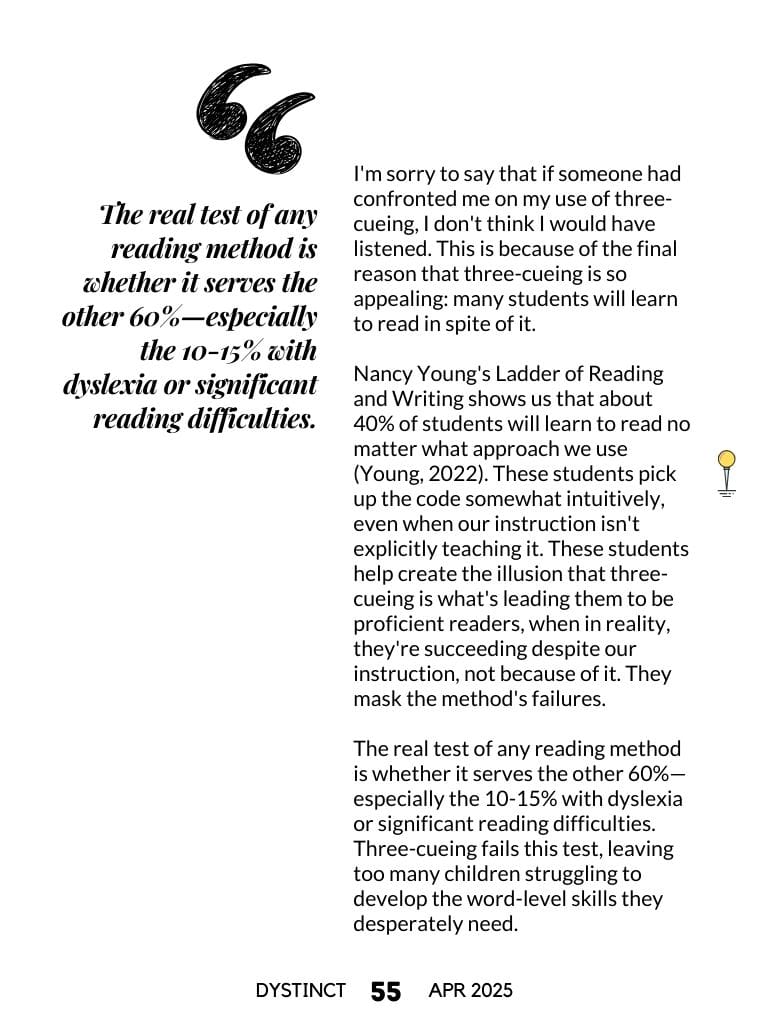
I'm sorry to say that if someone had confronted me on my use of three-cueing, I don't think I would have listened. This is because of the final reason that three-cueing is so appealing: many students will learn to read in spite of it.
The real test of any reading method is whether it serves the other 60%—especially the 10-15% with dyslexia or significant reading difficulties.
Nancy Young's Ladder of Reading and Writing shows us that about 40% of students will learn to read no matter what approach we use (Young, 2022). These students pick up the code somewhat intuitively, even when our instruction isn't explicitly teaching it. These students help create the illusion that three-cueing is what's leading them to be proficient readers, when in reality, they're succeeding despite our instruction, not because of it. They mask the method's failures.
The real test of any reading method is whether it serves the other 60%—especially the 10-15% with dyslexia or significant reading difficulties. Three-cueing fails this test, leaving too many children struggling to develop the word-level skills they desperately need.
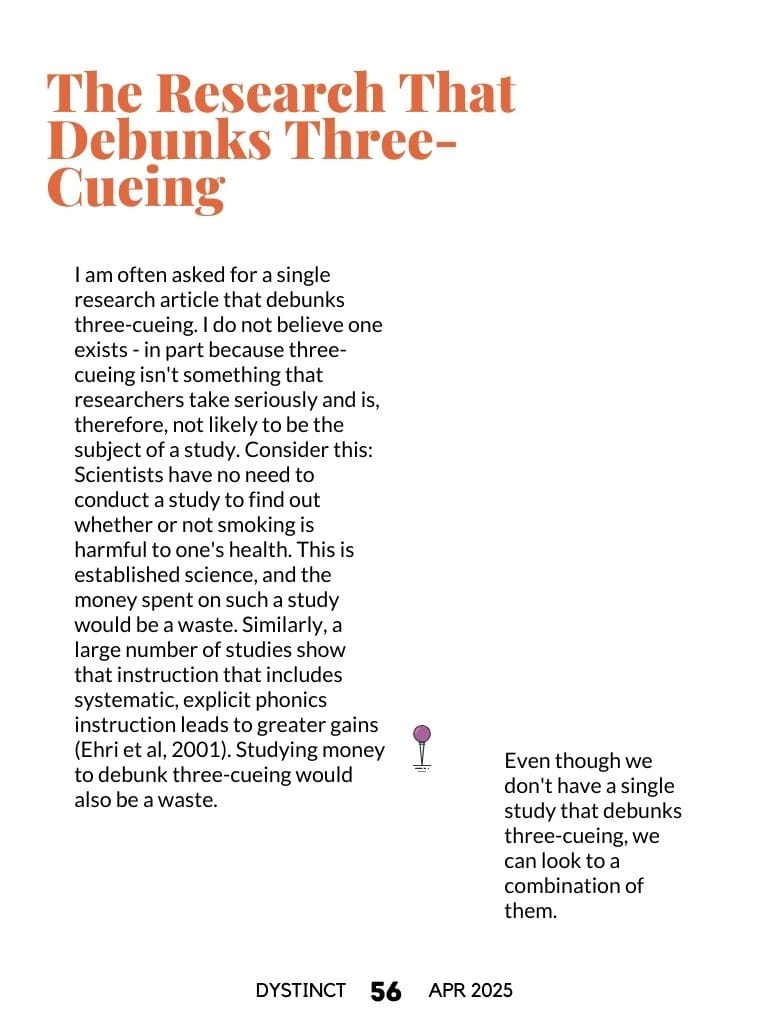
The Research That Debunks Three-Cueing
The Research That Debunks Three-Cueing
I am often asked for a single research article that debunks three-cueing. I do not believe one exists - in part because three-cueing isn't something that researchers take seriously and is, therefore, not likely to be the subject of a study. Consider this: Scientists have no need to conduct a study to find out whether or not smoking is harmful to one's health. This is established science, and the money spent on such a study would be a waste. Similarly, a large number of studies show that instruction that includes systematic, explicit phonics instruction leads to greater gains (Ehri et al, 2001). Studying money to debunk three-cueing would also be a waste.
Even though we don't have a single study that debunks three-cueing, we can look to a combination of them.
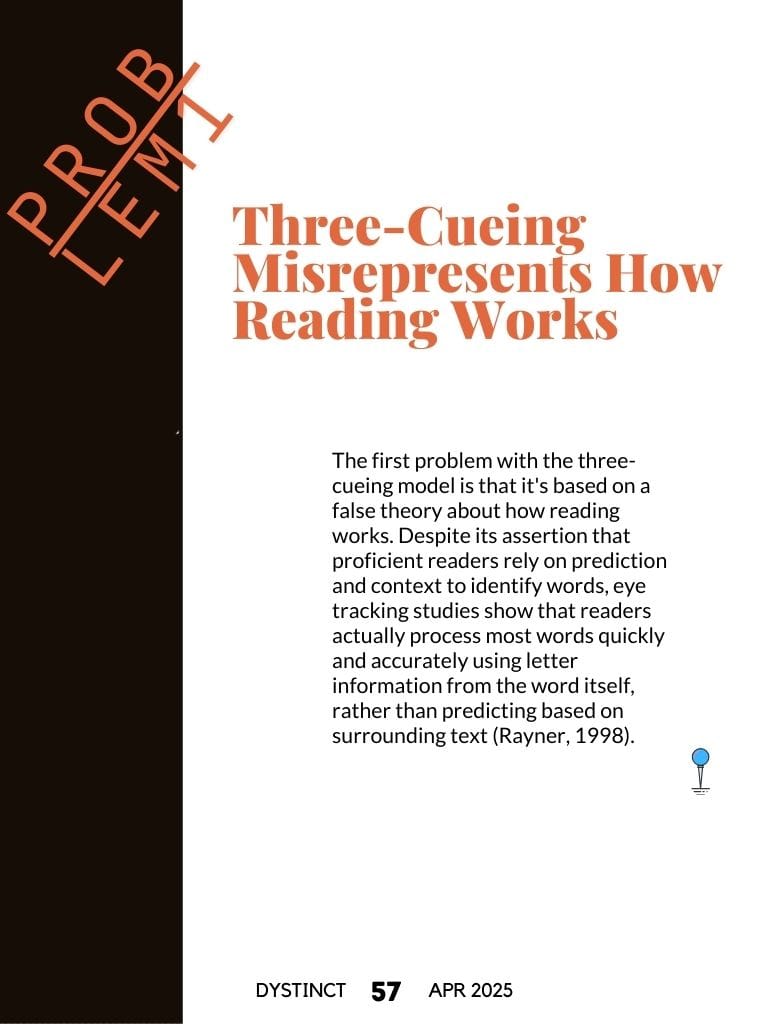
Problem 1: Three-Cueing Misrepresents How Reading Works
Problem 1: Three-Cueing Misrepresents How Reading Works
The first problem with the three-cueing model is that it's based on a false theory about how reading works. Despite its assertion that proficient readers rely on prediction and context to identify words, eye tracking studies show that readers actually process most words quickly and accurately using letter information from the word itself, rather than predicting based on surrounding text (Rayner, 1998).
Problem 2: Three-Cueing Contradicts The Simple View of Reading
Problem 2: Three-Cueing Contradicts The Simple View of Reading
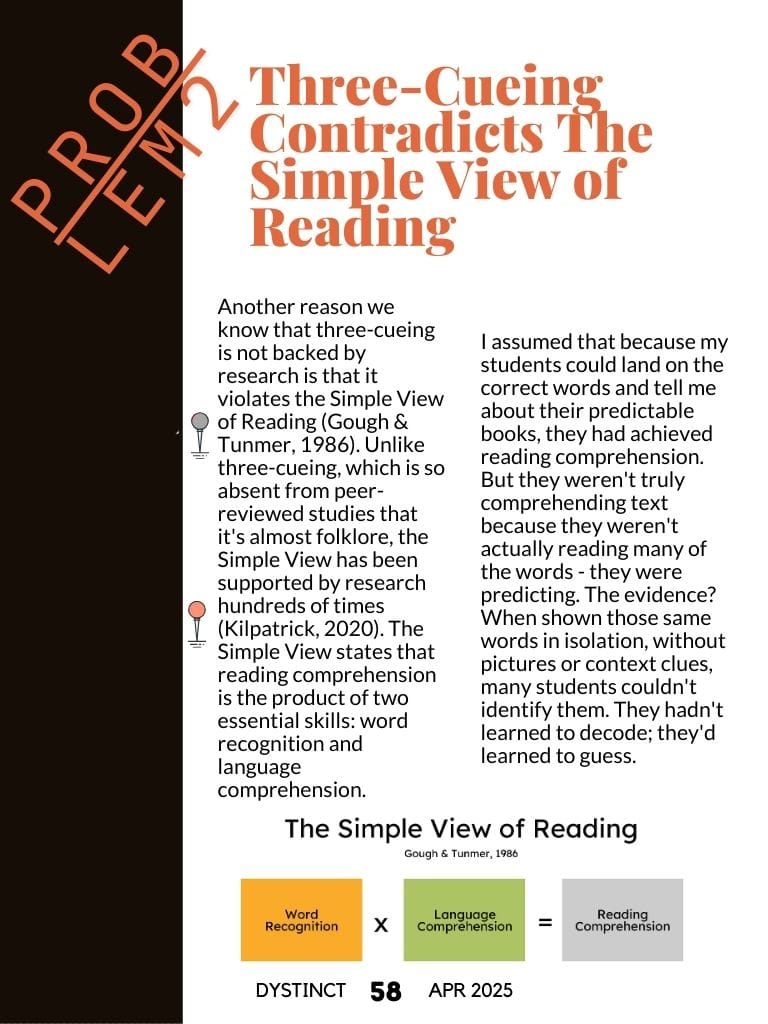
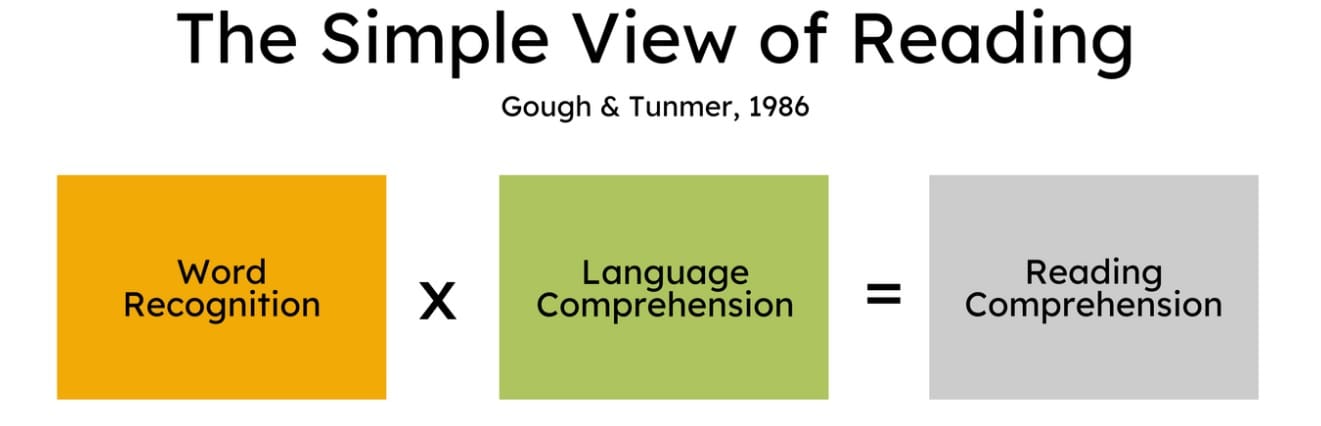
Another reason we know that three-cueing is not backed by research is that it violates the Simple View of Reading (Gough & Tunmer, 1986). Unlike three-cueing, which is so absent from peer-reviewed studies that it's almost folklore, the Simple View has been supported by research hundreds of times (Kilpatrick, 2020). The Simple View states that reading comprehension is the product of two essential skills: word recognition and language comprehension.
I assumed that because my students could land on the correct words and tell me about their predictable books, they had achieved reading comprehension. But they weren't truly comprehending text because they weren't actually reading many of the words - they were predicting. The evidence? When shown those same words in isolation, without pictures or context clues, many students couldn't identify them. They hadn't learned to decode; they'd learned to guess.
Problem 3: Three-Cueing Undermines Orthographic Mapping
Problem 3: Three-Cueing Undermines Orthographic Mapping
Three-cueing actively undermines orthographic mapping, the crucial process through which readers form letter-sound connections that allow words to be stored in long-term memory (Ehri, 2005). When students rely on pictures, context, or first-letter guessing instead of decoding all the letters in a word, they bypass the critical neural pathways needed for orthographic mapping to occur.
Orthographic mapping requires students to pay attention to the specific sequence of letters and their corresponding sounds—the very process that three-cueing discourages by teaching students to look away from the word. In other words, orthographic mapping requires students to "sound it out" - the very process I was told to discourage! Each time I had my students look at just the first letter of a word and use the picture, they weren't, as I believed, becoming strategic readers. Instead, they were missing an opportunity to build the skills necessary to orthographically map the word. The three-cueing approach actually prevents students from developing the word-recognition skills necessary for proficient reading.
What To Do Instead?
What To Do Instead?
When I began my science of reading journey, I was getting ready to teach my youngest son to read. The first day of our official reading lessons, I had a decodable book and a leveled, predictable book at the ready. I was still holding on to my beautiful predictable books - because surely they could help with fluency and comprehension, right? He worked hard at the decodable text, reading every word - albeit slowly and "painfully."
When I handed him the leveled text, and he tried to sound out the words (which were far more difficult than CVC words), I heard myself say, "Wait, you can't sound out this word yet. Use the picture to help you." At that moment, I could almost see the lightbulb over my head, and I wondered what on earth I was doing. I set aside the predictable text, and he read decodable text in our reading lessons from there on out. The decodable texts didn't kill his love of reading - they gave him confidence! He chose to reread them all on his own, and within a few months, he was choosing (and reading) non-decodable text independently.
The decodable texts didn't kill his love of reading - they gave him confidence!
Instead of giving our beginning readers predictable text and encouraging them to use all the cues available, we need to give them explicit, systematic instruction in phonics and provide them with decodable texts for practice. Decodable texts are carefully constructed to include words that students can sound out based on the phonics patterns they've learned. This allows them to practice decoding skills in context while building the critical neural pathways for orthographic mapping. We teach students to focus on the letters in the word and build their decoding skills systematically. As these skills become automatic, they free up mental energy for comprehension, and our students become ready for more complex texts.
Decodable texts allow beginning readers to practice decoding skills in context while building the critical neural pathways for orthographic mapping.
During read-alouds, we can model fluent reading, teach vocabulary, develop listening comprehension, and engage students in rich discussions about texts that are beyond their current decoding ability. This builds the language comprehension component of the Simple View of Reading while students develop their word recognition skills through systematic phonics instruction and the use of decodable texts.
The transition may seem slower at first compared to the fake fluency I observed when my students read predictable texts, but the long-term results speak for themselves: readers who can tackle unfamiliar words independently, who don't rely on pictures or context as a crutch, and who don't hit that infamous wall in upper elementary grades when texts become more complex and less predictable.
The research is clear: Evidence shows that three-cueing does not reflect how skilled reading develops.
As a teacher and teacher-educator, I once firmly believed in the three-cueing model. I didn't question it because it was widely accepted and reinforced by my training and professional reading. But the research is clear: Evidence shows that three-cueing does not reflect how skilled reading develops. If we want to support all readers—not only the ones who succeed despite weak instruction—we need to align our practices with what the science of reading tells us about how children learn to read.
References
References
- Chall, J. S. (1967). Learning to read: The great debate. New York, NY: McGraw-Hill.
- Ehri, L. C., Nunes, S. R., Stahl, S. A., & Willows, D. M. (2001). Systematic Phonics Instruction Helps Students Learn to Read: Evidence from the National Reading Panel's Meta-Analysis. Review of Educational Research, 71(3), 393-447. (Original work published 2001) [doi.org]
- Ehri, L. C. (2005). Learning to read words: Theory, findings, and issues. Scientific Studies of Reading, 9(2), 167–188. [doi.org]
- Gough, P. B., & Tunmer, W. E. (1986). Decoding, reading, and reading disability. Remedial and Special Education, 7(1), 6–10. [doi.org]
- Kilpatrick, D. (2020). The article that introduced the simple view of reading: The Reading League Journal, 1(2), 13-14.
- Rayner, K. (1998). Eye movements in reading and information processing: 20 years of research. Psychological Bulletin, 124(3), 372–422. [doi.org]
- Young, N. (2022). The Ladder of Reading & Writing: Where do you fit in? [Infographic]. Nancy Young, SLP. [nancyyoung.ca]
Anna Geiger
OG Certified Educator, Author, Podcast host & Founder of The Measured Mom | themeasuredmom.com | instagram | facebook | x | youtube | pinterest | podcasts.apple.com
Anna Geiger
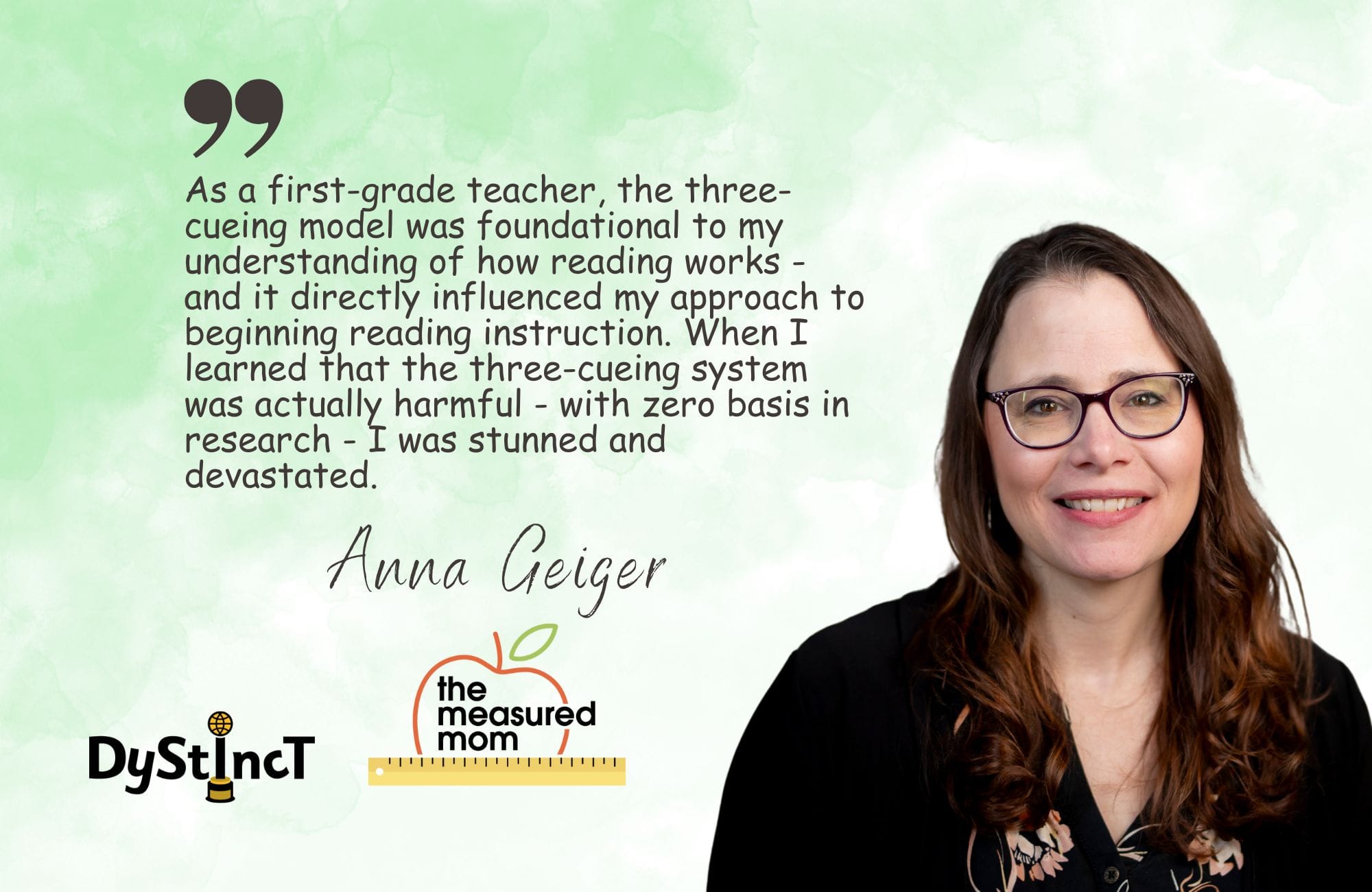
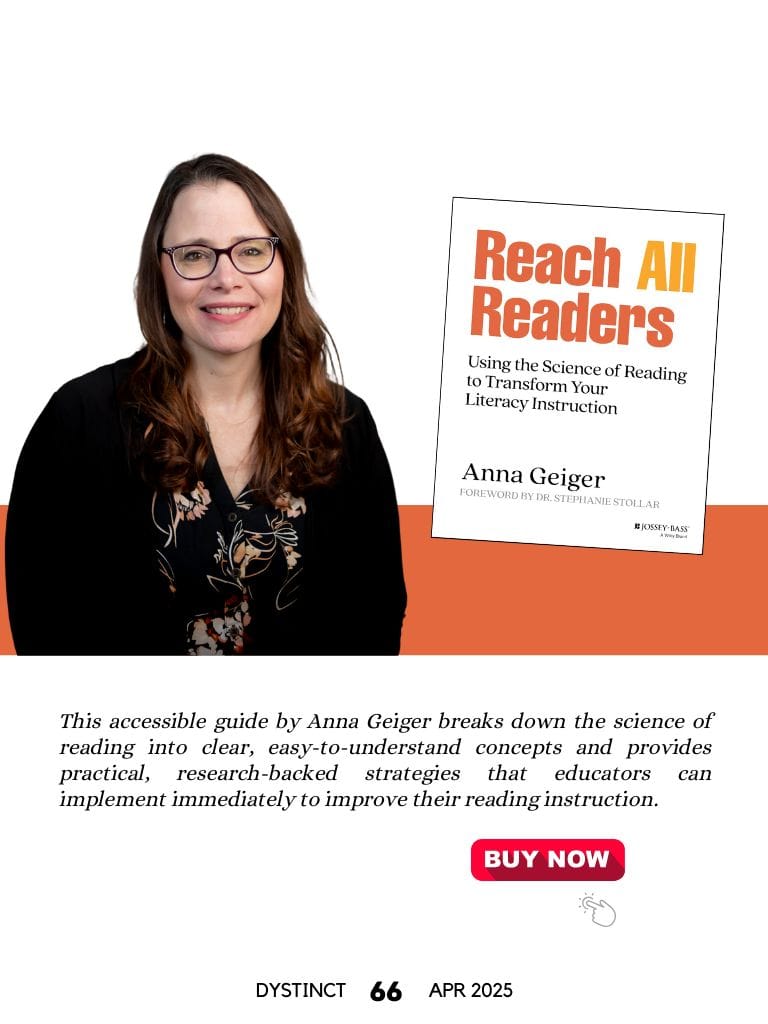
Anna Geiger, M.Ed., is the author of Reach All Readers, a comprehensive and concise guide to the science of reading for classroom teachers. Anna has classroom experience from first through fifth grade. After earning her Master's degree in Curriculum & Instruction, she began caring for her children at home. Now Anna serves educators through her website, The Measured Mom, where she shares hands-on lessons, thoughtful articles, and printable resources. Anna is Orton-Gillingham certified and has a Reading Science graduate certificate from Mount St. Joseph University. She hosts a weekly podcast called Triple R Teaching, and she provides thousands of resources to members of her membership site for PreK-3rd grade educators.
BUY BOOK
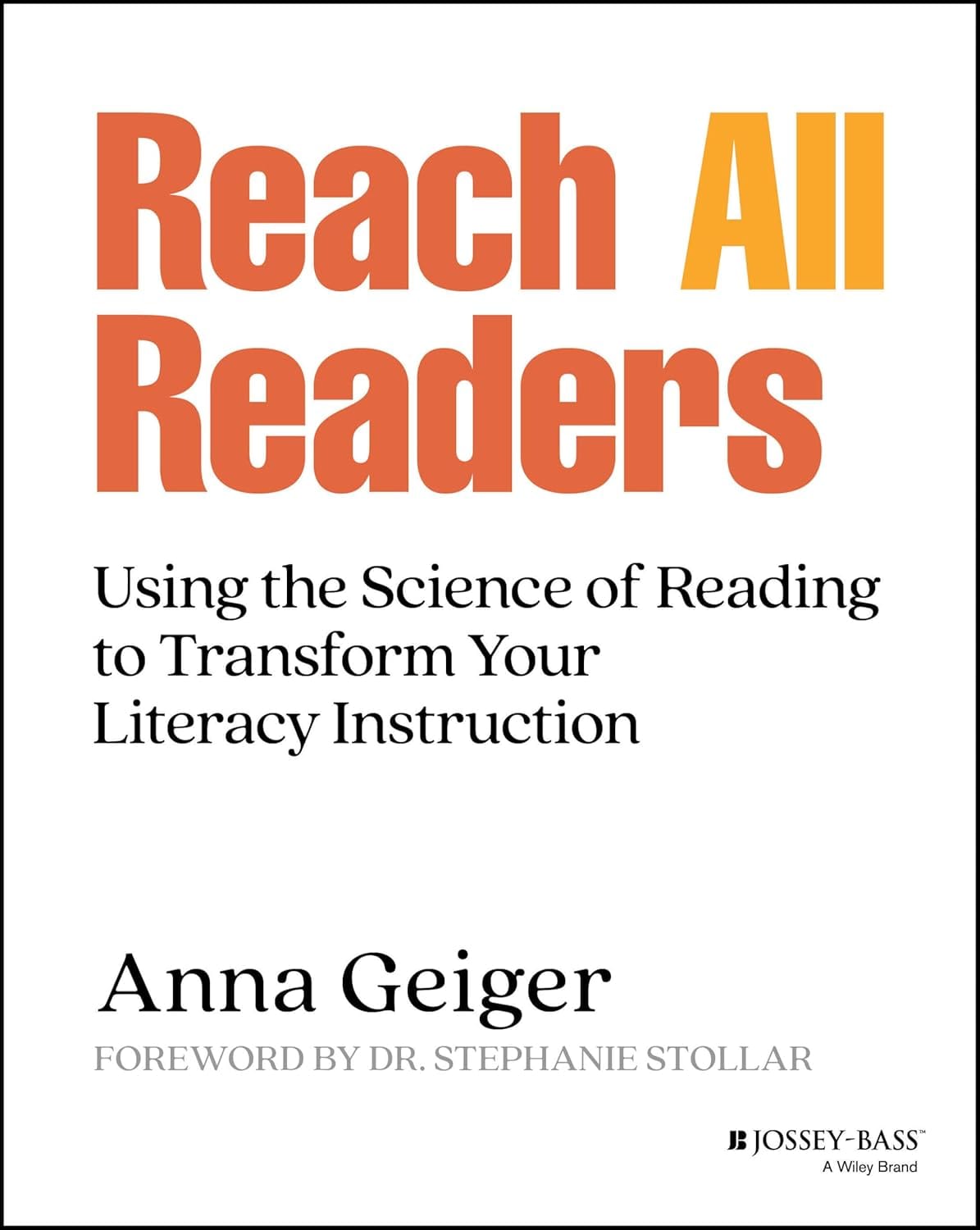
Reach All Readers | Using the Science of Reading to Transform Your Literacy Instruction
This accessible guide by Anna Geiger breaks down the science of reading into clear, easy-to-understand concepts and provides practical, research-backed strategies that educators can implement immediately to improve their reading instruction.
Extracts from Dystinct Magazine
Extracts from Dystinct Magazine