Issue 31: Bringing Learning to Life Through Research-Informed Stories | Dr Dominic Petronzi & Rebecca Petronzi
Dr Dominic and Rebecca introduce the Learning through Evidence-informed Narrative Storybooks (LENS) approach, demonstrating how research can be transformed into engaging, accessible storybooks that help children explore complex topics through narrative, discussion, and practical activities.


Rebecca Petronzi is a Senior Lecturer in Education at the University of Derby, Teacher Educator, & Author [derby.ac.uk]
From Research To Storybook
From Research To Storybook
For many children, research can feel distant from everyday learning. It is often published in academic journals or lengthy reports, while families and teachers are left to translate ideas into practical classroom or home use.
The Learning through Evidence-informed Narrative Storybooks (LENS) approach was developed to help bridge this gap. It translates complex research and organisation/charity expertise into accessible narrative forms, allowing learners to engage with challenging ideas in meaningful and supported ways through short, illustrated storybooks and simple companion activities.
LENS is an inclusive education approach designed to support access to learning for a wide range of learners. Its design draws on principles such as narrative learning, structured engagement with ideas, and multimodal representation of information, helping to make research more approachable.
This includes supporting a range of learners who may experience barriers to accessing written information, including some children with dyslexia, as well as others who benefit from additional support when engaging with text.
Developed since 2017 at the University of Derby (England, UK), LENS brings together research, theory, creative design, and collaboration with academic subject specialists, along with stakeholder insights. The aim is simple: to make research usable in real classrooms and homes.
To make the ideas in this article feel practical, we’ll follow one of our favourites: a story about coral reefs and the people who care for them. We enjoyed producing it, and we’ll use it as a running example of how LENS turns research into classroom-ready resources and activities, helping to build understanding, raise awareness, and spark conversation around real-world topics. This example also shows how research can be translated into a narrative format that is both engaging and grounded in real scientific content. Our storybook ‘Coral Rescue’ (2025) is a 32-page illustrated resource, developed with an internationally recognised Professor in Molecular Ecology. It translates complex coral science into an accessible narrative form, supported by illustrations and activities, as a practical and usable resource in everyday classroom and home settings.
So, in this article, we explore what LENS does, the research that shapes it, and how Coral Rescue can be used as an example to showcase how complex research can be translated into engaging and accessible learning experiences, with the wider aim of developing a growing series of resources across different topics.
Download the book PDF for FREE
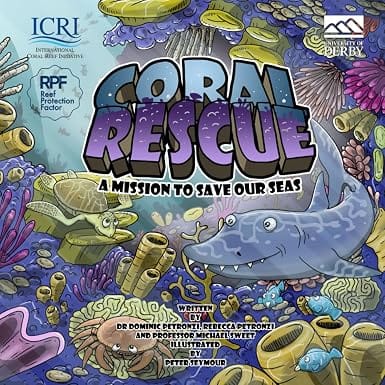
CORAL RESCUE - A mission to save our seas
Tropical coral reefs only cover a very tiny fraction of our planet's surface, but they are home to upwards of 25-40% of all marine species. They also protect our coastlines and provide food and jobs for millions of people. Sadly, these 'rainforests of the sea' are under threat. Undoubtedly, the major threat to reefs (and many other ecosystems) is climate change. However, so-called more local stressors such as overfishing and pollution also play a major toll. This is why I personally believe everyone can make a difference to save our reefs. Did you know for example, that 80% of plastic pollution in our oceans comes from rivers? What did you do with that plastic bottle you just finished? Also, did you know that even your choice of sunscreen can impact our aquatic life? Our response to this crisis, will not only determine the future of coral reefs, but also the well-being of human communities who depend on them. There is therefore an argument to be had whereby protecting, managing, conserving, and restoring reefs could be viewed, not as an altruistic quest, but a pragmatic goal to sustain human civilization and all life on Earth. It is now time to wake up, act in ways big or small and give our planet and you and your family a chance to flourish.
What LENS Does In Practice
What LENS Does In Practice
LENS turns research into short, usable storybooks and simple activities that adults can use straight away. Each output is a narrative resource supported by prompts, questions, and activities that help unpack key ideas and support critical thinking.
To date, LENS storybooks have explored a wide range of topics, including coral reef conservation, healthy eating, sleep hygiene, maths anxiety, bullying awareness and prevention, and nature connection. More broadly, we see potential for approaches like this to play a stronger role in translating complex research findings into accessible formats for classrooms and homes, where they can have clear practical value and real-world impact. This includes ongoing development in areas such as digital formats, multilingual and translanguaging approaches, and ways of evaluating how these kinds of resources are used in practice.
The development process that we have refined is collaborative and iterative. We begin with a clear topic and a review of relevant research, then work closely with academic subject specialists and external stakeholders to shape the story and accompanying activities. Where possible, drafts and illustrations are tested with our intended audience and refined along the way, ensuring the final resources are informed by both research and real-world use.
For families and educators, this means each resource is designed to support engagement with real subject knowledge in an accessible and structured way. Books are developed with:
- Narrative storytelling as the primary structure
- Opportunities to encounter and revisit subject vocabulary in context
- Illustrations that are engaging, support meaning-making and are thoughtfully designed when presenting sensitive content
- Short, practical activities that extend understanding and discussion, while leaving space for parents and teachers to adapt or create their own
These features are intended to help learners access complex ideas in different ways, rather than relying on text alone, such as through narrative explanation and visual examples like coral transplantation in Coral Rescue, where divers plant corals grown in special laboratory tanks back onto reefs.
Key Research And Theory Informing Our Approach
Key Research And Theory Informing Our Approach
LENS is built on well-established ideas from education and psychology, translated into practical tools.
Stories as learning tools.
Children learn through narrative, as stories help them explore ideas, situations, and problems in a structured way that builds language, literacy, and deeper understanding. They also create a low-pressure space for engaging with new concepts and topics.
Guided reading supports understanding.
When adults support reading with short prompts, vocabulary discussion or focused questions, children engage more deeply with texts. This helps them make sense of what they are reading while also reflecting on both enjoyable and challenging aspects of learning.
Growth mindset and metacognition.
Stories that show characters learning through trial and error help children see learning as a process. Simple prompts encourage reflection, planning and monitoring, while the narrative also supports emotional understanding, self-regulation, and resilience.
Modelling real-world problem-solving.
Stories can demonstrate practical solutions to problems children may encounter, helping them to transfer learning to real life.
Multimodal engagement with learning.
Combining audio, visuals, repetition, and activity-based learning can help support engagement with complex information for a wide range of learners.
These principles are embedded in every LENS resource so that learning is supported through narrative, discussion, and activity, rather than text alone.
The Coral Reef Book : A Practical Example
The Coral Reef Book : A Practical Example
The coral reef storybook translates coral science into a child-friendly narrative. Rather than attempting to cover everything about ocean ecosystems, it focuses on three core ideas: why coral reefs matter, what threatens them, and what people can do to help - all brought to life through vibrant, detailed illustrations. In practice, this structure helps learners engage with scientific ideas in manageable steps, while still encountering authentic subject vocabulary where appropriate, including words such as “spawning,” “transplanted,” and “symbiosis.”
At its heart, Coral Rescue is not a specialist intervention resource. Instead, it is designed to support flexible and inclusive reading in both classrooms and at home. As with all our books, the aim is to offer multiple ways for children to access and engage with research-informed information on a topic. What this looks like in practice is a blend of narrative, illustration, and discussion - supporting a wide range of learners, helping children explore scientific ideas and key information in context. And while it isn’t designed as a dyslexia intervention, some readers may benefit from simple support strategies, such as breaking down unfamiliar scientific terms or leaning on visual context to support understanding.
Alongside this, the story gradually builds. Vocabulary is introduced naturally within the narrative, supported by detailed illustrations that help children interpret complex ideas. Learning is then extended through embedded activities, including “search and find” elements that encourage close observation, alongside “did you know?” pages that spark curiosity and invite children to go a little further.
And importantly, adults play an active role in shaping how the story is experienced. Through shared reading and conversation, you can introduce key vocabulary before reading, pause to explore questions as they arise, and use the illustrations to deepen understanding. Taken together, these approaches help children connect the story to wider themes of oceans, conservation, and sustainability.
Using The Coral Rescue PDF
Using The Coral Rescue PDF
The accompanying PDF lends itself to a range of short activities that can be used before, during, or after reading. These are designed to be flexible and easily adapted to different learners and settings. Some simple ways to use the resource include:
Vocabulary exploration:
Pick out a few rich, descriptive words such as tranquil, magnificent, harmony, or uninhabited before reading, then look out for them in the story, discuss their meaning, and think about how else children might use those words in different contexts.
Word detectives:
Explore longer scientific words together by breaking them into smaller chunks or syllables and discussing their meaning, like transplantation and symbiosis.
Search and find challenges:
This activity is integrated into the book itself, so you can encourage children to locate hidden animals in the illustrations, supporting close observation and recognition of different species.
"Did you know?” discussions:
Use the fact pages at the back of the story to spark questions, challenge misconceptions, extend thinking beyond the narrative, and explore positive actions children can take.
Drawing and reflection:
Invite children to draw a reef animal, a healthy coral reef, or one action people can take to protect ocean habitats. You can be really creative with this one.
Discussion prompts: Explore questions such as “Why are coral reefs important?” or “What can people do to help?” to encourage reflection and problem-solving.
Practical Classroom And Home Use
Practical Classroom And Home Use
The storybook has been designed to be used flexibly across a range of settings. In classrooms, it can support discussions about marine ecosystems, climate change, and conservation, with the illustrations and activities providing opportunities for collaborative learning. At home, families can explore the story together, discuss key messages, and use the follow-up facts and activities to extend learning beyond the narrative.
Whether used as part of a lesson, a guided reading session, or shared reading at home, the emphasis remains on developing understanding, encouraging curiosity, and creating opportunities for meaningful discussion. Sometimes, a structured and informed resource is needed to initiate conversations that might not otherwise take place.
A Final Word
A Final Word
Coral Rescue sits within a broader book project exploring how narrative, illustration, and activities can support children’s engagement across diverse topics in accessible and meaningful ways. It reflects an ongoing interest in how research can inform the design of engaging learning resources, and we hope to expand this work in the years to come - including through digital readings and translanguaging approaches.
Dr Dominic Petronzi
Senior Lecturer in Psychology at the University of Derby, Researcher, & Author | derby.ac.uk | X | LinkedIn
Dr Dominic Petronzi
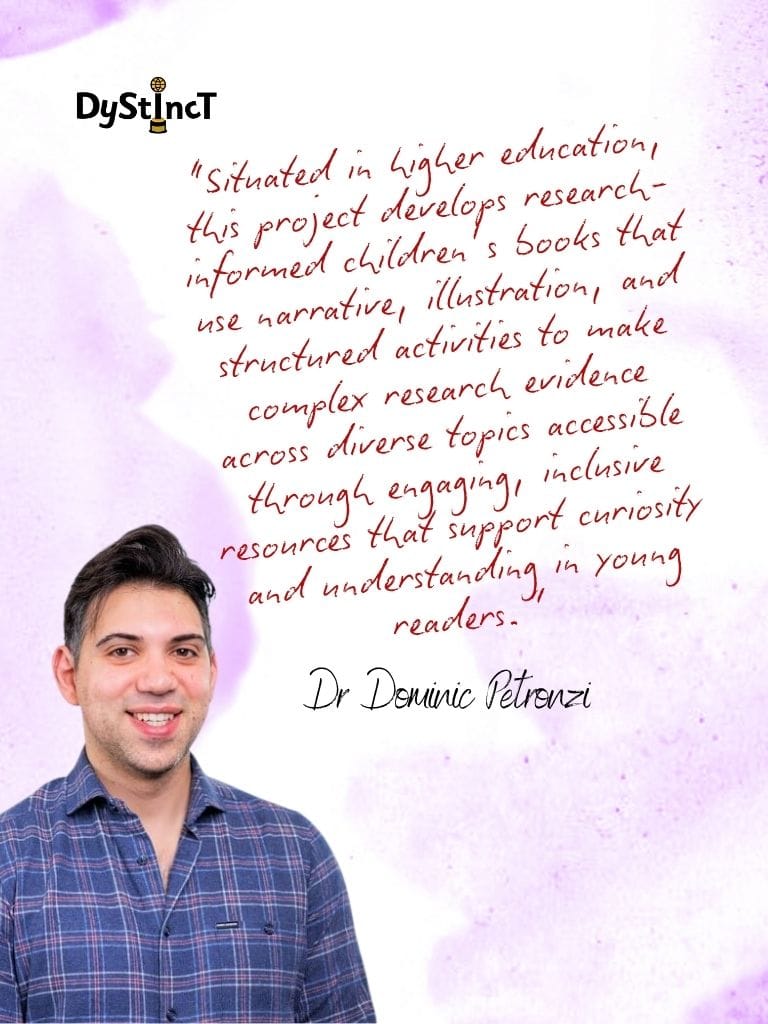
Dominic is a Senior Lecturer in Psychology at the University of Derby (England, UK), where he studied from undergraduate to doctoral level and completed his PhD in 2016. His research focuses on the development of maths anxiety in children and young people, including how it relates to educational experiences and career trajectories, and how it can be reduced. He developed the Children’s Maths Anxiety Scale UK (CMAS-UK), the first validated measure for assessing maths anxiety in children as young as four, alongside work combining insights from children, parents, and teachers. His research also includes reviews of interventions for maths anxiety and the development of a storybook-based approach to support emotion regulation and reduce maths anxiety. Dominic project leads and co-authors research-informed storybooks that translate academic research into accessible resources for children, families, and educators across topics including wellbeing, health, and environmental issues. Earlier in his career, he worked with children and young people with complex needs in education and residential care settings.
This post is for subscribers only
SubscribeAlready have an account? Log in