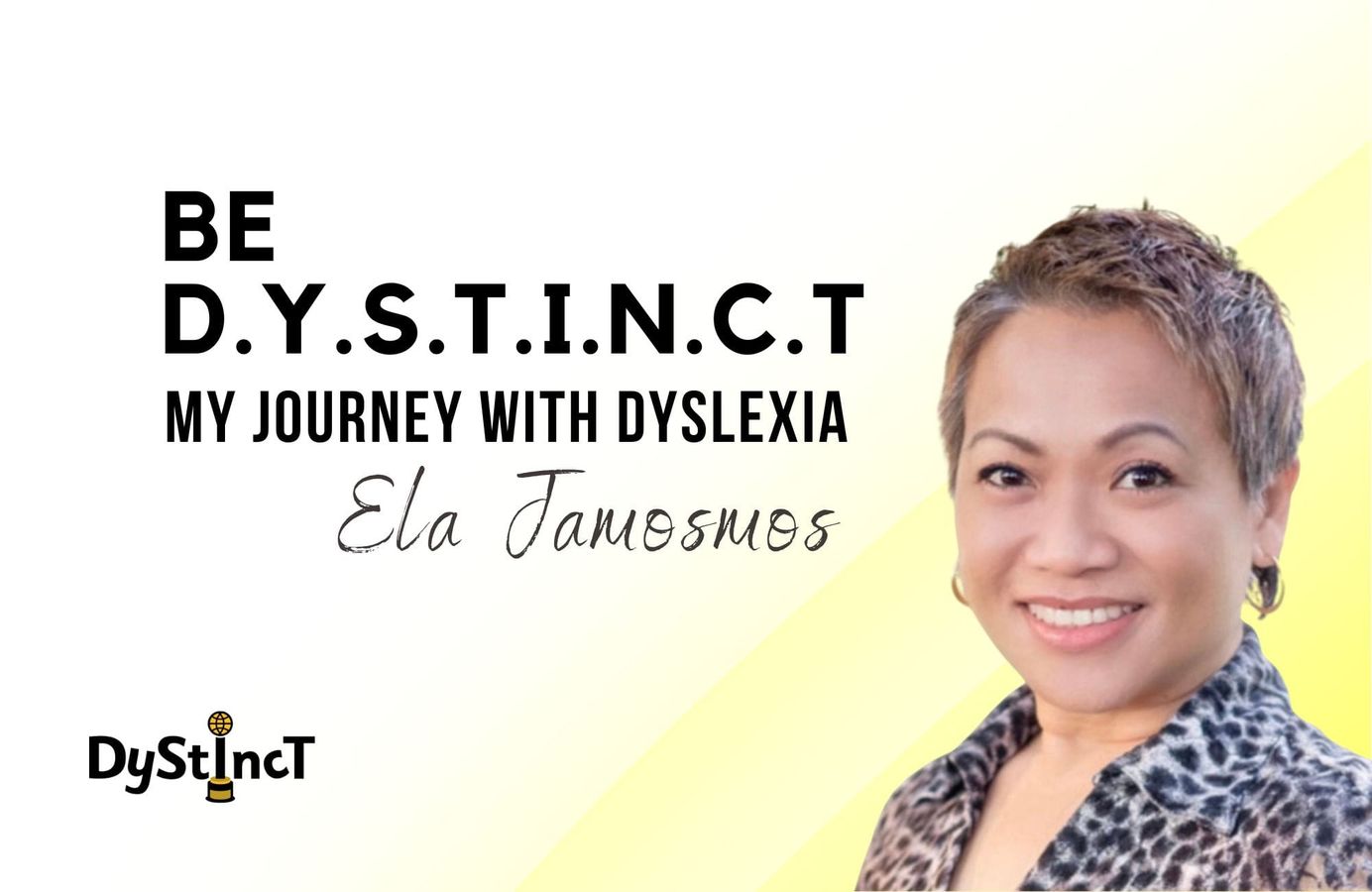
Issue 27: Be D.Y.S.T.I.N.C.T My Journey with Dyslexia | Ela Jamosmos
Ela traces her lifelong journey with undiagnosed dyslexia from silent childhood struggles to creative breakthroughs and leadership, ultimately transforming shame into self-acceptance and using her voice, art, and public speaking to empower others to embrace their difference and own their strengths.
Table of Contents
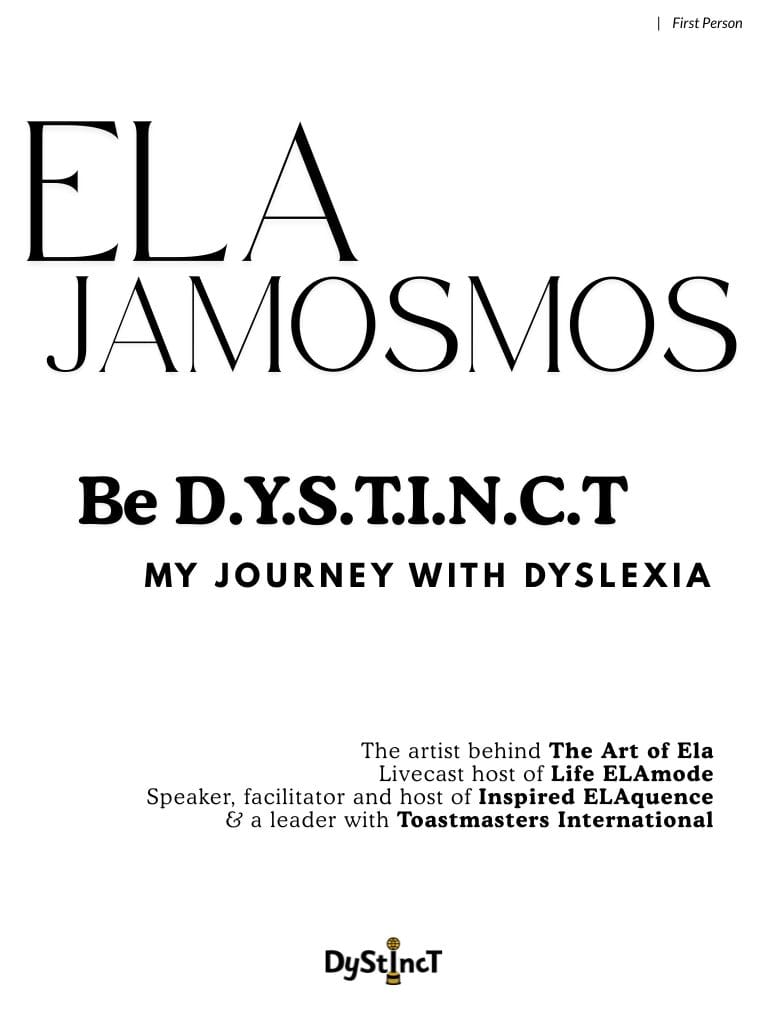
The artist behind The Art of Ela
Livecast host of Life ELAmode
Speaker, facilitator and host of Inspired ELAquence &
Leader with Toastmasters International
Kindergarten graduation was approaching fast. There was only a short time left to rehearse our program. One by one, we lined up at the edge of the stage, facing rows of empty chairs, seats that would soon be filled with proud parents.
Each of us was assigned a letter of the alphabet, starting with "A" on the far left. There needed to be at least 26 of us to complete the full set. I was given the letter "M" - the 13th letter in the alphabet. Smack dab in the middle of the stage.
The plan was simple: we would sing the alphabet, each student taking a turn to sing their letter in order. The moment the letter "A" was sung, panic surged through me. I couldn't remember my letter.
Why can't I remember?
The rhythm broke. I froze. The melody stalled, and all I could hear was the pounding of my heart, loud and fast in my tiny chest. Everything else faded into a blur - the other kids, the teacher's face, even the music. I knew every eye was on me, and I stood there, swallowed by silence and shame.
I was five years old.
Words by Ela Jamosmos
Words by Ela Jamosmos
In the days that followed, I became obsessed with remembering. I repeated "M, M, M, M" over and over to myself, day and night. During practice, I waited for the student to my left to sing "L," and I would blurt out "M", not musically, not cheerfully, but with a stern seriousness. My face must have looked terrified.
On graduation day, I did the same thing. One strong, flat "M." No melody, no joy, just survival. That moment marked the beginning of my awareness that school and learning would always feel different for me. The pressure made it difficult. Harder. Heavier. Not wrong… just different.
Yes, different.
I remember a time when my mom was helping my older sister memorize a song for school. They sat together, going over it again and again, while I simply watched from the side. No one asked me to learn it. There was no pressure, no expectation. I was just there… listening, enjoying, soaking it in.
After their tutorial session, I surprised them both; I had memorised the entire song. No stress. No flashcards. Just fun. That moment showed me something I wouldn't fully understand until years later: I learn differently. When learning feels like a performance, a play, or a passion, I thrive. When it feels like a test, a trap, or a ticking clock, I freeze.
I didn't lack ability. I learned with a different rhythm.
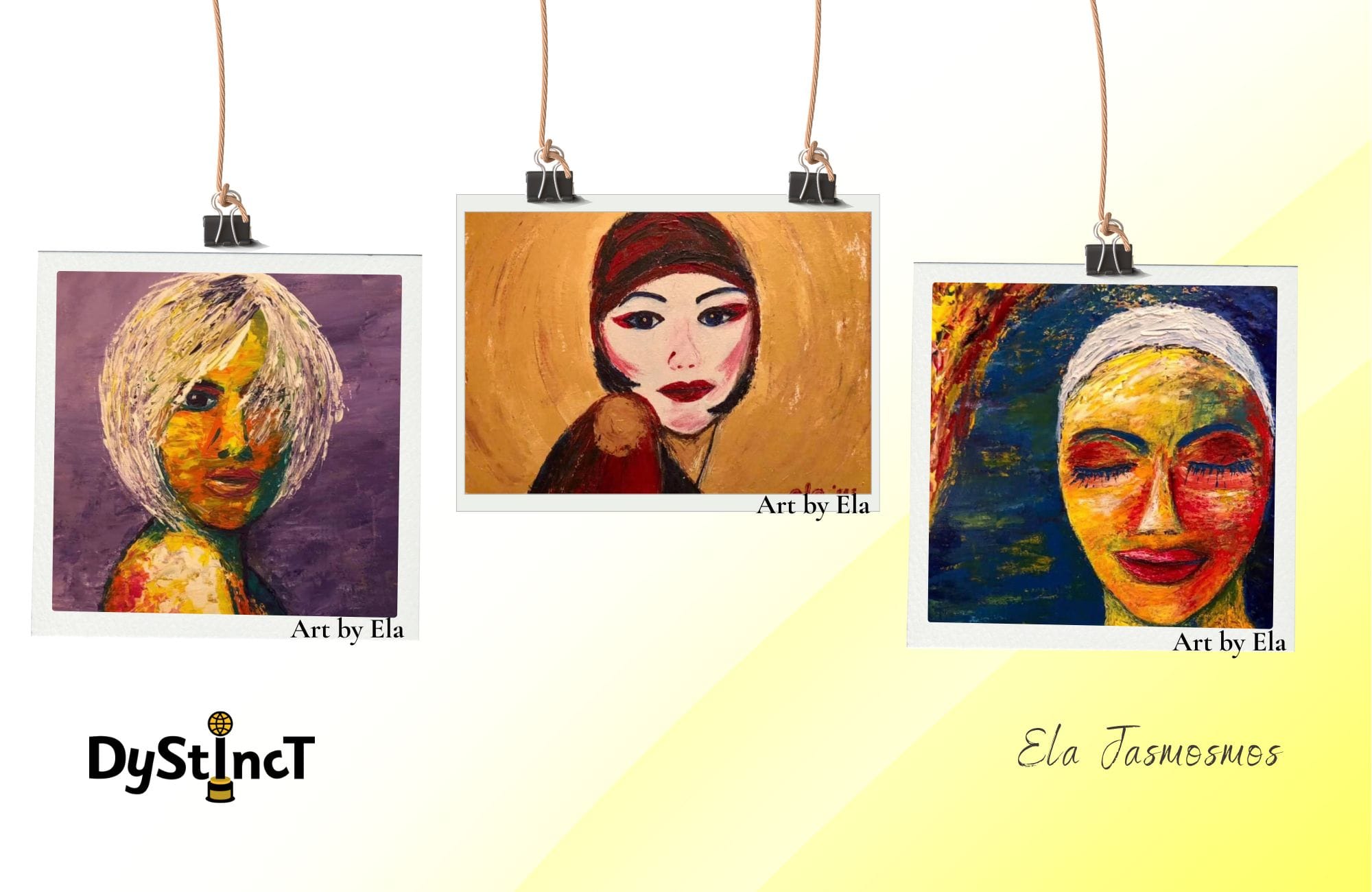
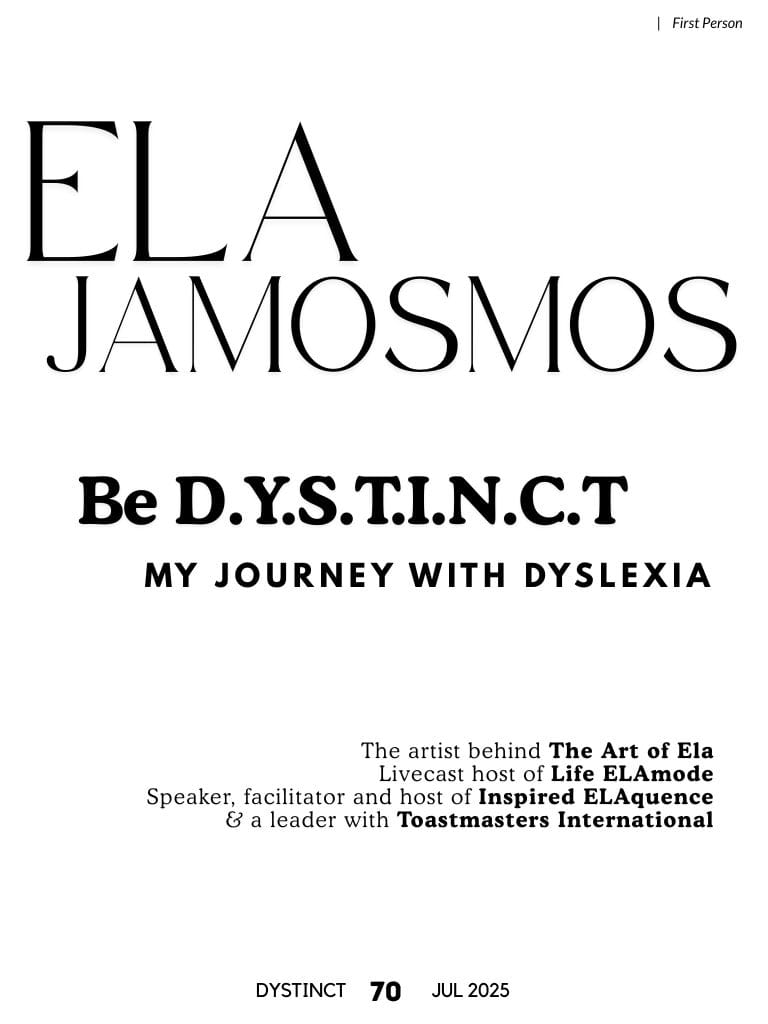
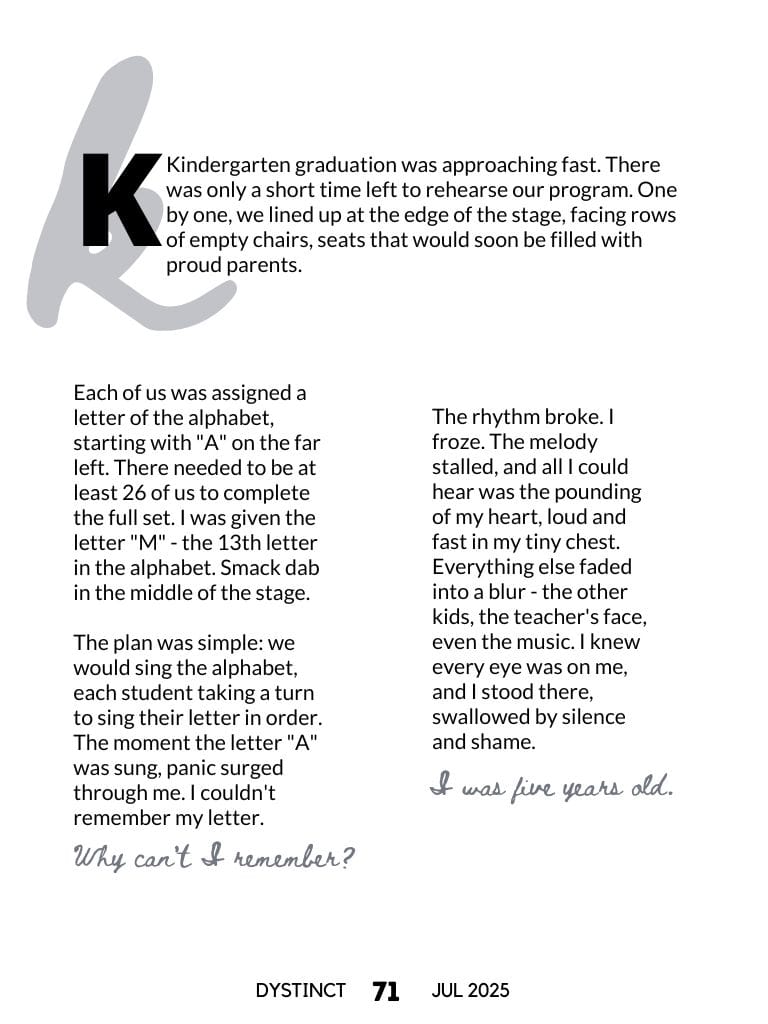
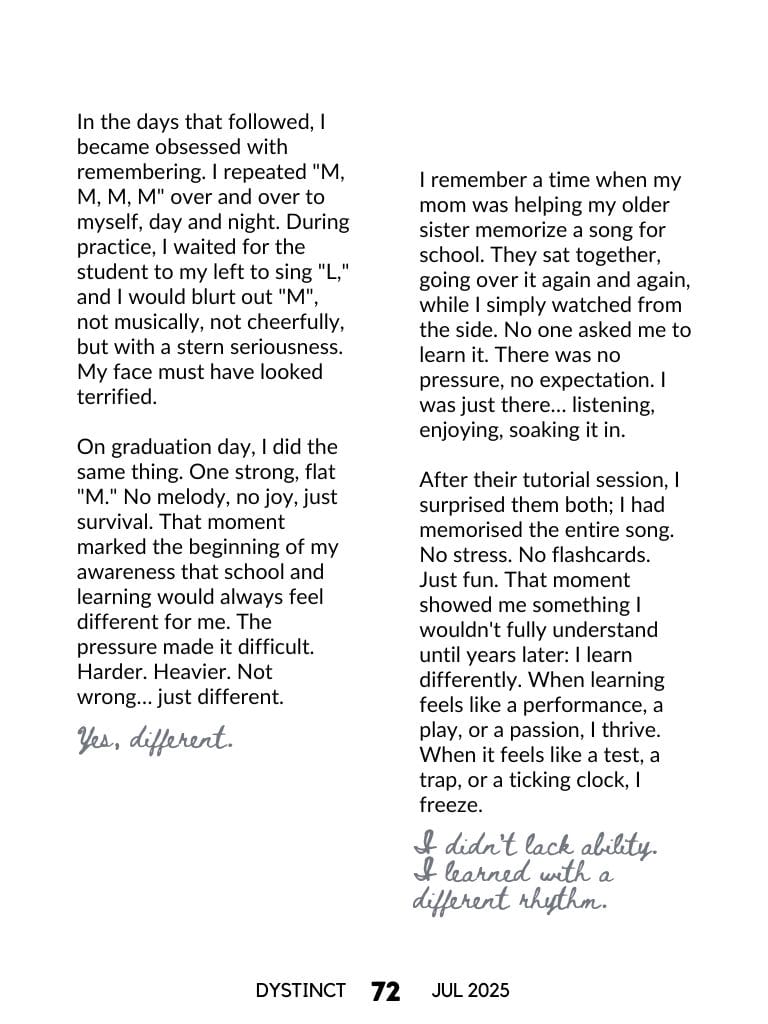
I was a fun-loving, laugh-out-loud, and sweet young girl who lived for music. By the age of eight, I was already choreographing dance routines for the neighborhood kids. The world, to me, was both a canvas and a stage. I danced through my days and sang through my nights, so much so that my mom eventually bought me my own karaoke machine just to keep up with my mini performances at the age of ten. But singing and dancing were just the beginning.
As a teenager, I found another outlet: writing poems and composing songs. Whenever I was in pain, wrestling with rejection, judgment, or the sting of being misunderstood, I turned to the arts. It became my refuge, my release, and my revelation. When the world felt too harsh or confusing, I would write or sing my way back to myself. Art wasn’t just a hobby for me; it was a means of survival. It was healing. It was the language my soul spoke fluently when no one else seemed to understand my voice.
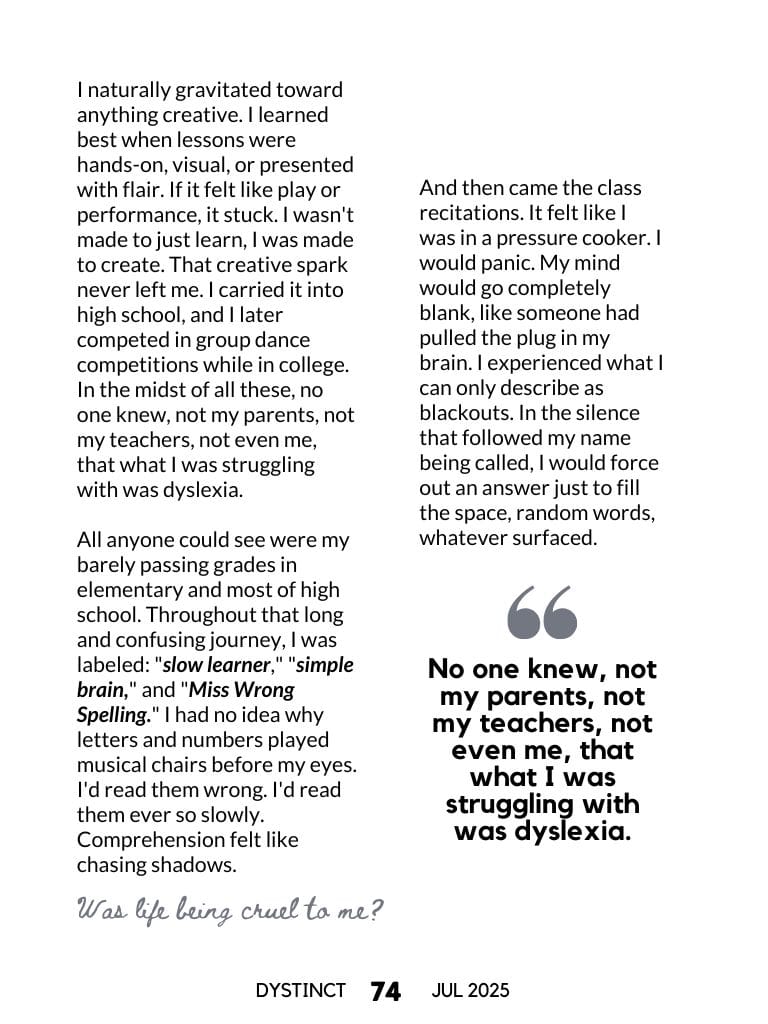
I naturally gravitated toward anything creative. I learned best when lessons were hands-on, visual, or presented with flair. If it felt like play or performance, it stuck. I wasn't made to just learn, I was made to create. That creative spark never left me. I carried it into high school, and I later competed in group dance competitions while in college. In the midst of all these, no one knew, not my parents, not my teachers, not even me, that what I was struggling with was dyslexia.
All anyone could see were my barely passing grades in elementary and most of high school. Throughout that long and confusing journey, I was labeled: "slow learner," "simple brain," and "Miss Wrong Spelling." I had no idea why letters and numbers played musical chairs before my eyes. I'd read them wrong. I'd read them ever so slowly. Comprehension felt like chasing shadows.
Was life being cruel to me?
And then came the class recitations. It felt like I was in a pressure cooker. I would panic. My mind would go completely blank, like someone had pulled the plug in my brain. I experienced what I can only describe as blackouts. In the silence that followed my name being called, I would force out an answer just to fill the space, random words, whatever surfaced.
No one knew, not my parents, not my teachers, not even me, that what I was struggling with was dyslexia.
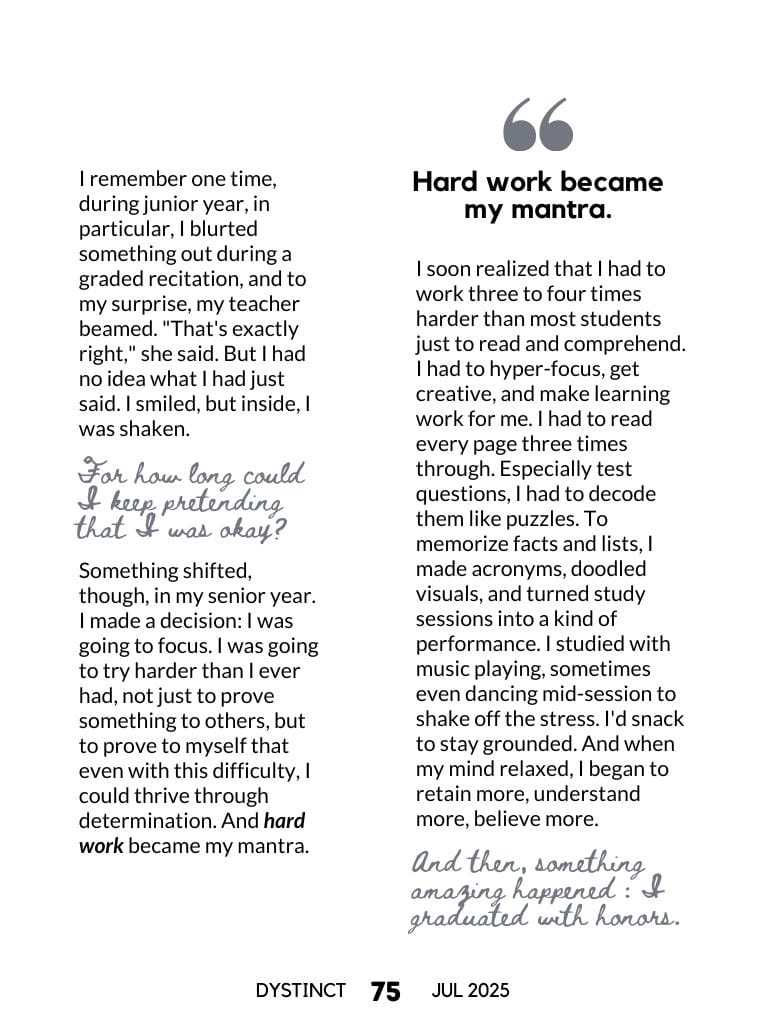
I remember one time, during junior year, in particular, I blurted something out during a graded recitation, and to my surprise, my teacher beamed. "That's exactly right," she said. But I had no idea what I had just said. I smiled, but inside, I was shaken.
For how long could I keep pretending that I was okay?
Something shifted, though, in my senior year. I made a decision: I was going to focus. I was going to try harder than I ever had, not just to prove something to others, but to prove to myself that even with this difficulty, I could thrive through determination. And hard work became my mantra.
Hard work became my mantra.
I soon realized that I had to work three to four times harder than most students just to read and comprehend. I had to hyper-focus, get creative, and make learning work for me. I had to read every page three times through. Especially test questions, I had to decode them like puzzles. To memorize facts and lists, I made acronyms, doodled visuals, and turned study sessions into a kind of performance. I studied with music playing, sometimes even dancing mid-session to shake off the stress. I'd snack to stay grounded. And when my mind relaxed, I began to retain more, understand more, believe more.
And then, something amazing happened : I graduated with honors.
To the shock and disbelief of my entire family. And most of all, to the stunned wonder of my mom, who never understood why I wasn't as academically "smart" as my parents and siblings were. Their "Miss Wrong Spelling" had done it.
How did that happen?
Because I learned to fight for myself, not against who I was.
I carried that same drive for hard work into college and into the workplace. My creativity stayed with me. It was my loyal companion, my strength. But so did something else: an intense fear of public speaking. Every time I had to give a presentation, my whole being went into panic mode. I felt like I was melting, like I might die from the fear alone. It was official: public speaking was my number one fear. And it made sense. Speaking out loud exposed me. It was where the stumbles, the misspoken words, the mental blanks, all the things I tried so hard to hide, had nowhere to go but out.
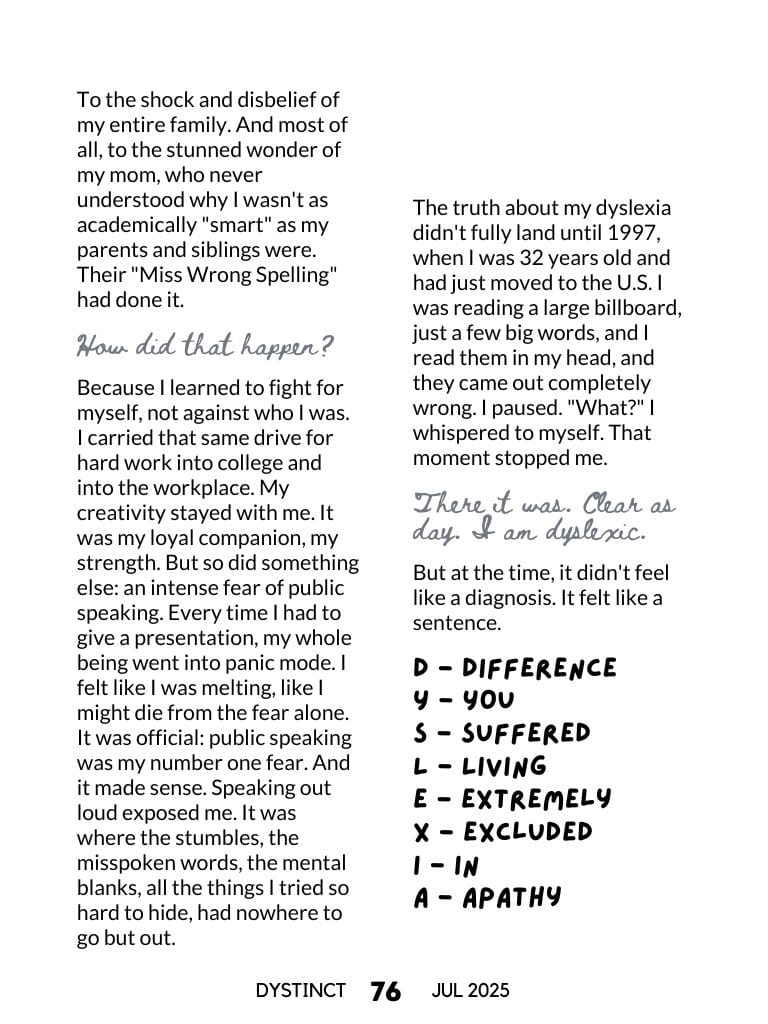
The truth about my dyslexia didn't fully land until 1997, when I was 32 years old and had just moved to the U.S. I was reading a large billboard, just a few big words, and I read them in my head, and they came out completely wrong. I paused. "What?" I whispered to myself. That moment stopped me.
There it was. Clear as day. I am dyslexic.
But at the time, it didn't feel like a diagnosis. It felt like a sentence.
D - Difference
Y - You
S - Suffered
L - Living
E - Extremely
X - eXcluded
I - In
A - apathy
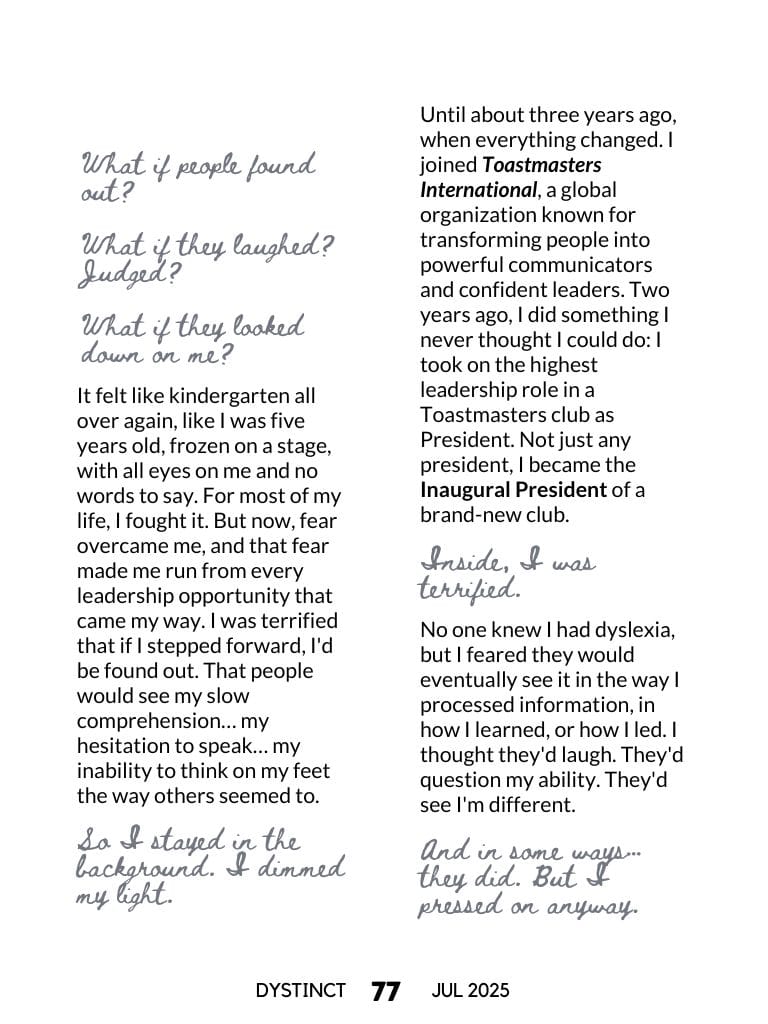
What if people found out?
What if they laughed?
Judged?
What if they looked down on me?
It felt like kindergarten all over again, like I was five years old, frozen on a stage, with all eyes on me and no words to say. For most of my life, I fought it. But now, fear overcame me, and that fear made me run from every leadership opportunity that came my way. I was terrified that if I stepped forward, I'd be found out. That people would see my slow comprehension… my hesitation to speak… my inability to think on my feet the way others seemed to.
So I stayed in the background. I dimmed my light.
Until about three years ago, when everything changed. I joined Toastmasters International, a global organization known for transforming people into powerful communicators and confident leaders. Two years ago, I did something I never thought I could do: I took on the highest leadership role in a Toastmasters club as President. Not just any president, I became the Inaugural President of a brand-new club.
Inside, I was terrified.
No one knew I had dyslexia, but I feared they would eventually see it in the way I processed information, in how I learned, or how I led. I thought they'd laugh. They'd question my ability. They'd see I'm different.
And in some ways… they did. But I pressed on anyway.
It was there, in one of the early meetings, that I heard a small voice. I believe it was the Spirit of God whispering to my heart: "Don't fight it. Leverage it."
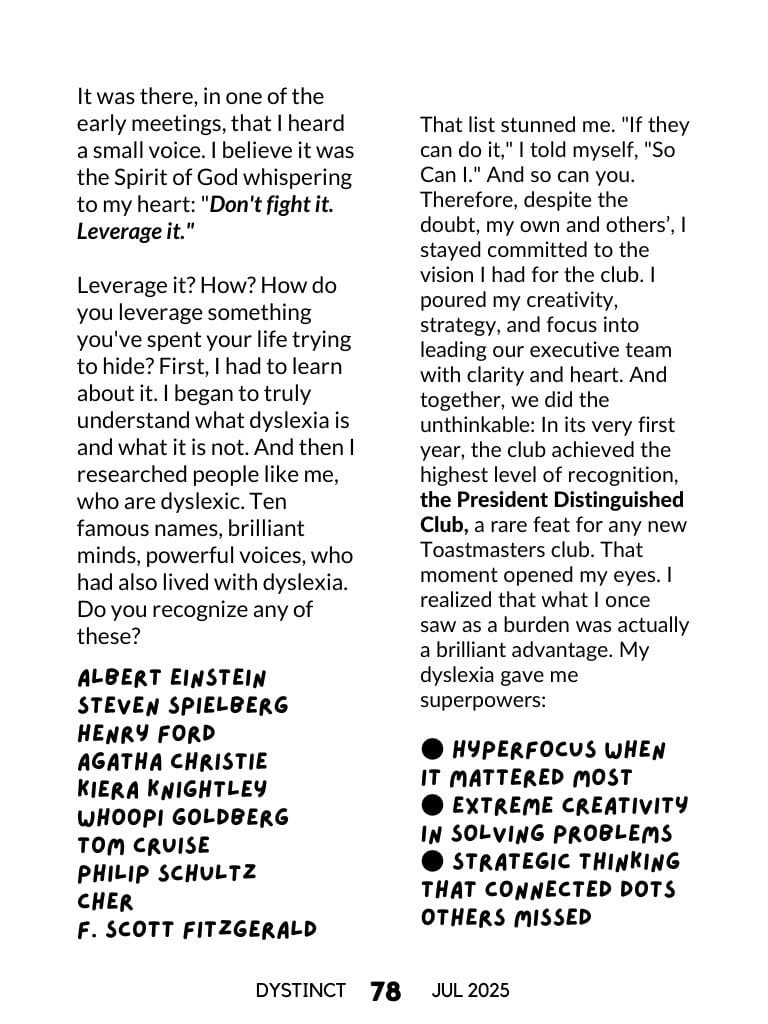
Leverage it? How? How do you leverage something you've spent your life trying to hide? First, I had to learn about it. I began to truly understand what dyslexia is and what it is not. And then I researched people like me, who are dyslexic. Ten famous names, brilliant minds, powerful voices, who had also lived with dyslexia. Do you recognize any of these?
- Albert Einstein
- Steven Spielberg
- Henry Ford
- Agatha Christie
- Kiera Knightley
- Whoopi Goldberg
- Tom Cruise
- Philip Schultz
- Cher
- F. Scott Fitzgerald
That list stunned me. "If they can do it," I told myself, "So Can I." And so can you. Therefore, despite the doubt, my own and others’, I stayed committed to the vision I had for the club. I poured my creativity, strategy, and focus into leading our executive team with clarity and heart. And together, we did the unthinkable: In its very first year, the club achieved the highest level of recognition, the President Distinguished Club, a rare feat for any new Toastmasters club. That moment opened my eyes. I realized that what I once saw as a burden was actually a brilliant advantage. My dyslexia gave me superpowers:
● Hyperfocus when it mattered most
● Extreme creativity in solving problems
● Strategic thinking that connected dots others missed
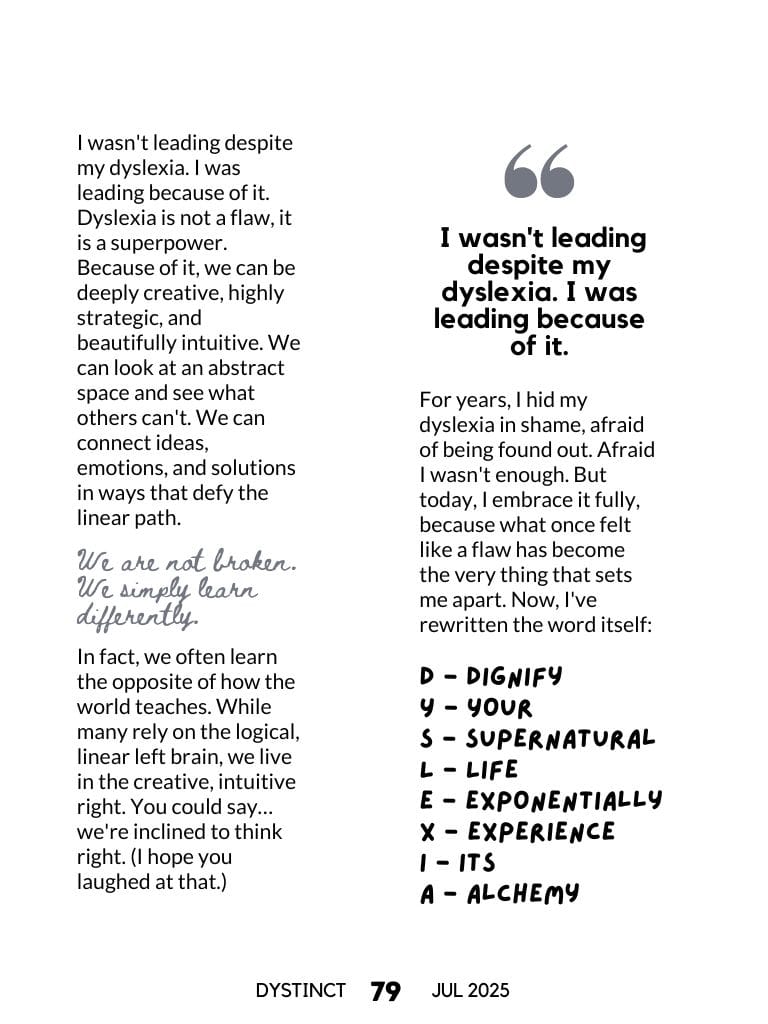
I wasn't leading despite my dyslexia. I was leading because of it. Dyslexia is not a flaw, it is a superpower. Because of it, we can be deeply creative, highly strategic, and beautifully intuitive. We can look at an abstract space and see what others can't. We can connect ideas, emotions, and solutions in ways that defy the linear path.
We are not broken. We simply learn differently.
In fact, we often learn the opposite of how the world teaches. While many rely on the logical, linear left brain, we live in the creative, intuitive right. You could say… we're inclined to think right. (I hope you laughed at that.)
I wasn't leading despite my dyslexia. I was leading because of it.
For years, I hid my dyslexia in shame, afraid of being found out. Afraid I wasn't enough. But today, I embrace it fully, because what once felt like a flaw has become the very thing that sets me apart. Now, I've rewritten the word itself:
- D - Dignify
- Y - Your
- S - Supernatural
- L - Life
- E - Exponentially
- X - eXperience
- I - Its
- A - Alchemy
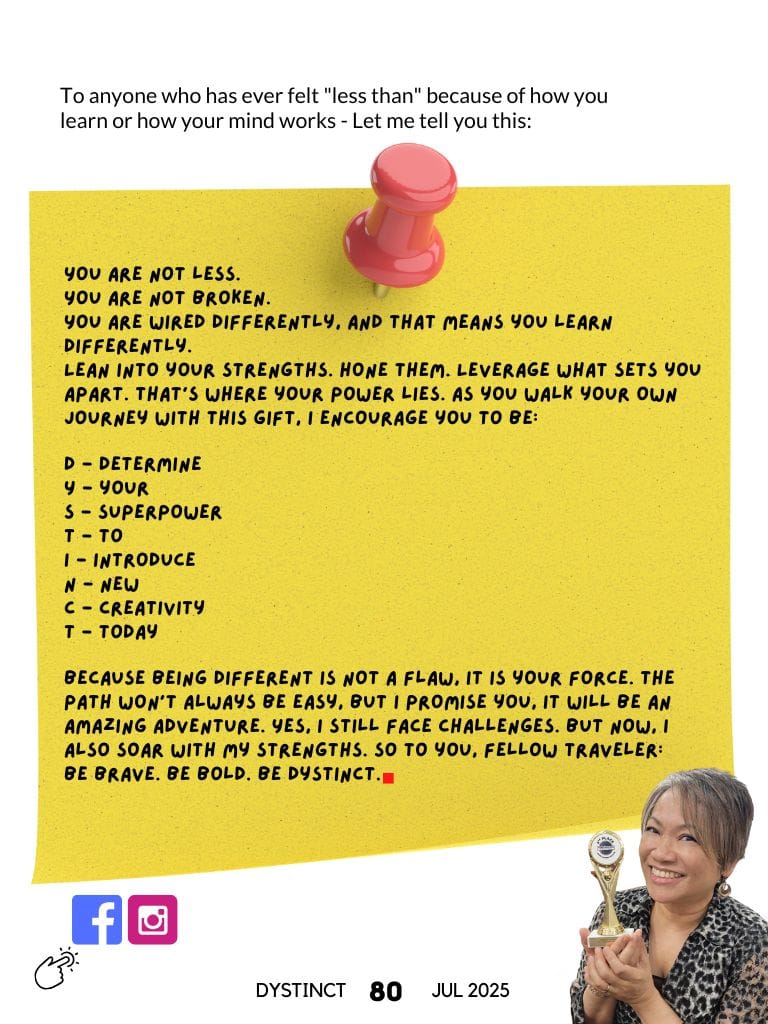
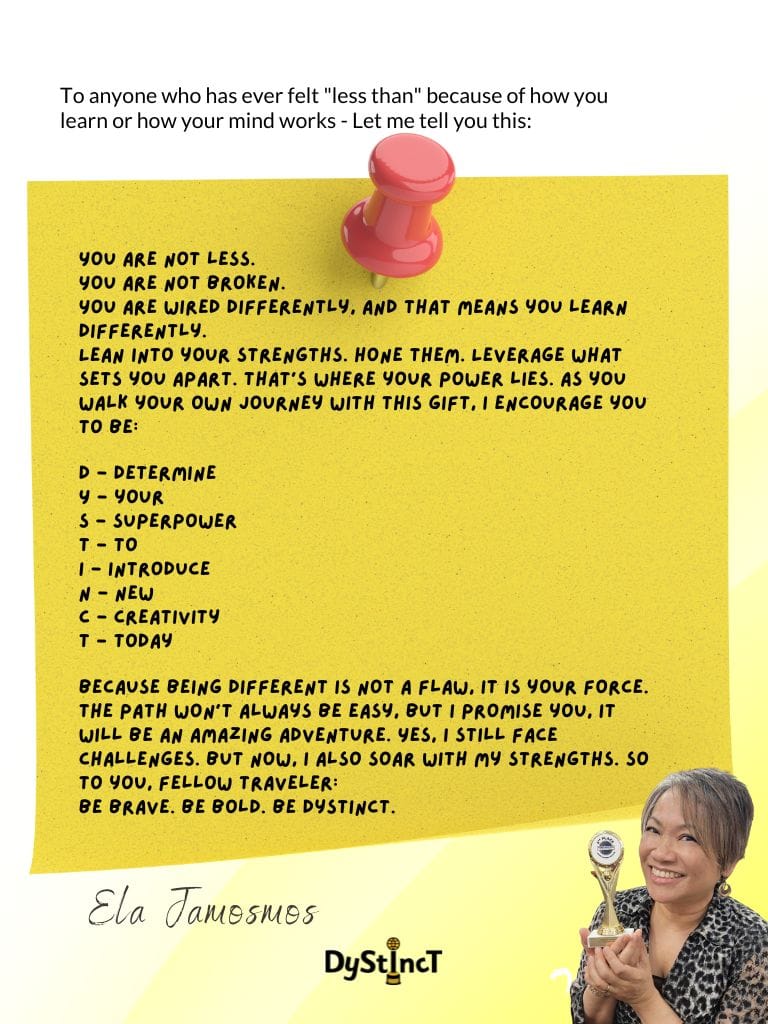
To anyone who has ever felt "less than" because of how you learn or how your mind works - Let me tell you this:
You are not less.
You are not broken.
You are wired differently, and that means you learn differently.
Lean into your strengths. Hone them. Leverage what sets you apart. That's where your power lies. As you walk your own journey with this gift, I encourage you to be:
- D - Determine
- Y - your
- S - superpower
- T - to
- I - Introduce
- N - New
- C - Creativity
- T - Today
Because being different is not a flaw, it is your force. The path won't always be easy, but I promise you, it will be an amazing adventure. Yes, I still face challenges. But now, I also soar with my strengths. So to you, fellow traveler:
Be brave. Be bold. Be Dystinct.
Ela Jasmosmos
Extracts from Dystinct Magazine
Extracts from Dystinct Magazine