Issue 23: A Welcoming Approach to Spelling? | Tricia Millar
Tricia Millar outlines the key elements of the program 'That Spelling Thing' and illustrates how its approach leverages phonics and morphology to strengthen memory, boosting confidence and accuracy in spelling for dyslexic learners.

Table of Contents
One day, I received an email from a 62-year-old dyslexic man, which ended, 'I just want to be able to misspell with confidence like everybody else.'
Another day, a science teacher in a special school asked, 'Can you please just get them to spell 'fractional distillation'?'
My background is in English language and linguistics, and I love nothing more than delving deep into our wonderful, rich, huge, language. As a literacy professional and programme creator, I sometimes wonder if I should be injecting more morphology, more etymology, and more top-down teaching, but then I come back to the needs of those two individuals.
How do we help teens and adults who've struggled for years gain enough confidence in their spelling to feel 'like everyone else'? Equally important, how do we help non-specialist teachers, parents and support staff to confidently answer, 'How do you spell words like fractional distillation?' or ‘definite’ or ‘inseparable’, especially those who feel less than confident about their own spelling?
That Spelling Thing Framework
That Spelling Thing Framework
Accurate spelling requires memory, and no course, book or gimmick will magically change that. However, we can reduce the amount of memory required by carefully scaffolding the process. Students work through a consistent series of prompts. They learn an internal script that helps them identify what's easy and predictable about a word and where they need to focus their limited memory.
The four main ingredients are:
- Phonics (spoken syllables, sounds and how to spell those sounds).
- 'Everyday' morphology and limited etymology
- That Spelling Thing script
- Grapheme puzzle
Phonics
spoken syllables, sounds and how to spell those sounds
Phonics
Phonics isn't the whole answer for spelling, but it provides a solid foundation on which to build knowledge about English orthography. There are no syllable types or rules to learn. Instead, we start with the student's own voice and accent and introduce them to their 'internal translator' to turn normal speech into accurate writing.
'Everyday' morphology and limited etymology
'Everyday' morphology and limited etymology
From the very beginning of learning to read with That Reading Thing, we 'nudge spoken syllables for meaning'. If a student wants to spell 'fighting' and says the syllables as 'figh/ting', we nudge that to 'fight/ing' as a quick way to introduce the concept of morphology.
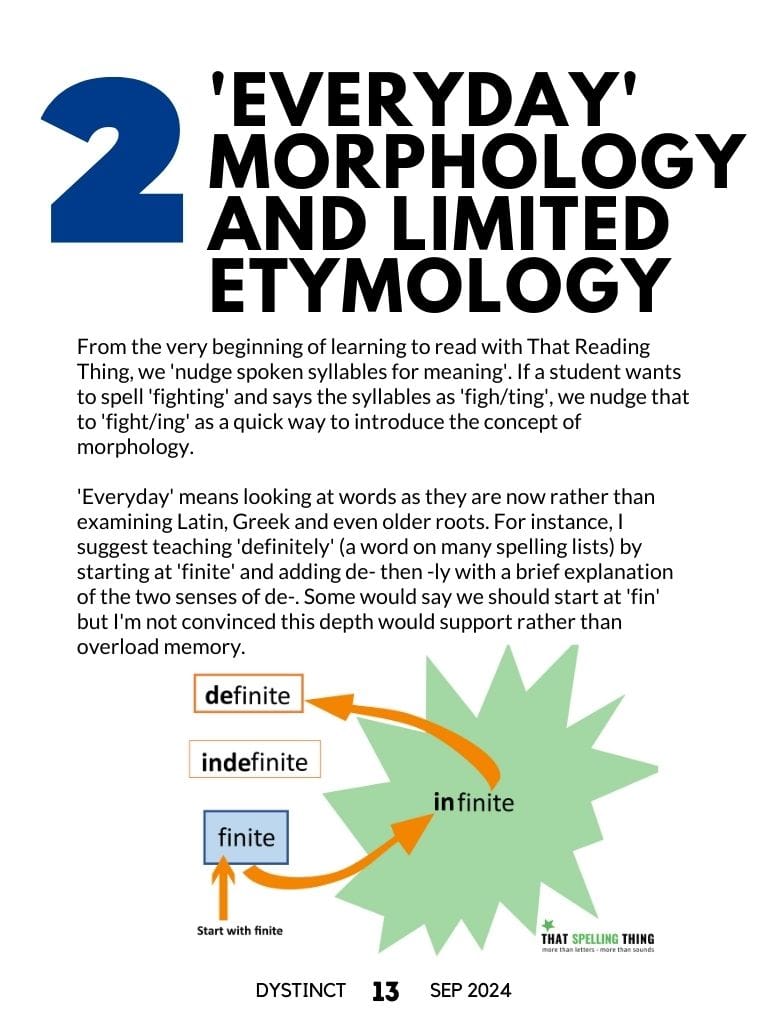
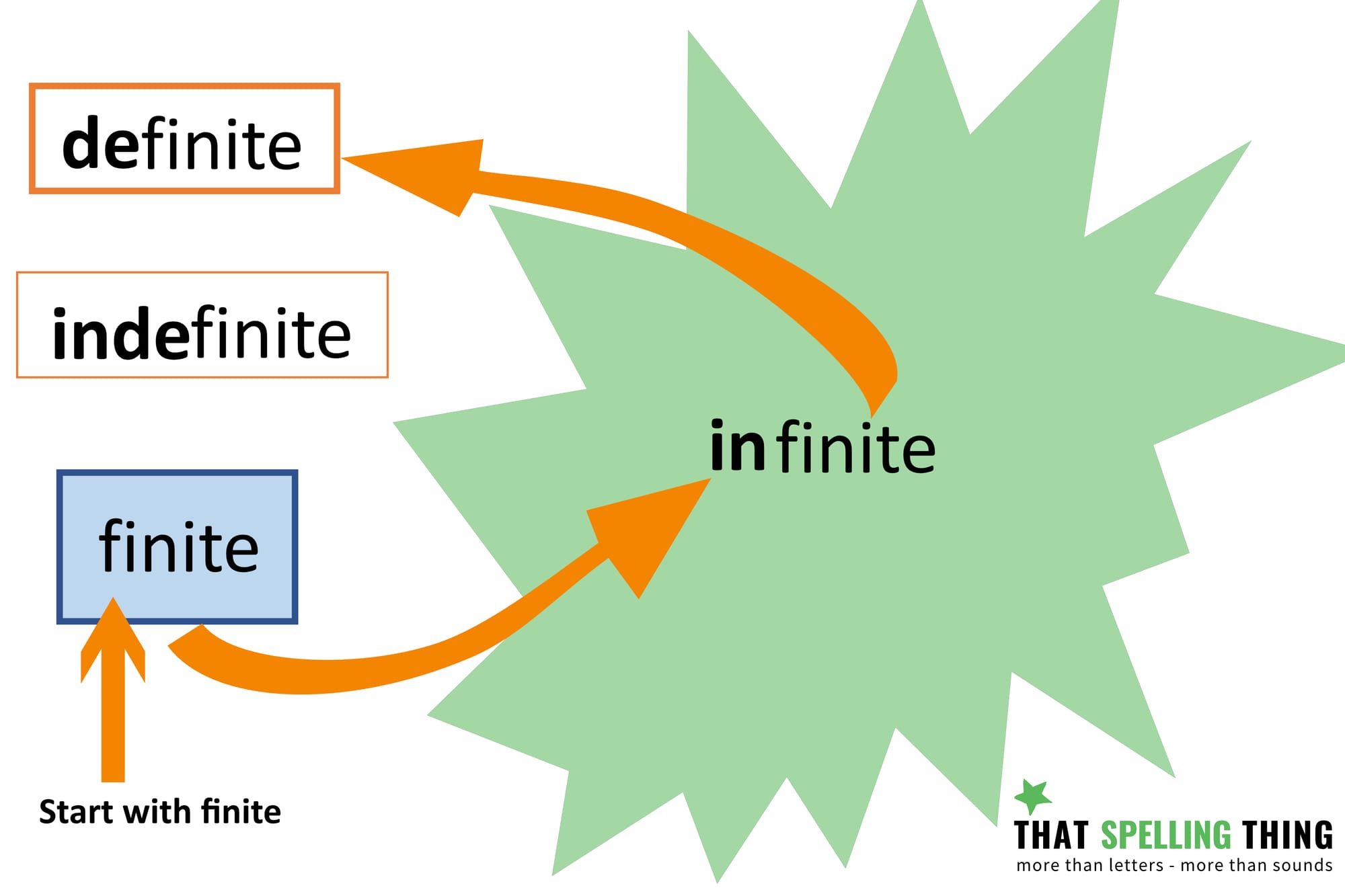
'Everyday' means looking at words as they are now rather than examining Latin, Greek and even older roots. For instance, I suggest teaching 'definitely' (a word on many spelling lists) by starting at 'finite' and adding de- then -ly with a brief explanation of the two senses of de-. Some would say we should start at 'fin' but I'm not convinced this depth would support rather than overload memory.
We keep etymology, even the most interesting word stories, to a minimum because dyslexic students say they find the extra knowledge distracting when they're working hard to spell accurately. You can always read about words in a separate lesson.
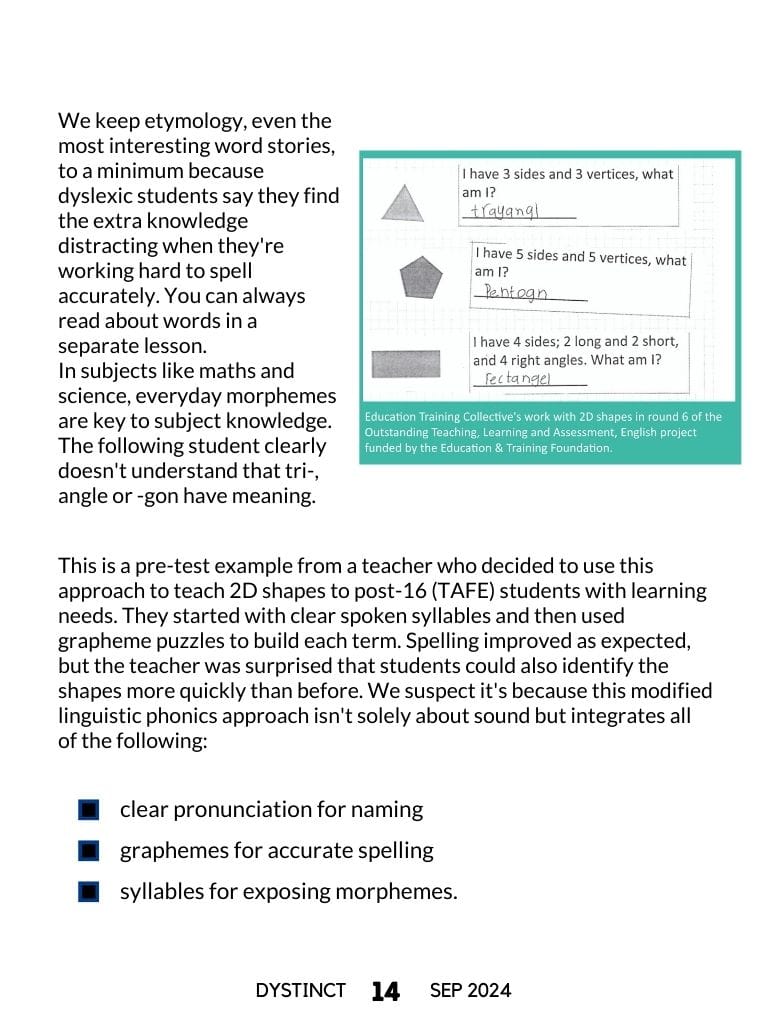
In subjects like maths and science, everyday morphemes are key to subject knowledge. The following student clearly doesn't understand that tri-, angle or -gon have meaning.
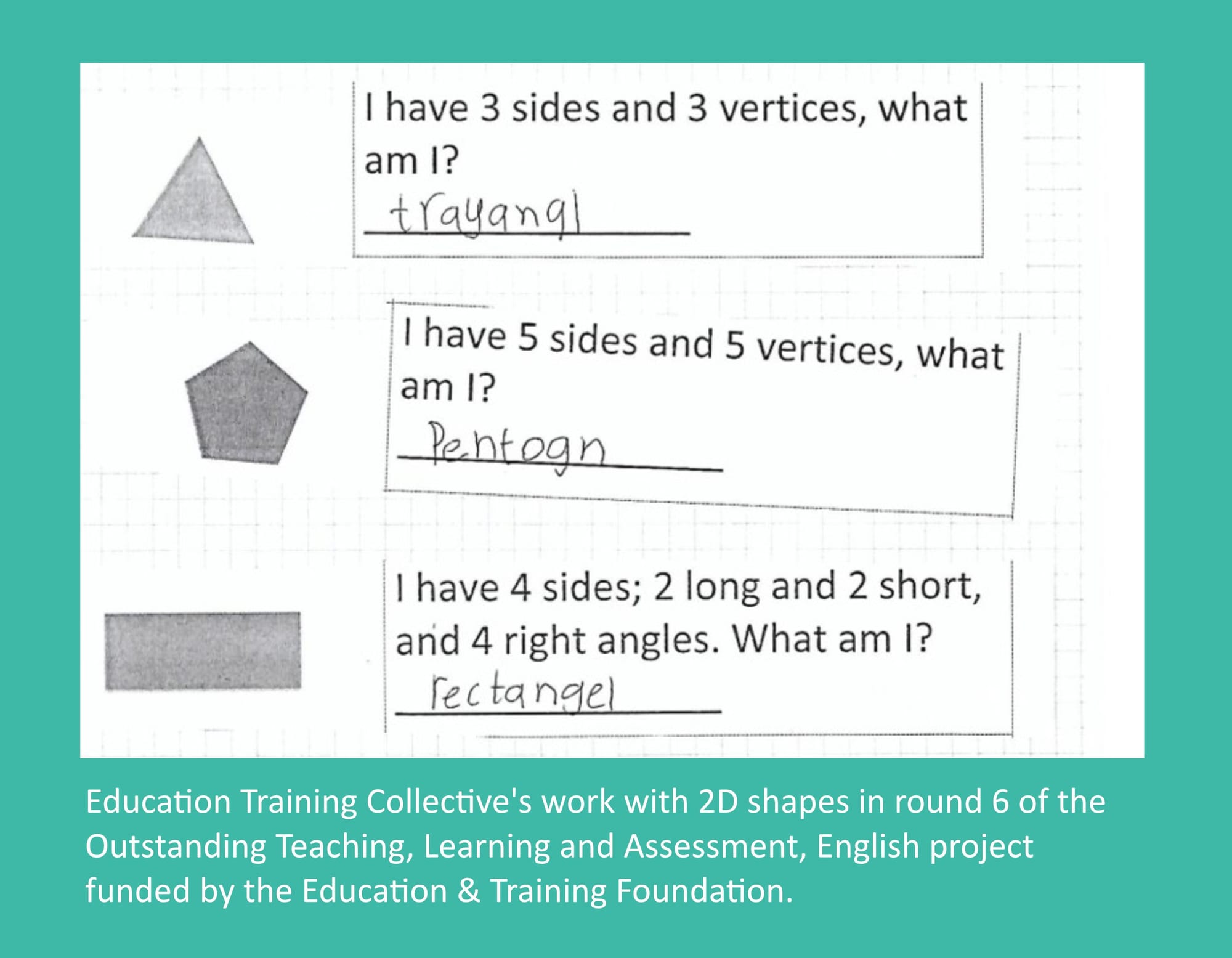
This is a pre-test example from a teacher who decided to use this approach to teach 2D shapes to post-16 (TAFE) students with learning needs. They started with clear spoken syllables and then used grapheme puzzles to build each term. Spelling improved as expected, but the teacher was surprised that students could also identify the shapes more quickly than before. We suspect it's because this modified linguistic phonics approach isn't solely about sound but integrates all of the following:
- clear pronunciation for naming
- graphemes for accurate spelling
- syllables for exposing morphemes.
That Spelling Thing script
That Spelling Thing script
This is not scripted teaching but a few sentences for the student to internalise and use as a starting place when writing independently.
The script:
- helps anxious spellers stay calm and focused.
- slows down the process in order to speed it up later
- frames spelling as a conversation where students and teachers are all using the same language to talk about words
- walks the student through a consistent process, which they then apply when writing independently
- reveals what a student already knows but also gives them the responsibility of deciding what they need to work on remembering by asking, 'What's your tricky bit?'
This is when the real work of remembering starts, but it's often limited to a tiny bit of the word. That's a long way from not wanting to write the word at all. The student's self-talk changes from 'I can't spell fractional distillation' to 'Are there two ls or one in distillation?'. Good spellers know what they don't know, and that's what we're hoping for our students.
Grapheme puzzle
Grapheme puzzle
If we have a secret weapon, it's using a puzzle approach while following the script. Puzzles make the correct spelling of a word almost inevitable and help a student internalise the script and quickly identify the bit they're going to need to work on remembering.
The approach in practice
The approach in practice
A parent homeschooling three dyslexic boys emailed me the following question:
I am taking my 14 and 17-year-olds through an Entrepreneurship class. There are some big vocabulary words in this class… Last week we did the first module, and I broke some vocab words up on puzzles pieces so they could build the words. Unfortunately, entrepreneur (and) entrepreneurial were way too long for them. They struggled to get the pieces in order.
This is where we slow them down to speed them up. When I talk about building with puzzle pieces, I don't mean handing over a pile of graphemes and letting a student solve the puzzle. That's a puzzle activity rather than a spelling activity. We want to create links between spoken and visual language, using the script and graphemes as a prompt.
First, I want to stress how much I have to slow down and say each syllable as I type en-tre-pren-eur-i-al. I suspect most good spellers would do the same, so be prepared to move extra slowly with this unfamiliar word.
We try to strip back each word to its simplest form, which in this case is 'entrepreneur'.
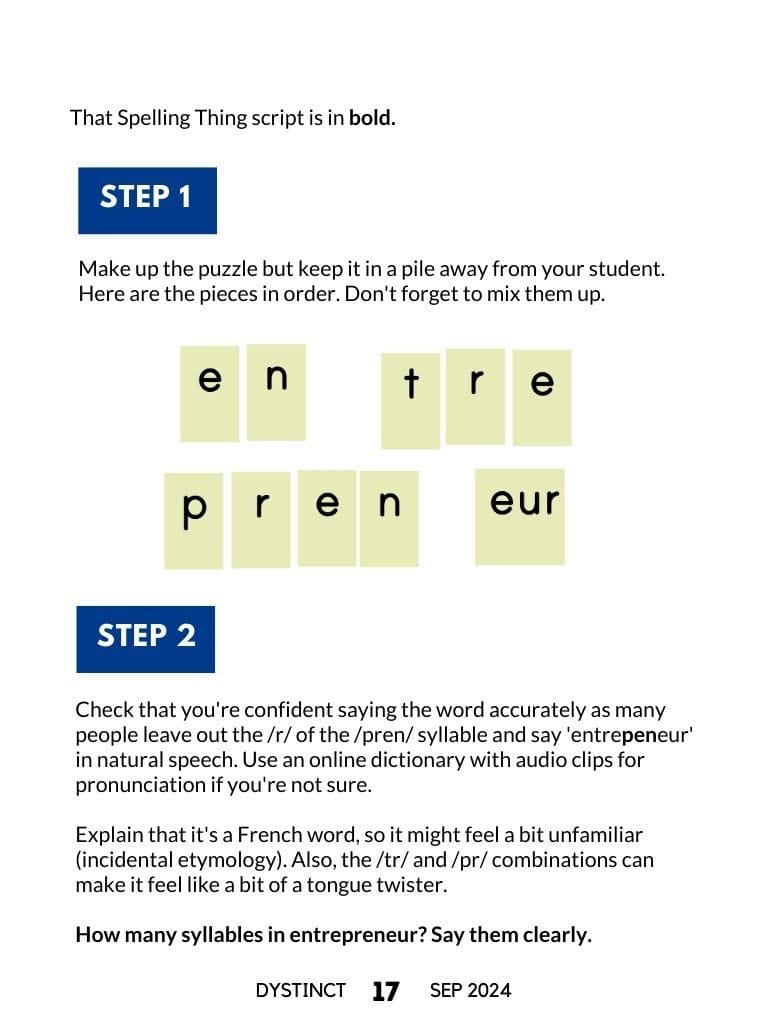
That Spelling Thing script is in bold.
Step 1
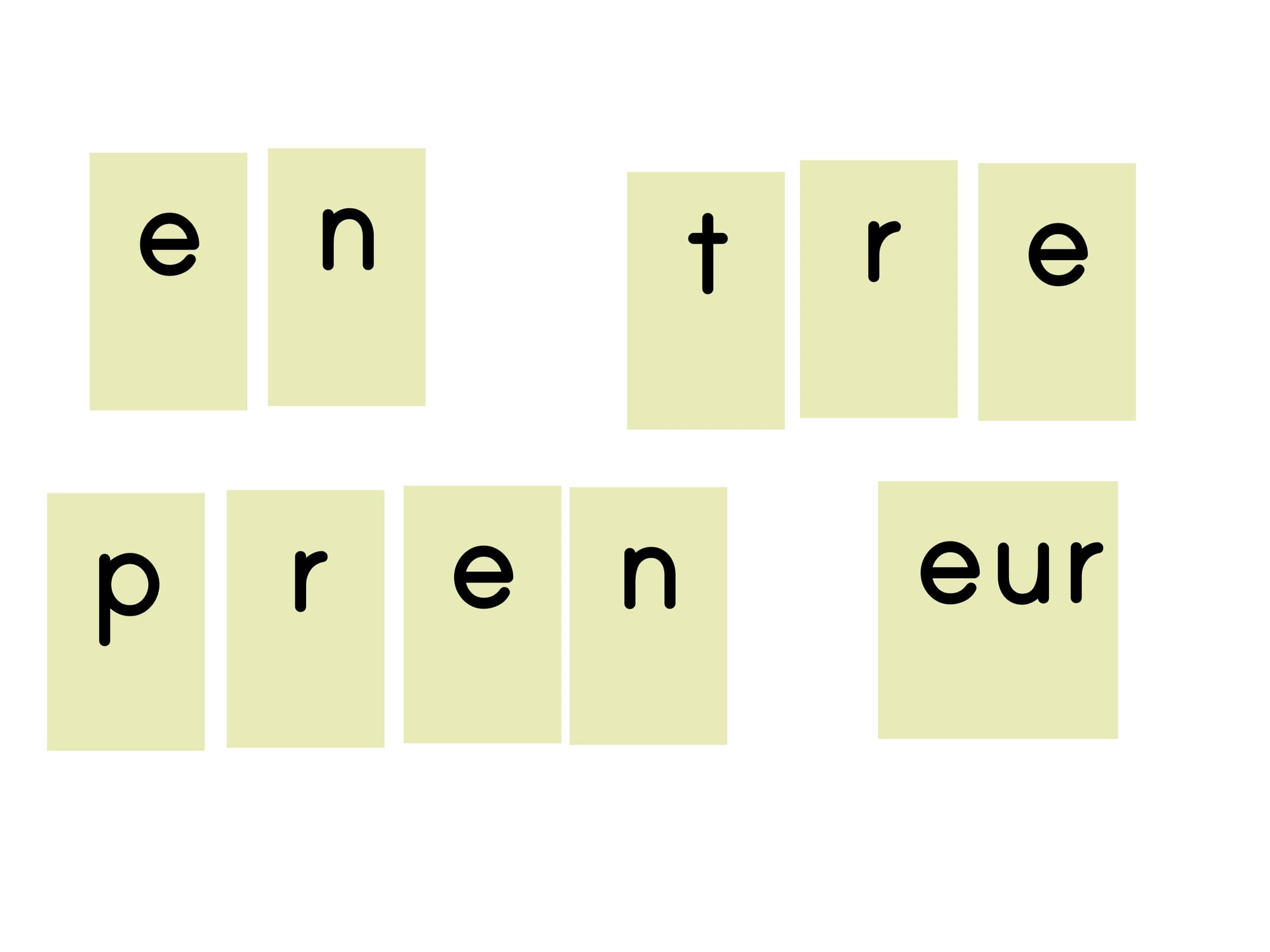
Make up the puzzle but keep it in a pile away from your student. Here are the pieces in order. Don't forget to mix them up.
Step 2
Check that you're confident saying the word accurately as many people leave out the /r/ of the /pren/ syllable and say 'entrepeneur' in natural speech. Use an online dictionary with audio clips for pronunciation if you're not sure.
Explain that it's a French word, so it might feel a bit unfamiliar (incidental etymology). Also, the /tr/ and /pr/ combinations can make it feel like a bit of a tongue twister.
How many syllables in entrepreneur? Say them clearly.
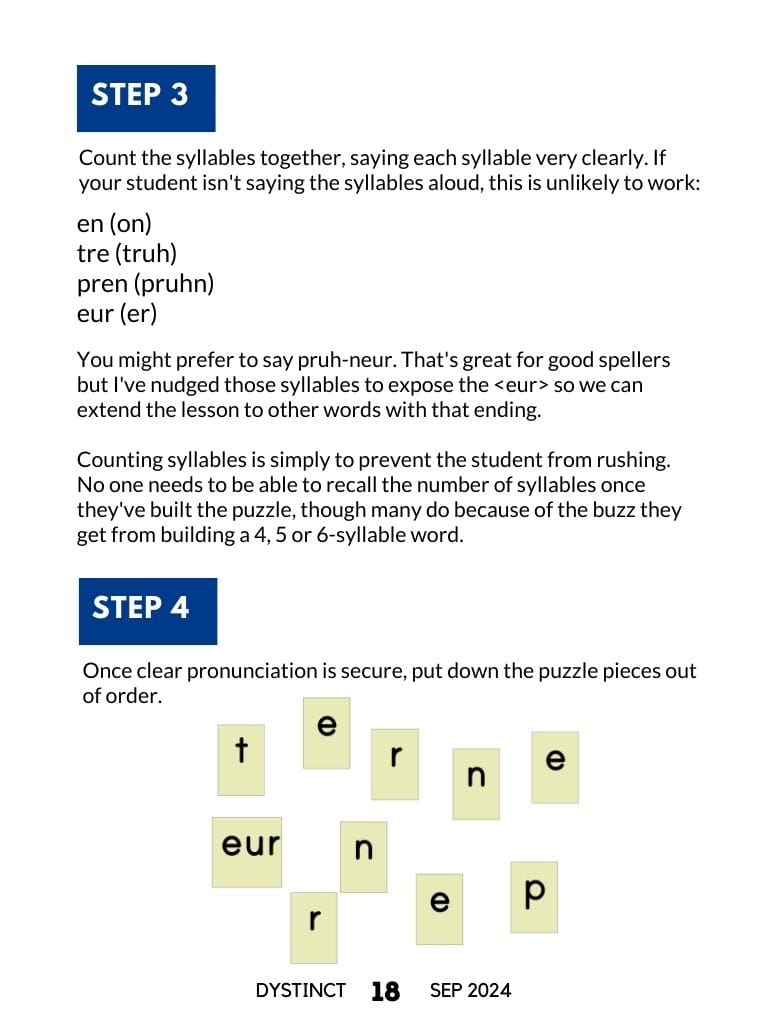
Step 3
Count the syllables together, saying each syllable very clearly. If your student isn't saying the syllables aloud, this is unlikely to work:
en (on)
tre (truh)
pren (pruhn)
eur (er)
You might prefer to say pruh-neur. That's great for good spellers but I've nudged those syllables to expose the <eur> so we can extend the lesson to other words with that ending.
Counting syllables is simply to prevent the student from rushing. No one needs to be able to recall the number of syllables once they've built the puzzle, though many do because of the buzz they get from building a 4, 5 or 6-syllable word.
Step 4
Once clear pronunciation is secure, put down the puzzle pieces out of order.
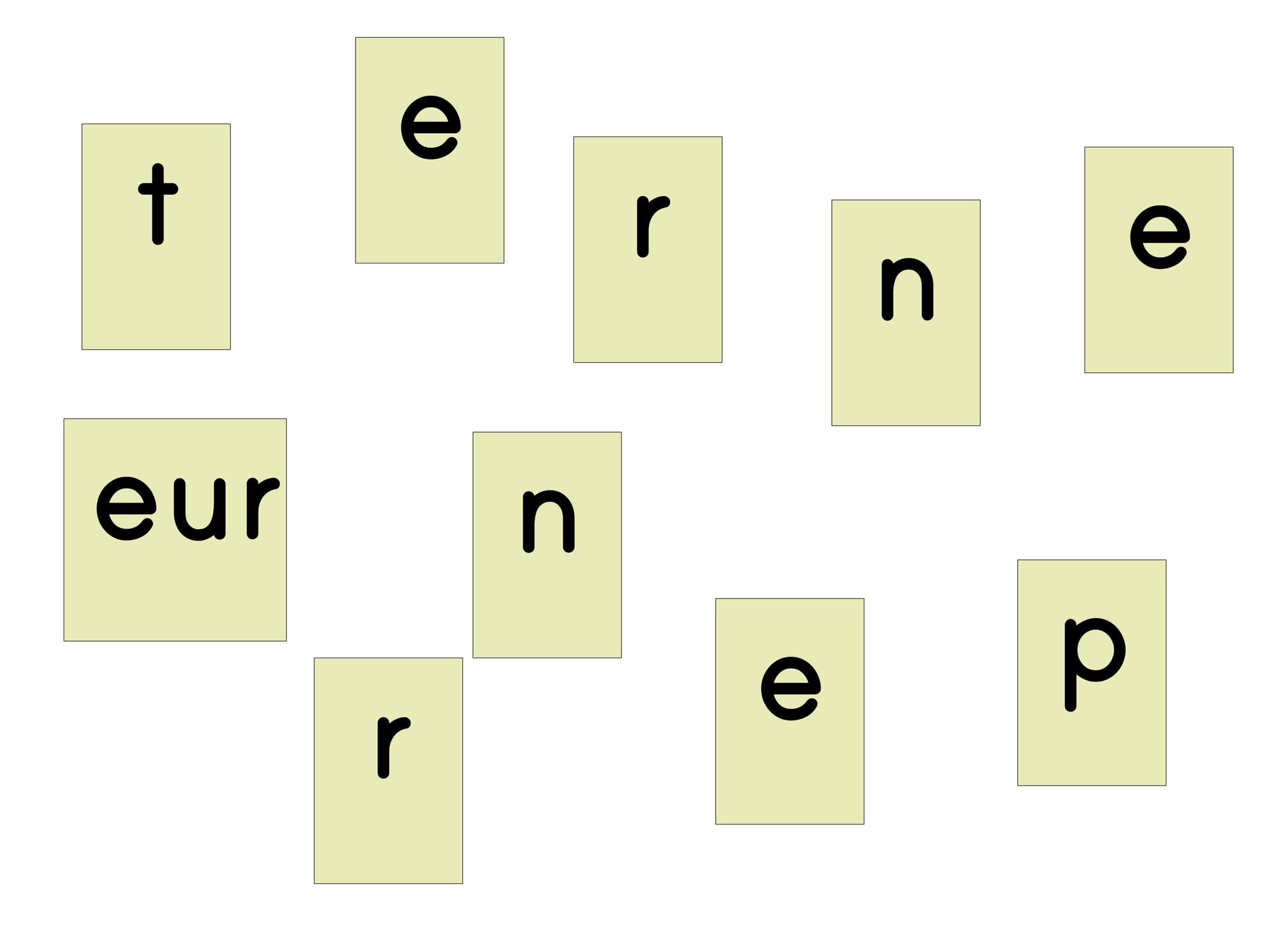
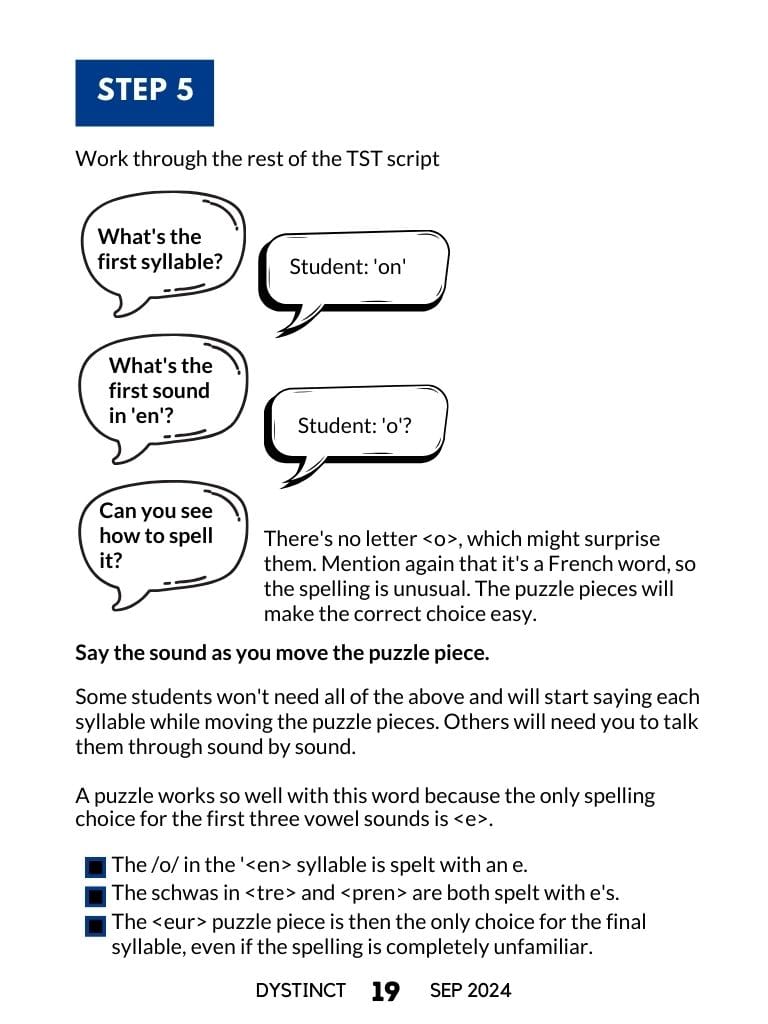
Step 5
Work through the rest of the TST script
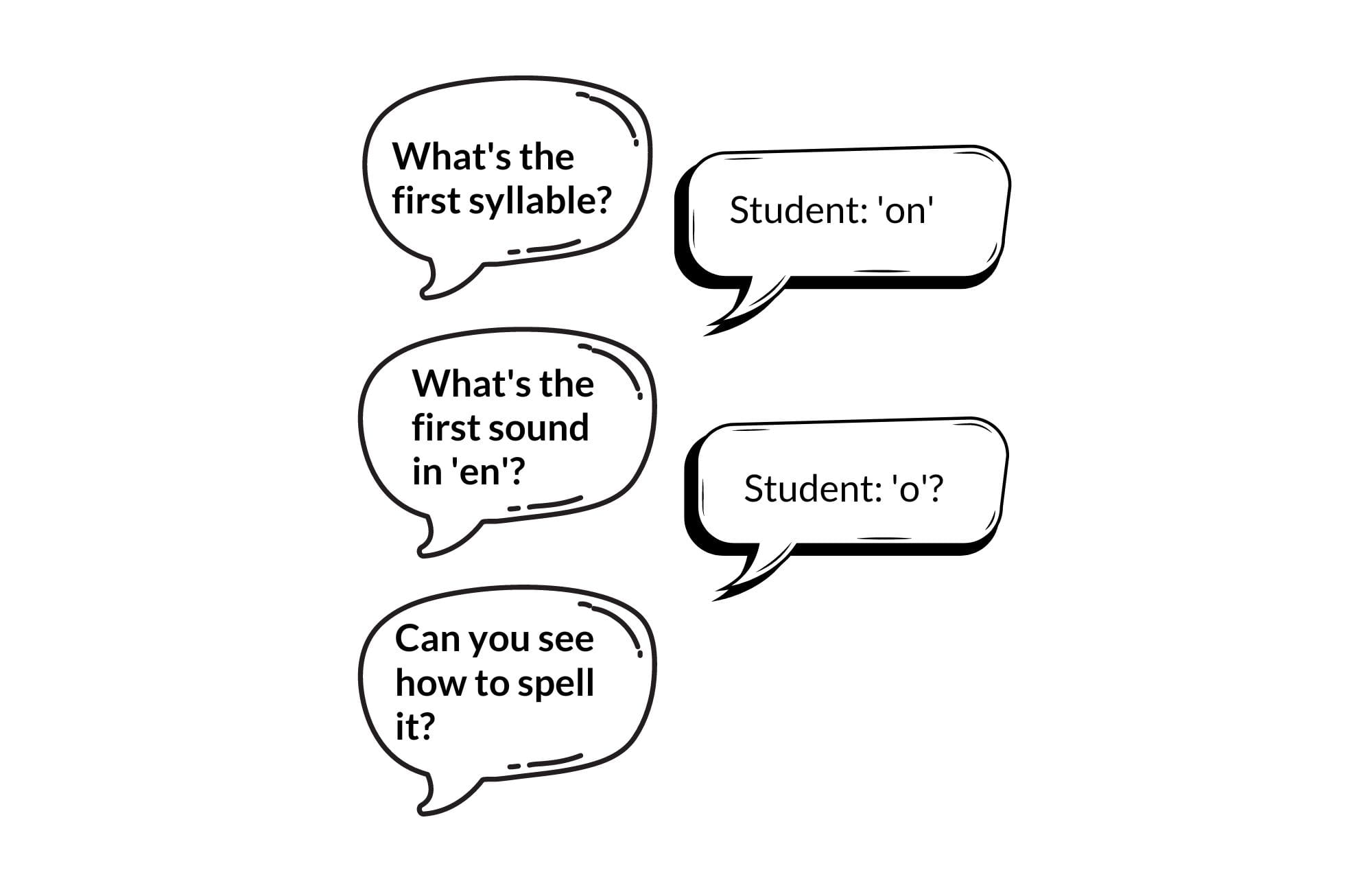
There's no letter <o>, which might surprise them. Mention again that it's a French word, so the spelling is unusual. The puzzle pieces will make the correct choice easy.
Say the sound as you move the puzzle piece.
Some students won't need all of the above and will start saying each syllable while moving the puzzle pieces. Others will need you to talk them through sound by sound.
A puzzle works so well with this word because the only spelling choice for the first three vowel sounds is <e>.
- The /o/ in the '<en> syllable is spelt with an e.
- The schwas in <tre> and <pren> are both spelt with e's.
- The <eur> puzzle piece is then the only choice for the final syllable, even if the spelling is completely unfamiliar.
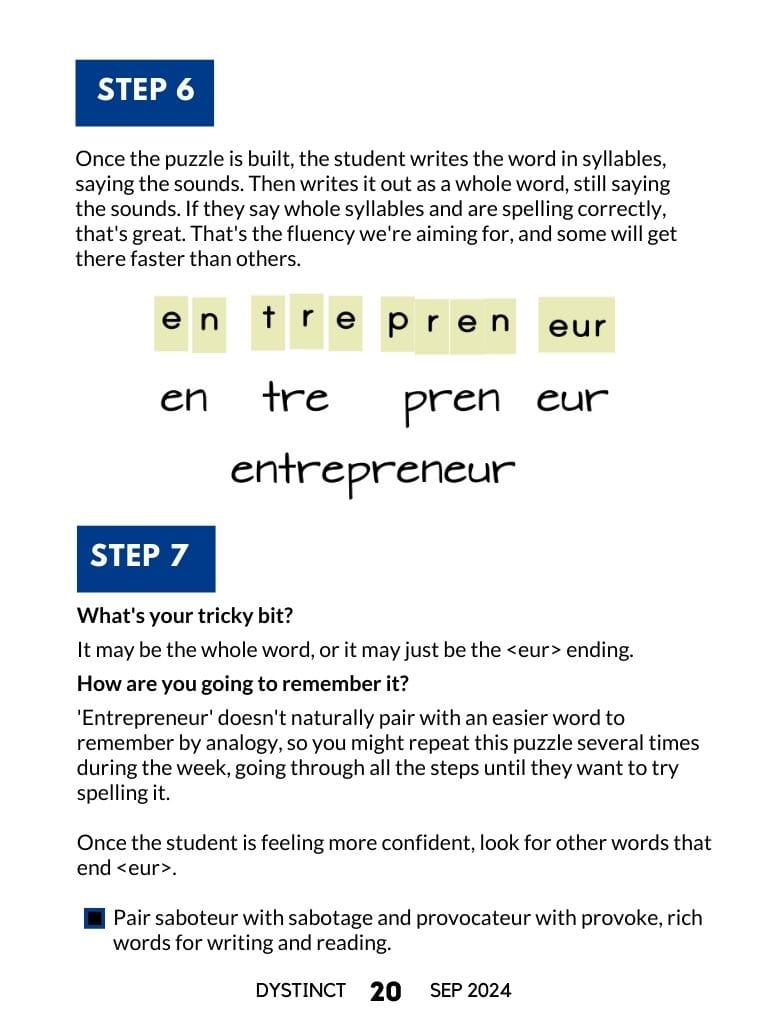
Step 6
Once the puzzle is built, the student writes the word in syllables, saying the sounds. Then writes it out as a whole word, still saying the sounds. If they say whole syllables and are spelling correctly, that's great. That's the fluency we're aiming for, and some will get there faster than others.
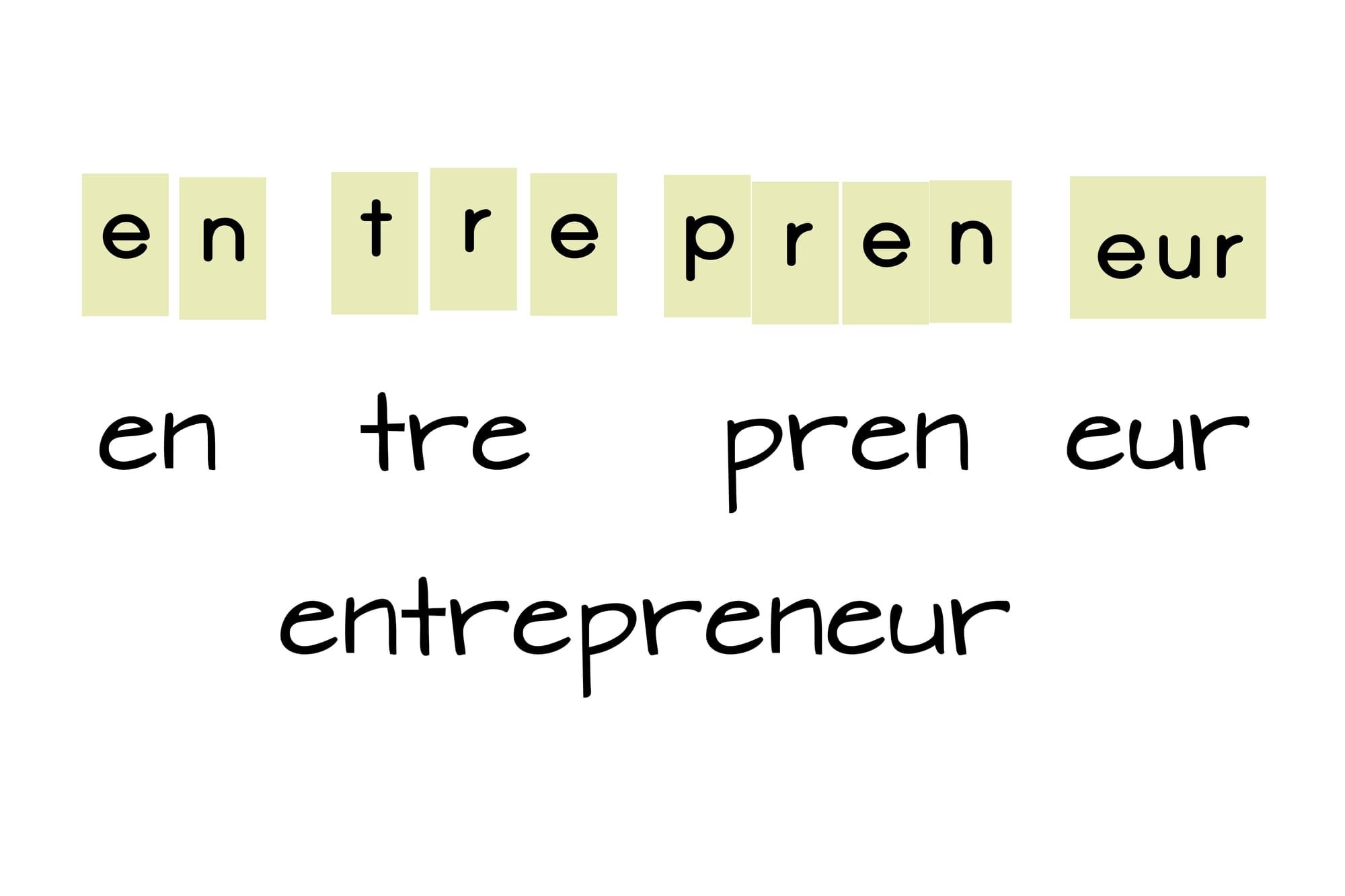
Step 7
What's your tricky bit?
It may be the whole word, or it may just be the <eur> ending.
How are you going to remember it?
'Entrepreneur' doesn't naturally pair with an easier word to remember by analogy, so you might repeat this puzzle several times during the week, going through all the steps until they want to try spelling it.
Once the student is feeling more confident, look for other words that end <eur>.
- Pair saboteur with sabotage and provocateur with provoke, rich words for writing and reading.
You might also look for <eur> in other positions.
- At the beginning of Europe and Euro, it spells 2 or 3 sounds depending on your accent, but in each, the first sound is /y/ as in 'yes'.
- Eur/ope, Eur/o
- or
- Eu/rope, Eu/ro
- In the middle of a word, it may or may not include a /y/ sound depending on your accent.
- Try it with 'neurology' and' neuron'.
Once they've cracked 'entrepreneur', add <i> and <al> for 'entrepreneurial', a confidence-boosting 6-syllable word.
How did it work out for the dyslexic teens?
That helps so much! I wasn't slowing down the words and making sure they were hearing each of the sounds. Today, I went back to puzzle pieces. Before I gave them the pieces, I made sure they could clearly repeat the word. It worked MUCH better!
Then this happy bonus followed from their mom.
Yesterday, I was trying to use the word aneurysm in a text. I knew there were a lot of vowels and a y somewhere. I tried a couple of combos with a y to get the /yer/ sound. Autocorrect could not figure out the word I wanted, so I thought, 'Hey, let me try the /yer/ spelling we learned in entrepreneur and Europe!' Wow! It worked! I was able to spell aneurysm!
No one knows everything about spelling. Instead, we encourage everyone, students and teachers, to learn the basic concepts and trust that knowledge will increase as we work together. That's the cumulative and collaborative approach to spelling, and everyone is welcome.
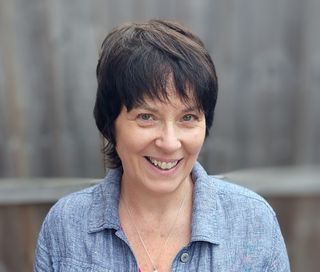
Tricia Millar
Educator, Trainer, & Creator | thatreadingthing.com | thatspellingthing.com | Facebook | Twitter | LinkedIn
Tricia Millar
Tricia Millar (a Canadian in the UK) trains and equips teachers, tutors, support workers and community educators around the world in shame-free and engaging phonics approaches that get teen and adult learners' unstuck'. She is the creator of Reading Thing (TRT), an age-appropriate linguistic phonics programme and That Spelling Thing, a book for secondary teachers that has also been adopted by parents of struggling spellers. That Reading Thing started as a grassroots response to the needs of local young people but is now used in every educational setting imaginable, including mainstream high schools and colleges (TAFE), alternative education settings, adult and juvenile prisons and dyslexia centres.
Tricia started out as a secondary English teacher, adult EAL teacher and volunteer youth worker. Through TRT, she has become an expert in answering the questions,
- How do we teach teens and adults to read using phonics?
- What more is needed for the teaching of spelling?
BUY BOOK
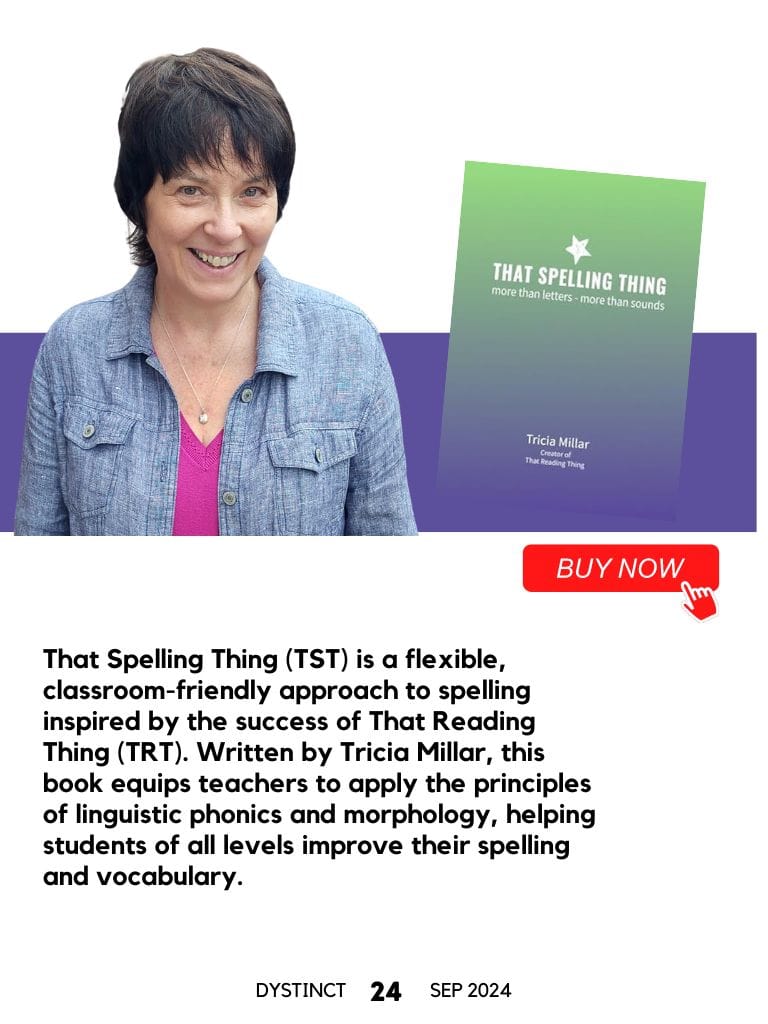
That Spelling Thing
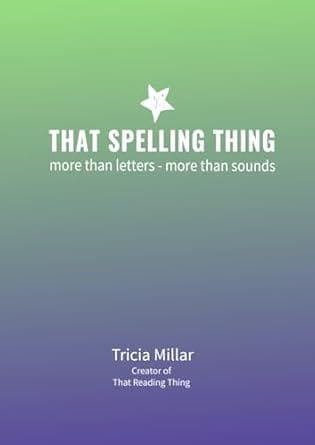
That Spelling Thing (TST) is a flexible, classroom-friendly approach to spelling inspired by the success of That Reading Thing (TRT). Written by Tricia Millar, this book equips teachers to apply the principles of linguistic phonics and morphology, helping students of all levels improve their spelling and vocabulary.
Extracts from Dystinct Magazine
Extracts from Dystinct Magazine